
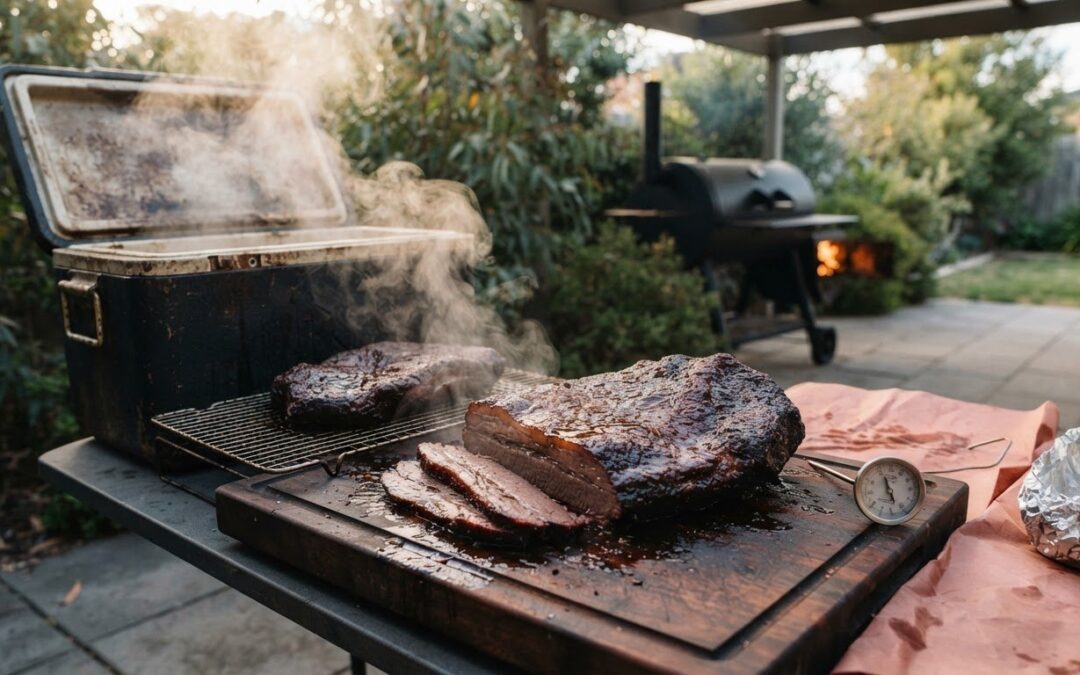
Your insulated cooler did not preserve your smoked brisket; it steamed it alive. Nothing stings quite like tending a fire for twelve hours, crafting a deep mahogany crust over clean hardwood lump charcoal, only to unpack a soggy, mushy surface. If you are asking yourself why did my brisket bark go soft in the cooler, the culprit is simple physics rather than poor pit skills. You locked intense heat and evaporating moisture into an airtight box, effectively braising the very exterior you worked all day to build.
You don’t have to sacrifice juicy tenderness to protect that tactile crunch. In this guide, you will discover the precise resting thermodynamics needed to halt carryover cooking and keep your bark intact. We examine why surface venting makes or breaks the crust, whether butcher paper or foil suits your cook, and how to rapidly crisp up a compromised bark before the meat hits the slicing board.
Key Takeaways
- Understand the core thermodynamics behind why did my brisket bark go soft in the cooler, and how trapped latent steam turns an insulated box into a braising chamber.
- Discover why porous pink butcher paper and the foil boat method protect a crunchy crust far better than impermeable aluminium foil.
- Master the critical open-air counter burp protocol to release surface heat and halt carryover cooking before transferring the meat into your cooler.
- Compare descending cooler holds against steady 65°C heated cabinet rests to maintain food-safe temperatures without accumulating excess moisture.
- Learn the fast smoker or oven rescue technique to dehydrate, firm up, and re-crisp compromised bark just minutes before carving.
The Thermodynamics of Mushy Bark: What Actually Happens Inside the Cooler
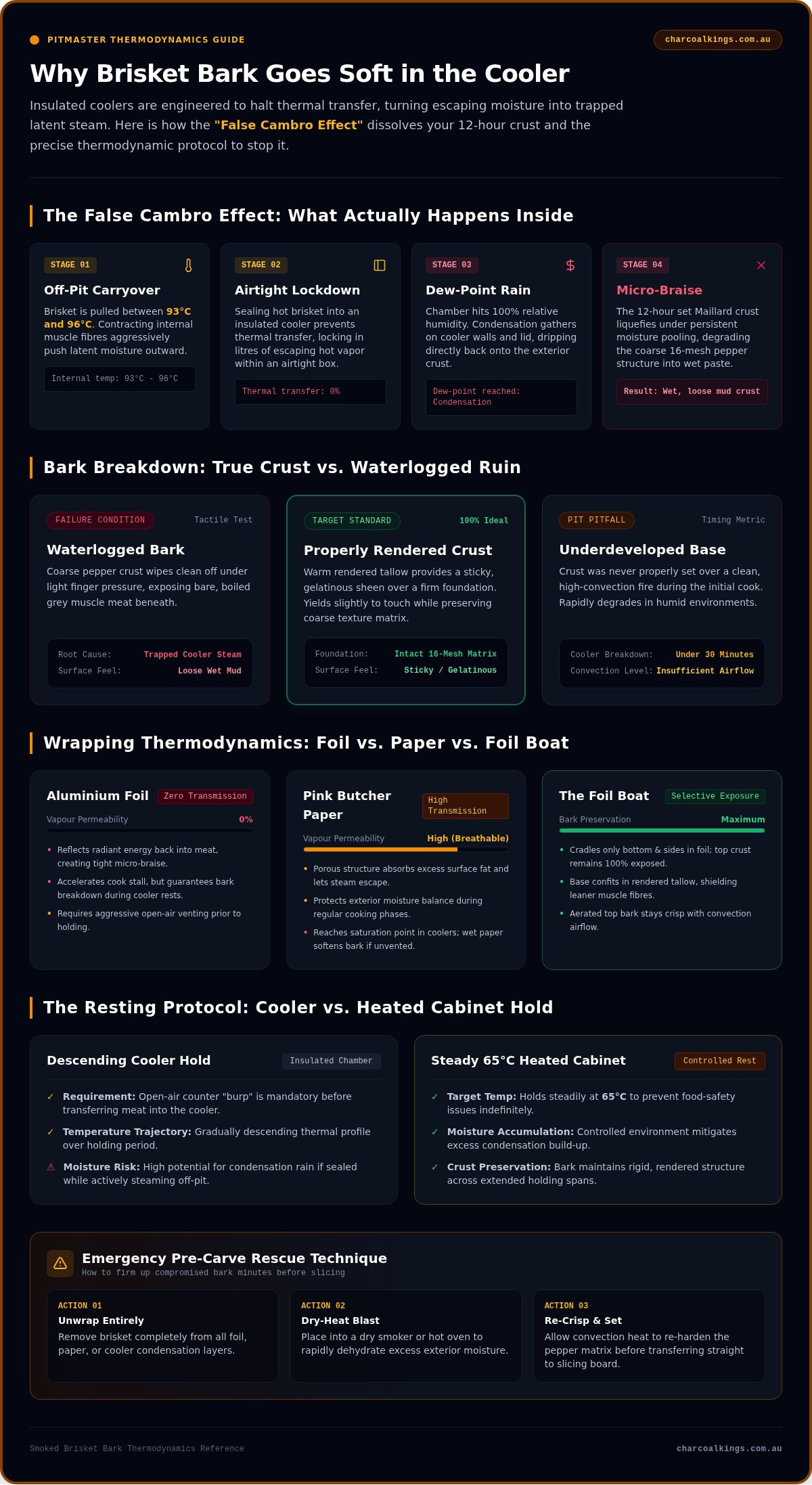
When pitmasters wonder why did my brisket bark go soft in the cooler, they often blame their rub or wood selection. The actual culprit is the false cambro effect. Insulated coolers are engineered to stop thermal transfer entirely. When you seal a piping-hot brisket straight off the pit, you aren’t just trapping heat; you are locking in litres of escaping moisture inside an airtight chamber. This turns an environment intended for resting into an aggressive steam cabinet.
To see how these resting dynamics play out in practice, watch this breakdown from Chuds BBQ:
The Evaporation Stall and Condensation Trap
Internal muscle fibres contract as beef cooks, pushing moisture toward the surface. When you pull a brisket at 93°C to 96°C, carryover cooking continues to drive this vapor outward. Inside a sealed cooler, that evaporating steam has nowhere to vent. Once the air hits total humidity saturation, the dew-point effect kicks in. Water droplets condense on the cooler lid and wrap, raining directly onto the surface. This moisture pool quickly dissolves the Maillard crust you spent twelve hours building.
Moisture vs Rendered Fat: Identifying True Bark Breakdown
You must differentiate between liquefied collagen and waterlogged ruin. A well-rested brisket should glisten with warm rendered tallow, presenting a sticky, gelatinous sheen over a firm foundation. True bark failure looks completely different:
- Waterlogged Bark: The coarse pepper crust wipes away like wet mud under slight finger pressure, leaving bare, grey meat underneath.
- Properly Rendered Crust: The exterior yields slightly to the touch but retains its coarse, textured matrix without peeling away.
- Underdeveloped Foundations: Crust that was never properly set over a clean, high-convection fire will collapse within thirty minutes inside an insulated box.
If you don’t allow that latent moisture to escape before latching the cooler lid, even the most resilient crust will turn to mush.
Foil vs Butcher Paper vs Foil Boat: Wrapping Methods and Bark Longevity
Your choice of wrap material dictates whether evaporating moisture escapes cleanly or attacks your crust. Pitmasters struggling with why did my brisket bark go soft in the cooler often blame holding times, but the wrap material is usually the true catalyst. Thermal barriers interact differently with escaping vapour, meaning your choice between aluminium foil, peach butcher paper, or a foil boat determines bark survival.
The Texas Crutch: Why Heavy-Duty Foil Braises Your Crust
Standard aluminium foil creates an impermeable, non-porous barrier. As internal juices heat up, foil reflects radiant energy back onto the meat while pooling rendered moisture at the base. This completely halts surface evaporation. Instead of preserving a crunchy 16-mesh pepper crust, the trapped moisture creates a micro-braise. Within an hour, your firm crust softens into a loose paste. Foil accelerates cooking during the stall, but it demands aggressive venting before entering any insulated container.
Pink Butcher Paper and the Foil Boat Alternative
Porous pink butcher paper offers high breathability. It absorbs excess surface fat while allowing steam to escape into the atmosphere. Inside a sealed cooler, however, paper reaches a saturation threshold. If the environment hits maximum humidity, the paper remains wet and softens the bark anyway.
The foil boat solves this dilemma. Popularised by leading craft smokehouses, this method cradles only the bottom and sides of the flat in heavy foil while leaving the entire top crust exposed to convection air:
- Aluminium Foil: Zero vapour transmission. Maximises tenderness and accelerates cook times, but guarantees bark degradation in tight cooler rests.
- Pink Butcher Paper: High vapour transmission. Protects exterior moisture balance, though it will still soften if sealed into a humid cooler without pre-venting.
- Foil Boat: Selective exposure. The base confits in rendered tallow, shielding leaner muscle fibres while top bark remains crisp and aerated.
Protecting a crisp crust requires balancing airflow and clean heat long before the rest begins. Dialling in pristine combustion on an offset smoker with quality fuels and reliable tools from Charcoal Kings ensures your bark sets hard enough to endure the wrap phase without deteriorating.
The Foolproof Brisket Resting Protocol: How to Vent and Hold Without Ruining Bark
Resting a brisket is not a passive waiting game; it is an active, multi-stage thermal decline. Tossing meat straight from the grates into an insulated box is the definitive reason why did my brisket bark go soft in the cooler. Halting the heat engine before sealing the lid protects your bark without compromising intramuscular moisture. Follow this disciplined four-step staging process to secure a firm, gelatinous crust every run.
The Essential Countertop Burp Step
Pulling your brisket at probe tenderness (typically 93°C to 96°C) means thermal energy is still peaking. Place the wrapped parcel onto a wire rack or prep bench and open the paper or foil immediately. Allow the brisket to counter-vent for 15 to 30 minutes until internal temperatures drop to roughly 77°C to 82°C. You will see heavy, billowing steam taper off into a subtle vapor while the tacky, pepper-dense surface firms up. Venting expels volatile moisture into the kitchen rather than trapping it against the meat fibers.
Insulating the Cooler for Stable Long-Term Holding
Once surface steam clears and the bark stabilizes, rewrap the parcel tightly. Now the brisket is conditioned for extended resting. Manage the internal microclimate inside the icebox with strict discipline:
- Buffer Dead Air Space: Pack empty cooler volume with clean, dry cotton bath towels. Large air pockets accelerate convective heat loss and collect condensing droplets that fall back onto your paper.
- Absorb Stray Vapour: Dry towels act as secondary desiccant barriers, trapping residual moisture before it liquefies on cold cooler plastic.
- Track Food Safety Thresholds: Insert a high-accuracy leave-in probe before latching the lid. Cooked beef must remain above 60°C to prevent bacterial growth in the food safety danger zone.
- Target the Slicing Zone: Plan your rest duration so the brisket glides down to 60°C-63°C just prior to carving. Slicing at this temperature prevents rendering fat from instantly flashing off as steam.
Controlling airflow and temperature loss this way keeps the crust brittle and dry, ensuring you never face the disappointment of peeling mushy bark off an otherwise masterclass cook.
Cooler Resting vs Heated Cabinet Holding: Which Produces Better Bark?
Coolers are passive heat sinks, not climate-controlled holding units. The core thermal flaw behind why did my brisket bark go soft in the cooler is the descending temperature curve. As heat radiates out of the meat, the air inside the cooler steadily drops. Cooler air cannot hold as much moisture in vapor form. As a result, ambient humidity condenses directly onto your bark, dissolving the crust while you wait.
The Descending Temperature Problem of Ice Coolers
Holding meat in an insulated chest works well for two hours, but extended holds quickly compromise quality. As internal temperatures drop below 70°C, vapor condensation accelerates rapidly. Prolonged exposure to this enclosed, high-humidity atmosphere softens the coarse rub matrix. Additionally, rendered tallow begins to solidify unevenly below 60°C. Instead of maintaining a clean, glossy crust, the exterior turns into a greasy, waterlogged surface.
Using Low-Temperature Heated Holds (65°C / 150°F)
Legendary Texas smokehouses rest their briskets for eight to sixteen hours without losing crust integrity by using heated cabinets held at 65°C. At this controlled temperature, humidity stays suspended in the air, preventing condensation from settling onto the meat. Collagen continues to break down into silky gelatin, while the bark remains dry and brittle.
You can replicate commercial results using a domestic kitchen oven. Follow these calibration steps to avoid drying out the beef:
- Verify Oven Accuracy: Kitchen oven dials are notoriously inaccurate. Clip a digital air probe to the centre rack to confirm the ambient heat stabilizes between 65°C and 70°C.
- Apply a Tallow Barrier: Spoon rendered beef tallow over your butcher paper before wrapping. Tallow locks interior moisture into the muscle fibres while protecting the pepper crust against dehydration.
- Rest on a Wire Rack: Elevate the wrapped parcel above a sheet pan. Keeping the brisket off direct metal surfaces promotes even 360-degree heat circulation.
Achieving a crust resilient enough to endure an eight-hour heated rest requires establishing a rock-solid foundation during the cook. Mastering clean combustion and consistent convective heat while barbecuing with charcoal creates the durable pepper crust you need. To upgrade your smoking rig with competition-tested equipment, explore smoker fuels and accessories at Charcoal Kings.
How to Rescue Soft Bark and Dial In Better Smoke Production Next Time
Pulling your brisket from the rest to find a damp, spongy crust feels like a total loss, but you can salvage the exterior before slicing. If you find yourself asking why did my brisket bark go soft in the cooler after hours of meticulous fire management, do not carve into it immediately. Short bursts of intense, dry convective heat can dehydrate surface water without overcooking the tender flat underneath.
The 10-Minute Broil or Hot Oven Bark Revival
Unwrap the brisket completely and discard the soggy paper or foil. Place the unwrapped meat on a wire rack set inside a rimmed baking sheet, then slide it into an oven or hot smoker preheated to 200°C for 8 to 10 minutes. Watch the surface closely. You want the pooled rendered tallow to bubble and sizzle, driving off surface moisture and resetting the crunchy pepper crust.
Avoid walking away during this flash bake. High heat can quickly scorch pepper or caramelise residual sugars into a bitter rind. Pull the brisket the moment the bark feels crisp to the touch, and slice immediately onto the cutting board. Rewrapping the beef at this stage will simply restart the condensation cycle.
Setting Indestructible Bark in the Smoker from Hour One
A quick oven rescue solves an immediate disaster, but true bark resilience begins the moment meat hits the smoker grates. Soft bark often traces back to an underdeveloped crust that never cured properly during the initial smoke phase:
- Use 16-Mesh Coarse Black Pepper: Fine-ground table pepper dissolves into an impermeable paste. Coarse 16-mesh black pepper creates a rugged, porous matrix that allows moisture to vent while smoke adheres to the meat proteins.
- Run Pure, Clean Fuel: Clean airflow and steady heat transfer evaporate surface moisture efficiently. Review the ultimate guide to charcoal to master the clean combustion needed for optimal convective draft.
- Select Dense Hardwoods: Smouldering green wood produces bitter soot that weakens crust formation. Consult our guide on choosing quality firewood to pair properly seasoned native woods with your pit.
Build your fire with pure, chemical-free hardwood lump charcoal, quality smoking wood, and dedicated accessories from Charcoal Kings to ensure your bark sets hard, holds strong, and never turns to mush in the rest.
Master the Rest and Protect Your Hard-Earned Crust
Understanding why did my brisket bark go soft in the cooler comes down to respecting surface thermodynamics. Trapped steam and carryover heat will liquefy the finest crust if you rush straight from the smoker grates into an insulated box. Vent your brisket down to safe threshold temperatures on the counter, ditch impermeable foil in favour of breathable paper or a foil boat, and buffer your rest with dry towels to halt condensation before it starts.
Great bark also relies on the fire you build from hour one. Clean convection airflow requires pure heat without acrid soot or dirty smoke. Proudly Australian owned and operated in Holden Hill, South Australia, Charcoal Kings supplies 100% natural, chemical-free hardwood lump charcoal alongside heavy-duty smokers, digital probes, and competition rubs. Upgrade your BBQ game with premium Australian hardwood lump charcoal at Charcoal Kings, master your resting protocols, and serve competition-grade, crunchy mahogany bark every single cook.
Frequently Asked Questions
Why did my brisket bark turn soft and soggy in the cooler?
Your bark turned soggy because trapped latent steam had nowhere to escape inside the airtight cooler. If you are wondering why did my brisket bark go soft in the cooler, the sealed environment created a false cambro effect. Internal moisture forced out by carryover cooking saturated the air and condensed on the walls and meat, effectively braising your crisp crust instead of allowing it to rest cleanly.
How long can you safely rest a brisket in a cooler?
You can safely rest a brisket in an insulated cooler for two to four hours, provided the internal temperature stays above 60°C. Once meat dips below 60°C, it enters the bacterial danger zone and must not sit longer than two hours. For holds exceeding four hours, a calibrated electric holding cabinet or low-temp oven set to 65°C prevents excessive heat loss and surface moisture buildup.
Should I burp my brisket before putting it in a cooler?
Yes, you must always burp your brisket on the kitchen counter before placing it into a cooler. Leaving the wrap unsealed for 15 to 30 minutes halts carryover cooking and vents aggressive surface moisture into the room. If you transfer meat straight off the grates into insulation, the trapped steam will dissolve your pepper crust within minutes. Wait until surface steaming subsides before closing the wrap.
Is pink butcher paper better than foil for preserving brisket bark?
Pink butcher paper is significantly better than foil for preserving crust texture because it allows steam to breathe while absorbing rendered tallow. Standard aluminium foil forms an impermeable barrier that boils the meat in trapped juices, resulting in a soggy exterior. Paper maintains an optimal balance between moisture retention and crust protection, making it ideal for managing why did my brisket bark go soft in the cooler.
Can you firm up soft brisket bark after taking it out of the cooler?
Yes, you can quickly firm up a softened crust by unsealing the brisket and placing it into an oven or smoker heated to 200°C for 8 to 10 minutes. This blast of dry, convective heat evaporates accumulated surface condensation and renders remaining exterior fat without cooking the core. Keep a close watch to prevent pepper charring, and slice immediately once the crust feels dry and set.
What temperature should a brisket drop to before going into an insulated rest?
A freshly cooked brisket should drop to an internal temperature of roughly 77°C to 82°C before you seal it in a cooler. Pulling beef off the grates at 93°C to 96°C leaves massive latent heat inside the muscle fibres. Allowing the core to counter-vent down to around 80°C stops carryover cooking, ensuring evaporating juices don’t condense into standing water on your bark during the hold.
Can I rest a brisket in the oven instead of using a cooler?
Resting in an oven is superior to cooler holding for rests extending past four hours. Unlike a cooler, which slowly loses heat, a domestic oven calibrated to 65°C keeps temperature static. This steady heat stops ambient moisture from condensing back onto the crust while keeping meat safe above food-handling limits. Elevate the wrapped parcel on a wire rack over a tray for optimal 360-degree airflow.