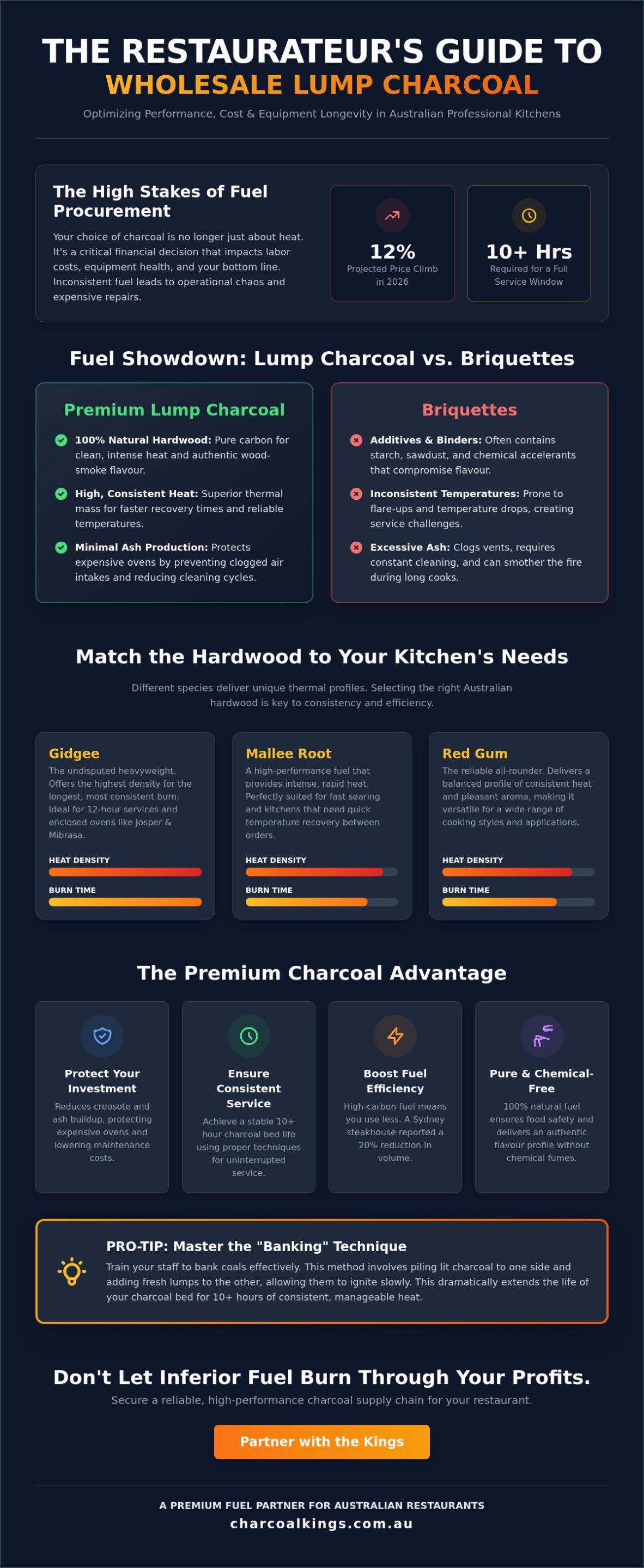
Your kitchen’s fuel density is now the primary factor in your labor costs and equipment longevity. With wholesale charcoal prices projected to climb by up to 12% in 2026, choosing the wrong supplier is an expensive mistake. If you’re tired of inconsistent coal sizes creating hot spots or excessive ash clogging your high-end Mibrasa, you need a technical approach to procurement. Mastering the supply of wholesale lump charcoal for restaurants Australia is about more than just finding a low price; it’s about securing the natural hardwood that protects your ovens and your bottom line.
We understand that supply chain disruptions and shifting biosecurity rules can make consistent service feel like a gamble. This guide provides the expertise you need to source premium fuel that delivers superior flavour and reliable performance. You’ll learn how to navigate the BICON import regulations updated on March 28, 2026, and why international benchmarks like the $850 USD per ton for hardwood lump impact your local costs. We’ll show you how to optimize your procurement for maximum efficiency and scheduled reliability. Let’s get sizzlin’.
Key Takeaways
- Match specific hardwood species like Gidgee and Mallee Root to your kitchen’s service window to ensure maximum heat density and fuel efficiency.
- Identify the critical criteria for choosing a reliable partner for wholesale lump charcoal for restaurants Australia to avoid low-quality “fines” and supply gaps.
- Master the “Banking” technique and staff training protocols to extend your charcoal bed’s life for 10+ hours of consistent service.
- Protect expensive commercial oven hardware by switching to 100% natural, chemical-free charcoal that reduces ash buildup and maintenance costs.
Why Premium Lump Charcoal is the Foundation of High-Volume Australian Hospitality
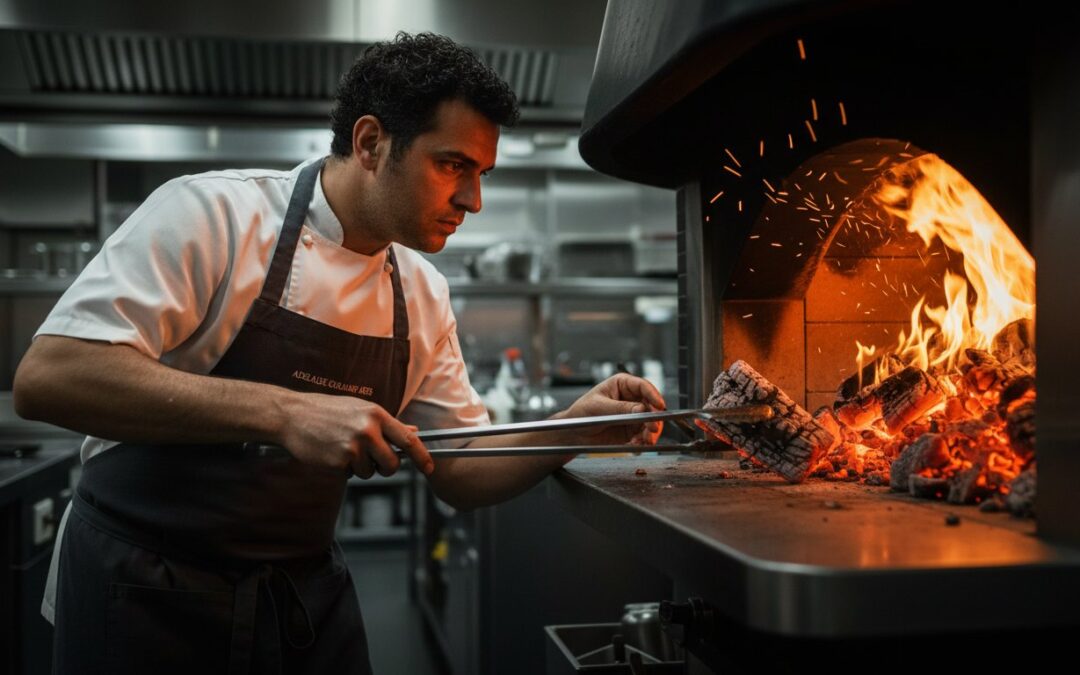
Premium hospitality starts with the fuel. Professional-grade lump charcoal consists of 100% natural, chemical-free carbonised hardwood. Understanding What is lump charcoal is fundamental for any head chef or procurement manager. It isn’t just a heat source; it’s a precision tool for temperature control. High-purity carbonised wood burns cleaner and hotter than any processed alternative. It provides the consistent thermal mass required for 12-hour service windows without the performance dips associated with gas or electric grills.
In 2026, the Australian market shifted heavily toward sustainable, locally sourced fuels. This move wasn’t just about ethics; it’s about performance. High-volume kitchens now demand wholesale lump charcoal for restaurants Australia that protects expensive Josper or Mibrasa ovens. Pure lump charcoal prevents the heavy creosote buildup that damages ventilation systems and increases fire risks. It’s a technical choice for long-term equipment health and operational safety.
To better understand this concept, watch this helpful video:
Lump Charcoal vs. Briquettes in Commercial Kitchens
Briquettes often contain starch binders and accelerants that produce excessive ash. In a high-volume setting, this ash clogs air intakes and forces more frequent cleaning cycles. Lump charcoal provides intense, searing heat that briquettes can’t match. It allows for faster recovery times between orders. Securing a steady supply of wholesale lump charcoal for restaurants Australia ensures your team isn’t fighting inconsistent temperatures during a rush. By choosing 100% natural hardwood, you ensure food safety by eliminating chemical fumes from your cooking line.
The Role of Charcoal in Modern Australian Cuisine
Modern diners want “fire-to-table” transparency. They expect the signature smoke profile that only natural hardwood provides. This flavour should enhance, not overpower, premium Australian beef or seafood. In early 2026, a prominent Sydney steakhouse reported a 20% reduction in fuel volume after switching from standard grade to premium lump. The higher carbon content meant they used fewer kilograms of fuel to maintain the same service temperature over a full shift. This efficiency directly impacts the cost-per-service for any commercial operator.
Selecting the Right Hardwood Species for Your Kitchens Cooking Style
Every hardwood species delivers a different thermal result. For a commercial kitchen, selecting the wrong wood leads to inconsistent plate quality and wasted fuel. The Australian market relies on the “Big Three” of professional fuels: Gidgee, Mallee Root, and Red Gum. Gidgee is the undisputed heavyweight, offering the highest density and longest burn time. Mallee Root provides a unique, intense heat suited for rapid searing. Red Gum acts as the reliable all-rounder, balanced for both heat and aroma. Professional chefs often order bulk hardwood lump based on these specific thermal profiles to ensure their service window remains consistent.
Density directly dictates your burn time. A high-density wood like Gidgee can maintain cooking temperatures for up to 6 hours in an open grill, while lower density alternatives might collapse in 3 hours. Carbonisation levels are also critical. In 2026, safety standards for indoor kitchens have tightened regarding particulate matter. High-purity charcoal with low moisture content prevents “sparking,” a common hazard in open-plan restaurants. Sourcing from FSC certified charcoal suppliers ensures that your species selection is both environmentally responsible and technically superior. Using a single-origin wholesale lump charcoal for restaurants Australia eliminates the “surprise” temperature spikes caused by mixed-species bags.
The Best Charcoal for Josper and Mibrasa Ovens
Enclosed ovens require fuel that produces minimal ash and maximum radiant heat. Gidgee and Ironbark are the preferred choices for these environments. Their high carbon content means they burn almost entirely away, leaving very little residue to clog your oven’s air intakes. Grading is equally important here. Large-graded lumps (60mm to 120mm) allow for optimal airflow within the firebox. This prevents the “suffocation” of the fire that occurs with smaller, retail-grade coals. Protecting your $20,000 oven investment starts with using high-purity, premium-graded fuel.
Fueling Rotisseries and Open Grills
- Red Gum: Best for rotisseries. It provides a steady, manageable heat and a sweet, distinct aroma that enhances lamb and poultry without overpowering the meat.
- Mallee Root: The workhorse for high-volume grilling. It reaches high temperatures quickly and holds them, making it the cost-effective choice for busy burger and steak lines.
- Species Layering: Many pitmasters use a base of Gidgee for longevity and top it with Red Gum for a boost in aroma during the first 2 hours of service.
Effective fuel management reduces your total consumption. By matching the wood species to your specific cooking equipment, you can lower your daily fuel volume by up to 15% while maintaining a superior flavour profile. Reliable wholesale lump charcoal for restaurants Australia provides the predictable performance your kitchen team needs to execute every dish perfectly.
Evaluating Wholesale Charcoal Suppliers: Beyond the Price Per Bag
Price per bag is the most deceptive metric in hospitality procurement. A low unit price often masks a high percentage of “fines,” which are the charcoal dust and small fragments unusable in a commercial grill. If 30% of your pallet consists of dust, your effective cost for usable fuel increases by 43%. Professional wholesale lump charcoal for restaurants Australia must be graded to specific sizes, typically 60mm to 120mm, to ensure consistent airflow and heat. Relying on seasonal or retail-focused suppliers is a significant risk. These vendors prioritize the high-margin domestic market during summer peaks, which often leaves restaurant contracts unfulfilled during the busiest service weeks of the year.
Sustainability is no longer optional in 2026. Diners expect ethically sourced ingredients, and that includes the fuel used to cook them. Sourcing from managed Australian forests ensures your supply chain is transparent and environmentally responsible. It also guarantees a product free from the chemical contaminants often found in unregulated international imports. A reliable supplier provides documentation of their wood source, ensuring your “fire-to-table” story is authentic and legally compliant.
The Logistics of Bulk Charcoal Procurement
Calculating the real cost of charcoal requires looking at the total landed price. This includes palletizing, freight, and tail-lift delivery. Most urban restaurants lack a forklift or loading dock; a supplier without tail-lift capabilities is useless for city distribution. Storage is another technical hurdle. You must keep 1 to 2 tonnes of fuel in a dry, ventilated area. Moisture absorption ruins the carbon structure, leading to excessive smoke and poor heat output. Lead times in Australia are critical. Order volumes for the December peak period should be finalized by October to avoid the 15% price surcharges often seen in last-minute holiday logistics.
Quality Assurance in Wholesale Batches
Consistency is the hallmark of a master craftsman. A dedicated account manager ensures every batch matches the density and moisture levels of the last. You can perform a simple “Shake Test” upon delivery. If the bags feel excessively heavy at the bottom or emit a thick cloud of dust when moved, the batch has high breakage. This material won’t burn; it will only clog your ash tray. For chefs transitioning from gas to solid fuel, Mastering the Art of Barbecuing with Charcoal provides the foundational knowledge needed to manage these batches effectively. Reliable supply is about predictability, not just the lowest quote.
Optimising Fuel Efficiency and Storage in Commercial Environments
Procuring premium wholesale lump charcoal for restaurants Australia is a technical investment. If your kitchen team doesn’t know how to manage a charcoal bed, you’re burning through your profit margins. Effective management starts with staff training. A well-constructed bed of Gidgee or Mallee Root can provide consistent heat for 10 hours or more. Your team must understand that solid fuel doesn’t behave like a gas dial. It requires a proactive approach to airflow and heat distribution. Proper ignition using chimney starters eliminates the need for chemical firelighters, ensuring the natural hardwood flavour remains untainted.
The “Banking” technique is the most effective way to lower your cost-per-service. Between lunch and dinner shifts, kitchen staff should mound the remaining hot coals together and restrict the airflow. This preserves the ignited core and prevents the fuel from burning out during downtime. When the dinner rush begins, simply opening the vents and spreading the coals brings the grill back to temperature in minutes. This method can reduce total daily fuel consumption by up to 15%. For more detailed technical advice on managing different fuel types, check out Charcoal: The Ultimate Guide to Fuelling Your BBQ.
Reducing Waste in the Kitchen
Partially burned lump charcoal shouldn’t be discarded. Once cooled, these “reclaimed” coals are highly carbonised and ignite faster than fresh fuel. Mix them into your morning setup to speed up the pre-service burn. To track efficiency, implement a “Charcoal Log.” Recording the weight of fuel used against the number of covers provides a clear metric of kitchen performance. If fuel usage spikes without a corresponding increase in covers, it often indicates poor airflow management or leaving vents open overnight. Stop wasting fuel and buy premium bulk charcoal that delivers the density required for long-shift reliability.
Storage Solutions for High-Volume Sites
Moisture is the primary enemy of charcoal performance. Even a 5% increase in moisture content leads to excessive smoke and a significant drop in peak temperature. Store your wholesale lump charcoal for restaurants Australia in a dedicated, dry area elevated off the floor. Using pallets is essential to prevent ground moisture from seeping into the bags. Additionally, bulk storage areas must be secured against pests. Natural hardwoods can attract wood-boring insects if left in damp, unventilated conditions. Keep your stock rotated using a first-in, first-out (FIFO) system to ensure every bag used on the line is at its peak thermal efficiency.
Safety remains the top priority for indoor charcoal use. Ensure your ventilation system complies with AS 1668.2-2012 standards to manage carbon monoxide and particulate matter. Ash disposal must follow a strict protocol; always use a lidded metal bin and never store unlit bags near active heat sources. These small operational details separate a profitable charcoal-based kitchen from an inefficient one.
Partner with Charcoal Kings: Reliable Bulk Supply for Australian Restaurants
Charcoal Kings stands as a seasoned partner for the Australian hospitality industry. We don’t just move bags; we manage the thermal performance of your kitchen. Our operation bridges the gap between traditional craft and large-scale food service logistics. When you source wholesale lump charcoal for restaurants Australia from us, you’re gaining access to a supply chain optimized for the 2026 market. We understand that the projected 12% increase in production costs requires a supplier who offers more than just a product. We offer reliability, expert knowledge, and a commitment to your restaurant’s profitability.
Our range is the most comprehensive in the country. We provide everything from the high-density Gidgee required for Josper ovens to the specialized fuels used in fine dining. For kitchens demanding the pinnacle of heat and longevity, our Binchotan Charcoal: The Ultimate Guide to Japanese White Charcoal explains why this “white charcoal” is the gold standard for yakitori and precision grilling. Wholesale partners receive tiered pricing that rewards volume and consistency. We provide priority delivery slots to ensure you never run dry during a public holiday rush. Every commercial account is paired with a dedicated support contact who understands burn times, wood density, and kitchen airflow.
Our Commitment to Quality and Consistency
We maintain a rigorous screening process for every pallet. Retail-grade charcoal often contains up to 30% dust and small fragments that go straight to waste. We filter our bulk stock to ensure optimal piece size, protecting your ventilation systems from ash-clogging. Every kilogram of our hardwood is ethically sourced from managed Australian forests. We guarantee 100% natural, chemical-free fuel that lets the quality of your ingredients speak for themselves. This consistency ensures your head chef can predict heat levels with 100% accuracy every shift.
Custom Solutions for Your Business
We solve the logistical headaches of urban hospitality. If your venue has limited storage, we can tailor a delivery schedule that keeps you stocked without cluttering your floor space. Our team provides expert advice on matching specific fuels to your unique equipment and menu requirements. Whether you’re running a high-volume rotisserie or a boutique steakhouse, we have the technical solution. Securing your wholesale lump charcoal for restaurants Australia shouldn’t be a gamble.
Contact our Wholesale Team today for a custom quote and secure your 2026 fuel requirements. It’s time to stop relying on inconsistent retail supplies. Join the ranks of the elite and become a CHARCOAL KING. Get Sizzlin’!
Secure Your Kitchen’s Thermal Performance for 2026
Mastering your fuel supply is a strategic move that directly impacts your bottom line. Choosing the right species like Gidgee or Mallee Root ensures your kitchen maintains consistent heat for 10 plus hours. High-purity, 100% natural hardwood prevents the ash buildup that damages expensive Josper or Mibrasa ovens. By prioritizing logistics like tail-lift delivery and professional grading, you eliminate the “fines” that waste 30% of standard retail bags. Securing a reliable supply of wholesale lump charcoal for restaurants Australia is the final step in professionalizing your fire-to-table operation.
Charcoal Kings provides the authoritative expertise and reliability your business needs to thrive. We deliver premium restaurant-grade hardwood with no chemical additives or fillers. Our team handles the heavy lifting with Australia-wide tail-lift delivery to your venue door. Don’t let supply chain disruptions or inconsistent fuel quality ruin your service window. It’s time to partner with a master craftsman who understands the technical requirements of high-volume hospitality.
Get a Wholesale Quote for Your Restaurant and ensure your kitchen is ready for the 2026 season. Get Sizzlin’!
Frequently Asked Questions
Why is lump charcoal better than briquettes for restaurants?
Lump charcoal reaches higher peak temperatures and produces significantly less ash than briquettes. Most commercial briquettes contain starch binders and chemical accelerants that can taint delicate ingredients. For high-volume kitchens, the lack of fillers in lump charcoal means less downtime for cleaning and fewer ventilation maintenance issues throughout the shift.
Which Australian wood species provides the longest burn time for commercial use?
Gidgee provides the longest burn time of any Australian hardwood due to its extreme density. It burns up to 50% longer than softer woods or standard mixed hardwoods. This density allows chefs to maintain a stable cooking temperature for 6 plus hours without constant reloading, making it the most efficient fuel for sustained service.
How much charcoal does a typical restaurant use per day?
A typical high-volume steakhouse or grill using wholesale lump charcoal for restaurants Australia consumes between 30kg and 60kg of fuel per day. This volume varies depending on the equipment type; enclosed ovens are generally more efficient than open grills. Tracking your specific consumption against daily covers helps identify waste and optimize your procurement schedule.
Do you provide wholesale delivery to regional Australia?
We provide reliable delivery across regional Australia using specialized freight partners. Our logistics network handles tail-lift requirements for venues without a forklift or loading dock. Whether you’re in a metropolitan CBD or a remote regional hub, we ensure your bulk pallet arrives intact and on a predictable schedule.
Can I use your lump charcoal in a Josper or Mibrasa oven?
Yes, our premium lump charcoal is specifically graded for use in enclosed high-heat ovens like Josper and Mibrasa. These machines require high-purity fuel to prevent creosote buildup in the chimney and ash clogging the air intakes. Using 100% natural hardwood ensures your expensive equipment remains in peak operational condition for years.
What is the minimum order quantity for wholesale charcoal pricing?
Wholesale pricing typically applies to full pallet orders to maximize freight efficiency for the client. A standard pallet consists of approximately 40 to 50 bags, depending on the bag weight and species density. For restaurants with limited storage, we can discuss tailored delivery schedules to manage stock levels effectively without sacrificing price benefits.
How should I store bulk charcoal to prevent moisture and fire risks?
Store bulk charcoal in a dry, well-ventilated area elevated at least 100mm off the floor. Using pallets prevents moisture from seeping into the bags, which is the leading cause of excessive smoke and poor heat output. Keep fuel away from active heat sources and maintain a strict first-in, first-out inventory system to ensure stock freshness.
Is your charcoal sustainably and ethically sourced in Australia?
Our charcoal is ethically sourced from managed Australian hardwood forests. We prioritize suppliers who adhere to sustainable forestry practices to ensure long-term environmental health. This transparent supply chain protects your restaurant’s reputation and complies with the increasing consumer demand for fire-to-table transparency and ethical sourcing in 2026.