Most BBQ enthusiasts believe “Premium Grade” on a bag of charcoal is an official government certification, but in Australia, there are no regulated national standards for charcoal quality. It’s a technical science of carbon density and lump size, not just a marketing label. You’ve likely felt the frustration of a long cook failing because your fuel produced inconsistent heat or clogged your vents with excessive ash. It’s even worse when a chemical smell from low-quality additives ruins a prime cut of meat.
By understanding charcoal grades, you’ll learn to identify the technical specs that actually matter for your grill. We’ll show you how to look for a fixed carbon content of at least 70% and an ash content below 10% to ensure a clean burn. This guide breaks down the differences between supplier-defined grades so you can achieve predictable burn times and maximum value for money. We’ll explore how to choose the perfect fuel for every cook, from high-heat searing to low-and-slow smoking. Whether you’re buying Red Gum lump at $50 plus GST or hunting for Mallee Root after the 2026 shortages, you’ll know exactly what you’re paying for. Let’s get sizzlin’!
Key Takeaways
- Mastering the technical side of understanding charcoal grades helps you distinguish between mere marketing labels and actual fuel performance.
- Identify the “sweet spot” of 75% to 85% fixed carbon to ensure your fuel burns hot and clean with minimal ash residue.
- Learn how professional screen sorting ensures consistent lump sizes, which is vital for maintaining steady temperatures in kamados and offset smokers.
- Discover how high-density Australian timbers like Gidgee and Ironbark provide the long-lasting heat required for professional-grade low-and-slow sessions.
- Gain the knowledge to source 100% natural, chemical-free hardwood that protects the flavour of your meat and the life of your grill.
What Does “Grade” Actually Mean in the BBQ Charcoal World?
In the world of outdoor cooking, understanding charcoal grades is the difference between a clean, steady burn and a bitter, ash-filled mess. For a professional supplier, “grade” isn’t a subjective rating. It’s a technical measurement of carbon purity, the density of the source timber, and the consistency of the lump size. While a bag might say “Premium,” the real quality is determined during charcoal production; this is where wood is heated in an oxygen-free environment to remove moisture and impurities. If the process is rushed, the resulting fuel is inconsistent and poor-performing.
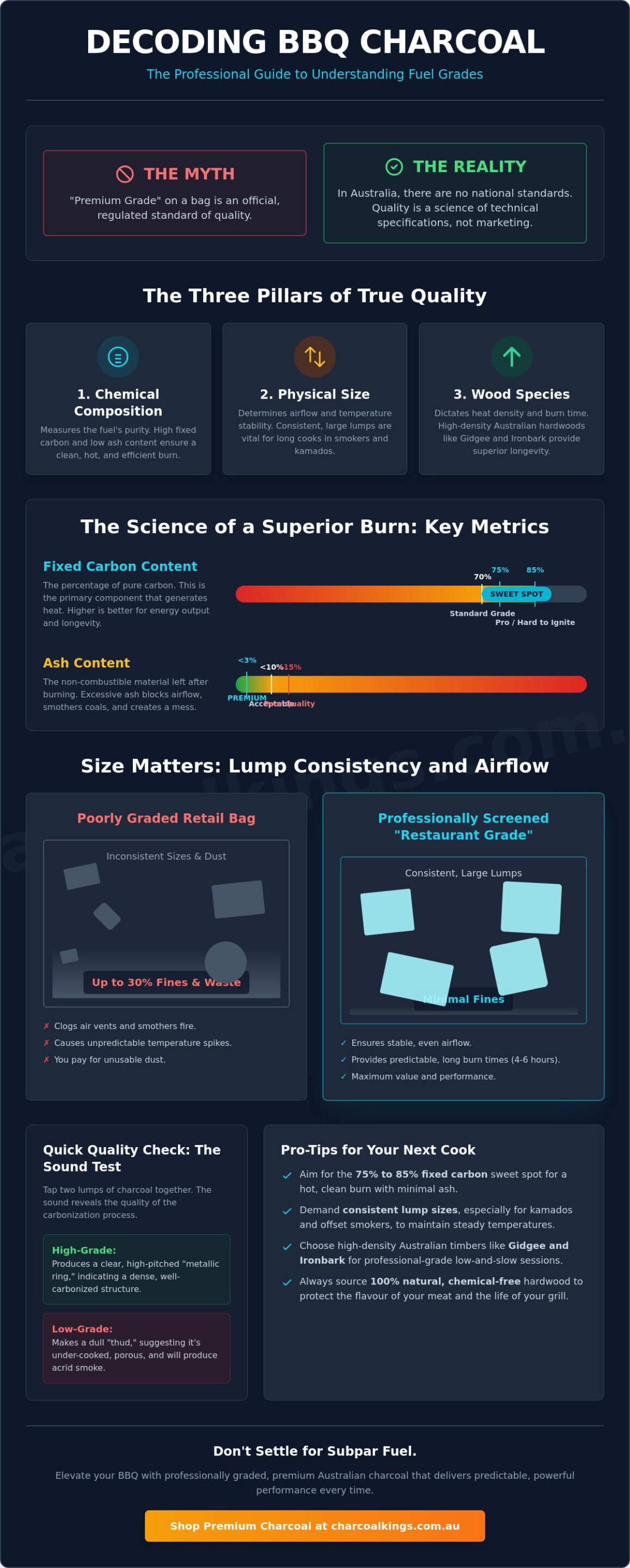
The three pillars of quality are chemical composition, physical size, and wood species. Chemical composition tells you how clean the fuel burns. Physical size determines how the air moves through your fuel stack. Wood species, like Australian Gidgee or Ironbark, dictates the maximum heat potential and the scent profile. When these three elements align, you get a fuel that responds predictably to your grill’s air vents.
To better understand the different types of fuel configurations and how they perform, watch this helpful video:
Culinary vs. Artistic Charcoal: A Critical Distinction
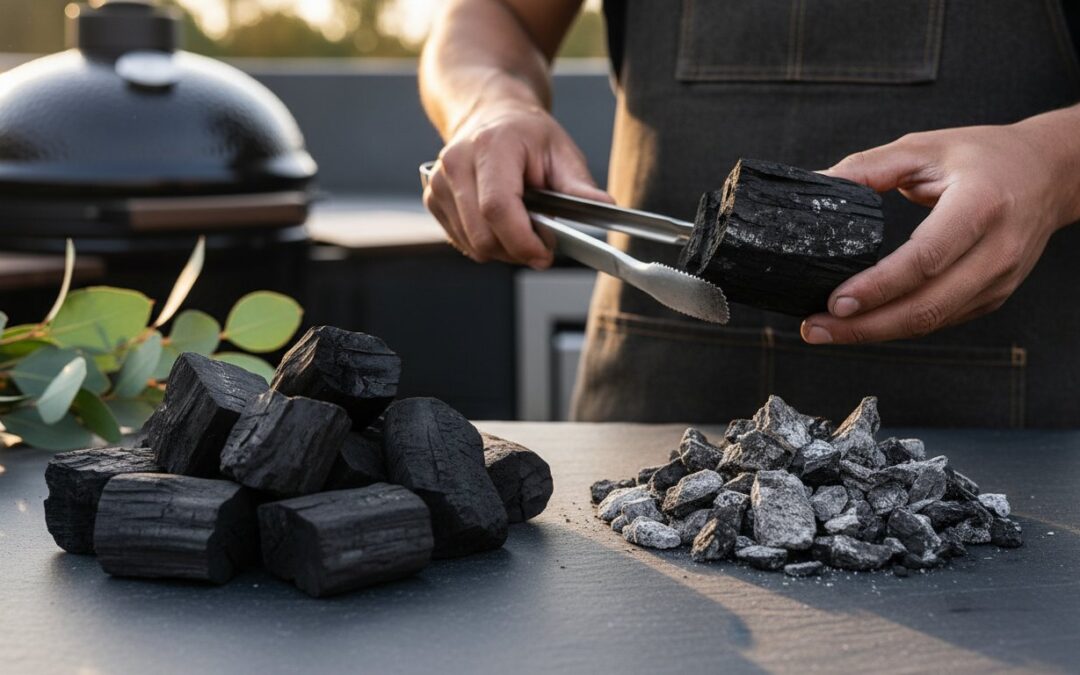
Don’t confuse BBQ fuel with the HB or B ratings found in an art supply store. Art charcoal is designed to smudge and stick to paper. It often contains chemical binders or is made from soft willow that burns away in seconds. It can even be toxic if ignited for cooking. Fuel-grade charcoal is about energy density and purity. If you tap two pieces of high-grade lump together, they’ll produce a clear, metallic ring. This sound indicates a high carbon content and a thorough carbonisation process. A dull thud usually means the wood is under-cooked and will produce heavy, acrid smoke.
The Three Metrics of Professional Grading
- Fixed Carbon: This is your mileage. High-grade charcoal sits between 75% and 85% fixed carbon. Anything lower means the wood wasn’t fully processed, leading to sparks and uneven heat.
- Ash Content: This is the waste material. Premium hardwood lump should leave behind less than 3% ash. Excessive ash blocks airflow and smothers your fire during long cooks.
- Volatile Matter: These are the remaining gasses. You need a small amount for easy ignition, but too much creates thick smoke that ruins the flavour of expensive meats.
You’ll see “Restaurant Grade” on many retail bags, but it’s often a loose marketing term. In a professional kitchen, this label implies large, consistent lumps that provide a predictable 4 to 6-hour burn time. Retailers sometimes use it to describe standard-sized chips that wouldn’t last an hour in a commercial oven. A true professional grade product is screened to remove “fines” or dust. If your bag is 30% dust, you’re paying for waste that only serves to clog your grill’s air vents. Stick to the technical specs, not the flashy labels.
The Science of Carbonisation: Fixed Carbon and Ash Content
Pyrolysis is the thermal decomposition of organic material at elevated temperatures in the absence of oxygen. During this specific chemical reaction, wood transforms into high-carbon fuel by driving off water and volatile gasses. Achieving the correct temperature is critical for understanding charcoal grades. If a kiln fails to reach at least 400 to 500 degrees Celsius, the wood remains under-carbonised. This results in “Standard” grade charcoal that retains high moisture levels and impurities, leading to heavy smoke and aggressive sparking during ignition.
For premium hardwood lump, the “sweet spot” for fixed carbon is between 75% and 85%. This level of carbonisation ensures the fuel burns clean and steady. When carbon levels exceed 85%, the fuel becomes harder to ignite, though it offers immense longevity. Lower carbon levels, often found in budget retail bags, mean you’re paying for uncarbonised wood and moisture rather than pure energy. Implementing rigorous charcoal quality control during the burn ensures that volatile matter is reduced, which directly correlates to lower smoke production and a neutral flavour profile.
Standard grades typically contain 10% to 15% moisture. This moisture absorbs energy during ignition, making the coals pop and crack. Premium grades are kiln-dried until moisture drops below 5%. This technical difference is why professional pitmasters avoid hardware store brands. They want the energy going into the meat, not into evaporating trapped water. You can order high-density hardwood charcoal that has been processed to these professional standards to ensure your next cook is smoke-free and efficient.
Why Low Ash Content is the Mark of High Grade
High ash content is the enemy of airflow. If your charcoal produces more than 4% ash, it quickly smothers the fire and restricts the oxygen needed for high-heat searing. You can judge the grade by the colour of the residue. Pure, high-grade wood produces a clean white or light grey ash. If you see brown or yellow residue, it indicates soil contamination or high levels of bark and impurities in the raw timber. For those seeking the absolute peak of performance, Binchotan charcoal represents the pinnacle of low-ash grading, often leaving behind almost zero waste even after a 6-hour burn.
Fixed Carbon vs. Heat Output
Fixed Carbon is the solid combustible residue that remains after a coal is heated to high temperatures. It represents the actual energy density of the fuel. High-grade charcoal doesn’t just burn hotter; it burns longer. This predictability is vital for 12-hour brisket cooks where temperature swings can ruin the bark. You can test the density of your fuel at home. High-density hardwoods like Gidgee or Ironbark that have been properly carbonised will often sink in water. If your “premium” lump floats like a cork, it lacks the carbon density required for professional performance.
Understanding Lump Size Grading and Screen Fractions
Professional charcoal suppliers rely on mechanical screening to sort their product into precise size fractions. This physical sorting is a vital part of understanding charcoal grades. Without it, a bag is just a random collection of timber chunks and dust. In the science of charcoal production, the structural integrity of the final product determines how it reacts to airflow. If the lumps are too small, they settle into a dense pack that smothers the fire. If they’re too large for the specific grill type, they create cold spots and uneven heat distribution.
Common size grades found in the Australian market include:
- 20-40mm (Standard): Best for quick direct grilling like steaks or sausages where a 1 to 2-hour burn is sufficient.
- 40-80mm (Premium): The sweet spot for ceramic kamados and gravity-fed smokers, offering a balance of airflow and longevity.
- 100mm+ (XL): Specifically sorted for large offset smokers and industrial rotisseries that require massive fuel loads.
Avoid bags heavy with “fines” or crumbs. These small pieces are often the result of poor screening or rough handling during transport. They offer no value and only serve to block your air vents, making temperature control nearly impossible. A high-grade bag should contain at least 80% of its stated size fraction.
The Role of Size in Airflow and Burn Rate
Large lumps are essential for low and slow cooking. They create significant air pockets within the fuel stack, allowing for stable, long-duration burns that can last over 12 hours. Medium lumps ignite faster and provide the intense, direct heat needed for searing. If you find yourself with small crumbs at the bottom of the bag, don’t throw them out. Use them as a base layer for quick-start sessions, but never use them for overnight cooks where airflow is your primary concern.
Why Wholesale Grades Differ from Retail
A true restaurant-grade standard demands consistency between 40mm and 120mm. Chefs can’t afford temperature fluctuations caused by varying lump sizes. Because high-quality charcoal is brittle, professional suppliers use double-walled bags or reinforced packaging to prevent breakage during delivery. When buying, give the bag a gentle shake. If it sounds like a box of cereal, it’s likely 50% dust. You want the heavy, distinct clunk of solid hardwood. This sound confirms you’re getting the large, intact pieces required for professional performance.
Matching the Grade to Your Grill: A Practical Framework
Selecting fuel based on your specific equipment is the final step in understanding charcoal grades. A portable kettle grill has different requirements than a heavy-duty offset smoker. For a quick 20-minute burger session, you might question if premium grades are necessary. While standard grades ignite faster due to lower density, they often lack the thermal mass to maintain heat if you decide to cook a second round of food. Premium hardwood lump offers better efficiency. You use less fuel to achieve the same temperature, which saves money over a season of grilling.
Wood species significantly impacts the final grade and performance. Australian Gidgee is a high-density timber that creates a premium, long-lasting coal. In contrast, Mallee is a standard-grade option that provides excellent flavour but burns through faster. When barbecuing with charcoal in humid coastal environments, premium grades are superior. Their high carbon density prevents them from absorbing atmospheric moisture as quickly as porous, lower-grade alternatives. This ensures your fuel stays dry and ready for ignition even in 80% humidity.
The Best Grade for Ceramic Kamados and Smokers
High-purity, large-lump hardwood is non-negotiable for 12-hour cooks in ceramic grills. Kamados rely on precise airflow. Small, low-grade pieces will settle and block the fire grate, causing your temperature to plummet mid-cook. You must avoid “sparky” woods often found in budget bags. These sparks can damage delicate felt or wire mesh gaskets over time. Using 100% natural, chemical-free fuel ensures a neutral flavour profile. This lets your dry rubs and meat quality shine without the interference of acrid smoke produced by under-carbonised wood.
Grades for Hibachis and Tabletop Grills
For small, open-air grills like hibachis, density matters more than lump size. You need a fuel that emits intense infrared heat without massive flames. This is where high-end Binchotan grades excel. You can identify premium Kishu Binchotan by its smooth, glass-like surface texture and its ability to ring like a bell when tapped. Lower Vietnamese Binchotan grades often have a rougher, more porous exterior and a shorter burn time. If you want a professional result, buy premium lump charcoal that matches your specific grill’s airflow design to ensure consistent heat every time.
The Charcoal Kings Standard: Sourcing Premium Australian Fuel
Charcoal Kings bridges the gap between technical theory and backyard reality. While understanding charcoal grades is essential for any pitmaster, having a reliable source for that fuel is what guarantees consistent performance. We specialise in 100% natural, chemical-free hardwood. Our focus remains on high-density Australian timbers like Gidgee and Ironbark. These species are naturally superior to the softwoods found in many imported bags. Local production allows us to oversee every stage of the process, ensuring the structural integrity of the lump remains intact from the kiln to your door.
Imported charcoal often hides its origin and chemical additives behind flashy packaging. We take the opposite approach by prioritising transparency and performance. Our Gidgee lump is sourced from the arid regions of Queensland, where the harsh environment creates some of the densest timber on the planet. This density is what allows our fuel to burn hotter and longer than standard retail options. Our screening process is a manual and mechanical effort. We sort our charcoal into specific size fractions to ensure that your bag contains the 40mm to 100mm lumps required for steady airflow. If a batch doesn’t meet these metrics, it doesn’t get the “King” label.
From the Outback to Your Grill
Sustainable harvesting is at the core of our operations. We source our timber from managed lands where the density of the wood has developed over decades. Our kiln process guarantees a minimum 80% fixed carbon level. This provides the high energy density required for professional-grade results. We combat the issue of “bag fines” through specialized handling at our Holden Hill warehouse. By managing our own logistics, we reduce the number of times a bag is moved. This significantly decreases the breakage that occurs during typical retail transport chains.
Expert Support for Your BBQ Journey
We recognise that every cook has different requirements. This is why we offer both Premium and Standard grades to suit varying budgets and equipment needs. Whether you’re running a commercial kitchen or a backyard kettle, the right grade makes the difference. You don’t have to guess which fuel is right for your next brisket. You can get personalised advice from the Charcoal Kings team at our Adelaide headquarters. We help you match our fuel to your specific smoker or grill setup to ensure you get the best value for your money. Understanding charcoal grades shouldn’t be a hurdle to great food.
Get Sizzlin’! We invite you to explore our full range of premium hardwood charcoal, professional smokers, and BBQ accessories. Our team is ready to help you master the craft of fire and smoke.
Elevate Your Grilling Performance
Mastering the art of fire starts with understanding charcoal grades and their technical impact on your cook. You now know that premium performance requires a fixed carbon content between 75% and 85% and an ash residue below 3%. These metrics ensure your fuel provides the long-lasting, clean heat necessary for competition-level results. Choosing the correct lump size for your specific equipment prevents airflow issues and keeps your temperatures stable for hours on end.
Charcoal Kings is a trusted wholesale supplier to leading Australian restaurants because we don’t compromise on quality. Our products are 100% natural and chemical-free; this ensures the pure flavour of your meat is never masked by synthetic additives. Every bag is expertly screened for consistent lump size to meet our rigorous professional standards. Don’t settle for inconsistent hardware store brands that ruin expensive cuts of meat. Shop our range of Premium Hardwood Charcoal and Get Sizzlin’! It’s time to take control of your grill and produce the best barbecue of your life.
Frequently Asked Questions
Is “Restaurant Grade” charcoal actually better than what I buy at the supermarket?
Yes, restaurant grade is superior because it undergoes stricter screening for lump size, typically ranging from 40mm to 120mm. Supermarket bags often contain 30% to 40% dust and small crumbs that block airflow and smother your fire. Restaurant grade offers a more predictable burn time, often lasting 4 to 6 hours compared to the 1 to 2-hour burn of budget retail options.
What is the difference between Grade A and Grade B lump charcoal?
Grade A charcoal features a higher fixed carbon content, usually above 75%, and larger, consistent lump sizes. Grade B is composed of smaller fragments and often has a higher percentage of uncarbonised wood. This results in more smoke, aggressive sparking, and a shorter burn time. Understanding charcoal grades helps you identify these technical differences before you invest in fuel for a long cook.
Can I use art charcoal to smoke meat if I run out of BBQ fuel?
No, you should never use art charcoal for cooking. It’s made from softwoods like willow and often contains chemical binders to help it smudge on paper. These chemicals can be toxic when burned and ingested. It also lacks the carbon density required for heat, meaning it burns away in minutes rather than providing the hours of heat needed for BBQ.
How much ash should a high-quality charcoal produce?
High-quality hardwood charcoal should produce less than 3% ash by weight. If your fuel produces over 4% ash, it’ll likely smother the fire and restrict oxygen flow in your grill. Clean white or light grey ash is a sign of pure wood. Brown or yellow residue suggests soil or bark contamination in the raw material used during production.
Why does some charcoal spark more than others?
Sparking occurs when the wood is under-carbonised or contains high levels of resin and moisture. Budget “Standard” grades often spark aggressively because the moisture inside the wood expands rapidly when heated. Premium hardwoods like Gidgee or Ironbark are kiln-dried to moisture levels below 5%. This technical standard significantly reduces sparking and popping during the ignition phase.
Does the wood species used affect the charcoal grade?
Yes, the wood species is a primary factor in determining the final grade and heat performance. High-density hardwoods like Gidgee provide a “Premium” grade because they offer more energy per cubic centimetre. Softer woods are usually relegated to “Standard” grades because they burn through quickly and lack the thermal mass needed for 12-hour low-and-slow smoking sessions.
How do I know if the charcoal in the bag is mostly dust before I buy it?
You can check for dust by gently shaking the bag or feeling the weight in the bottom corners. If you hear a distinct, heavy clunking sound, the bag contains solid lumps. If it sounds like sand or small pebbles shifting, it’s likely filled with useless fines. A high-grade bag should contain at least 80% intact lumps of the stated size fraction.
How should I store high-grade charcoal to maintain its performance?
Store high-grade charcoal in a cool, dry place away from direct contact with concrete floors. Charcoal is porous and will absorb moisture from the air, which degrades its performance and makes it harder to ignite. Use a sealed plastic bin or a dedicated charcoal storage bag to maintain the low moisture levels achieved during understanding charcoal grades and the carbonisation process.