
The top vent is not a thermostat; using it as one is the quickest way to choke your fire and coat your meat in bitter creosote. Many pitmasters struggle with fluctuating temperatures or a fire that refuses to stay lit because they treat both dampers as interchangeable tools. It’s a common error that leads to acrid flavors and wasted Hardwood Lump Charcoal. Mastering the top vent vs bottom vent smoker relationship is the difference between a stressful day at the pit and a reliable, high-performance cook.
You’ll learn the physics of airflow to achieve stable, set-and-forget temperatures and that elusive thin blue smoke every single time. We will break down how the bottom intake sets your temperature range while the top exhaust manages smoke quality and airflow speed. This guide provides the technical knowledge needed to stop babysitting your dampers and start producing results that meet superior standards with total confidence in your hardware.
Key Takeaways
- View your smoker as a thermal circuit where the bottom vent provides oxygen for combustion and the top vent exhausts spent gases.
- Treat the bottom vent as your primary accelerator to establish and hold your target temperature range throughout the cook.
- Resolve the top vent vs bottom vent smoker debate by using the top exhaust to manage smoke velocity and ensure a clean, blue smoke profile.
- Stop chasing temperatures with constant adjustments; learn the “set-and-forget” method by making small, incremental changes to the intake.
- Select pure fuels like Hardwood Lump Charcoal to maintain consistent airflow and avoid the heavy ash production of low-grade briquettes.
Understanding the Science of Airflow: Intake vs. Exhaust
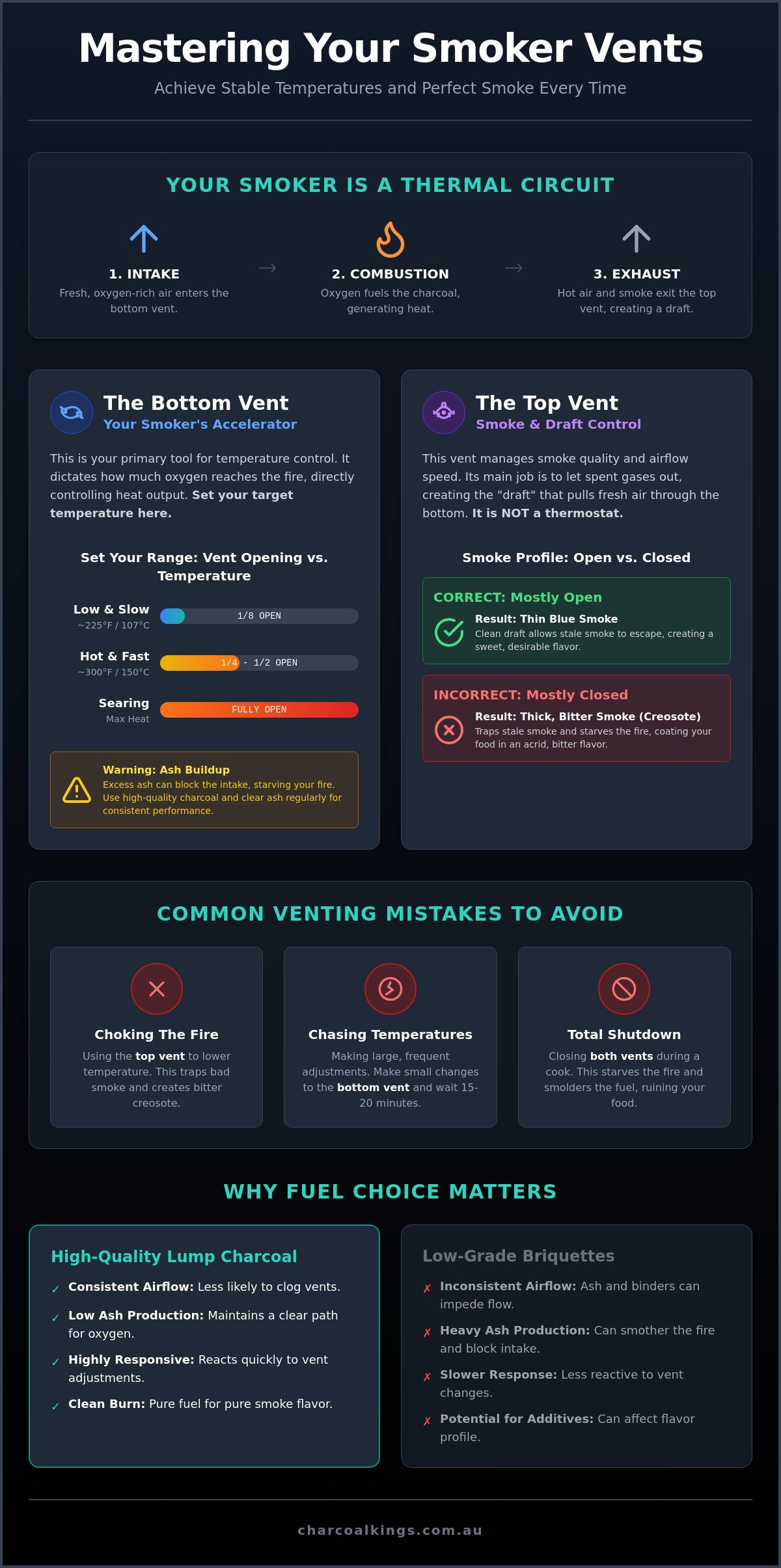
Understanding the top vent vs bottom vent smoker relationship starts with seeing the unit as a thermal circuit. Oxygen enters at the bottom, fuels the fire, and exits through the top. This movement is the foundation of the Science of cooking with smoke. Without a clear path for air to travel, your fire dies or smolders. The bottom vent acts as the intake, providing the lifeblood for your Hardwood Lump Charcoal. The top vent serves as the exhaust, releasing heat and spent gases. If you block either end of this circuit, the system fails and your cook is compromised.
To better understand these mechanics in action, watch this breakdown of basic vent operation:
The top vent vs bottom vent smoker dynamic relies on the “pull” factor. Hot air is less dense than cool air, so it naturally rises. As heat escapes through the top exhaust, it creates a vacuum that pulls fresh, oxygen-rich air through the bottom intake. This continuous cycle is essential for a clean burn. Never close both vents completely during an active cook. Doing so traps stale smoke and starves the fire. This creates a low-oxygen environment where the wood smolders rather than burns, leading to a bitter, creosote-covered product that ruins expensive cuts of meat.
The Role of Oxygen in Combustion
Oxygen levels directly dictate the intensity of your charcoal fire. More air equals more heat. The relationship is simple: increased oxygen intake results in higher BTU output. If your pit is running too hot, restricting the bottom intake is your primary method for lowering the temperature. By limiting the fuel’s access to oxygen, you force the fire to settle into a lower, more manageable heat range. It’s a game of precision. Small adjustments to the intake can result in significant temperature shifts over fifteen to twenty minutes.
Convection and the “Draft” Effect
Proper draft prevents stagnant, stale smoke from ruining your meat. A smoker requires a constant exit point to maintain a clean burn and prevent the buildup of heavy soot. This movement is driven by convection. High-quality smokers with significant thermal mass maintain a steadier draft because the heated walls help keep the internal air moving consistently. This ensures that the smoke touching your food is always fresh and moving. When the draft is weak, smoke lingers. This creates a “gray smoke” environment that imparts a harsh, chemical taste rather than the desired sweet, smoky profile.
The Bottom Vent: Your Smoker’s Accelerator Pedal
The bottom vent is your primary control for heat generation. Think of it as the gas pedal in your car. Just as Oztrack Performance Tuning & Engines provides the technical expertise to optimize vehicle performance, opening the intake injects oxygen directly into the heart of the fire, accelerating combustion and raising the temperature. Closing it throttles the oxygen supply, slowing the burn and cooling the pit. In the top vent vs bottom vent smoker hierarchy, the bottom vent dictates your baseline. Precision is mandatory here. A movement of just a few millimeters can shift your internal temperature by 10 or 15 degrees. It’s the most powerful tool in your kit for hitting a specific target and staying there.
During long cooks, ash buildup becomes a silent enemy of the accelerator pedal. As your fuel burns, the resulting ash can settle over the intake holes, physically blocking the air path. This makes your smoker feel sluggish and unresponsive to adjustments. Regularly clearing the intake area or using a kick-ash basket ensures that your “gas pedal” doesn’t get stuck. For those seeking the ultimate burn, sourcing high-performance fuel is the first step toward temperature mastery.
Setting Your Range: Low and Slow vs. Hot and Fast
Your target cook style determines your initial vent position. For a traditional low and slow session at 107°C (225°F), your bottom vent will often be restricted to a mere sliver, perhaps one-eighth open. If you’re roasting poultry hot and fast at 150°C (300°F), you’ll need a wider gap to maintain that higher BTU output. Wide-open vents are reserved for two specific moments: lighting the initial fire or high-heat searing. Using premium hardwood lump charcoal provides the clean, reactive burn needed for such precise control. Unlike low-grade alternatives, pure lump charcoal responds almost instantly to intake changes, allowing for tighter temperature windows.
Wind and Ambient Temperature Factors
External environment impacts how your accelerator performs. Strong winds can “force-feed” the bottom vent, pushing more oxygen into the fire than you intended and causing sudden temperature spikes. Position your smoker to shield the intake from direct gusts to maintain a steady flow. Ambient temperature also plays a role. A cold Australian winter night in Melbourne requires a slightly wider intake setting than a 40-degree Perth summer day to achieve the same internal heat. You must adjust for the air density and temperature outside to keep your internal thermal circuit balanced. Reliability comes from understanding these variables and adjusting your intake to compensate for the world outside the steel.
Creating a more controlled environment with an adjustable louvre system from Patios Coast2Coast can help you manage these external conditions, providing the necessary shelter to keep wind and rain from disrupting your temperature stability.
The Top Vent: Mastering Exhaust and Smoke Quality
The top vent is the fine-tuner of your thermal circuit. While the bottom vent provides raw power, the exhaust manages the quality of the cooking environment. Many pitmasters follow the “Top Open” rule, leaving the exhaust fully open throughout the cook. This is a reliable starting point for beginners because it ensures a clean burn. However, it’s not a universal law. Experienced cooks use the top vent to create backpressure. This keeps heat inside the chamber longer, improving fuel efficiency and stabilizing the internal environment. Mastering the top vent vs bottom vent smoker balance means knowing when to restrict that exit to hold heat without compromising air quality.
Thin Blue Smoke (TBS) is your ultimate objective. This translucent, bluish vapor indicates a clean-burning fire and optimal airflow velocity. If the exhaust is too wide, the smoke may move too fast to impart deep flavor. If it’s too restricted, you’ll see thick, billowy white clouds. This indicates stagnant air. You want a steady, gentle stream that carries the essence of your smoking woods across the meat without overwhelming it. Achieving this requires a delicate touch on the exhaust damper to maintain a constant, fresh flow of gases.
The Danger of “Stale Smoke” and Creosote
Choking the exhaust is a dangerous shortcut to saving fuel. When you restrict the top vent too much, you trap heavy soot particles inside the chamber. Creosote is the byproduct of incomplete combustion and poor exhaust. It’s a bitter, oily substance that ruins the flavor of your cook. Look for the warning signs. If you see thick white smoke or your meat develops a black, sticky appearance, your exhaust is too restricted. The air is stagnant. Open the vent immediately to let the stale gases escape and restore a clean burn to your fire.
Fine-Tuning Temperature with the Exhaust
The top vent is excellent for “shaving off” the last 5 to 10 degrees of a temperature spike. If the intake is already set, a slight adjustment to the exhaust can stabilize the pit without requiring a major change to the fire’s oxygen supply. Closing the exhaust is always more dangerous for flavor than closing the intake. You should always prioritize air quality over minor heat fluctuations. Use the “Symmetry Rule” as a guide. Aim for a balance where both top and bottom openings work in harmony to maintain stability. If you’re using high-quality Charcoal Briquettes or Hardwood Lump Charcoal, your fuel will remain predictable, making these fine-tuning adjustments much easier to execute.
Common Venting Mistakes and How to Fix Them
Successful temperature control is rooted in discipline rather than constant adjustment. Many pitmasters struggle with the top vent vs bottom vent smoker balance because they react to every minor flicker of the thermometer. This leads to a “yo-yo” effect where the temperature never settles. Troubleshooting your airflow requires a systematic approach. You must identify whether your issues stem from user error, environmental factors, or hardware failures like air leaks. Correcting these common mistakes is the only way to achieve the reliable, set-and-forget performance that defines a master craftsman.
The 15-Minute Rule for Adjustments
The most frequent error in vent management is impatience. When you adjust a damper, the internal temperature does not change instantly. This is due to thermal lag. In heavy steel offset smokers or thick-walled ceramic Kamados, the unit’s thermal mass holds onto heat. It takes time for the new oxygen levels to alter the fire’s intensity and for that change to radiate through the cooking chamber. You must wait at least 15 minutes after any vent change to see the true result. Making a second adjustment before the first one has taken effect is the fastest way to lose control of your pit.
Patience is the most important tool in barbecuing with charcoal. If the temperature is climbing too high, close the bottom intake by a small increment and walk away. Don’t touch it again until the 15-minute window has passed. This measured approach allows the system to find its new equilibrium. Professional results require this level of restraint. If you find yourself constantly fiddling with the dampers, you aren’t managing the fire; the fire is managing you.
Identifying and Fixing Air Leaks
A leaky smoker makes vent adjustments irrelevant. If air enters through gaps in the lid, doors, or firebox seams, your intake settings no longer dictate the fire’s oxygen supply. You can tell if you have a leak by performing a “smoke test.” Fire up your smoker with a heavy wood chunk and close all the vents. Smoke should only exit through the exhaust. If you see plumes escaping from the lid or door seals, you have an air leak. These gaps allow “rogue oxygen” to fuel the fire, often causing the temperature to stay high even when the intake is fully closed.
Fixing these leaks is straightforward. High-quality BBQ gaskets or high-temp RTV silicone can seal these gaps and restore total control to your vents. Once your unit is airtight, your dampers will respond with much higher precision. To ensure your hardware performs at its peak, equip your pit with high-quality charcoal and accessories that eliminate fuel-related variables. A sealed smoker fueled by pure Hardwood Lump Charcoal is a formidable tool that remains stable regardless of external conditions.
Why High-Quality Fuel Makes Venting Easier
The hardware is only half of the equation. Even the most precise top vent vs bottom vent smoker adjustments fail if your fuel source is unpredictable. Fuel purity directly dictates your burn rate and the responsiveness of your airflow system. When you use materials loaded with fillers or chemical binders, you introduce variables that no amount of vent fiddling can fix. Professional-grade results require professional-grade fuel. You cannot achieve a stable thermal circuit with inconsistent heat sources.
Cheap briquettes are notorious for high ash production. This ash settles at the base of your firebox, physically obstructing the intake. As the cook progresses, your bottom vent becomes less effective because air cannot reach the coals. This forces you to open the vents wider just to maintain a baseline temperature, eventually leading to a stalled fire. Switching to premium hardwood lump charcoal eliminates this mechanical failure. Pure charcoal burns down to almost nothing, keeping your intake clear and your temperature settings consistent for the duration of the cook.
Purity and Performance
A “No Additives” guarantee is not just a marketing claim; it’s a performance metric. Pure carbon fuel provides a cleaner burn with minimal sparks and zero chemical odors. This purity ensures that the heat output is entirely dependent on your vent settings rather than the uneven combustion of fillers. High-carbon fuels like Binchotan or top-tier lump charcoal maintain a steady draft by producing intense, consistent heat. This reliability reduces the need for constant vent fiddling. You set the dampers once, and the fuel follows the command. It’s the difference between fighting your fire and directing it.
The Charcoal Kings Promise
Professional-grade fuel is the foundation of airflow control. If you are struggling to master the top vent vs bottom vent smoker relationship, the solution is often in your fuel bin rather than your damper settings. Upgrading to superior materials simplifies the learning curve by removing the frustration of temperature drops caused by ash-clogged intakes. We position Charcoal Kings as the only choice for serious pitmasters who value performance and authenticity over convenience.
Don’t let inferior charcoal ruin a high-stakes cook. High-standard materials ensure your smoker performs exactly how the manufacturer intended. You deserve the confidence that comes with predictable, high-carbon heat. Explore the full Charcoal Kings range of hardwood fuels today and experience the difference that pure carbon makes at the pit. Smoke with authority.
Master the Fire and Dominate the Pit
You now have the technical framework to manage the top vent vs bottom vent smoker relationship with absolute precision. Success at the pit comes down to understanding the thermal circuit; the bottom intake dictates your heat intensity while the top exhaust preserves smoke purity. Keep your unit sealed, respect the 15-minute rule for all adjustments, and stop chasing minor temperature flickers. When you control the airflow, you control the outcome.
Even perfect technique fails when fueled by low-grade materials that clog your intake with excessive ash. Professional results require professional fuel. Upgrade to Premium Hardwood Charcoal for Better Temperature Control and eliminate the variables that ruin long cooks. As Australia’s leading supplier of additive-free hardwood charcoal, we provide expert-tested fuels designed for consistent 12+ hour burns. We are trusted by professional pitmasters and BBQ hobbyists nationwide who demand reliability. It’s time to stop fighting your hardware and start producing the clean, blue smoke your craft deserves. Get back to the pit and smoke with confidence.
Frequently Asked Questions
Should I ever completely close the top vent while cooking?
Never close the top vent completely during an active cook. Doing so causes spent gases to linger, leading to the buildup of bitter creosote on your meat. The exhaust must remain at least 25% open to maintain a clean thermal circuit. If you need to kill the fire after the cook is finished, you may close all vents to starve the remaining coals of oxygen.
How do I lower the temperature quickly if my smoker gets too hot?
Lower the temperature by restricting the bottom intake vent to a tiny sliver. This reduces the oxygen supply to the fire without affecting smoke quality. Avoid closing the top vent to drop heat; this traps acrid smoke and ruins the flavor profile. If the temperature remains too high despite closing the intake, check for air leaks around the lid or door seals.
Why is my smoker producing thick white smoke even with the vents open?
Thick white smoke is usually a sign of dirty combustion or unseasoned wood. It occurs when the fire is smoldering rather than burning cleanly. Ensure your Hardwood Lump Charcoal is dry and has reached a steady glow before adding meat. If the firebox is overloaded with cold wood, the temperature drops and produces heavy soot until the wood ignites properly.
Does the type of charcoal I use affect how I set my vents?
The fuel type significantly changes your top vent vs bottom vent smoker settings. Hardwood Lump Charcoal is highly reactive and requires smaller adjustments than dense Charcoal Briquettes. Pure fuels like Binchotan Charcoal produce almost zero ash, preventing the intake blockages that often plague long cooks. High-carbon fuels allow for tighter vent settings while maintaining a consistent, high-heat output.
How much should I open the vents when starting my smoker?
Open all vents to the 100% position when lighting your smoker. This provides maximum oxygen for the initial ignition and helps establish a strong draft through the cooking chamber. Once the internal temperature is within 15 degrees of your target, begin closing the bottom intake to its running position. Don’t attempt to throttle down a fire that hasn’t fully established its thermal mass.
Can I control the smoke flavour using just the vents?
Exhaust management is your primary tool for altering flavor intensity. A wide-open top vent results in a lighter, cleaner smoke profile suitable for poultry or fish. Restricting the exhaust slightly increases the residence time of the smoke, providing the deeper bark and heavier flavor required for beef brisket. Always ensure the smoke remains translucent and bluish to avoid a harsh, chemical bitterness.
What is the best vent setting for a long “low and slow” brisket cook?
For a low and slow brisket cook at 107°C, start with the bottom vent roughly one-eighth open. Keep the top vent fully open to ensure maximum airflow and a clean burn. As the cook progresses and the pit stabilizes, you may use the top vent to shave off minor temperature spikes. This balance ensures the 12+ hour burn time required for large primal cuts without clogging the firebox with ash.
Do I need to adjust my vents differently for an offset smoker vs a kettle?
Offset smokers require more aggressive exhaust management to maintain a horizontal draft across the cooking grate. Kettle grills rely on vertical convection, making them more sensitive to bottom intake adjustments. In an offset, the distance between the firebox and the chimney creates a different pressure dynamic than the compact, circular airflow found in a kettle or ceramic smoker. You must learn the specific draft characteristics of your hardware to achieve total control.