
Why does the most capable cook in the neighborhood always end up eating a cold snag alone by the grill while the rest of the party is already finished? It’s the classic pitmaster’s trap. You spend hours prepping the perfect spread only to realize the brisket needs another hour while the chicken is drying out and the sides are stone cold. Learning how to time multiple dishes for a bbq party is the difference between a stressed host and a local legend.
We agree that nothing kills the vibe of a great Australian cookout faster than a disjointed serving schedule. You want every cut of meat perfectly rested and every side dish piping hot without being tethered to the vents all afternoon. This guide promises to transform your approach by mastering the art of the BBQ timeline. You’ll learn to leverage strategic resting periods and heat zone management to reclaim your social life while maintaining professional standards.
We will break down the exact steps to organize your cook. This includes choosing high-performance fuel like Hardwood Lump Charcoal for longevity and using secondary units for smaller tasks. Prepare to serve a feast that proves you’re a master of both the fire and the clock.
Key Takeaways
- Reverse engineer your timeline by using the final serve time as your anchor, ensuring you account for a critical 60-minute rest window.
- Learn how to time multiple dishes for a bbq party by matching your fuel choice, such as Hardwood Lump Charcoal, to the required cook duration.
- Stagger your cooking order by starting large cuts hours before guests arrive, leaving the grill free for quick-searing smaller items later.
- Utilize a standard esky as a professional-grade holding cabinet to maintain safe serving temperatures and moisture without overcooking the meat.
- Deploy precision tools like instant-read thermometers to eliminate guesswork and ensure every dish is pulled at its absolute peak.
The Pitmasters Secret: Reverse Engineering Your BBQ Timeline
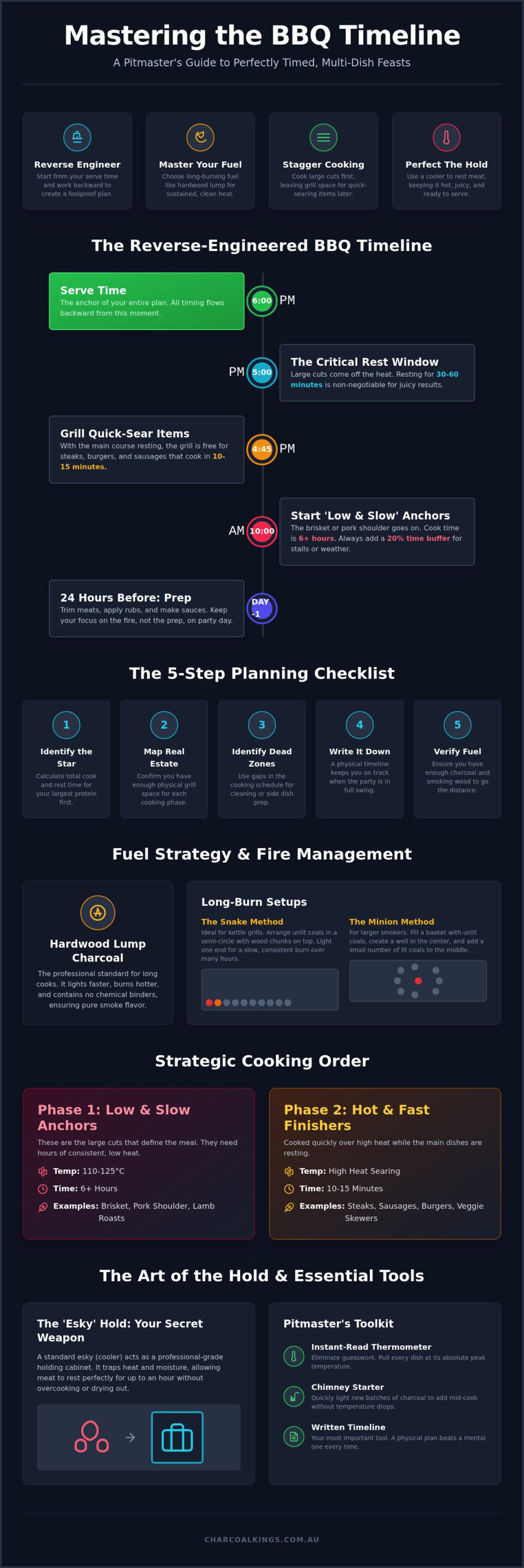
The secret to learning how to time multiple dishes for a bbq party isn’t found in the fire. It starts with a pen and paper hours before you light the first match. You must work backward from your desired serving time. If you want guests to eat at 6:00 PM, that is your anchor. Every calculation flows from this fixed point. This reverse-engineered approach ensures you aren’t serving the salad two hours before the brisket is ready.
The most overlooked phase in BBQ planning is the “Rest Window.” Large roasts require 30 to 60 minutes of resting to allow juices to redistribute. Skipping this step results in dry meat and a messy cutting board. By understanding barbecue techniques, particularly the low-and-slow method, you realize that resting is as critical as the cook itself. It provides a natural safety net for your timeline.
Always add a 20% buffer zone to your estimates. Charcoal is a natural product, not a dial on a stove. Environmental factors like wind, ambient temperature, or humidity can alter burn rates and internal meat temperatures. A 20% time cushion ensures you aren’t rushing the process if the meat hits a “stall.” Use the 24 hours before the party to clear the cooking deck. Trim your meats, apply your rubs, and prep your sauces. This keeps your focus on the grill during the event.
Step 1: Categorising Your Menu
Group your dishes by their specific heat and time requirements. “Low and Slow” anchors like brisket or pork shoulder need 6 plus hours of consistent heat. These dishes thrive on the longevity of premium Hardwood Lump Charcoal. “Hot and Fast” finishers like steaks or sausages only need 10 to 15 minutes over high heat. Separate passive sides that sit in the fridge from active grill items that require constant flipping and monitoring.
The 5-Step Planning Checklist
A physical timeline beats a mental one every time. Use this checklist to maintain control:
- Identify the Star: Calculate the total cook and rest time for your largest protein.
- Map Real Estate: Confirm you have the physical grill space for each dish phase.
- Identify Dead Zones: Look for gaps in the cooking schedule to handle prep or cleaning.
- Write It Down: Document the timeline to keep yourself on track when the drinks start flowing.
- Verify Fuel Supplies: Ensure you have enough charcoal and smoking wood to go the distance.
Fuel Strategy: Managing Charcoal Longevity for Multiple Rounds
Your fuel choice is the mechanical engine of your cook. If the fire dies halfway through, your carefully planned timeline collapses. For a standard 6-hour party window, you need a fuel that offers both high-intensity heat and long-term endurance. Hardwood lump charcoal is the professional standard here. It lights faster and burns hotter than standard briquettes, giving you the flexibility to pivot between different cooking styles as guests arrive.
Mastering how to time multiple dishes for a bbq party requires a strategic grill setup. The “Snake Method” is ideal for kettle grills, where you arrange unlit fuel in a semi-circle to burn slowly over several hours. For larger smokers, the “Minion Method” involves placing lit coals into a well of unlit fuel. Both techniques provide the sustained, steady heat necessary for those “Low and Slow” anchors mentioned in our planning phase. When you need to add hardwood lump charcoal mid-party, do it in small batches. Pre-lighting them in a chimney starter prevents temperature drops and avoids the “dirty” smoke associated with fresh, unlit coals.
Airflow control is your thermostat. Use your bottom vents to dictate the burn rate of your fuel. Wide open vents provide maximum oxygen for high-heat searing, while restricted vents maintain the 110-125°C range required for roasts. Your top vent should remain at least partially open to ensure consistent exhaust and prevent soot buildup on the meat.
The Power of Hardwood Lump
Purity is the hallmark of a master pitmaster. Premium hardwood lump contains no chemical binders or fillers, ensuring your food tastes like meat and smoke, not additives. This purity is vital during long cooks where food is exposed to the fire for several hours. You can harness the initial high-heat burst for a quick sear on appetizers, then rely on the clean, residual heat to keep your sides warm without overcooking them. For the best results, always source high-grade Hardwood Lump Charcoal that guarantees consistent performance.
Zonal Cooking: Creating Heat Hierarchies
Never use your entire grill surface for direct heat. A two-zone setup creates a “Direct” zone for searing and an “Indirect” zone for roasting. This indirect area acts as a critical holding station. According to safe food handling guidelines, maintaining proper internal temperatures is non-negotiable for guest safety. For a continuous flow of snacks, consider a secondary Hibachi grill fueled with Binchotan. Its incredibly consistent, clean heat is perfect for skewers while your main unit handles the heavy lifting.
Strategic Cooking Order: From Brisket to Burgers
Mastering how to time multiple dishes for a bbq party depends on your ability to overlap different cooking phases. You don’t cook one item at a time; you layer them. Start with the “Long-Haul” proteins. Brisket or pork shoulder should be on the grill hours before the first guest knocks. These items are forgiving once they hit their target temperature because they can rest for hours in an insulated environment without losing quality. If your brisket finishes early, it’s a victory, not a problem.
At the one-hour mark before serving, move to mid-range items. This includes poultry, such as chicken thighs or wings, and dense vegetables like corn on the cob or thick-cut pumpkin. These require steady, moderate heat. If your main grill is reaching capacity, this is when you must manage “Grill Crowding.” Move your fully cooked roasts to a pre-warmed esky or a low-temperature oven. This frees up the grates for the high-energy “Sizzle Finish.”
The final 15 minutes is reserved for high-speed items. While your big cuts are resting, crank the vents for a high-heat sear on burgers, sausages, or seafood. This sequence ensures you aren’t trying to flip dozens of patties while simultaneously slicing a delicate brisket. By following this order, you maintain control over the fire and the flow of food.
The BBQ Timing Matrix
Group items with similar temperature requirements to maximize efficiency. Use the following guide to plan your transitions:
- Brisket: 10-14 hours cook time | 1-4 hours rest | High complexity.
- Pork Shoulder: 8-10 hours cook time | 1-2 hours rest | Medium complexity.
- Whole Chicken: 1.5 hours cook time | 20 minutes rest | Medium complexity.
- Steaks: 10-15 minutes cook time | 10 minutes rest | Low complexity.
- Sausages: 10 minutes cook time | No rest required | Low complexity.
The resting period is your best friend for timing flexibility. It acts as a buffer that allows you to finish smaller items without the main course going cold.
The “Intermission” Snacks
Keep guests occupied with appetizers while the main proteins complete their rest. Quick-cook skewers are perfect for this role. Pro tip: use premium skewers to maximise your grill space and ensure even cooking. If you have a secondary Hibachi, use Binchotan charcoal to keep a steady flow of snacks moving without interrupting the main grill’s temperature. Finish the timeline with the “Bread Toss,” toasting buns and bread in the final two minutes for that perfect crunch.
The Art of the Hold: Keeping Food Hot Without Drying Out
Finishing a brisket three hours before dinner isn’t a mistake; it’s a strategic advantage. Knowing how to time multiple dishes for a bbq party means mastering the “hold.” A proper hold allows you to clear the grill for high-heat items while the large roasts stay at peak quality. This phase is not just about waiting. It is an active part of the cooking process that improves the texture of the meat.
Professional pitmasters use a “Faux Cambro” by repurposing a standard esky. Wrap your meat tightly in heavy-duty foil, then in two layers of clean towels. The towels act as extra insulation, filling the air gaps in the esky. This setup uses the meat’s own thermal mass to maintain temperature. It is a simple, effective way to manage your timeline without sacrificing the integrity of the food.
Safety is the primary concern during an extended hold. You must keep the food above 60°C to stay out of the “Danger Zone” where bacteria thrive. Use a probe thermometer to monitor the internal temperature without opening the esky lid. If the temperature approaches the 60°C threshold, move the meat to a controlled heat source immediately.
Understand the difference between resting and holding. Resting occurs at room temperature to stop the cooking process and allow juices to settle. Holding is an extended period in an insulated environment designed to keep food at serving temperature. To prevent a mushy bark, vent the foil for 10 minutes before sealing it for the long hold. This allows excess steam to escape so the crust stays intact.
Esky Management for Pitmasters
Pre-heat your esky to maximize its efficiency. Pour two liters of hot tap water into the unit and close the lid for 15 minutes. Drain and dry the interior before adding your wrapped meat. This prevents the cold walls of the esky from sucking the heat out of your roast. A large pork shoulder or brisket can stay hot and safe for up to 4 to 6 hours using this method. For precise monitoring during these long holds, equip yourself with professional BBQ Accessories like instant-read thermometers.
The Oven as a Backup
If your esky is full, your kitchen oven is a reliable secondary option. Set the oven to its lowest possible temperature, ideally between 60°C and 70°C. Place a water pan on the bottom rack to maintain humidity. This prevents the dry air of the oven from dehydrating the meat. While the oven works for proteins, it is the superior choice for holding hot sides like smoked mac and cheese or corn. These items often become soggy in the airtight environment of an esky but stay crisp in the oven. To ensure your kitchen is equipped for high-volume entertaining, you can explore Commission-Based Appliance Sales and Direct Product Sales for versatile tools that simplify side dish preparation.
Success in learning how to time multiple dishes for a bbq party relies on your equipment. You can’t manage a complex timeline with guesswork. Instant-read thermometers are mandatory. They provide the only definitive way to know when to pull meat, preventing overcooked chicken or underdone steaks. Heat-resistant gloves are another essential. They allow you to move hot grates or adjust fuel without fumbling for tongs, which significantly speeds up your workflow during high-pressure moments.
Efficiency is about maximizing your grill space and maintaining the cooking surface. Grill baskets and toppers allow you to manage small items like sliced mushrooms or prawns without losing them to the coals. A clean grill scraper is vital for maintenance. It prevents mid-party sticking and flare-ups caused by old grease or carbon buildup. A clean surface ensures your heat transfer remains consistent across every square inch of the grate, allowing for predictable cook times.
Essential Hardware for Multi-Tasking
Multi-level rack systems effectively double your cooking surface. This is critical when you need to toast buns or warm sides while a large roast occupies the main grate. Wireless probes allow you to monitor your “Star” proteins from a distance. This freedom lets you socialize with guests without neglecting the fire. For those using offset smokers, the quality of your fuel is paramount. Using seasoned hardwood firewood provides the clean, blue smoke and stable temperatures required for long-duration cooks.
The Clean-Up Strategy
A master pitmaster cleans as they go. This isn’t just about aesthetics; it is about performance. Ash buildup can block the bottom vents of your grill, choking the fire and causing sudden temperature drops. Managing how to time multiple dishes for a bbq party includes scheduled ash removal during long sessions. Use a dedicated ash tool to clear the path for oxygen. This keeps your fuel burning at its peak efficiency until the last burger is served. Maintaining a clear airflow path is the only way to ensure your charcoal lasts the entire party window.
Ready to upgrade your fuel? Shop Charcoal Kings Premium Hardwood Lump today.
Own the Clock and the Coals
Mastering the timeline is what separates a casual griller from a true pitmaster. By reverse-engineering your serve time and utilizing professional holding techniques, you ensure every guest receives a hot, perfectly rested meal. We have covered the importance of strategic cooking orders and the necessity of precision tools to eliminate guesswork. Success relies on your preparation and the performance of your fuel.
Your fire is the foundation of your schedule. Mastering how to time multiple dishes for a bbq party requires a fuel that offers consistent heat and superior longevity. Charcoal Kings provides 100% Natural Hardwood Lump charcoal that serves as the reliable engine for any complex cook. We deliver wholesale quality for home pitmasters with Australia-wide shipping.
Master your next BBQ with Charcoal Kings Premium Fuels and take total control of your grill. With the right strategy and the cleanest fuel on the market, you’ll spend less time stressing over the vents and more time enjoying your reputation as a master host. Get the fire started today.
Frequently Asked Questions
How do I keep BBQ food warm for 2 hours without it drying out?
Use an insulated esky as a holding cabinet. Wrap your proteins in heavy-duty foil and thick towels to trap thermal mass. This method keeps roasts hot for hours without the drying effects of an oven. For side dishes, use a kitchen oven set to 60°C with a small pan of water to maintain humidity. This prevents the food from reaching the danger zone while preserving the original texture.
Should I cook the meat or the vegetables first at a BBQ?
Start with your large proteins first. These cuts require significant resting time, which is the foundation of how to time multiple dishes for a bbq party. While your brisket or pork shoulder rests in an insulated esky, you gain full access to the grill for secondary items. Cook your vegetables and quick-searing meats last so they go directly from the fire to the guest’s plate while the main course is sliced.
What is the “Snake Method” for charcoal and how does it help with timing?
The Snake Method is a technique where you lay unlit fuel in a curved line around the internal perimeter of the grill. By lighting only one end, the fire moves slowly through the chain. This creates a stable, low temperature for several hours. It is an essential strategy for long cooks, providing a predictable heat source that allows you to manage other menu items without constant vent adjustments.
How long can I safely rest a brisket or pork shoulder in an esky?
A large brisket or pork shoulder can stay safely in a well-insulated esky for up to 6 hours. The critical factor is keeping the internal temperature above 60°C to prevent bacterial growth. Use a wireless probe to monitor the meat without opening the lid. This extended holding time is vital when learning how to time multiple dishes for a bbq party, as it provides a massive buffer for your schedule.
What do I do if the charcoal dies out before the food is finished?
Act quickly by lighting a fresh batch of fuel in a chimney starter. Once the coals are glowing, add them to the grill to restore the temperature. Avoid adding unlit charcoal directly to the embers, as the resulting smoke contains impurities that can ruin the flavor. Using premium Hardwood Lump Charcoal provides the longevity needed to avoid this issue, as it burns longer and cleaner than standard options.
Can I cook multiple types of meat on the same charcoal grill?
You can cook different meats simultaneously by establishing distinct heat zones. Use the indirect zone for roasts and the direct zone for fast-cooking items like sausages. This layout prevents grill crowding and allows you to manage various thermal requirements at once. Always use dedicated temperature probes for each meat type to ensure they are pulled at their specific peak, maintaining the high standards of a master pitmaster.
How many bags of charcoal do I need for a 4-hour BBQ party?
A typical 4-hour session usually requires one 5kg bag of premium Hardwood Lump Charcoal. Factors like wind and your specific grill’s insulation will affect the burn rate. It’s best practice to have a second bag ready to ensure you don’t run out mid-cook. High-quality fuel without additives provides more heat per kilogram, making it more efficient for long parties than cheaper, filler-heavy alternatives found in supermarkets.
What are the best quick-cooking sides to finish on the grill?
Vegetables like asparagus, zucchini, and corn are ideal because they cook in under 10 minutes. Sliced halloumi and fruit skewers also work well for a quick finish. These items should be placed on the grill the moment you begin slicing your rested proteins. Using a stainless steel grill basket keeps these smaller items secure, ensuring they don’t fall into the coals while you are busy managing the final serving steps.