Your charcoal isn’t just a heat source; it’s the most critical ingredient in your cook. If you’re still using chemical starters or struggling with fires that flame out before the meat is done, you’re fighting a losing battle against your equipment. This charcoal bbq guide provides the technical foundation you need to stop guessing and start commanding the grill. We understand that nothing ruins a weekend faster than a brisket that tastes like lighter fluid or a fire that refuses to stay lit.
You want that authentic smoky flavour and the confidence to walk away from your smoker knowing the temperature will hold. This guide delivers exactly that by stripping away the confusion surrounding fuel types and heat management. We’ll examine the performance of hardwood lump versus briquettes and teach you professional lighting techniques that rely on purity rather than additives. From selecting the right smoking woods to mastering airflow, you’re about to gain total control over the flame. By the end of this manual, you’ll have the expert knowledge required to produce professional results every time you light the fire.
Key Takeaways
- Understand why 100% natural hardwood lump is the professional choice for high-heat searing while briquettes provide the stability needed for low and slow sessions.
- Learn how to achieve an authentic smoky flavour by harnessing infrared heat and vaporised fats without the interference of chemical additives or binders.
- This charcoal bbq guide teaches you to master the chimney starter technique, ensuring a clean burn and eliminating the need for foul-smelling lighter fluids.
- Discover the specific performance benefits of Binchotan charcoal for precision grilling and why it remains the gold standard for consistent, clean heat.
- Gain the confidence to manage airflow and temperature across different hardware, from versatile kettle grills to professional-grade offset smokers.
Why Charcoal BBQ Wins: Flavour, Heat, and the Primal Craft
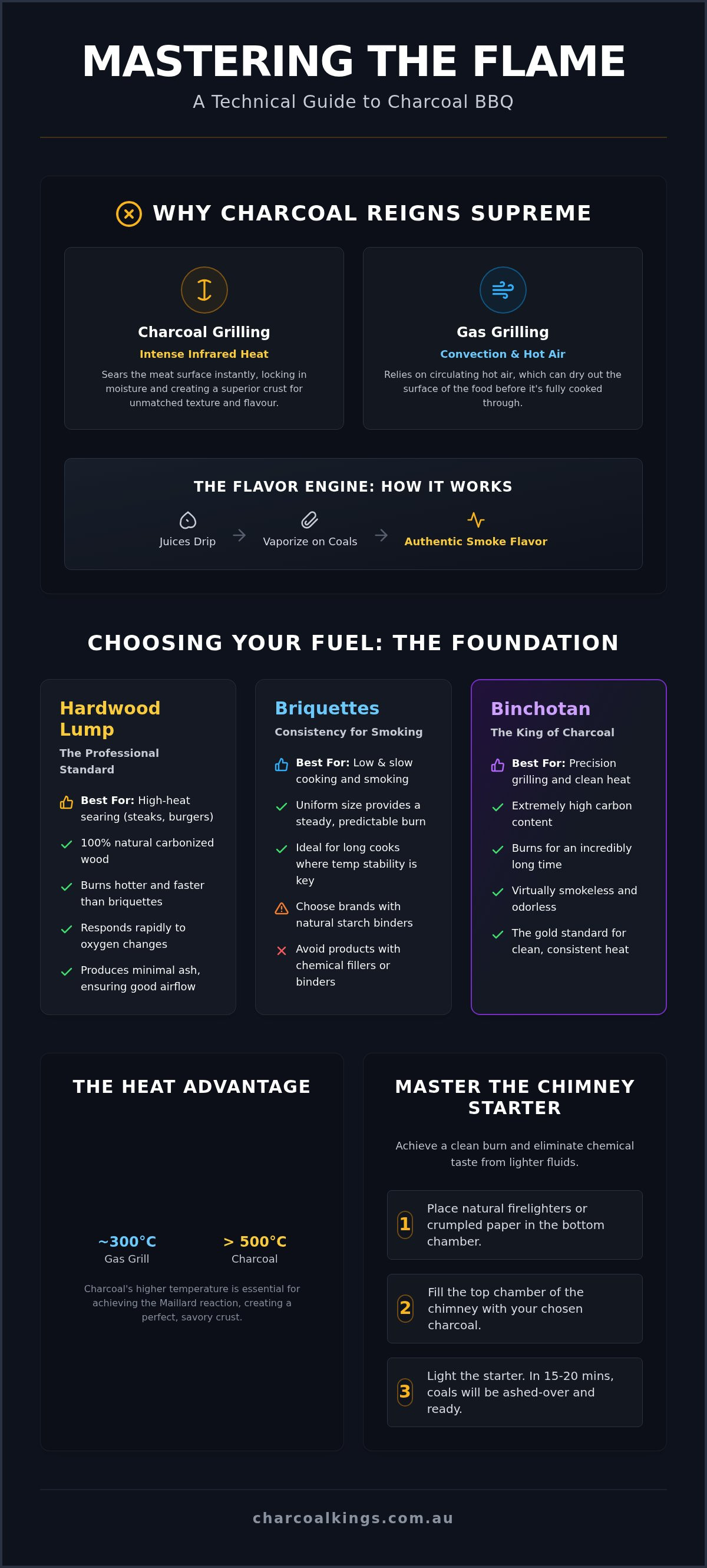
Charcoal isn’t just a fuel source; it’s a primary ingredient that defines the quality of your cook. While gas grills rely on convection and hot air, charcoal provides intense infrared heat. This radiation sears the meat surface instantly, locking in moisture and creating a superior crust. When fats and juices drip onto the white-hot coals, they vaporise immediately. This creates a complex smoke that circulates and coats the food, providing the authentic profile you can’t replicate with propane. Understanding these mechanics is a core part of any comprehensive different types of barbecue grills analysis.
Using natural hardwood lump charcoal connects you to a primal craft. It’s a ritual that requires patience and skill. You aren’t just turning a dial; you’re managing a live fire. This process builds a deeper connection with your food. Choosing chemical-free hardwood is also a sustainable choice. Unlike mass-produced briquettes that often contain coal dust and chemical binders, natural lump charcoal is a pure carbon product. It burns cleaner, produces less ash, and leaves no environmental footprint beyond the wood itself.
The Flavour Profile of Hardwood
The type of wood you burn dictates the final taste of your meat. Premium Australian hardwoods like Gidgee and Mallee offer distinct characteristics. Gidgee provides an intense, long-lasting heat with a subtle sweetness, while Mallee delivers a classic, robust smoke. High-quality charcoal ensures you avoid the bitter, chemical aftertaste found in inferior supermarket fuels. A clean burn occurs when the charcoal reaches a state of complete combustion, emitting translucent heat waves rather than thick, acrid smoke. This purity allows the natural qualities of the meat to stand out.
The Heat Advantage
Charcoal outperforms propane in raw power. A standard charcoal fire can easily exceed 500 degrees Celsius, significantly higher than the average output of a domestic gas burner. Professional chefs demand this high-heat capability for the Maillard reaction, which is the chemical process responsible for the browned, savoury crust on a steak. You control this heat through oxygen management. By adjusting your grill’s vents, you dictate the fire’s intensity with precision. This charcoal bbq guide focuses on the fact that heat is your most powerful tool. Mastery over airflow means mastery over the cook.
Choosing Your Fuel: Hardwood Lump vs. Briquettes vs. Binchotan
Selecting the right fuel is the foundation of this charcoal bbq guide. Most commercial options contain fillers like coal dust, limestone, and chemical accelerants that taint your food. We demand purity. Look for products that state 100% natural and list the specific wood species used. If the bag doesn’t specify the wood or mentions petroleum-based binders, put it back on the shelf. When you prioritise fuel quality, you ensure a cleaner burn and consistent performance. Always remember to follow basic charcoal grill safety protocols by keeping your fuel storage dry and away from open flames.
Hardwood Lump: The Professional Standard
Lump Charcoal is the gold standard for high-heat applications. It’s made by burning wood in the absence of oxygen until only carbon remains. Quality lump is identifiable by its size and the metallic “tink” sound it makes when handled. This sound indicates a high carbon content and a lack of moisture. Because it responds rapidly to oxygen, it’s perfect for searing steaks and burgers. It produces minimal ash, which prevents airflow blockages during long cooks. For the best results, use large chunks to create a stable fire bed that lasts.
Briquettes: Consistency for Smoking
Briquettes offer a level of predictability that lump charcoal can’t match. They’re manufactured to a uniform size and shape, ensuring a steady burn rate. This makes them the hero for low and slow sessions in gravity-fed smokers or kettle grills. However, you must distinguish between professional-grade briquettes and supermarket junk. Look for briquettes held together by natural starch binders rather than chemical fillers. This ensures you get the longevity of a compressed product without the acrid smell of additives. Their uniform density allows you to calculate exactly how many hours of heat you’ll get per load.
Binchotan: The King of Charcoal
Binchotan charcoal represents the pinnacle of fuel technology. This Japanese White Charcoal undergoes an extreme carbonisation process at temperatures exceeding 1000 degrees Celsius. The result is a fuel that burns for up to five hours with zero smoke, odour, or sparks. It’s the essential choice for precision Hibachi grilling, where the focus is on the ingredient’s natural flavour. While it requires more effort to light, the infrared heat output is unmatched. If you’re serious about your craft, you can browse our professional fuel range to find the right match for your next cook.
Mastering the Fire: Lighting Techniques and Temperature Control
Lighting your fire correctly is the difference between a clean cook and a bitter failure. This charcoal bbq guide recommends the chimney starter as your primary tool for every session. It uses a vertical design to pull air through the fuel, igniting the coals quickly without the need for toxic chemicals. Never use liquid lighter fluid. It leaves a chemical residue that ruins the flavour of your meat and poses significant safety risks. Stick to natural wood-wool firelighters or recycled paper. These provide a clean start without the oily soot associated with petroleum-based starters.
Step-by-Step: Lighting the Perfect Fire
When filling your chimney, place larger chunks of hardwood lump at the bottom to maintain maximum airflow. Light your firelighters on the bottom grate and place the chimney directly over them. You must wait for the “Blue Smoke” rule to take effect. You aren’t ready to cook until the heavy white smoke clears and becomes a thin, translucent blue. This change indicates the fuel has reached full combustion and is no longer off-gassing impurities. Review these charcoal grill-safety tips before pouring your hot coals to prevent accidents or carbon monoxide buildup in enclosed spaces.
Advanced Heat Management
Precision comes from the “Two-Zone” setup. Bank your coals on one side of the grill to create a direct heat zone for searing and an indirect zone for gentle roasting. This acts as a safety net. If your meat flares up, move it to the cool side immediately. Control the actual temperature using your vents. The bottom vent is your throttle; it dictates how much oxygen the fire receives. The top vent is your exhaust; it regulates how much heat and smoke stay inside the cooking chamber. Keep the top vent at least partially open to prevent creosote buildup on your food.
For 12-hour sessions like brisket or pork shoulder, use the Snake Method. Arrange your briquettes in a semi-circle around the edge of the grate, overlapping them like scales. Light one end and let the fire travel slowly through the chain. This provides a consistent, low-temperature burn for half a day without needing to refuel. If you don’t have a thermometer, use the Hand Test. Hold your palm roughly 10 centimetres above the grate. If you can only hold it there for 2 to 4 seconds, you’ve reached high heat suitable for searing. If you can hold it for 8 to 10 seconds, you’re in the low and slow range.
Essential Hardware: From Kettle Grills to Offset Smokers
Your choice of hardware dictates your ability to execute the techniques found in this charcoal bbq guide. Cheap, thin-walled units lose heat rapidly and rust within a single season. Professional results require heavy-gauge steel. This material retains thermal energy, providing a stable environment for your fire. High-quality hardware allows for precision airflow control, which is the only way to manage temperatures over long durations. Without a well-sealed unit, you’re constantly fighting air leaks that cause unpredictable spikes in heat.
Choosing Your First Grill
The Ultimate BBQ Buying Guide recommends the kettle grill as the essential starting point for every Australian backyard. It’s a versatile machine capable of both high-heat searing and indirect roasting. When inspecting a kettle, focus on the airflow seals. A tight seal allows you to kill the fire instantly by closing the vents, which saves your fuel for the next session. Look for stainless steel or porcelain-coated grates for maximum durability. Effective ash management systems are also vital. They prevent clogs that starve your fire of oxygen. Quality steel is an investment that lasts decades if maintained correctly.
The World of Offset Smoking
Progressing to mastering the art of barbecuing with charcoal on a larger scale often leads to the offset smoker. These machines use a separate firebox to generate heat and smoke, which then flows through the main cooking chamber. The firebox is the heart of the machine. It requires constant attention to maintain a clean-burning fire. This setup has a steeper learning curve than a kettle. Patience is your primary skill. You must learn to read the smoke and adjust your fuel load to keep temperatures steady over many hours. It’s the only way to achieve authentic Texas-style results.
Precision cooking in smaller spaces requires specialised equipment like Hibachi or tabletop grills. These are designed for high-heat, focused cooking using Binchotan charcoal. Maintenance for all hardware is non-negotiable. Keep your steel seasoned with a light coat of high-smoke-point oil after every use. This creates a polymerised barrier that prevents rust and corrosion. Always store your equipment in a dry area or use a heavy-duty weather cover. If you’re ready to take the next step, view our professional range of smokers and grills to find your perfect match.
The Charcoal Kings Advantage: Premium Fuel for Serious Cooks
Every technique detailed in this charcoal bbq guide relies on one non-negotiable factor: the quality of your fuel. We’ve seen how generic retail options often fail by including unidentified timber scrap or chemical binders that compromise the integrity of your cook. Choosing the right fuel isn’t just about heat; it’s about the purity of the environment where your food is prepared. We focus on providing professional-grade materials that deliver predictable results for both backyard hobbyists and commercial pitmasters.
Our commitment to the Australian BBQ community extends beyond just selling bags of charcoal. Based in Holden Hill, South Australia, we’ve built a reputation as specialists in high-performance fuels like Binchotan and chemical-free hardwood lump. We understand the local climate and the specific hardwoods required to handle it. Whether you’re running a busy restaurant or perfecting a weekend brisket, having a reliable specialist network ensures you never have to settle for inferior supermarket alternatives.
Why Purity is Our Signature
Purity isn’t a marketing buzzword. It’s a technical requirement for anyone serious about the craft of live-fire cooking. Many mass-produced fuels contain petroleum-based accelerants and mineral fillers that leave a thick, oily residue on your grates and a bitter aftertaste on your meat. These additives don’t just ruin the flavour; they can also damage the delicate seals and steel of high-end smokers over time. We select specific Australian hardwoods for their density and carbonisation potential, ensuring a product that burns hotter and lasts longer than standard offerings.
Our selection process focuses on hardwoods that provide a clean, consistent burn with minimal ash production. This allows for better airflow management in your grill, which we’ve identified as the most critical part of temperature control. No-nonsense fuel leads to better results because it eliminates the variable of chemical interference from your cooking process. When you burn our charcoal, you’re getting nothing but pure wood energy and authentic smoke flavour.
Get Started with Charcoal Kings
If you’re ready to put the theory from this charcoal bbq guide into practice, visit our Holden Hill showroom. Our team provides expert advice on matching the right fuel to your specific hardware and cooking style. For those outside of South Australia, our online store offers fast shipping across the country. We specialise in bulk orders for wholesale clients and individual bags for home cooks who refuse to compromise on quality. You can Browse our range of Premium Hardwood Charcoal today to secure the fuel your next cook deserves. Stop fighting your fire and start mastering it with the right tools for the job.
Command the Grill with Confidence
Mastering the flame requires more than just a grill; it requires technical knowledge and superior materials. You’ve seen how chemical additives and poor airflow management can ruin a cook. By prioritising 100% Natural Hardwood and understanding the specific roles of lump, briquettes, and Binchotan, you take total control over your results. This charcoal bbq guide has provided the blueprint for professional heat management and authentic flavour production.
Charcoal Kings is South Australian Owned and Operated, providing the high-performance fuels and smokers Trusted by Professional Pitmasters. We guarantee No Chemical Additives because we know purity is the foundation of every successful session. Whether you’re searing at high heat or managing a low and slow burn, our products provide the longevity and consistency you need. It’s time to stop fighting inconsistent fires and start producing the results your craft deserves.
Upgrade your next cook with Australia’s finest Hardwood Charcoal and experience the difference that professional-grade fuel makes. Get the fire right, and the rest will follow.
Frequently Asked Questions
Is charcoal better than gas for BBQ?
Charcoal is superior for achieving authentic flavour and high-intensity heat. Unlike other fuels, charcoal emits infrared radiation that sears meat surfaces instantly while vaporising drippings to create a complex smoke profile. This process is essential for the Maillard reaction, which produces the savoury crust professional chefs demand. For those following a professional charcoal bbq guide, the sensory results and temperature potential of natural hardwood far outweigh the convenience of alternative cooking methods.
How much charcoal do I need for a single cook?
The amount of fuel required depends on your cooking method and the duration of the session. For a standard high-heat sear on a kettle grill, 1 to 2 kilograms of hardwood lump charcoal is usually sufficient. If you’re planning a low and slow cook, such as a 12-hour brisket, you’ll need a larger volume of briquettes arranged in a snake method to maintain steady temperatures. Always start with enough fuel to avoid opening the lid mid-cook.
Can I reuse charcoal that hasn’t fully burned?
You can certainly reuse charcoal that hasn’t fully combusted during your previous session. Once your cook is finished, close all vents on your grill to starve the fire of oxygen and extinguish the embers. Before your next use, shake the charcoal grate to remove old ash, which can block airflow. Supplement the remaining pieces with fresh hardwood lump to ensure you reach the necessary temperatures for a clean burn and optimal performance.
What is the difference between lump charcoal and briquettes?
Hardwood lump charcoal is pure carbonised wood that burns hotter and faster, making it the pro choice for searing. Briquettes are manufactured into uniform shapes, often using natural starch binders to ensure a consistent and predictable burn rate for long smoking sessions. This charcoal bbq guide emphasises that purity is key; always select products without chemical fillers or additives to prevent off-flavours from tainting your meat during the cooking process.
How do I stop my charcoal from smoking too much?
Excessive smoke is usually a result of incomplete combustion or low-quality fuel containing chemical additives. To minimise smoke, ensure your charcoal has reached the “Blue Smoke” stage, where the fuel is glowing red and covered in a thin layer of grey ash. This indicates that volatile gases have burned off. Using premium, chemical-free hardwood lump also prevents the thick, acrid white smoke associated with inferior supermarket brands and petroleum-based firelighters.
How long does it take for charcoal to be ready for cooking?
Charcoal typically takes 15 to 20 minutes to reach the ideal cooking temperature when using a chimney starter. You’ll know the fuel is ready when the pieces at the top of the chimney are covered in a light grey ash and the heavy white smoke has dissipated. Pouring the coals too early results in uneven heat and potential chemical flavours. Patience ensures the fire is clean and the infrared heat is stable for your ingredients.
Do I need to use a chimney starter?
A chimney starter is the most effective tool for igniting your fuel without relying on liquid lighter fluid. It uses a vertical design to concentrate heat and pull oxygen through the coals, ensuring a rapid and even start every time. Using this tool protects the flavour of your food from chemical contamination. It’s a foundational piece of equipment for anyone serious about mastering the craft of live-fire cooking and maintaining grill longevity.
Is charcoal BBQ safe to use on a balcony?
Safety regulations regarding charcoal use on balconies vary significantly by location and building type. The International Fire Code generally prohibits charcoal grills on combustible balconies or within 3 metres of combustible construction. You must check your local South Australian council regulations or strata by-laws before lighting a fire. Always keep a fire extinguisher nearby and never leave a lit grill unattended, especially in elevated or high-density residential settings where wind can carry sparks.