
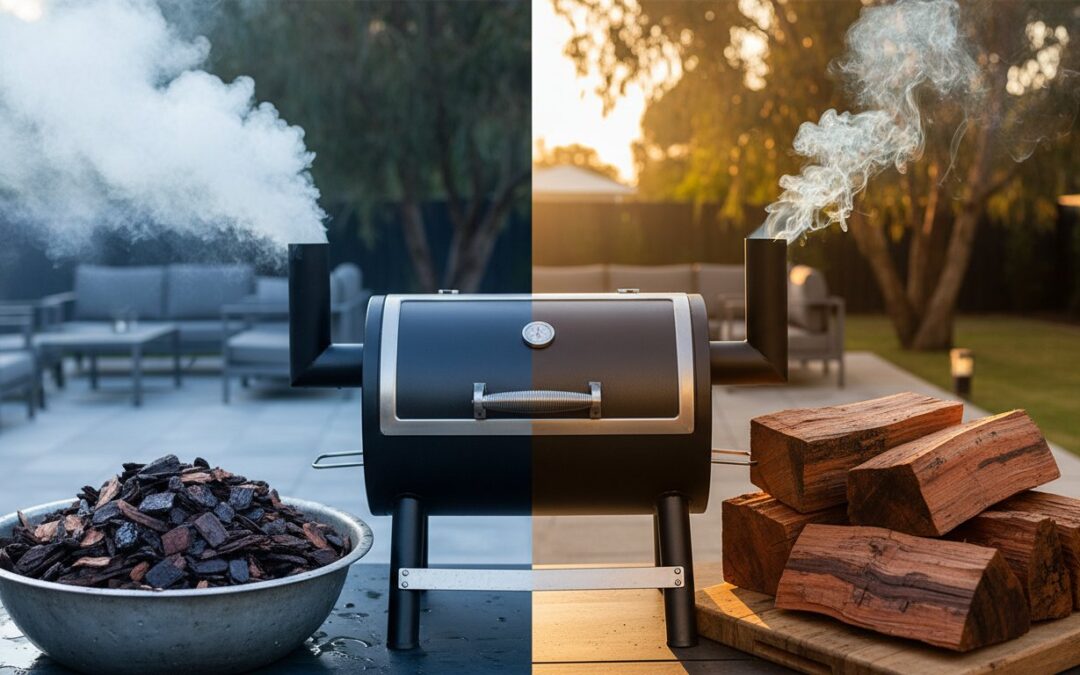
Soaking your wood chips before a cook doesn’t create better smoke; it just turns your high-end smoker into a glorified humidifier. You’ve likely been told for years that a long soak prevents wood from burning too fast and adds moisture to the meat, but the reality is quite different. The soaking wood chips myth is one of the most persistent errors in backyard BBQ. It’s often the hidden reason you’re struggling with bitter, acrid flavours and frustratingly inconsistent temperatures.
We’re here to dismantle this practice with hard science to show you how dry wood actually produces the clean, blue smoke necessary for professional results. You’ll discover why moisture is the enemy of combustion and how to use high-density Australian hardwoods like Ironbark, which has a density of 1,200kg/m3, to achieve a consistent burn. We’ll explain the professional way to manage your fire so you can stop waiting for steam to clear and start producing real, competition-grade BBQ every time you light the pit.
Key Takeaways
- Understand why the soaking wood chips myth is debunked by the hydrophobic nature of wood, which prevents significant internal moisture absorption even after 24 hours.
- Differentiate between useless steam and high-quality blue smoke to avoid the 100°C temperature plateau that stalls your smoker and ruins meat flavour.
- Implement professional burn-control strategies like the foil pouch method and strategic chip placement to regulate smoke release without using water.
- Leverage the superior density of Australian hardwoods like Ironbark and Red Gum to ensure a long, clean burn that lighter, generic woods cannot match.
- Ensure consistent, professional-grade results by using pure, additive-free smoking woods that are properly seasoned for immediate, high-performance use.
The Science Behind the Soaking Wood Chips Myth
Wood is not a sponge. It is a complex biological structure designed to transport water through specific channels while remaining structurally sound and water-resistant. The soaking wood chips myth relies on the flawed assumption that wood absorbs water like a paper towel. In reality, seasoned hardwood is naturally hydrophobic. If timber absorbed water as easily as many backyard cooks believe, the Australian maritime industry would have collapsed centuries ago. Wooden hulls would simply saturate, lose their buoyancy, and sink during the first week at sea.
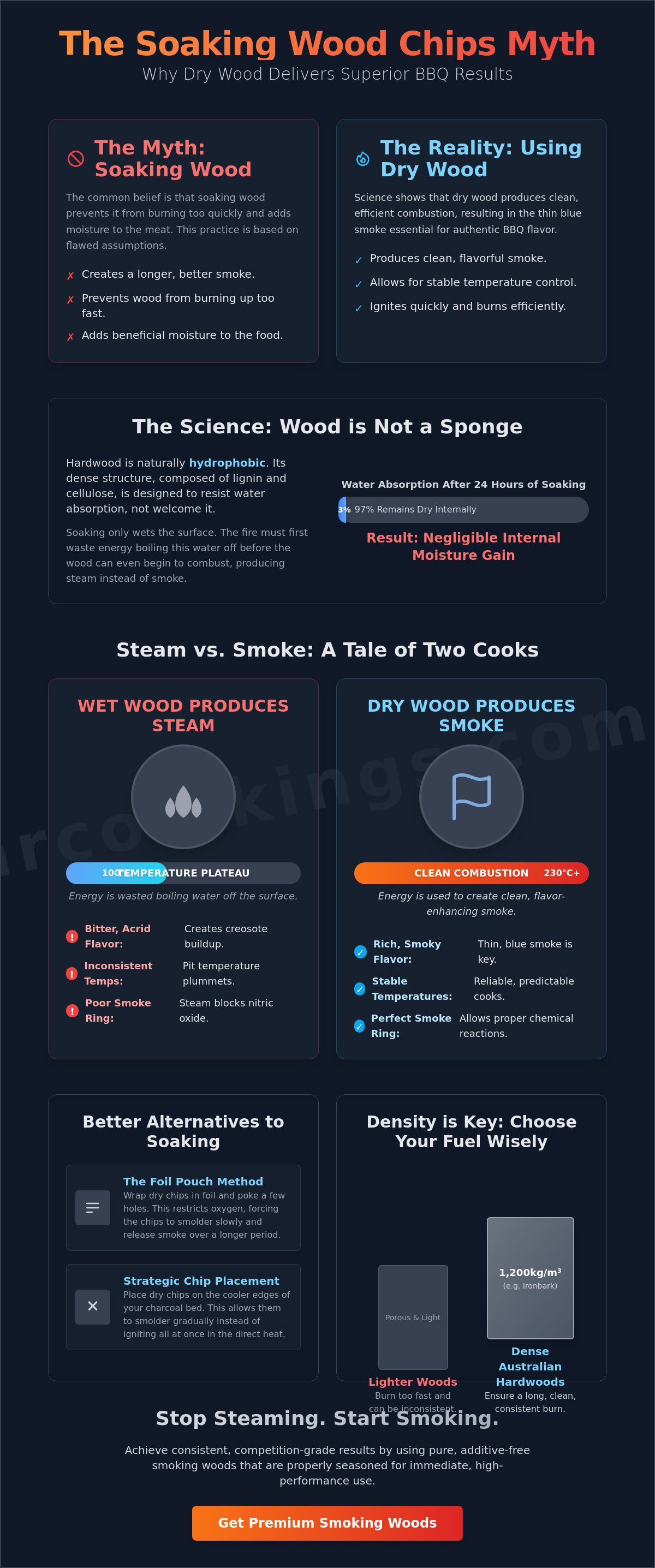
Scientific weight tests consistently dismantle the idea of deep saturation. When you submerge seasoned hardwood chips in water for 24 hours, the internal moisture gain is negligible. Data shows that water typically only penetrates the outer millimetre of the wood, resulting in a weight increase of roughly 1% to 3%. To master The science of smoking food, you must accept that you aren’t “moistening” the fuel. You are merely making the surface wet, which creates problems rather than solving them.
To better understand why this practice fails the science test, watch this helpful video:
Why Water and Wood Don’t Mix
Hardwood is composed of lignin and cellulose, which serve as natural barriers to moisture. Lignin provides the structural rigidity and water resistance that allows trees to survive in the wild. Surface tension also prevents water from entering the microscopic pores of the wood without extreme pressure. In the context of seasoned BBQ wood chips, hygroscopy refers to the wood’s natural ability to slowly absorb or release water vapour from the atmosphere to reach an equilibrium with its environment. This is a slow, molecular process that cannot be bypassed by a quick dunk in a bucket.
Debunking the ‘Longer Burn’ Theory
Many pitmasters believe soaking wood chips leads to a longer burn, but they’re actually observing a delayed ignition. Your fire must boil off every drop of surface water before the wood can reach its combustion temperature of approximately 230°C. This process is an energy thief. Instead of rendering fat or developing a crusty bark, your fire spends its energy evaporating water. This causes your pit temperature to plummet and ruins your cooking timeline. Wet wood smothers the fire and produces thick, white steam that carries a bitter, acrid flavour. This is the opposite of the clean, blue smoke required for professional-grade BBQ results.
Steam vs. Smoke: What Actually Happens in Your Smoker?
That thick, billowing white cloud rising from your smoker isn’t the flavour-packed smoke you’re after. It’s steam. When you fall for the soaking wood chips myth, you aren’t preparing your wood for a better burn; you’re just adding a layer of surface water that must be boiled away. Physics dictates that water boils at 100°C. Until every drop of that moisture has evaporated, the wood cannot exceed this temperature. Combustion doesn’t even begin until the wood reaches approximately 230°C. This creates a massive thermal lag that stalls your cook. Relying on the soaking wood chips myth is a sure-fire way to create temperature instability.
While the water is boiling off, your smoker is filled with ‘dirty’ smoke. This heavy, white plume is a mixture of water vapour and soot. It’s the primary cause of bitter, acrid meat. This residue is called creosote. It sticks to the cold surface of the meat, creating a chemical aftertaste that ruins the natural flavour of the protein. Achieving ‘thin blue smoke’ requires clean, hot combustion that only dry wood provides. This is why an AmazingRibs.com experiment on soaking wood proved that wet wood is a hindrance to quality BBQ. Steam also acts as a barrier, preventing the formation of a deep smoke ring by interfering with the interaction between nitric oxide and myoglobin.
The Chemistry of Combustion
Wood combustion occurs in four distinct stages: dehydration, gasification, oxidation, and charcoal burn. Soaking your wood forces the process to stall in the dehydration phase. Dry wood skips this delay. It allows for the immediate release of Volatile Organic Compounds (VOCs), which provide the sweet, smoky aroma. If you want high-performance results, using properly seasoned smoking woods ensures your fire stays in the productive gasification stage.
Temperature Fluctuations and Control
Adding wet wood to your charcoal bed is like throwing a wet blanket on a fire. The energy required to turn water into steam is immense. This leads to sharp temperature drops in your pit, forcing you to constantly fiddle with vents. Dry wood offers a predictable heat spike. It allows you to maintain a steady environment for long-form cooks. You get a controlled smoulder without the unpredictable humidity of steam, leading to a superior bark and consistent internal temperatures.
Controlling Burn Rate: Better Alternatives to Soaking
Many hobbyists cling to the soaking wood chips myth because they fear dry wood will flash over and disappear in minutes. This fear is misplaced. If your wood is burning too fast, the problem isn’t the moisture content; it’s your oxygen management. By using mechanical methods to restrict airflow to the wood, you can achieve a sustained, clean smoulder that lasts for hours without the bitter steam produced by wet timber. Professional pitmasters don’t reach for a bucket of water; they reach for better fire-building techniques.
The most effective way to throttle combustion for dry chips is the foil pouch technique. Instead of dunking wood in water, wrap a handful of dry chips in heavy-duty aluminium foil. Poke two or three small holes in the top. This creates a low-oxygen environment where the wood can gasify and release flavourful compounds without igniting. It acts as a time-release capsule for smoke. One pouch can provide consistent smoke for 30 to 45 minutes. For long-duration cooks, simply prepare multiple pouches and rotate them. This method beats the soaking wood chips myth every time by providing predictable results without the thermal cost of evaporation.
Strategic placement within your fuel bed is another professional alternative. Burying dry chips deep within your charcoal allows them to ignite only when the fire reaches them. This is essentially the Minion Method applied to smoking wood. It creates a slow-burn fuse of flavour that moves through your smoker at a predictable pace. You can control the timing of your smoke by how deep you bury the chips, ensuring the meat receives smoke during the critical first few hours of the cook.
Mixing Chips with Lump Charcoal
Consistency starts with your base fuel. Distributing dry wood chips throughout your hardwood lump charcoal ensures a steady stream of smoke as the fire spreads. For long-duration cooks like a 12-hour brisket, use a layering strategy. Place a layer of charcoal, then a handful of chips, and repeat. High-quality charcoal provides the stable, clean-burning foundation needed for dry wood to perform at its peak. This method eliminates the need for constant intervention and ensures you don’t run out of smoke halfway through the stall.
Airflow Mastery
Master your vents to control combustion speed. Your smoker’s intake and exhaust are your primary tools for heat management. Closing the intake slightly starves the fire of oxygen, slowing down the burn rate of both your charcoal and your wood chips. This is a far more precise method than using water to dampen the fire. Using vents allows you to maintain the high internal wood temperatures required for clean smoke while preventing the wood from vanishing too quickly. It requires practice, but it’s the only way to achieve professional-grade results.
Australian Hardwoods and Density: Why Local Wood Chips Differ
Australian hardwoods are fundamentally different from the softwoods and lighter hardwoods found in the Northern Hemisphere. While many American BBQ guides discuss Oak or Hickory, Australian pitmasters work with timber of significantly higher density. Ironbark, for example, boasts a staggering density of 1,200kg/m3. This structural integrity makes the soaking wood chips myth even more redundant in an Australian context. Water cannot easily penetrate the tight, interlocking grain of a species like Ironbark or Grey Box. While a porous US softwood might absorb a tiny amount of surface moisture, Australian hardwoods act like solid rock.
Sourcing seasoned wood is the only priority for a serious cook. Seasoned wood has been dried to a precise moisture level, typically around 15%, to ensure it ignites quickly and burns clean. If you attempt to soak these chips, you are fighting against the wood’s natural properties. High-quality Aussie woods are prized for their purity and lack of additives. You want the natural oils and resins to combust at high temperatures to release their unique flavour profiles. From the subtle sweetness of Cherrywood to the heavy, earthy punch of Ironbark, these flavours are only unlocked through dry, efficient combustion.
Red Gum and Ironbark Dynamics
Local species like River Red Gum contain natural sugars that are often 2% to 3% higher than other Eucalyptus varieties. This sugar content aids in bark caramelization, but only if the wood burns hot enough to gasify those compounds. Adding water creates a smouldering, low-temperature fire that turns these sugars into bitter soot. Dense Australian timber requires zero pre-treatment because its tight grain structure effectively locks out liquid moisture while preserving the internal volatile compounds needed for flavour.
Local Climate Considerations
The Australian environment plays a major role in how your fuel performs. In regions with Adelaide’s dry heat, wood chips can lose moisture rapidly if not stored correctly. It is vital to keep your smoking wood in a dry, ventilated area to prevent it from becoming ‘dead’ or overly brittle, but you should never compensate by soaking it. Mastering the art of barbecuing with charcoal starts with understanding that your fuel must be kept bone-dry to maintain the high-performance standards required for professional BBQ. Consistent results depend on stable, predictable fuel sources that haven’t been compromised by moisture.
Stop wasting time with buckets of water and start using professional-grade fuel designed for the Australian climate. Explore our range of premium, seasoned smoking woods and experience the difference that dry, high-density timber makes to your next cook.
Choosing the Right Fuel: Charcoal Kings’ Guide to Premium Smoking
Quality BBQ is built on the foundation of clean combustion. At Charcoal Kings, we provide only 100% pure Australian hardwood with zero chemicals or additives. When you understand the science, the soaking wood chips myth becomes a clear barrier to the ‘Low and Slow’ lifestyle you’re chasing. Professionals don’t look for shortcuts; they look for high-performance fuel that behaves predictably every time the lid is closed. Our commitment to purity ensures that your meat is flavoured by the wood itself, not by synthetic binders or the acrid steam of wet timber.
The final verdict is simple. Ditch the bucket. Trust in the natural power of dry Australian timber to deliver the authentic BBQ flavour your guests crave. By moving past the soaking wood chips myth, you’re taking the first step toward professional-grade results. Consistent heat and clean smoke are the only ways to guarantee a perfect bark and a deep, natural smoke profile on every cut of meat you cook.
Chips vs. Chunks: When to Use Which
Wood chips are excellent for short-duration cooks like steaks or burgers where you need a quick burst of flavour. For the long haul, wood chunks are the superior choice. Because chunks have a much larger mass and a lower surface-area-to-volume ratio, the idea of soaking them is even more illogical than soaking chips. It would take weeks, not hours, for water to reach the core of a dense hardwood chunk. You’d spend the first half of your cook fighting steam instead of building a flavour profile. Pair our dry chunks with premium lump charcoal to create a custom flavour profile that lasts through an entire 12-hour cook.
The Professional’s Setup
Whether you’re a competition pro in Holden Hill or a weekend enthusiast, your results depend on your equipment and your fuel. The best pitmasters never reach for the hose because they know that moisture is the enemy of the thin blue smoke. You need a reliable smoker and premium smoking woods that have been properly seasoned to the optimal 15% moisture level. This ensures that when the wood hits the charcoal, it begins gasifying immediately. This setup provides the stability required for consistent internal temperatures and a predictable cooking timeline.
Upgrade your smoke game with Charcoal Kings’ premium smoking woods and leave the myths behind. Focus on the craft, master the fire, and let the quality of the wood do the heavy lifting for your next BBQ masterpiece.
Master Your Fire with Clean Combustion
Transitioning from a backyard hobbyist to a seasoned pitmaster requires a shift from folklore to physics. The soaking wood chips myth has persisted for decades, but the results don’t lie. Dry, seasoned wood provides the immediate gasification needed for thin blue smoke and a perfect bark. By managing your airflow through vents rather than water, you maintain a stable pit temperature and avoid the acrid creosote that ruins a long cook. High-density Australian timber is built for heat, not hydration.
High-performance BBQ relies on the purity of your fuel. Charcoal Kings is an Australian-owned and operated specialist in chemical-free hardwood that delivers consistent, professional results. Trusted by Adelaide’s top pitmasters, our range is designed to burn hot and clean every time you light the smoker. We focus on the quality of the timber so you can focus on the craft of the cook. It’s time to stop fighting steam and start producing the world-class flavour your effort deserves.
Stop steaming your meat; buy premium dry smoking woods here and elevate your next cook. Grab your gear and get the fire started.
Frequently Asked Questions
Does soaking wood chips prevent them from catching fire?
Soaking wood chips only delays ignition; it doesn’t prevent them from eventually catching fire. Your smoker must first boil off all surface moisture at 100°C before the wood can reach its combustion point. Once the water evaporates, the wood ignites just as quickly as dry chips. This delay creates unnecessary temperature instability and forces your smoker to work harder to maintain consistent heat throughout the cook.
How long should I soak wood chips if I still want to try it?
You shouldn’t soak them at all if you want professional results. If you choose to follow the soaking wood chips myth, most anecdotal guides suggest 30 to 60 minutes. However, scientific weight tests prove that even 24 hours of submersion results in negligible internal moisture gain. You are better off spending that time focusing on fire management and airflow control to achieve a cleaner burn.
Why does my smoker produce thick white smoke when I use wet chips?
The thick white cloud is a combination of water vapour and incomplete combustion byproducts. Clean smoke is thin and blue; it only occurs when wood burns at high temperatures. Wet chips lower the temperature of your fire bed, leading to a smouldering mess. This dirty smoke deposits bitter creosote on your meat, which ruins the flavour profile and leaves an unpleasant, acrid aftertaste on the palate.
Can I soak wood chips in juice or wine for extra flavour?
Soaking wood in juice or wine does not transfer those flavours to the meat. The flavour compounds in these liquids are destroyed by heat long before they can reach the food. Any aroma you perceive is simply the liquid burning off as steam. To add fruit or wine notes, use specific fruitwoods like Cherry or Apple and rely on high-quality rubs and sauces applied directly to the protein.
Is there any exception where soaking wood is actually beneficial?
There are no practical benefits to soaking wood for real smoking purposes. Some users place wet chips on high-heat grills to create a temporary burst of steam, but this is not authentic smoking. For real BBQ, dry wood is the only way to ensure the consistent, high-temperature combustion required for professional results. Stick to seasoned hardwoods to maintain the integrity of your fire and the quality of your bark.
How do I stop my dry wood chips from burning too fast?
Control the burn rate of dry wood chips by using a foil pouch or a smoker box to limit oxygen exposure. By wrapping chips in heavy-duty foil and poking only a few small holes, you create a time-release effect for the smoke. This allows the wood to gasify slowly without catching fire immediately. It provides a steady stream of flavour without the temperature-killing effects of added moisture.
What happens if I put wet wood chips directly onto hot charcoal?
Placing wet chips directly onto hot charcoal causes an immediate and sharp drop in pit temperature. The charcoal’s energy is diverted away from cooking the meat to boil off the water on the wood surface. This often leads to a stall in your smoker’s performance. You will likely find yourself constantly adjusting vents to compensate for the cooling effect, leading to an inconsistent and frustrating cooking experience.
Does the type of wood change the soaking rule?
The rule remains the same for all wood types: keep them dry for the best results. However, dense Australian hardwoods like Ironbark are even more resistant to water than softwoods. Their tight cellular structure and natural oils act as a barrier to liquid. While softwoods might absorb a tiny amount more surface moisture, neither type benefits from soaking. Always choose seasoned, chemical-free hardwoods for the cleanest possible flavour.