
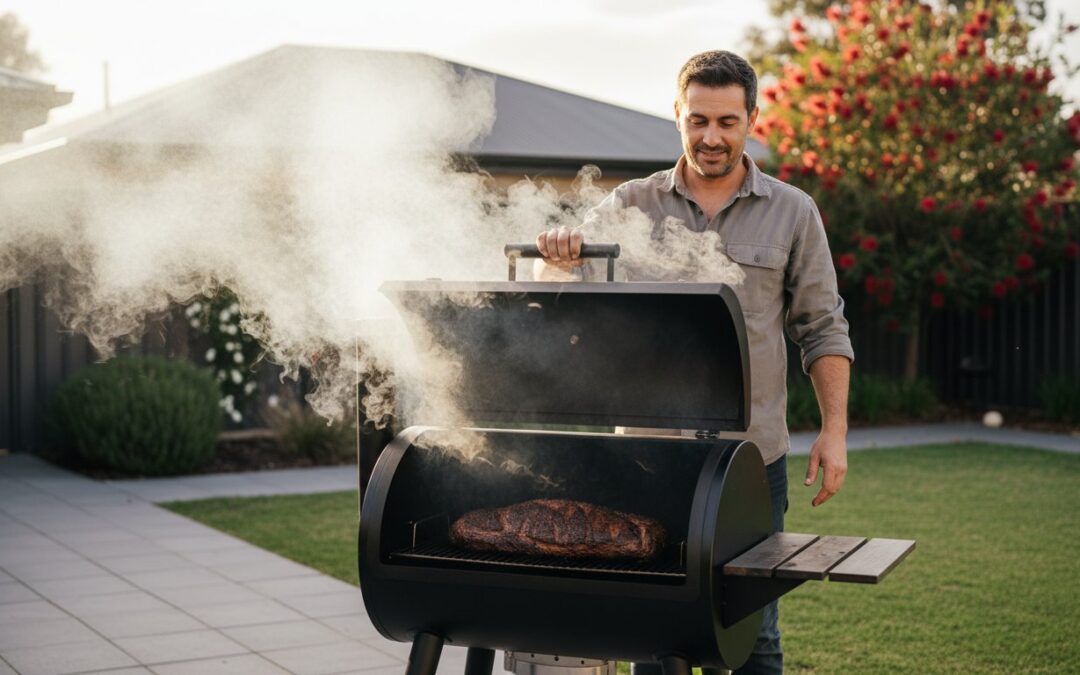
Waking up at 3:00 AM to check a fluctuating temperature dial isn’t a badge of honor; it’s a sign your equipment is failing you. Most pitmasters have sacrificed hours of sleep only to find their fire went out or spiked to 350°F, ruining a premium cut of meat in the process. You need a smoker that holds temperature overnight without babysitting so you can focus on the results rather than the struggle. Achieving competition-quality bark requires a machine with the thermal mass and airtight seals to stay locked at 225°F while you’re in bed.
We agree that the frustration of heat leaks and flame-outs shouldn’t be part of your weekend. This article identifies the top-rated units that actually deliver on the promise of rock-solid stability, allowing you to host large groups with total confidence. We’ll examine high-performance options for May 2026, including the $499.99 Oklahoma Joe’s Bronco and the $1,999.99 Traeger Ironwood XL, to find your perfect match for a 12 hour uninterrupted burn. For additional inspiration, you can discover Tools & Grill and their high-quality BBQ selection. Get Sizzlin’!
Key Takeaways
- Learn why airtight seals and heavy insulation are more important for thermal stability than digital gadgets alone.
- Identify the essential components of a smoker that holds temperature overnight without babysitting, specifically PID controllers and high-capacity gravity chutes.
- Compare the “set and forget” convenience of pellet grills against the authentic wood-fire results of automated charcoal systems.
- Master the Minion Method and water pan placement to create a self-regulating heat source for 12+ hour burns.
- Understand how premium, low-ash hardwood fuel prevents firebox clogs that lead to middle-of-the-night flame-outs.
Why Most Smokers Require Babysitting (and How to Stop)
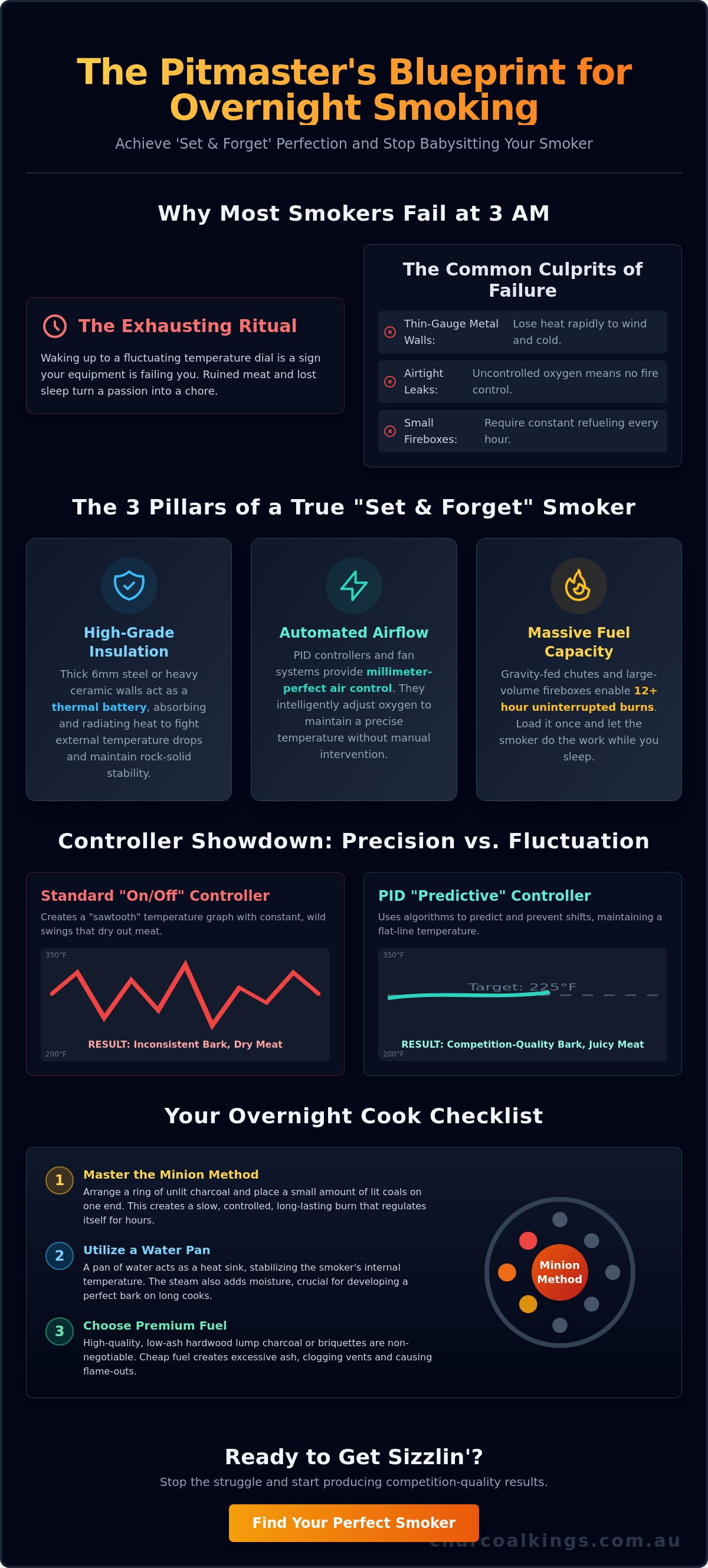
Most backyard pitmasters start their journey with an entry-level offset or a thin-walled vertical unit. These smokers often fail during long cooks because they lack the structural integrity to fight external variables. When the sun goes down and ambient temperatures drop by 20 degrees, a thin-gauge metal smoker loses heat faster than the fire can generate it. This creates the dreaded “3 AM charcoal check” cycle. It’s an exhausting ritual that turns a hobby into a chore. To achieve a professional result, you need a smoker that holds temperature overnight without babysitting.
The fundamental challenge in the process of smoking food is maintaining a stable environment despite wind, rain, or cold air. If your smoker leaks air through the lid or door, you lose control over the oxygen supply. Without total air control, you have no fire control. Cheap units with small fireboxes compound this issue by requiring fuel every 45 to 60 minutes. This constant feeding prevents you from ever reaching a “set and forget” state, leaving you tethered to the patio while the rest of the house sleeps.
To see how a properly managed fire can run for nearly half a day without intervention, watch this demonstration:
The Physics of Thermal Mass
Think of your smoker’s walls as a heat battery. Thick 6mm steel or heavy ceramic layers absorb thermal energy and radiate it back into the cooking chamber. This thermal mass acts as a critical buffer. While a thin-gauge supermarket unit reacts violently to every gust of wind, a heavy-duty smoker maintains its momentum. This stability is why competition-grade units stay locked at 225°F for hours. High-quality construction minimizes the need for constant oxygen adjustments because the internal environment is insulated from the outside world.
Airtight Integrity and Vent Control
Automation is impossible if your unit isn’t airtight. Entry-level smokers often leak smoke from every seam; these leaks are actually uncontrolled air intakes. High-temperature gaskets and precision-cut dampers are non-negotiable features for overnight success. They allow you to choke the fire down to a simmer or ramp it up with millimetre-perfect accuracy. Identifying and sealing common leak points is the first step toward confidence in your equipment. When the only air entering the firebox comes through a controlled vent, you can finally trust your smoker while you sleep. Get Sizzlin’!
The 3 Pillars of an Overnight “Set and Forget” Smoker
Achieving a true “set and forget” experience requires more than just a digital thermometer. A smoker that holds temperature overnight without babysitting relies on a trifecta of engineering: automated airflow, massive fuel capacity, and high-grade insulation. If any of these pillars fail, your fire will either choke or spike, forcing you out of bed to save your meat. Performance-focused pitmasters look for equipment that manages these variables through hardware rather than constant manual intervention.
Reliable temperature control also serves a critical safety function. Maintaining safe smoking temperatures between 225°F and 300°F prevents meat from sitting in the bacterial “danger zone.” Modern smokers achieve this by using fan-forced oxygen systems and gravity-fed fuel hoppers that provide a consistent energy source for 12 hours or more. Before you commit to a long cook, ensure you have a quality BBQ that can handle the endurance test of an overnight smoke.
Digital Controllers (PID vs. Standard)
Standard digital controllers operate on a simple “on/off” cycle. They wait for the temperature to drop before kicking in the fan or auger. This creates a “sawtooth” temperature graph with constant fluctuations. PID (Proportional-Integral-Derivative) controllers are superior because they use mathematical algorithms to predict temperature shifts. They adjust fan speeds in small increments to maintain a flat line. This precision is essential for a smoker that holds temperature overnight without babysitting, as it eliminates the wild swings that dry out brisket flat.
Insulation for the Australian Climate
Australian pitmasters face unique environmental hurdles. A 40°C South Australian afternoon or a humid Queensland evening can wreak havoc on thin-walled smokers. Double-walled insulation acts as a thermal barrier, keeping the internal heat in and the external climate out. This design significantly reduces fuel consumption. An insulated cabinet smoker might use 50% less charcoal than a thin offset smoker on a windy night. Ceramic kamados offer similar benefits; their thick shells retain moisture and heat, making them ideal for high-humidity environments where maintaining a steady burn is traditionally difficult. For the best results, pair your insulated unit with premium hardwood lump or briquettes to ensure a clean, long-lasting fire. Get Sizzlin’!
Comparing the Best Smoker Types for Overnight Stability
Choosing a smoker that holds temperature overnight without babysitting requires a choice between convenience and flavor depth. While several designs claim “set and forget” status, the mechanical execution varies significantly. For most home cooks, the decision narrows down to pellet grills, gravity-fed charcoal units, insulated cabinets, or ceramic kamados. Each system manages fuel and oxygen differently to achieve a 10 to 12 hour burn without manual intervention. Success depends on how well the machine handles the transition from a full fuel load to the final embers.
Technology has narrowed the gap between these systems, but the physics of the fuel remains a factor. Pellet grills use a motorized auger to feed compressed sawdust pellets into a burn pot. According to industry data from May 2026, a 40 pound bag of wood pellets provides up to 24 hours of continuous heat and costs between $6 and $10. Conversely, gravity-fed smokers use a vertical chute to hold charcoal that naturally drops as it consumes. These units are verified to run for 12 hours without a refill. While pellets offer digital precision, the charcoal system delivers a deeper bark and a more traditional flavor profile.
Pellet vs. Gravity-Fed: The Great Debate
Pellet grills are the leaders in convenience, but they rely on complex moving parts like augers and induction fans. Gravity-fed units are often more reliable long term because they have fewer mechanical failure points. In the Australian climate, where high humidity can cause pellets to swell and jam augers, many pitmasters are moving toward gravity systems. Charcoal briquettes cost approximately $0.62 per pound, making the hourly run cost comparable to pellets while providing the high heat necessary for a clean, blue smoke. For a smoker that holds temperature overnight without babysitting, the simplicity of a gravity chute often wins over the complexity of an auger.
The Insulated Cabinet Advantage
Professional competition teams often choose vertical insulated cabinets for their unmatched fuel efficiency. These units are built with thick insulation sandwiched between steel walls, creating a massive heat battery. The vertical design allows for a large water pan at the base. This water pan acts as a thermal regulator; it absorbs excess energy and releases moisture, preventing the temperature spikes that ruin expensive brisket. A standard insulated cabinet can easily maintain 225°F for 12 hours on a single load of fuel. This capacity allows you to smoke for a crowd without ever opening the door and losing your precious heat. Get Sizzlin’!
Setting Up Your Smoker for a Successful Overnight Cook
Setting up a smoker that holds temperature overnight without babysitting requires a strategic approach to fuel management. Even the best insulated cabinet or gravity-fed unit needs a correctly configured firebed to maintain a steady 225°F for 12 hours. The goal is to create a controlled burn that moves through your fuel source at a predictable rate. This prevents the fire from getting too large too quickly, which leads to temperature spikes and bitter, creosote-heavy smoke. A properly staged fire ensures that the transition between unlit and lit fuel is seamless and clean.
Mastering the Minion Method
The Minion Method is the industry standard for long-duration cooks. To execute this, fill your firebox with high-density hardwood lump or premium briquettes. Create a small well in the center of the unlit fuel. Add only 15 to 20 fully lit coals to this central well. These hot coals will slowly ignite the surrounding fuel over several hours, acting like a slow-burning fuse. When barbecuing with charcoal, using high-density lump is essential because it produces significantly less ash. Excess ash can choke the fire’s oxygen supply at 4:00 AM, causing the temperature to crash. This setup avoids the “dirty smoke” phase by ensuring only a small amount of fuel is burning at any given time.
Water Pan Management and Meat Prep
Utilizing a water pan provides a critical thermal buffer. Water acts as a heat sink that prevents the cooking chamber from exceeding 212°F easily. This moisture also helps the smoke adhere to the meat. Place your meat in the smoker while it is still cold from the fridge. Cold meat surfaces attract more smoke particles, helping you establish a deep smoke ring before the bark sets. Safety is paramount for unattended cooks. Always position your smoker at least 3 meters away from any structures or overhanging trees. Ensure your drip tray is empty to prevent grease fires during the night.
Remote Monitoring and Alarms
Technology acts as your safety net while you sleep. Use a dual-probe thermometer to monitor both the ambient pit temperature and the internal meat temperature. Set high and low alerts on your smartphone. A low-temp alert at 200°F warns you if the fire is dying, while a high-temp alert at 250°F signals a potential flare-up. If your fire dies at 4:00 AM, do not panic. Simply add a small amount of pre-lit charcoal to restart the fuse. For the best results, always stock up on premium BBQ fuel and accessories before starting a long cook. Get Sizzlin’!
The Secret Ingredient: Why High-Quality Fuel is Non-Negotiable
You have selected a high-performance smoker and mastered the Minion Method. However, even a smoker that holds temperature overnight without babysitting will fail if you use low-quality fuel. The charcoal provides the energy. If that energy source is inconsistent, your temperature graph will look like a rollercoaster. Premium fuel is the final piece of the stability puzzle. Fuel is the engine. Inferior fuel is the most common cause of middle-of-the-night failures.
Ash content is the primary reason fires die at 3:00 AM. Discount charcoal often contains fillers like sawdust, coal dust, or starch. These additives create a massive volume of ash that settles over your air intake. This layer of debris chokes the oxygen supply and forces the temperature to crash. Premium hardwood lump is different. It is 100% carbonized wood with minimal impurities. This density allows it to burn up to 3 times longer than standard supermarket brands while producing a fraction of the ash. Clean fuel ensures your vents stay clear and your airflow remains predictable.
Hardwood Lump vs. Premium Briquettes
Consistency is king for overnight cooks. High-density briquettes offer a uniform shape that prevents “bridging” in gravity-fed hoppers. Bridging occurs when odd-shaped pieces of charcoal wedge together and stop the fuel from falling into the burn zone. For shorter overnight sessions, natural hardwood lump provides a high-heat advantage and a cleaner flavor profile. Charcoal Kings Hardwood Lump is the preferred choice for South Australian pitmasters because it contains no chemicals or artificial binders. It burns steady and hot. You get a pure wood smoke flavor without the chemical aftertaste associated with quick-light products.
Fuel Storage and Moisture Control
Moisture is the enemy of thermal stability. Damp fuel requires energy to evaporate water before it can burn; this causes internal temperatures to fluctuate wildly. Keep your firewood and charcoal in a bone-dry, airtight container. High humidity in coastal regions can degrade fuel quality in just a few days. This degradation makes it impossible for your smoker to maintain a flat-line temperature. Protecting your fuel ensures your equipment performs as intended. A professional-grade smoker deserves professional-grade fuel. Get Sizzlin’!
Lock in Competition-Quality Results Every Time
Achieving a perfect bark and tender internal texture requires equipment that works as hard as you do. You have learned that thermal mass and airtight integrity are the foundation of stability. Without these, even the best digital controllers struggle against external variables. Choosing a smoker that holds temperature overnight without babysitting is the difference between a ruined brisket and a competition-quality feast. Success depends on the trifecta of heavy-duty construction, automated airflow, and high-density fuel that provides a 12 hour consistent burn.
Don’t let low-quality charcoal or thin-walled grills compromise your hard work. We provide Australia-wide shipping on premium hardwood charcoal and expert-vetted smokers designed for the serious pitmaster. Our fuel is chemical-free and 100% natural, ensuring your meat tastes exactly like the wood you use. Upgrade your rig and fuel with Charcoal Kings today! You have the knowledge to conquer long cooks with confidence. It’s time to let your equipment handle the night shift while you get the rest you deserve. Get Sizzlin’!
Frequently Asked Questions
Is it safe to leave a smoker running overnight while I sleep?
It is safe to run a smoker overnight if you follow basic fire safety protocols. Position the unit at least 3 meters away from any structures or flammable debris. Modern smokers equipped with digital controllers and remote alarms provide a safety net by notifying you of temperature spikes. Always ensure your drip tray is empty to prevent grease fires while you are away from the unit.
Which smoker type is the most fuel-efficient for 12-hour cooks?
Insulated cabinet smokers and ceramic kamados are the leaders in fuel efficiency. Their thick, double-walled construction retains heat far better than traditional offset smokers. These units act as thermal batteries, requiring up to 50% less fuel to maintain a steady temperature. This efficiency allows a single load of high-density charcoal to last for the entire 12-hour duration without a refill.
Can I use a temperature controller on a standard offset smoker?
You can install a digital controller on an offset smoker, but its effectiveness depends on the unit’s build quality. Controllers manage a fan that regulates oxygen flow to the fire. However, if the smoker is made of thin metal or has significant air leaks, the fan will struggle to compensate for heat loss. A dedicated smoker that holds temperature overnight without babysitting is a more reliable long-term solution.
How much charcoal do I need for a 10-hour overnight smoke?
A 10-hour cook typically requires between 5 and 8 kilograms of premium hardwood charcoal in an insulated unit. Gravity-fed smokers often have larger hoppers that hold up to 10 kilograms, providing a significant safety margin. Using high-density fuel is critical. Lower-quality brands burn faster and produce more ash, which can clog your firebox and cause the temperature to drop before the cook is finished.
Will a pellet grill work in the rain during an overnight cook?
Pellet grills can operate in light rain, but you must keep the fuel hopper completely dry. If moisture reaches the wood pellets, they will swell and jam the internal auger system. This mechanical failure will extinguish the fire. Use a dedicated weather shield or a smoker gazebo to protect the electronics and fuel supply if the forecast predicts rain during your overnight session.
What is the best temperature for an overnight brisket smoke?
The ideal temperature for an overnight brisket is 225°F (107°C). This low-and-slow approach allows the collagen in the meat to render properly over 10 to 12 hours. Maintaining this specific heat level is easiest with a smoker that holds temperature overnight without babysitting. It prevents the wild temperature swings that can lead to a dry, overcooked product or a stalled cook that never finishes.
Does a gravity-fed smoker produce better flavour than a pellet grill?
Gravity-fed smokers generally produce a more traditional, intense BBQ flavour. They burn natural hardwood charcoal and actual wood chunks, which creates a thicker smoke profile and a more defined bark. Pellet grills are highly convenient but use compressed sawdust pellets. This results in a milder smoke flavour that some enthusiasts find less authentic than the results from a real charcoal fire.
What happens if my smoker runs out of fuel in the middle of the night?
If your fuel runs out, the temperature will drop and trigger the low-temp alarm on your remote thermometer. The meat will stop cooking and begin to cool down. You can safely restart the fire if the meat has not spent more than 2 hours in the bacterial danger zone. Simply add pre-lit charcoal to the firebox to bring the pit back to 225°F and continue the cook.