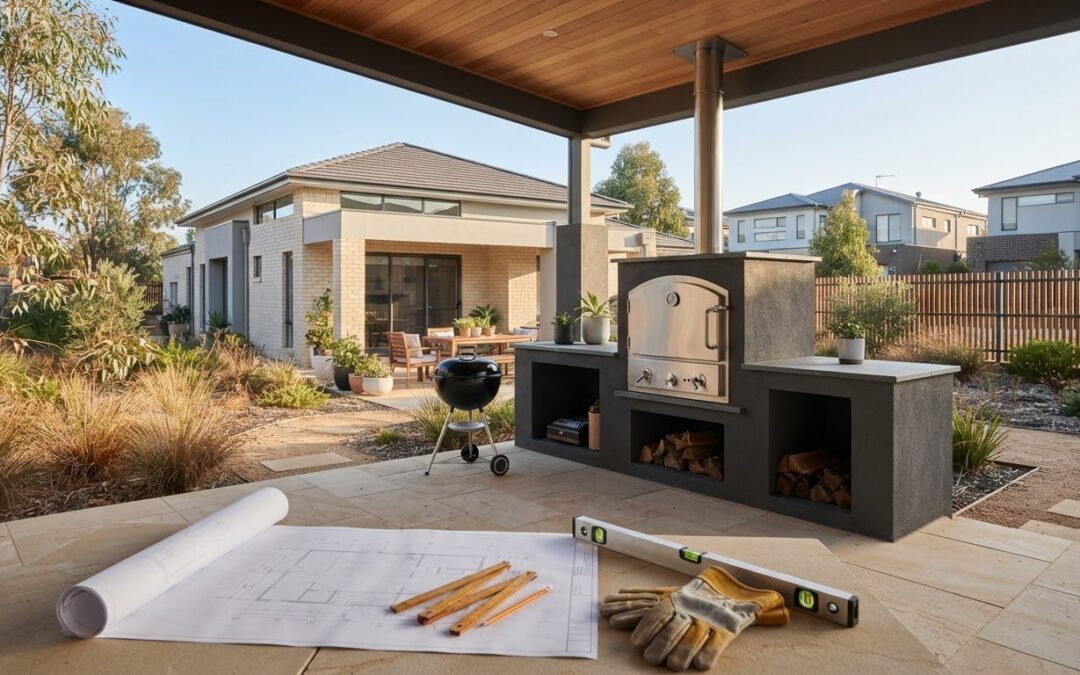
A backyard smoker may be simple to use, but making it permanent can change the approval picture. Whether you need council approval for a permanent backyard smoker nsw depends in part on what you’re building around it, not just the smoker itself. A movable BBQ and a fixed, roofed structure aren’t necessarily treated alike.
It’s sensible to want a clear answer before spending money or choosing a site. NSW doesn’t require council approval just to use a backyard barbecue, but constructing a permanent structure may bring planning and building checks into play. Local controls, smoke impacts and fire restrictions are separate considerations, and overlooking any one of them can create avoidable problems.
This 2026 guide explains how to assess the structure and its operation separately. You’ll learn which council and property controls to check, how exempt development rules may apply, and what to consider around bushfire risk, fuel and smoke. Use these checks to plan your setup before choosing a smoker or starting construction.
Key Takeaways
- Whether you need council approval for a permanent backyard smoker nsw depends on the structure, its location and the controls that apply to your property.
- Separate planning and building checks from fire restrictions and smoke nuisance considerations.
- Compare movable BBQs, fixed smokers and smokers built into larger structures to identify the questions your design raises.
- Prepare your address, site plan, dimensions and construction details before seeking guidance from your local council.
- Choose a smoker and fuel only after you’ve checked the site requirements and considered responsible operation.
Does a permanent backyard smoker need council approval in NSW?
Approval depends on the smoker’s construction, location and the planning controls that apply to the property. A movable smoker used as backyard BBQ equipment is different from a fixed installation with masonry, foundations or a shelter. The key question is not simply whether the smoker stays in one place. It’s whether the project creates or changes a structure, and which rules apply to that work.
There isn’t a single statewide yes-or-no answer for every design. Council approval for a permanent backyard smoker nsw can depend on site-specific details, including zoning, heritage controls and bushfire constraints. This guide provides general information, not a planning determination for a particular address. Check the relevant controls before building or making changes to your property.
This video discusses food-business approvals, not residential smoker structures, so use it only as general context for dealing with council requirements.
Planning approval addresses whether and how a structure may be built; it doesn’t replace requirements for construction or rules about fire and smoke. These checks can overlap, but one answer doesn’t settle them all. A barbecue may not need council approval simply to be used, while smoke restrictions still apply and a permanent enclosure may raise a separate planning question. For background on the statutory framework councils operate within, see the Local Government Act 1993 (NSW). It doesn’t determine the approval pathway for a specific smoker, so check the planning controls for the property separately.
What makes a backyard smoker permanent?
A freestanding smoker that can be moved is distinct from a built-in masonry unit, equipment fixed to foundations or a smoker incorporated into an attached structure. Permanence alone, however, doesn’t decide whether approval is needed. Record the smoker’s dimensions, any roof or shelter, chimney, foundations and site works. These details help establish whether the proposal is only equipment or also a building project.
Why does the answer vary between NSW properties?
Similar designs can face different checks because zoning, property constraints and local planning controls vary. A heritage-related control or environmentally sensitive area may affect whether an exempt pathway is available. Bushfire-prone land can bring additional construction standards into consideration. Strata owners should also review applicable by-laws before external work. Confirm which constraints apply to your address rather than assuming every smoker needs approval or qualifies for an exemption.
Start with the complete proposal, not just the smoker’s make or fuel. A chimney, roof, fixed base or changes to the ground can alter what council needs to assess. The following checks explain how to separate planning pathways from construction, fire and smoke considerations before committing to a design.
Which NSW planning and construction rules should you check?
Treat the proposal as several separate checks, not one approval question. Planning, building, fire and smoke rules each address a different issue, and satisfying one check doesn’t automatically satisfy the others. Start with your local council’s planning controls and application procedures, then establish which construction and operational requirements apply to your design.
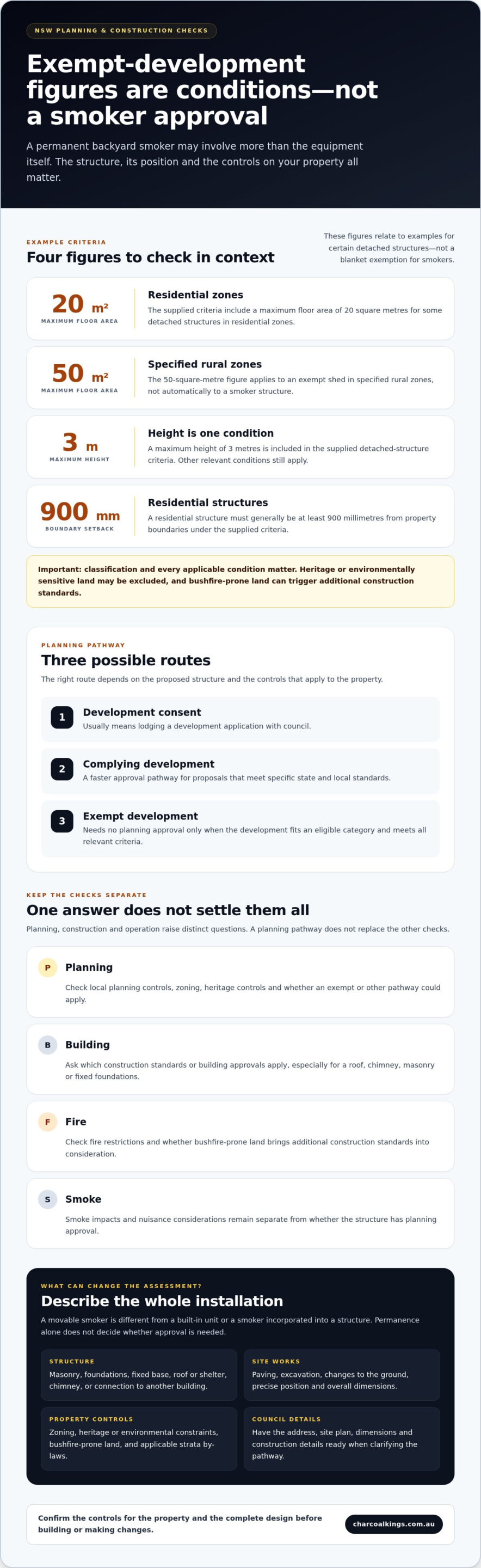
For council approval for a permanent backyard smoker nsw, the planning pathway depends on the proposed structure and the property. A smoker isn’t automatically exempt because it’s small or used for cooking. NSW’s State Environmental Planning Policy (Exempt and Complying Development Codes) 2008 sets criteria for certain types of development, but the structure must fit an eligible category and meet every applicable condition.
Planning pathway: consent, complying development or exemption
Development consent usually means lodging a development application with council. Complying development is a faster approval pathway for proposals that meet specific state and local standards, while exempt development needs no planning approval only when all relevant criteria are met. Check the current NSW Planning Portal guidance and your council’s controls before relying on any pathway.
For example, some detached structures may qualify as exempt development if they meet strict requirements. The supplied NSW criteria include a maximum floor area of 20 square metres in residential zones, or 50 square metres for an exempt shed in specified rural zones, a maximum height of 3 metres, and a position behind the road building line. A residential structure must generally be at least 900 millimetres from property boundaries. Heritage or environmentally sensitive land may be excluded, and bushfire-prone land can trigger additional construction standards. These figures do not create a blanket exemption for smokers. The structure’s classification and every relevant condition matter.
Before asking council to clarify your planning pathway, document the details that could affect classification:
- Overall size, height and precise position on the site
- Any roof, shelter, chimney or connection to another building
- Foundations, paving, excavation and other site works
- Property zoning and any heritage, environmental or bushfire constraints
Building, fire and smoke checks are separate
Planning permission doesn’t confirm that a structure meets building requirements. Ask what construction standards or building approvals apply to the actual design, especially if it includes a roof, chimney, masonry or fixed foundations. Don’t assume an exempt planning pathway removes separate construction obligations.
Check current NSW Rural Fire Service restrictions before using a solid-fuel smoker outdoors. During a Total Fire Ban, solid-fuel barbecues and fire pits are banned; any permitted gas or electric barbecue use is subject to conditions. Fire rules can differ from planning controls. Separately, excessive smoke is prohibited, and councils may act on neighbour complaints. Fuel choice and smoker operation matter even if the structure has an approval or exemption.
Once you’ve established the site requirements, you can consider BBQ grills and smokers that suit the planned location, along with appropriate charcoal or smoking wood for responsible use.
Permanent smoker vs movable BBQ: what changes the approval question?
The key difference is whether the proposal is just equipment or also a structure or site work. A movable BBQ is generally easier to distinguish from a built-in installation, but calling a fixed unit a “BBQ” doesn’t settle its planning status or remove fire and smoke considerations. Look at how it’s attached, what’s built around it and where it will operate.
Use this table to screen the design and identify questions for your council. It’s a practical guide, not a legal classification or an approval decision. The actual pathway depends on the property, the complete design and current local controls.
| Setup | Attachment and foundations | Shelter or chimney | Site and questions to investigate |
|---|---|---|---|
| Movable BBQ or smoker | Freestanding; no fixed foundation or built-in components | No added shelter or built structure; any chimney is part of the equipment | Where will it be used and stored? Check applicable fire restrictions, smoke impacts and safe placement. |
| Fixed smoker | May be anchored, set on permanent footings or built from masonry | Could include a fixed chimney or other attached features | Could the base or installation be treated as building work? What planning and construction checks apply to its location? |
| Smoker in a larger structure | Integrated with a built-in bench, wall, outdoor kitchen or existing building | May sit under a roof or connect to a fixed chimney | Does the larger structure or alteration need approval? Are property controls, setbacks or other constraints relevant? |
Which design features should trigger a closer check?
Permanent footings, masonry, built-in benches, a roof, a fixed chimney or changes to an existing structure are reasons to describe the whole proposal to council. None of these features alone confirms that approval is required. Include the smoker’s dimensions, materials and site works, then show its position relative to boundaries, neighbouring windows and combustible materials. These details help clarify planning questions and practical safety considerations.
How does the smoker’s operation affect neighbours?
A structure that meets its construction requirements can still produce smoke that affects nearby homes. Consider likely wind direction, how often you’ll cook, the fuel used and the hours of operation. Thoughtful placement and careful fuel and airflow management can help reduce avoidable impacts, but no location can guarantee that smoke will never travel beyond your property.
NSW guidance prohibits fires that produce excessive smoke, and local councils can act on neighbour complaints. Fire restrictions are separate from whether the smoker or its shelter needs planning approval. A movable unit isn’t exempt from operational rules simply because it has no foundations.
For council approval for a permanent backyard smoker nsw, describe both the physical installation and how you intend to use it. A compact, freestanding smoker beside a house raises different questions from a masonry unit built under a roof, but neither description alone confirms the approval outcome. Consider the structure, its location and its operation together.
How to check with your NSW council before building
A clear, well-prepared enquiry can help you identify the planning pathway and other checks to investigate before committing to a design. For council approval for a permanent backyard smoker nsw, give council enough information to assess the structure and its location, not just the smoker’s name or intended use.
Use this pre-build sequence:
- Identify the responsible council. Confirm which local council covers the property. Provide the property address so the enquiry relates to the correct site and planning controls.
- Record the proposed design. Note the smoker’s footprint and height, materials, fixings or foundations, chimney, shelter, and any excavation or other site work.
- Check the property controls. Review the council’s planning information for zoning and relevant site constraints. If the property is heritage-listed, environmentally sensitive, bushfire-prone or strata-titled, include that in your enquiry.
- Ask about the relevant pathway and checks. Explain the proposal and ask whether development consent, complying development or an exemption may apply. Ask separately whether construction, fire or environmental requirements need attention.
- Keep the response and follow the process. Save written council guidance with your plans. If a formal application or approval is required, follow the stated procedure and obtain it before construction begins.
What information should you prepare for a council enquiry?
Give council a clear picture of the proposal. Include the property address, smoker footprint and height, construction materials, how it will be fixed in place, foundation details, chimney and any roof or shelter. State the proposed location and distance from boundaries. Attach a simple site plan showing the home, smoker, property boundaries and nearby structures, such as a garage or neighbour’s building.
For questions about fire or smoke, describe the intended fuel and expected use pattern, including how often you plan to cook and at what general times. This helps distinguish the structure question from questions about operation and potential effects on neighbours.
What should you do after receiving council guidance?
Compare the response with the design you submitted. If it doesn’t address the fixed structure, chimney, intended use or site constraints, seek clarification before building. Treat general guidance as an indication of next steps, not as a substitute for any formal consent or approval council says is required.
Keep the enquiry, council response, plans and any formal approvals with your project documents. If you change the smoker’s location, dimensions, foundations, shelter or associated works, check whether the advice still applies. A revised design can raise different questions.
Once the site and approval requirements are clear, compare BBQ smokers and grills for a setup that fits the plan, then consider suitable charcoal or smoking wood for responsible use.
Choose a smoker and fuel after confirming your site requirements
Choose equipment only after you’ve established what the site can accommodate and checked the relevant planning and operating requirements. Product selection doesn’t replace council guidance. Keep the available footprint, access, intended cooking use and any conditions attached to your plans in view as you compare options.
A compact movable smoker may suit a space where flexibility matters. A fixed or built-in design occupies a defined area and may involve foundations, masonry or surrounding structures. Neither type is automatically approved or exempt based on its label. Choose equipment that fits the site and the pathway you’ve checked, without changing the project into a larger structure without reassessing it.
Match the smoker design to the approved space
Compare each option against your documented site constraints: available footprint, access, proximity to boundaries and nearby structures, and how you expect to cook. A movable unit can be repositioned for use and stored elsewhere, while an integrated installation is planned around a fixed location. Those practical differences don’t determine legal status, so make sure council’s advice relates to the actual design. The Australian BBQ buying guide can help you compare equipment features once your site requirements are clear.
Before settling on a model, check that its dimensions and placement align with the plan you discussed with council. Account for any shelter, bench or chimney too. A change in footprint or construction could mean the original advice no longer describes your proposal. For council approval for a permanent backyard smoker nsw, keep the approval question focused on the complete installation, not just the appliance.
Plan fuel and cooking technique responsibly
Fuel choice comes after confirming the smoker’s permitted use at your property. Charcoal Kings offers hardwood lump charcoal, charcoal briquettes and smoking woods, but a product category alone doesn’t establish that a particular fuel is permitted under current fire restrictions. Check the rules and conditions in force before lighting a solid-fuel smoker, and use fuel suited to the equipment and its instructions.
Operation matters, too. Consider how you’ll manage smoke, your cooking schedule and the effect on nearby homes. The guides to barbecuing with charcoal and the complete guide to BBQ charcoal offer general technique and fuel education. They don’t replace council or fire guidance for your site.
Once your requirements are settled, explore Charcoal Kings’ range of BBQ smokers and grills, charcoal and smoking woods to find options that fit your planned setup.
Make your next move with confidence
Once you have a clear response for your property, turn it into a firm design brief. That gives you a practical basis for comparing equipment and planning how it will fit your space, rather than choosing around assumptions that may change. Keep the advice and final design aligned as you move from research to purchase.
Understanding council approval for a permanent backyard smoker nsw is the first step. The next is selecting a setup that suits the site and the way you want to cook. Charcoal Kings supplies BBQ smokers, hardwood lump charcoal, briquettes and smoking woods to retail, wholesale and food-service customers.
Explore BBQ smokers and charcoal at Charcoal Kings when you’re ready to match your confirmed site requirements with suitable equipment and fuel. Plan the setup carefully, then fire it up with confidence.
Frequently Asked Questions
Do I need council approval for a permanent backyard smoker in NSW?
Is a built-in BBQ or smoker considered a permanent structure in NSW?
A built-in unit is generally physically integrated with its setting, for example, fixed into masonry or a bench, rather than designed to move like freestanding equipment. That practical distinction doesn’t settle its legal classification. Council may need to consider the whole installation, including its support, roof, chimney and any work to an existing building. Describe those features accurately instead of relying on the label “BBQ” or “smoker”.
Can I install a backyard smoker without development consent?
Possibly, if the proposal qualifies as exempt development under the current NSW criteria, but don’t assume a smoker qualifies just because it is small. Exempt development must meet every relevant condition, including those that may apply to the structure and property. Complying development is a different pathway and involves a certificate. If neither pathway fits, development consent may be needed. Check the current NSW Planning Portal rules and local controls.
What should I send my local council before building a permanent smoker?
Send the property address and a simple site plan marking the house, smoker, boundaries and nearby structures. Add the smoker’s footprint and height, materials, fixing or foundation details, chimney, shelter and proposed position. Include any excavation or changes to existing structures. If asking about smoke or fire requirements, describe the intended fuel and expected pattern of use. This gives council a specific proposal to respond to, rather than a general question about smokers.
Can smoke from a backyard smoker lead to a neighbour complaint in NSW?
Yes. Excessive smoke is prohibited in NSW, and a council may act on a neighbour’s complaint. Smoke reaching a neighbour’s open windows or outdoor living area can create friction even if the smoker itself has been approved. Consider the direction smoke may travel, how often you plan to cook and likely cooking times. If smoke becomes an issue, adjust how or when you use the smoker and check your council’s advice.
Do fire restrictions apply when using a charcoal smoker in NSW?
Yes. Fire restrictions can affect whether you may use a solid-fuel smoker, regardless of planning status. During a Total Fire Ban, solid-fuel barbecues and fire pits are banned. Check current NSW Rural Fire Service advice and local conditions before lighting charcoal. Don’t assume a backyard setting or a previous council response overrides a fire restriction. Requirements can depend on the day’s conditions and the type of fire or equipment.
Does council approval cover the smoker’s chimney, roof, or surrounding structure?
It covers only the work described and assessed in the relevant approval, so make sure plans show the whole installation. A chimney, roof, built-in bench or connection to an existing building may raise additional planning or construction questions. Don’t treat approval for one component as automatic clearance for other work. If you change the design after approval, ask council whether the revised plans need further assessment before proceeding.