That unmistakable chemical stench rising off a cheap fire lighter isn’t just unpleasant. It’s actively destroying the flavour of the premium meat you just spent serious money on. If you’ve invested in quality hardwood lump charcoal or Binchotan, using a petroleum-soaked cube to light it is a contradiction that no amount of cooking skill can fix. Natural fire starters aren’t a nice-to-have upgrade. They’re a performance requirement.
You already know that fuel quality matters. You’ve made the switch to additive-free charcoal precisely because you want clean heat and pure wood smoke flavour on the plate. The frustration of watching a fire lighter fizzle out halfway through lighting dense lump charcoal, or catching that faint kerosene note on the first sear, is a familiar one. It shouldn’t be.
This guide covers everything you need to know about choosing and using natural fire starters effectively: how they work, why they’re the only acceptable match for premium charcoal fuels, and how to get a consistent, odour-free light every single time.
Key Takeaways
- Natural fire starters are combustible materials made from wood, wax, or resins — and they’re the only ignition method that won’t compromise the flavour of premium charcoal fuels like Hardwood Lump or Binchotan.
- Choosing the right natural fire starters — whether wood wool or fatwood — makes a measurable difference to ignition reliability, heat output, and the cleanliness of your cook.
- Chemical lighters don’t just smell bad; petroleum and paraffin vapours absorb into porous lump charcoal, tainting the food before the first piece of meat hits the grate.
- The chimney starter and pyramid methods are the two most effective techniques for getting a consistent, odour-free light — and the right natural starter makes both significantly easier to execute.
- Premium charcoal and clean ignition are a system, not separate decisions — this guide explains exactly how to match your fuel and fire starter for the best possible result.
Why Natural Fire Starters are Essential for Premium Barbecuing
Natural fire starters are combustible materials made from wood, wax, or natural resins. No petroleum. No kerosene. No paraffin. That distinction matters far more than most people realise, and it starts with understanding what actually happens when a chemical lighter meets porous hardwood lump charcoal.
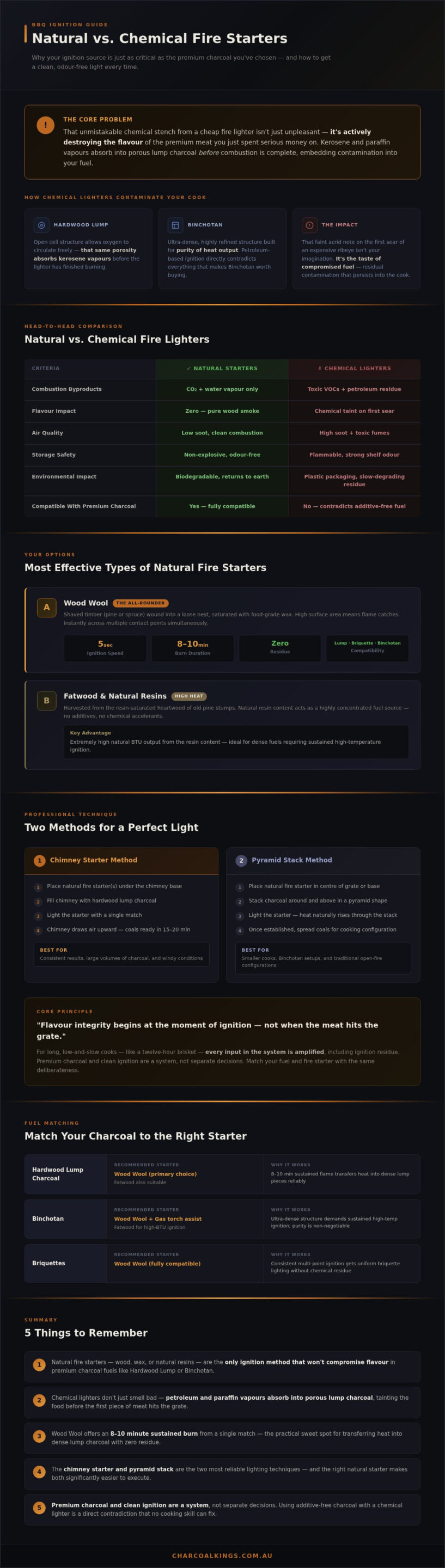
Hardwood lump charcoal is structurally porous by nature. That’s precisely what makes it such a superior fuel: the open cell structure allows oxygen to circulate freely, producing intense, consistent heat. But that same porosity works against you the moment a chemical lighter enters the equation. Kerosene and paraffin don’t simply burn off cleanly. Their volatile organic compounds absorb into the charcoal before combustion is complete, embedding themselves in the fuel you’re about to cook over. The result isn’t just a faint chemical smell at ignition. It’s residual contamination that persists into your cook.
Binchotan is even more susceptible. Its ultra-dense, highly refined structure is built for purity of heat output. Introducing a petroleum-based ignition source to Binchotan is a direct contradiction of everything that makes it worth buying.
The impact on food is real. That faint, slightly acrid note on the first sear of an expensive ribeye isn’t your imagination. It’s the taste of compromised fuel. Premium cuts deserve a clean start.
The Science of Clean Combustion and Flavour
Natural fire starters reach ignition temperature through the combustion of organic carbon compounds, releasing carbon dioxide and water vapour as primary byproducts. There are no toxic volatile organic compounds introduced into the heat column above the coals. For long, low-and-slow cooks, this matters enormously. A twelve-hour brisket cook amplifies every input in the system, including ignition residue. Flavour integrity is the preservation of natural wood smoke character without chemical interference, and it begins at the moment of ignition, not when the meat hits the grate.
Health and Safety: Beyond the BBQ Flavour
The benefits of natural fire starters extend past flavour. Cleaner combustion means significantly reduced soot production, which translates to better air quality for the person managing the fire. From a storage standpoint, wood and wax-based starters are non-explosive, carry no unpleasant shelf odour, and won’t degrade nearby food or equipment. They’re also biodegradable. Chemical lighters typically arrive in plastic packaging and leave behind residues that don’t break down quickly. Wood-based starters return to the earth. That’s a straightforward environmental advantage with no performance trade-off.
Choosing natural fire starters isn’t a compromise. It’s the only logical choice when the fuel you’re lighting is already held to an additive-free standard.
The Most Effective Types of Natural Fire Starters in 2026
Not all natural fire starters perform equally. The format, composition, and burn characteristics of each type determine how well it handles the specific demands of your fuel and cooking setup. Matching the ignition source to the charcoal is as deliberate a decision as choosing the charcoal itself.
Wood Wool: The Versatile All-Rounder
Wood wool is shaved timber, typically pine or spruce, wound into a loose nest and saturated with food-grade wax. That nest shape is the key to its performance. The high surface area means flame catches instantly across multiple contact points simultaneously, rather than relying on a single ignition edge. For Hardwood Lump Charcoal, which requires sustained heat transfer to reach working temperature, this matters.
Burn time is where wood wool earns its reputation. An 8 to 10 minute burn window is the practical sweet spot for charcoal ignition: long enough to transfer heat into dense lump pieces, short enough that the starter has fully combusted before the cook begins. No residual material. No lingering vapours. Just lit charcoal.
- Ignition speed: Catches from a single match in under five seconds
- Burn duration: 8 to 10 minutes of sustained, high-intensity flame
- Compatibility: Hardwood Lump Charcoal, Briquettes, Binchotan
- Residue: None; fully combusts to ash
Fatwood and Natural Resins
Fatwood is harvested from the resin-saturated heartwood of old pine stumps, typically sourced from trees that fell decades ago. As the surrounding wood decays, natural resin concentrates in the core, producing a dense, highly combustible material that’s been used as a reliable fire-starting method long before manufactured alternatives existed.
The resin content gives fatwood a critical practical advantage: it functions effectively in damp conditions where compressed sawdust cubes or standard wood wool may struggle. The natural oils act as a waterproof fuel source, sustaining ignition even when surface moisture is present. This makes fatwood the preferred choice for outdoor fire pits and campfires where quality firewood is the primary fuel rather than charcoal.
For dedicated BBQ use, fatwood works best as a supplementary starter when conditions are less than ideal, particularly in humid Australian coastal environments where stored fuel can absorb ambient moisture overnight.
Organic Wax Cubes: Steady and Predictable
Compressed sawdust bound with vegetable-derived wax produces a slower, more measured burn than wood wool. The trade-off is deliberate. Organic wax cubes prioritise duration over flame intensity, typically sustaining combustion for 12 to 15 minutes at a lower temperature profile. That makes them well suited to Charcoal Briquettes, which are denser and more uniform than lump charcoal and benefit from extended heat contact rather than rapid high-flame ignition.
The pairing principle is straightforward: match ignition intensity to fuel density. High-flame wood wool for irregular, porous lump charcoal. Steady wax cubes for dense, uniform briquettes. Both are clean, both are additive-free, and both deliver the flavour integrity that premium charcoal demands from the first strike.
If you’re building a system around premium additive-free charcoal, the ignition source deserves the same standard of selection as the fuel itself.
Natural vs. Chemical Fire Lighters: A Performance Comparison
The Reddit consensus that chemical starters are “always faster” misses the point entirely. Speed of ignition is irrelevant if the lighter burns out before the charcoal catches. What matters is sustained heat transfer, and that’s where natural fire starters win on every measurable metric.
Burn Time and Heat Intensity
Heat consistency is more important than initial flash-point when lighting solid fuels. A petroleum block or alcohol gel produces an aggressive initial flame that drops off rapidly. Dense lump charcoal pieces, particularly larger irregular chunks, need sustained contact heat to reach working temperature from the inside out. When a chemical lighter flashes off in three minutes, the charcoal surface may be scorched while the core remains cold. This is the “cold heart” problem: charcoal that appears lit but collapses back to inert chunks the moment you stop feeding it oxygen.
Organic wax-based natural fire starters burn at a lower initial intensity but sustain that heat for 8 to 15 minutes depending on format. That extended burn window is precisely what forces heat into the mass of the charcoal rather than skimming across its surface. The result is a full, even catch across the fuel bed rather than a patchy, unreliable start that forces you to add more lighter and more contamination to rescue the situation.
- Chemical lighters: High initial flame, rapid drop-off, frequent re-lighting required
- Natural wax starters: Steady, sustained burn; full heat transfer into dense lump pieces
- Fatwood: Resin-rich combustion that holds in humid conditions where other formats struggle
The Residual Odour Test
Open-air lighting masks the problem. Close the lid of a ceramic kamado or hooded kettle immediately after using a chemical lighter, and you’ve created a sealed chamber where petroleum vapours concentrate directly against the cooking surface. That chemical smell isn’t dissipating into the atmosphere; it’s cycling through the dome and absorbing into everything it contacts.
Binchotan Charcoal must never be lit with chemical fire lighters. Its ultra-refined, highly porous structure absorbs volatile compounds with exceptional efficiency, and no amount of pre-heating will fully purge that contamination before the cook begins. The investment in Binchotan is an investment in purity of heat. A chemical lighter cancels that investment at the moment of ignition.
There’s also a practical dimension that’s easy to overlook. Starting your cook with the clean scent of pine resin and timber sets a different mental register than the acrid hit of a petrol station forecourt. It’s not sentimental. It’s a signal that the system is clean, the fuel is uncompromised, and the cook is starting correctly. Storage reinforces this: natural fire starters produce no toxic residue, no flammable liquid spills, and no lingering chemical odour in your prep area or storage kit.
On cost-efficiency, the calculation is straightforward. A natural starter that reliably lights your charcoal in a single attempt costs less per successful cook than a cheaper chemical block that requires two or three applications to achieve a full catch. Count the lights, not the unit price.
Professional Techniques: How to Light Your BBQ with Natural Starters
Technique separates a reliable light from a frustrating one. The right natural fire starters, placed correctly with proper airflow management, will catch dense lump charcoal every time. The wrong placement, even with quality materials, produces a patchy, uneven start that wastes fuel and patience.
The Chimney Starter Method
A chimney starter is the most efficient tool for lighting lump charcoal cleanly. Place one or two wood wool starters on the bottom grate of your grill. Set the chimney directly over them, then fill it with lump charcoal. Light the starters through the chimney’s lower vents. The column effect does the rest: heat rises through the charcoal mass, igniting pieces from the bottom up. Full catch typically occurs within 15 to 20 minutes, at which point coals at the top will show a light grey ash edge. Pour them out and spread evenly.
The Pyramid Method
Without a chimney, the pyramid method works on the same principle: natural convection. Stack charcoal into a tight cone above the starter, leaving deliberate gaps between pieces for airflow. Tuck the starter at the base, not the centre. Flame travels upward. A starter buried in the middle of a flat fuel bed has nowhere to go. The pyramid shape channels heat into the core of the stack, where it builds the sustained temperature needed to ignite surrounding pieces.
Open all vents fully at ignition. Maximum oxygen intake accelerates the initial burn and prevents the starter from smothering under restricted airflow. Once the charcoal is fully caught and you’re managing cooking temperature, adjust vents accordingly.
Lighting Lump Charcoal and Briquettes
One to two natural starters is sufficient for a standard grill load. More isn’t better; it’s unnecessary. The starter’s job is heat transfer, not combustion of the entire fuel bed. For lump charcoal, tuck the starter beneath irregular pieces so the chimney effect draws flame upward through the gaps. For briquettes, which are uniform and sit flush together, position starters at the base edge where airflow enters. Wait until the outer edges of the coal bed show grey ash before spreading. Spreading too early collapses the heat column and extends your wait time.
Advanced Ignition: Binchotan and Offset Smokers
Binchotan requires patience. Its density means heat transfer is slower than with lump charcoal. Use wood wool directly beneath a small stack, and resist the urge to spread coals early. Allow a full 25 to 30 minutes before the Binchotan reaches working temperature. Rushing it produces an uneven heat bed that defeats the purpose of using it.
For offset smokers, natural starters serve a different role: pre-heating the log bed before adding smoking wood. Place starters beneath a small kindling stack in the firebox, allow them to establish a clean flame, then add splits progressively. This maintains the purity chain from ignition through to the final smoke ring. No chemical residue enters the smoke column, and the flavour profile of the wood remains uncompromised across the entire cook.
If the fire doesn’t catch on the first attempt, don’t reach for a chemical lighter. Check airflow first. A closed vent is the most common cause of failed ignition. Add a second starter if needed, re-stack the fuel to restore the pyramid shape, and open vents fully before relighting.
Build your ignition system around the same standard as your fuel. Explore premium additive-free charcoal and accessories designed to work as a clean, uncompromised system from the first match to the final bite.
Elevate Your BBQ Experience with Charcoal Kings
Everything covered in this guide points to the same conclusion: ignition and fuel are a single system, not two separate decisions. Charcoal Kings is built around that principle. The same no-additives standard applied to every bag of Hardwood Lump Charcoal and every piece of Binchotan extends to every product stocked alongside it. That consistency isn’t accidental. It’s the entire point.
The Charcoal Kings Standard for Purity
Charcoal Kings doesn’t stock products that contradict its core position. Chemical fire lighters aren’t on the shelf because they don’t belong in a system built on additive-free fuel. The natural fire starters available through Charcoal Kings are selected on the same criteria applied to the charcoal itself: clean combustion, no petroleum compounds, no residue that transfers to the cook. For the serious pitmaster, that’s a non-negotiable baseline. Visit the Holden Hill store for a hands-on demonstration and see exactly how clean ignition performs against premium charcoal in person.
Complete Your BBQ Toolkit
Clean ignition is the foundation. What you build on top of it matters equally. Charcoal Kings stocks a full range of rubs, sauces, and cures designed to complement additive-free charcoal cooking rather than compete with it. A quality dry rub on a properly lit, chemical-free coal bed produces a flavour result that a compromised ignition source will always undercut, regardless of how good the rub is. The system works as a whole or it doesn’t work at all.
For restaurants and food service operators, the stakes are higher. Flavour consistency across a full service depends on every input being controlled, including ignition. Charcoal Kings supplies the food service industry directly, with wholesale opportunities available for operators who demand that same purity standard across volume cooking. One inconsistent lighter in a kitchen that runs Binchotan under premium protein is one too many.
The full range of accessories, fuels, and ignition products is available online and in-store. If you’re ready to build a complete, uncompromised BBQ setup, start with barbecuing essentials and work outward from there. Every product in the Charcoal Kings range is chosen to hold the same standard. No shortcuts. No additives. Just clean heat and honest flavour from the first match to the final plate.
Clean Ignition, Every Cook, No Compromises
The case for natural fire starters is straightforward: chemical lighters contaminate the fuel you’ve already paid a premium to keep pure. That contradiction undermines every cook before the first piece of meat hits the grate.
Three things to take away from this guide. First, ignition and fuel are a single system. Second, matching your starter to your fuel type, whether wood wool for Hardwood Lump or a sustained burn for Binchotan, produces measurably better results. Third, technique matters as much as materials. Proper airflow and correct placement will deliver a reliable catch every time.
Charcoal Kings natural fire starters carry no chemical additives, produce no petroleum odours, and are trusted by professional Australian pitmasters who can’t afford a compromised cook. They’re built to pair directly with Hardwood Lump and Binchotan, holding the same no-additives standard as the fuel itself.
This philosophy of purity is a hallmark of quality Australian production, whether in the fuel used for the fire or the beverages served at the table. For those seeking a drink that matches this standard, Robinvale Wines offers a range of organic and biodynamic options that perfectly complement clean-cooked flavours.
Your charcoal deserves a clean start. Upgrade your ignition with Charcoal Kings Natural Fire Starters and get every cook off to the right beginning.
Frequently Asked Questions About Natural Fire Starters
Are natural fire starters better than chemical ones?
Yes, on every metric that matters for serious BBQ. Natural fire starters produce a sustained, clean burn without introducing petroleum or paraffin compounds into your fuel. Chemical lighters burn hotter initially but drop off fast, often requiring multiple applications to achieve a full catch. With premium fuels like Hardwood Lump Charcoal or Binchotan, chemical starters actively degrade the investment you’ve already made in additive-free fuel.
How many natural fire starters do I need to light a BBQ?
One to two starters is sufficient for a standard grill load. The starter’s role is heat transfer, not combustion of the entire fuel bed. Using more than two doesn’t accelerate ignition in any meaningful way; it just burns through your supply faster. Place them correctly with proper airflow, and a single wood wool starter will reliably catch a full chimney of Hardwood Lump Charcoal every time.
Can I use natural fire starters in a pizza oven?
Yes, and they’re well suited to it. Pizza ovens require a clean, odour-free ignition source because the enclosed dome traps and amplifies any combustion byproducts before the oven reaches working temperature. Natural fire starters, particularly wood wool, produce no chemical vapours that could absorb into the oven floor or affect the flavour of the cook. Place one or two beneath a small kindling stack and build the fire progressively from there.
Do natural firelighters expire or go off?
They don’t carry a formal expiry date, but storage conditions affect performance. Wood wool saturated with food-grade wax can absorb ambient moisture over time, which slows ignition and reduces burn consistency. Store natural fire starters in a sealed container or dry storage area away from direct sunlight. Fatwood is the most moisture-resistant format due to its natural resin content, making it the better choice if your storage environment is humid.
Are wood wool fire starters safe for indoor fireplaces?
Yes. Wood wool starters are one of the cleanest ignition options available for indoor use. They produce no toxic fumes, minimal soot, and combust fully to ash without leaving residue. Ensure your flue is open and drawing correctly before lighting, as this applies to any fire starter format indoors. The absence of petroleum compounds makes wood wool a straightforward, safe choice for open hearths and enclosed wood-burning fireplaces alike.
What is the best way to light Binchotan charcoal naturally?
Use wood wool placed directly beneath a small, tight stack of Binchotan pieces and allow a full 25 to 30 minutes before spreading the coals. Binchotan’s density means heat transfer is significantly slower than with standard lump charcoal. Patience is the critical variable here. Spreading too early collapses the heat column before the pieces reach working temperature. Never use chemical lighters with Binchotan; its highly refined, porous structure absorbs volatile compounds with exceptional efficiency.
Do natural fire starters produce a lot of smoke?
Natural fire starters produce some visible smoke during the initial ignition phase, which is normal and brief. This is water vapour and carbon dioxide from the combustion of organic wood and wax compounds, not the acrid chemical smoke associated with petroleum-based lighters. Once the charcoal catches and the starter has fully combusted, smoke output drops significantly. For low-and-slow cooks where smoke flavour is carefully managed, a clean ignition source is essential from the first strike.
Can I use natural fire starters with a chimney starter?
Absolutely, and the chimney starter method is the most reliable way to use them. Place one or two natural fire starters on the bottom grate of your grill, set the chimney directly over them, fill it with charcoal, and light through the lower vents. The column effect draws heat upward through the fuel mass, producing a full, even catch across the entire charcoal load within 15 to 20 minutes. It’s the cleanest, most consistent ignition system available for Hardwood Lump Charcoal.