
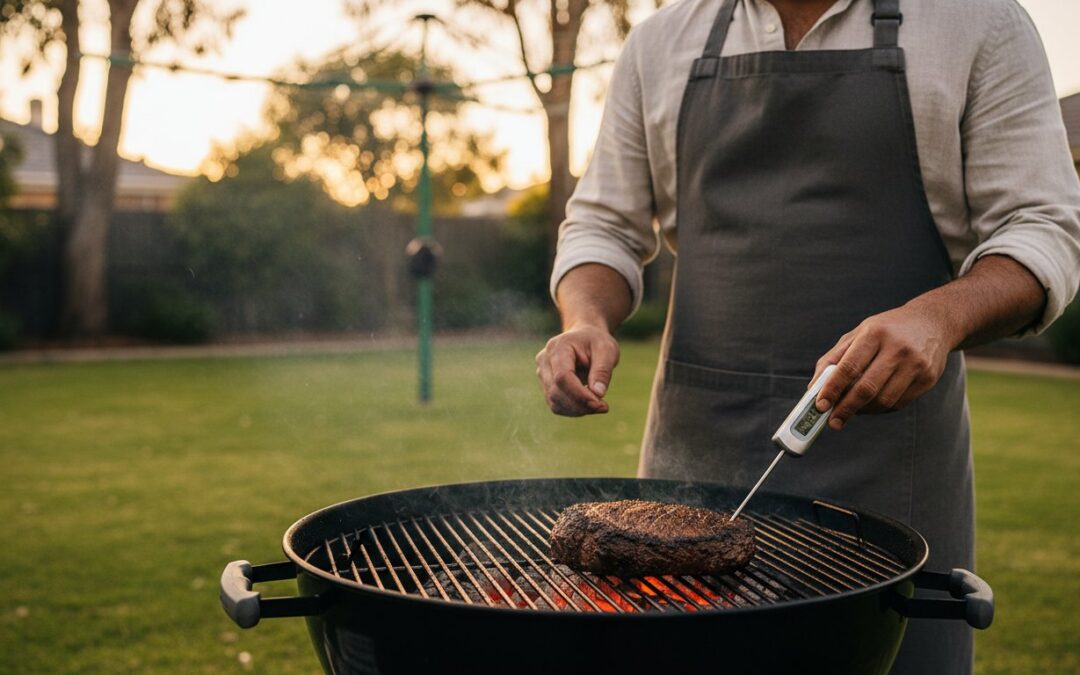
Great BBQ isn’t a talent you’re born with; it’s the result of systematically removing variables. Most backyard cooks struggle with inconsistent heat or the dreaded “dirty smoke” because they’re guessing instead of measuring. If you’ve ever felt overwhelmed by conflicting online advice or served a meal that didn’t live up to your expectations, you aren’t alone. Building confidence in your bbq skills starts with understanding the science of fire and the critical importance of your fuel source.
You deserve to host a stress-free weekend cookout where the flavor is professional-grade every single time. This guide provides a proven framework for mastering fire control, precise temperature management, and the use of high-quality, additive-free fuel. We’ll show you how to identify premium Hardwood Lump Charcoal and why the right tools, such as mid-range instant-read thermometers priced between $42 and $50, are non-negotiable for consistency. Stop hoping for the best and start commanding the flame with authority.
Key Takeaways
- Learn why moving beyond the “Recipe Trap” is essential for understanding the mechanics of fire and airflow.
- Building confidence in your bbq skills starts with identifying clean smoke and mastering precise oxygen control.
- Replace unreliable methods like the “hand test” with precision BBQ accessories to eliminate guesswork and burnt food.
- Develop your technique through low-pressure weeknight practice sessions before moving to expensive cuts or large gatherings.
- Utilize 100% pure Hardwood Lump Charcoal to ensure consistent heat performance without the interference of chemical additives.
The Psychology of BBQ Confidence: Why Most Beginners Struggle
BBQ is a primal craft. It involves many moving parts that happen simultaneously. Most beginners struggle because they treat the grill like a kitchen oven rather than a living combustion engine. You cannot simply follow a YouTube video and expect perfection. Every backyard has different wind, humidity, and ambient temperatures. The history of barbecue shows it evolved as a slow, deliberate process of heat management. Building confidence in your bbq skills means moving away from the “Recipe Trap” and toward total environmental control. You aren’t just cooking a meal; you’re managing an atmosphere.
To better understand this concept, watch this helpful video:
Understanding the Variables You Can Control
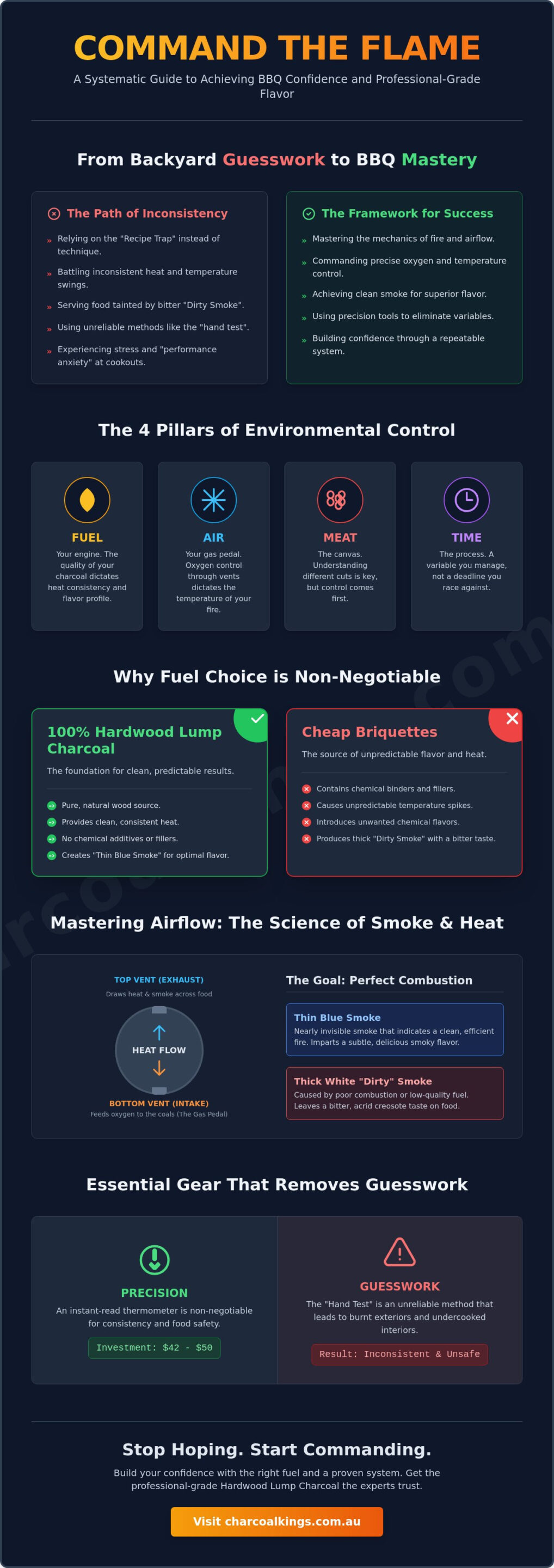
Confidence is built on stability. If you change your charcoal brand, your meat cut, and your vent settings all in one afternoon, you’ll never know why things went wrong. Focus on the four pillars: Fuel, Air, Meat, and Time. Fuel is your engine. Air is your gas pedal. To master these, you must standardize your setup. Use a single type of BBQ Grill or Smoker and stick with it until you can hit your target temperature within ten degrees every time. Changing variables too quickly is the fastest way to kill your momentum and increase performance anxiety when guests are watching.
Moving from Guesswork to Certainty
Success for a beginner isn’t a one-off “perfect” brisket. It’s consistency. It’s knowing that when you light your Hardwood Lump Charcoal, it will provide a clean, predictable heat profile. We prioritize purity because additives introduce unpredictable flavor spikes and heat fluctuations. By using high-quality fuel and reliable BBQ Accessories, you create a baseline. This repeatable process removes the stress of hosting. You aren’t guessing if the food will be good; you’re executing a proven system. Confidence comes from knowing your equipment and fuel will perform exactly as expected, allowing you to focus on the social side of the cookout instead of panic-checking the vents every five minutes.
Mastering Fire Control: The Foundation of Every Great Cook
Fire is a mechanical process, not a mystical one. It functions like an engine that requires a precise balance of fuel and oxygen to perform. When you are building confidence in your bbq skills, you must view your grill as a controlled environment rather than a chaotic pit. The most common cause of failure for beginners is using low-grade fuel. Cheap briquettes often contain chemical binders and industrial fillers that cause unpredictable temperature spikes. These additives also produce “dirty smoke,” the thick, white cloud that leaves a bitter, creosote taste on your food. True mastery begins with 100% pure Hardwood Lump Charcoal, which provides a clean, predictable heat baseline without the interference of hidden chemicals.
The “set and forget” mentality is a myth when working with live fire. While you don’t need to hover over the grates, you must actively monitor the combustion process. This active management ensures your meat reaches the safe minimum internal temperature while maintaining the moisture levels required for professional-grade results. Relying on high-quality Hardwood Lump Charcoal allows you to focus on the cook rather than fighting the fuel. Consistency is the byproduct of using superior materials and understanding the mechanics of your equipment.
The Science of Airflow and Vent Management
Airflow is the gas pedal of your BBQ. Bottom vents act as the intake, pulling oxygen into the coals to increase heat. Top vents act as the exhaust, drawing smoke across the food and out of the chamber. Use the “rule of halves” for adjustments. If your pit is running 20 degrees too hot, close the bottom intake by half and wait ten minutes. Small, deliberate movements prevent the “yo-yo” effect of extreme temperature swings. Always watch the color of your smoke. You are looking for “thin blue smoke,” which is nearly invisible. This indicates perfect combustion and a clean flavor profile.
Creating Heat Zones for Safety and Control
Every beginner needs a safety net to prevent burnt or raw food. The Two-Zone Setup is the most effective way to manage a cook. By piling your charcoal on one side of the grill, you create a high-intensity Direct Heat zone for searing and a cooler Indirect Heat zone for roasting.
- Direct Heat: Use this for quick-cooking items or for finishing a sear.
- Indirect Heat: This “safe zone” allows you to move meat away from flare-ups while it finishes cooking through convection.
- Thermal Mass: Adding heavy BBQ Accessories like cast iron grates helps stabilize the pit temperature by absorbing and radiating heat evenly.
This configuration gives you total control over the cooking environment, ensuring you never feel overwhelmed by an aggressive fire.
Essential Gear That Removes the Guesswork
Instinct is a skill earned through decades of trial and error. For the modern backyard cook, technology provides a shortcut. We call this “Assisted Confidence.” Instead of relying on subjective feelings, you utilize data to verify your progress. The “hand test” is a classic example of poor technique. Holding your palm over a hot grate to judge temperature is inaccurate; it ignores environmental factors like wind and humidity. It often results in singed hair and inconsistent results. Building confidence in your bbq skills requires moving away from these outdated myths and investing in tools that provide objective truths about your cooking environment.
Prioritizing your budget is critical for long-term success. A common mistake is spending thousands on a high-end smoker while neglecting the small tools that actually control the outcome. You should spend on the probe before the shiny exterior. Knowing the exact state of the meat provides immediate psychological relief. You stop worrying about whether the center is raw or the exterior is overdone because the numbers don’t lie. Precision is the enemy of anxiety.
The Instant-Read Thermometer: Your New Best Friend
This is the most important BBQ Accessory in your kit. It allows you to hit specific internal temperature targets with mathematical certainty. For a medium-rare steak, you are looking for 135°F (57°C). For poultry, you must reach 165°F (74°C) to ensure safety. To avoid losing juices, insert the probe into the thickest part of the meat and wait for a stable reading. Carry-over cooking is the secret to juicy steaks; it refers to the internal temperature continuing to rise by 5 to 10 degrees after the meat is removed from the flame. Budget models are available for $12 to $16, while professional-grade units like the Thermapen One cost approximately $115 as of May 2026. Mid-range options typically sit between $42 and $50.
Chimney Starters: Consistent Ignition Every Time
Eliminate lighter fluid from your process immediately. It introduces a permanent chemical aftertaste that ruins the purity of your Hardwood Lump Charcoal. A chimney starter uses the natural physics of a draft to ignite your fuel evenly. The “visual indicator” for readiness is simple: when the top layer of charcoal has a light coating of grey ash, the fire is ready to pour. This tool reduces the time spent waiting for the fire and ensures your heat source is fully engaged before the food touches the grate. Using a chimney starter creates a repeatable starting point for every cookout, which is the foundation of a stress-free experience.
Building Momentum: The “Low-Stakes” Practice Strategy
Confidence isn’t built in front of a crowd. It’s built on a random Tuesday when nobody is watching. A 2026 survey found that 50% of consumers now cook with BBQ flavors multiple times a week. This shift toward weeknight grilling is the perfect environment for building confidence in your bbq skills. You shouldn’t host your first large gathering with a $150 brisket. The pressure of hungry guests and expensive meat leads to panic. Panic leads to poor vent management and over-correction. When the stakes are high, you’re less likely to take the risks necessary to learn how your fire actually behaves.
Adopt the “Wednesday Night Cook” as your training ground. Use this time to experiment with vent settings and fuel loads. If the temperature stalls or the bark doesn’t set perfectly, the only consequence is a slightly later dinner for your household. Focus entirely on the internal temperature of the meat rather than the clock. Time is a variable you cannot control; temperature is a metric you can master. When you stop cooking by the hour and start cooking by the degree, your results will stabilize immediately. Treat every mistake as data. An overcooked rib isn’t a failure; it’s a lesson in when to adjust your intake vents.
Starting with Forgiving Cuts
Begin with cuts that have high fat content and connective tissue. Pork butt is the ultimate starter cut because its intramuscular fat protects it from drying out if you overshoot your target temp. Chicken thighs are similarly resilient. Unlike breasts, they remain juicy even if they climb past 175°F. For steaks, use the reverse sear method. Start with indirect heat until you hit 115°F, then move to direct heat for a final sear. This removes the “grey band” of overcooked meat and ensures a perfect edge-to-edge finish every time. These cuts provide a high margin for error while you master fire control.
Keeping a BBQ Log for Continuous Improvement
Treat your grill like a laboratory. Record the fuel type, ambient weather, vent positions, and final results. If you used our premium Hardwood Lump Charcoal and noticed a faster ignition time, write it down. This data allows you to perform “A-B Tests” on your technique. Use your phone to take photos of the “bark” development at different stages. This visual record helps you identify exactly when to wrap or when to add more oxygen to the fire. Mastery is simply the accumulation of documented successes. To start your own flavor experiments, browse our range of professional-grade Rubs, Sauces & Cures and find your signature profile today.
Why Pure Hardwood Charcoal is the Pro’s Secret Weapon
Fuel is the most overlooked component of the BBQ process. While many focus on expensive smokers or complex rubs, the actual heat source determines the success of the cook. Building confidence in your bbq skills is impossible if your fuel is unpredictable. Supermarket charcoal often contains industrial binders, scrap wood, and chemical accelerators. These additives produce an acrid, chemical taste that no sauce can hide. When you switch to hardwood lump charcoal, you eliminate these toxic variables and return to the natural essence of wood-fired cooking.
Premium fuel offers superior longevity and heat output. Because it consists of 100% natural timber, it burns cleaner and hotter than processed alternatives. This efficiency saves you money by requiring less fuel per session. It also reduces stress. A stable, long-burning fire allows you to maintain your target temperature with fewer vent adjustments. You can trust the flame to perform, giving you the freedom to engage with your guests instead of constantly troubleshooting a dying fire. Purity isn’t just about flavor; it’s about performance and reliability.
The Charcoal Kings Difference: Purity and Performance
Our commitment to chemical-free, natural hardwood ensures a neutral, clean smoke profile. We source our timber locally from Australian experts who understand the density and burn characteristics required for high-grade BBQ. Consistency is our standard. Our lump charcoal features uniform sizing, which leads to predictable burn times and even heat distribution across your grate. You won’t find dust or small fragments that choke your airflow. This is the professional standard for those who value quality over convenience.
Sourcing the Right Fuel for Your Skill Level
Beginners often ask whether they should start with lump or briquettes. While briquettes offer a uniform shape, they frequently contain the fillers we aim to avoid. We recommend starting with lump charcoal for the most authentic experience. Barbecuing with charcoal is about mastering the traditional relationship between wood and meat. It forces you to learn how air interacts with live fire, providing a deeper understanding of the craft. Once you experience the high-intensity heat and clean finish of pure hardwood, you’ll never return to supermarket alternatives. Stock up on premium fuel at Charcoal Kings and start your next cook with the confidence of a professional pitmaster.
Take Command of Your Next Cook
Mastery of the pit is not a matter of luck; it is a matter of discipline and the systematic elimination of variables. By moving beyond the recipe trap and focusing on environmental control, you transform the grill from a source of anxiety into a precision tool. Building confidence in your bbq skills requires a foundation of high-quality fuel and the right technical gear. When you control the airflow and use a reliable instant-read thermometer, you remove the guesswork that leads to inconsistent results.
The final step is choosing a fuel source that works with you, not against you. We provide 100% Natural Hardwood charcoal with zero additives, the preferred choice for Australia’s top pitmasters. This fuel provides the clean, intense heat required for professional-grade flavor every time. Stop settling for supermarket alternatives that ruin your efforts with chemical aftertastes. Master your fire with Australia’s premium hardwood charcoal and benefit from fast shipping across Australia. It’s time to step up to the grates with total authority. Get grilling.
Frequently Asked Questions
How do I know when my charcoal is ready to start cooking?
Charcoal is ready when it is mostly covered in a fine layer of light grey ash and the visible flames have subsided. For Hardwood Lump Charcoal, this process typically takes 15 to 20 minutes when using a chimney starter. Avoid pouring the coals into your grill while they are still black; this indicates they haven’t reached full ignition and may produce acrid smoke that ruins your food.
Is it harder to learn on a charcoal grill than a gas grill?
Charcoal requires more active management of airflow and fuel than gas, but it offers a superior heat profile and authentic flavor. Building confidence in your bbq skills is often more rewarding on a charcoal unit because you learn the fundamental mechanics of fire. Once you understand how to manipulate your vents, the process becomes just as predictable as using a gas dial.
What is the best cut of meat for a BBQ beginner to practice on?
Pork butt is the most forgiving cut for any beginner due to its high fat content and resilient connective tissue. It can withstand internal temperature fluctuations without becoming dry or tough. Chicken thighs are another excellent choice for shorter sessions. They are far more resilient than breasts and provide a low-stakes way to practice managing direct and indirect heat zones.
Can I reuse charcoal that didn’t fully burn during my last cook?
You can definitely reuse unburnt charcoal by closing all grill vents immediately after your session to starve the fire of oxygen. Once the grill is completely cold, shake the basket to remove loose ash and debris. Mix the remaining charcoal with fresh Hardwood Lump Charcoal for your next cook. This practice is efficient and ensures you get the maximum performance from your premium fuel.
Why does my BBQ food sometimes taste like lighter fluid or chemicals?
Chemical off-flavors are caused by using liquid fire starters or low-grade briquettes that contain industrial binders and fillers. These substances release unpleasant fumes that are absorbed by the meat during the combustion process. To eliminate this issue, use a chimney starter and 100% natural fuel. Purity in your heat source is the only way to ensure a clean, professional-grade flavor profile.
How do I control the temperature if my grill is getting too hot?
Restrict the oxygen supply by closing the bottom intake vents. If the temperature is climbing too quickly, close the bottom vents by 75% and monitor the change for ten minutes. Avoid opening the lid to “let the heat out.” This action actually introduces a surge of fresh oxygen that causes the coals to ignite further, resulting in an even hotter fire and potential flare-ups.
What is the difference between direct and indirect heat in charcoal grilling?
Direct heat involves placing food directly over the lit coals for high-intensity searing and fast cooking. Indirect heat involves placing the meat on the opposite side of the grill from the charcoal, allowing it to cook through convection. This two-zone configuration is a vital technique for building confidence in your bbq skills; it provides a safe zone where food can finish cooking without burning.
Do I really need an expensive thermometer to get good results?
You need accuracy rather than a high price tag, though professional-grade tools offer better speed and durability. As of May 2026, budget instant-read models are available for $12 to $16 and provide basic reliability. Mid-range models priced between $42 and $50 offer faster response times. For those seeking the highest precision, professional units like the Thermapen One are available for approximately $115.