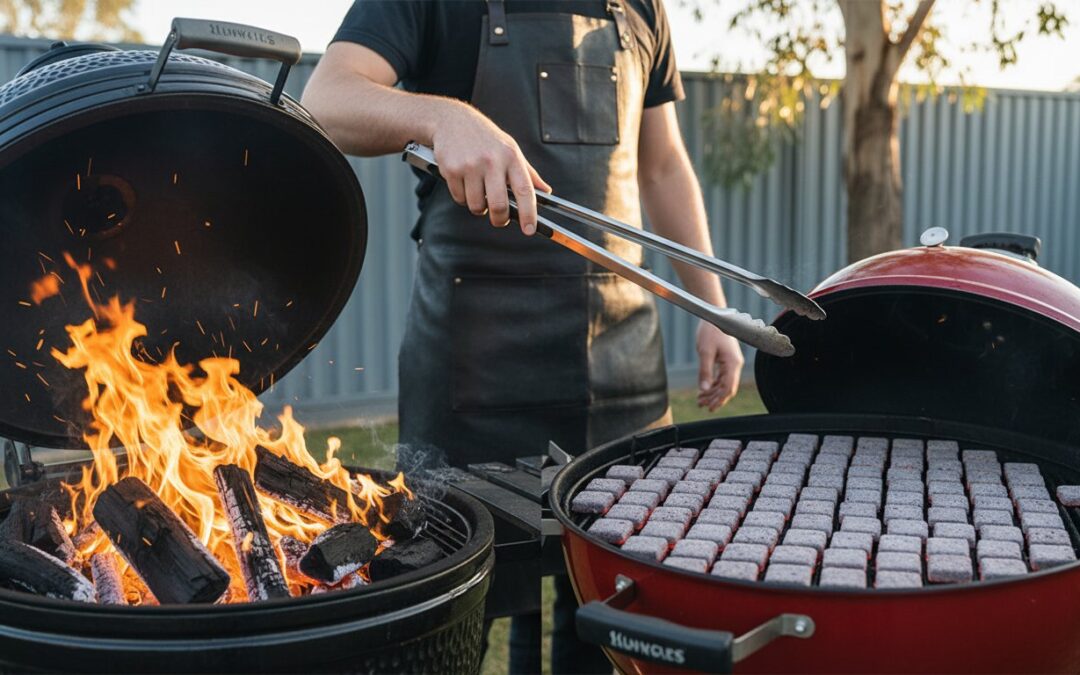
Your choice of fuel is a technical engineering decision that determines the success of your cook before you even light the match. Many Australian pitmasters settle for the convenience of uniform blocks, but the hidden cost of chemical binders and excessive ash often outweighs the initial savings. When comparing lump charcoal vs briquettes australia, the real battle is between raw performance and predictable convenience.
It is frustrating when a long low and slow session is ruined by fluctuating temperatures or a chemical smell that taints an expensive cut of meat. You deserve a clean, high performance burn that respects the quality of your ingredients. This guide will help you master the technical differences between fuel types so you can achieve searing temperatures of 700°C in minutes and reduce your ash waste by up to 80 percent. We will break down the energy density of different hardwoods, explain how the January 2026 shipping regulations impact your supply, and show you how to get better value and superior flavour from every bag you burn.
Key Takeaways
- Identify the structural differences between carbonized hardwood and manufactured briquettes to eliminate chemical odours and fillers from your food.
- Evaluate the performance metrics of lump charcoal vs briquettes australia to choose the right fuel for high-heat searing or consistent 4-hour low-and-slow burns.
- Optimize your gear by matching premium lump charcoal with ceramic grills and offset smokers, while utilizing briquettes for uniform heat distribution in Kettle BBQs.
- Maximize your investment by leveraging the reusability of high-density lump charcoal to lower your total cost per cook.
Understanding the Core Differences: Lump Charcoal vs. Briquettes
Choosing the right fuel is the primary technical decision for any cook. Within the Australian BBQ scene, the debate over lump charcoal vs briquettes australia centers on the trade-off between raw energy and manufactured consistency. What is charcoal at its most basic level? It is the carbonized remains of organic material, usually wood, that has been heated in an oxygen-free kiln to remove moisture and volatile gases. This process leaves behind a high-energy fuel source that burns hotter and cleaner than raw timber.
High performance cooking requires an understanding that charcoal quality serves as the foundation for your entire temperature management strategy. Lump charcoal is 100 percent carbonized hardwood, retaining the original shape of the branches or trunks. Briquettes are a composite product, manufactured by compressing charcoal dust and sawdust into uniform blocks using specific binders. This structural difference dictates how the fuel interacts with oxygen and how much heat it can project into your meat.
To better understand the physical differences between these two fuel types, watch this technical breakdown:
The Anatomy of Lump Charcoal
Lump charcoal is defined by its irregular shapes and natural origin. Because the pieces vary in size, they create a complex network of air gaps in your charcoal basket. These gaps allow for massive airflow, which is why lump can reach searing temperatures of 700°C in as little as 15 minutes. High-quality Australian lump contains zero chemical additives or fillers. It is pure carbonized timber. This purity means the fuel responds almost instantly to vent adjustments. If you open your intake, the heat spikes. If you choke it, the temperature drops. Unlike manufactured alternatives, the consistency of lump depends entirely on the timber species used. A dense Australian hardwood like Gidgee or Mallee root will provide a more predictable, long-lasting burn than lighter, imported softwoods.
How Briquettes are Made
Briquettes are the result of an industrial compression process. Manufacturers take charcoal fines and sawdust, mix them with binders like cornstarch, and press them into uniform pillows. Some mass-market brands include chemical accelerants to make lighting easier, though these often produce a distinct petroleum smell during the start-up phase. The uniform size of briquettes ensures a predictable, “flat” heat curve. You know exactly how much heat a single chimney of briquettes will produce. While this makes them ideal for beginners learning temperature control in a Kettle BBQ, the binders limit their peak intensity. Because they contain non-carbon materials, briquettes produce significantly more ash. This ash can clog air vents during long 12-hour cooks, requiring manual intervention to maintain airflow.
Performance Comparison: Heat, Burn Time, and Ash Production
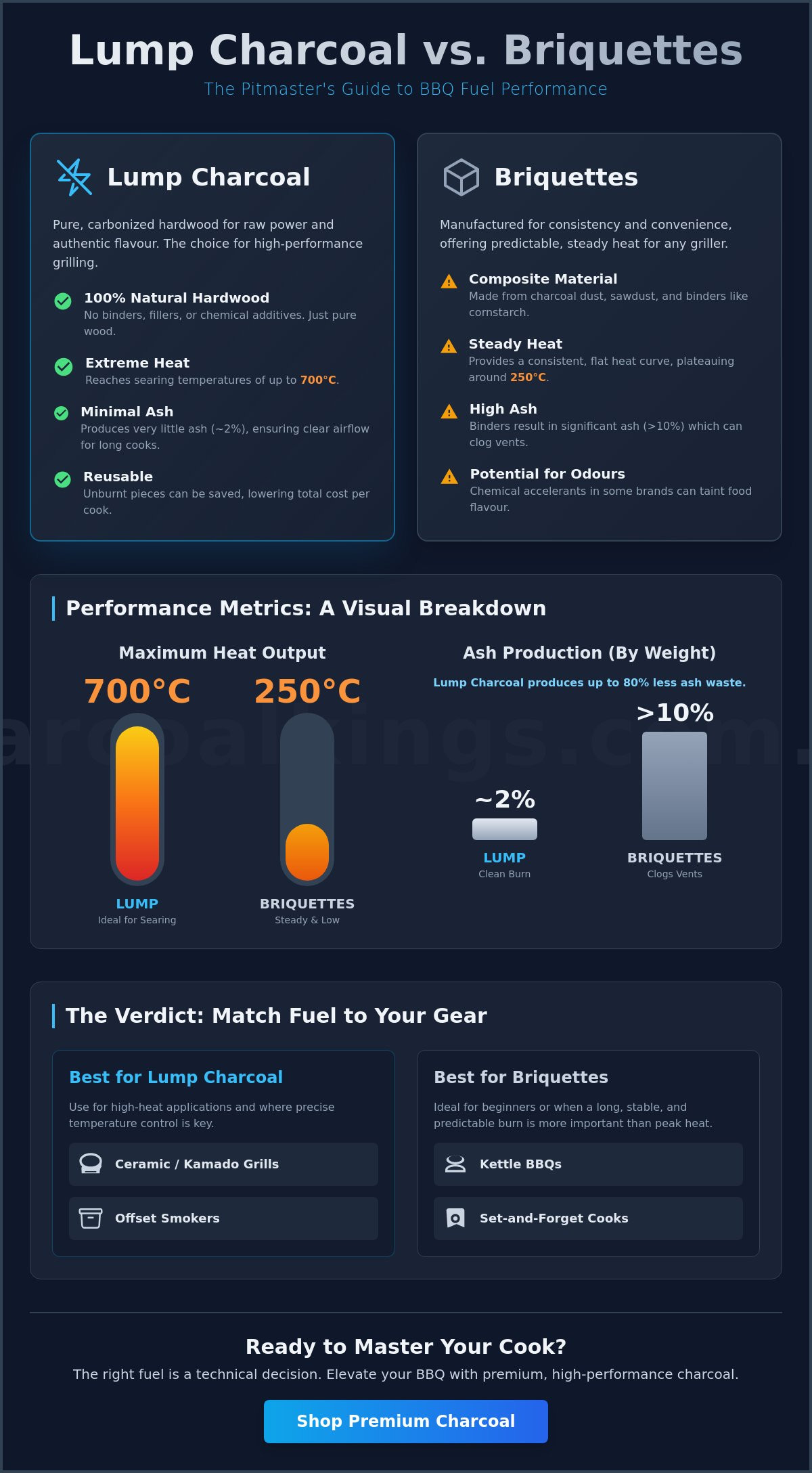
Thermal performance is the standard by which all fuels are measured. When evaluating lump charcoal vs briquettes australia, the primary technical distinction is the peak temperature. High quality lump charcoal, especially when sourced from dense Australian hardwoods, can reach temperatures of 700°C within 15 minutes. This searing heat is essential for professional steakhouse results. Briquettes are chemically engineered for a different purpose. They provide a steady, flat heat curve that typically plateaus around 250°C. While this lower intensity is manageable for beginners, it lacks the raw power required for advanced grilling techniques.
Ash production is a critical factor for long duration cooks. Lump charcoal is pure carbonized wood and leaves behind minimal residue, often as little as 2 percent of its original weight. This prevents the air vents in your smoker from clogging during a 12 hour brisket session. Briquettes produce a high volume of ash, sometimes exceeding 10 percent of their weight. This is due to the clay or starch binders used to hold the dust together. Excessive ash acts as an insulator, choking the fire and forcing you to intervene mid-cook to maintain airflow. For a detailed expert comparison of lump charcoal and briquettes, technical data consistently shows that lump is the cleaner, more efficient option for airflow management.
BTU Output and Thermal Energy
BTU, or British Thermal Units, measures the heat energy density of your fuel. Higher carbon content equals more efficient thermal energy. Dense Australian timbers like Gidgee are world renowned for their energy density. Because Gidgee is significantly heavier than common softwoods, it generates more heat per kilogram and maintains that heat for longer periods. Using a high density fuel means you spend less time refueling and more time focused on the cook. You can find these high performance Hardwood Lump Charcoal varieties to maximize your grill’s output.
The Longevity Myth: Which Fuel Really Lasts?
There is a common misconception that lump charcoal burns out too quickly. This is only true for low grade, airy softwoods. Premium Australian hardwood lump has the structural integrity to last through extended cooks. For a standard 4 hour session, you might only require 2 to 2.5 kg of premium lump charcoal, compared to 4 or 5 kg of standard briquettes. This efficiency changes the value proposition entirely. While a bag of briquettes may have a lower shelf price, the cost per hour of cook time is often lower with high quality lump. You also have the advantage of reusability. When you finish your cook, close the vents to extinguish the fire. You can relit the remaining lump for your next session, a feature that briquettes cannot reliably offer.
The Flavour Factor: Purity and the Australian Hardwood Advantage
Purity is the single most important factor when you want to achieve professional results. In the debate of lump charcoal vs briquettes australia, the sensory impact on your food is often overlooked in favour of simple burn times. Australian lump charcoal delivers a clean, mild wood smoke that enhances your meat. It doesn’t mask the natural flavours of a premium Wagyu or a delicate piece of Barramundi. This purity is a non-negotiable requirement for mastering the art of barbecuing with charcoal.
Cheap, mass-market briquettes present a significant risk to your final product. During the lighting phase, these products often emit a sharp petroleum or chemical odour. This smell is the result of industrial binders and fillers used to stabilize the charcoal dust. If you put your meat on the grill before these chemicals have fully burned off, you risk a permanent chemical taint. The acrid smoke from these additives can ruin hours of preparation in minutes.
Avoiding the “Chemical Taint”
Many budget-friendly briquettes rely on a cocktail of non-organic additives to maintain their shape and improve ignition. Common fillers found in mass-market brands include:
- Coal Dust: Used to increase the burn time but produces a heavy, acrid smoke profile.
- Limestone: Added to give the ash a white, “clean” appearance, though it adds no thermal value.
- Borax: A pressing agent that helps the briquette release from the manufacturing mould.
These substances are particularly damaging when cooking delicate proteins like fish or poultry. The porous nature of these meats allows them to absorb chemical vapours quickly. Charcoal Kings maintains a strict commitment to 100 percent natural, additive-free hardwood. We ensure that the only thing seasoning your food is the natural essence of the timber.
Australian Timber Species and Their Profiles
The terroir of Australian hardwoods offers a flavour profile that imported products cannot replicate. Selecting the right species is as important as selecting the right cut of meat. The density of our local timbers creates a unique infrared heat that locks in moisture.
- Gidgee: The heavy-hitter for high-heat searing. It produces a very clean burn with a neutral smoke profile and long-lasting embers.
- Mallee Root: A classic Aussie favourite. It provides a rugged, authentic smoke profile that is synonymous with the traditional Australian bush BBQ.
- Ironbark: Known for its exceptional density and a mild, sweet smoke that pairs perfectly with beef and pork.
For those seeking the absolute pinnacle of clean cooking, Binchotan charcoal offers an ultra-clean, infrared-style heat. It produces virtually zero smoke, allowing the natural quality of your ingredients to stand entirely on their own.
Sustainability and Sourcing: Why Local Hardwood Wins
Your choice of fuel has implications that extend far beyond the grill. While performance is the primary driver for most pitmasters, the origin of your charcoal determines its environmental and ethical footprint. Australian charcoal production is strictly regulated to ensure sustainable land management. This stands in stark contrast to many imported products from South America or Southeast Asia, which are frequently linked to unregulated deforestation. When evaluating lump charcoal vs briquettes australia, choosing local fuel ensures your hobby does not contribute to global habitat loss.
Logistical realities have shifted significantly in 2026. As of January 1, 2026, all forms of charcoal are mandatorily classified as Dangerous Goods (Class 4.2) for shipping under the IMDG Code. This classification has increased the cost and complexity of importing fuel into the country. Furthermore, the Australian Government updated biosecurity import conditions for plant-derived charcoal on March 28, 2026. These regulatory changes make local Australian hardwood a more reliable and secure choice for your supply chain. Reducing your “BBQ miles” by choosing fuel processed and packaged within Australia is now a matter of both ethics and logistical common sense.
Ethical Harvesting in the Australian Outback
Artisanal kiln-firing in rural Australia often utilizes invasive species or waste timber from land regeneration projects. Species like Mallee root are frequently harvested as part of sustainable land management practices. This process helps restore the natural balance of the landscape while producing a superior, high-density cooking fuel. Supporting the local industry secures long-term fuel security for the Australian BBQ community. It also provides vital jobs in regional areas. When you buy local, you receive a consistent, known wood species in every bag. You avoid the mystery mix of tropical softwoods often found in cheap, imported alternatives.
Carbon Footprint: Local vs. Imported
Shipping heavy, bulky fuel across oceans carries a massive environmental cost. High-density Australian hardwood is fundamentally more carbon-efficient because it packs more thermal energy into every cubic metre. You burn less volume of a dense wood like Gidgee to achieve the same thermal results as a larger volume of lighter, imported wood. Managed Australian hardwood forests represent a renewable resource that provides a continuous cycle of high-performance fuel. The energy density of our native timbers means you are transporting more “heat” and less “filler” per kilogram. This efficiency is the hallmark of a professional-grade setup.
Invest in the future of the Australian BBQ industry by sourcing your Hardwood Lump Charcoal from local masters of the craft.
The Verdict: Matching Your Fuel to Your BBQ Setup
The final decision in the lump charcoal vs briquettes australia debate depends entirely on the hardware in your backyard. Professional results require a synergy between your fuel and your airflow system. While premium lump charcoal is the superior engineering material for high intensity cooking, high quality briquettes serve a specific purpose for long, unattended sessions in restricted environments. Regardless of the format, you must prioritize purity. Additive-free fuel is the only way to protect the integrity of your ingredients and ensure a clean burn.
Experienced pitmasters often utilize a hybrid approach to maximize their efficiency. You can build a base of additive-free briquettes to provide a stable, long-lasting thermal floor. You then top this base with large chunks of Australian hardwood lump to provide the searing heat and the clean, organic smoke profile that defines world-class BBQ. This combination leverages the predictability of the manufactured product with the raw power of carbonized timber. It is a technical solution for complex, multi-stage cooks.
Hardware-Specific Fuel Recommendations
- Hibachi and Konro Grills: These compact units require intense, focused heat. You should exclusively use hardwood lump or Binchotan charcoal. This Japanese-style white charcoal provides ultra-clean, infrared heat that is essential for yakitori and high-end searing without the interference of smoke or flames.
- Offset Smokers: Airflow is the lifeblood of an offset smoker. Hardwood lump is essential here because its irregular shape prevents the firebox from becoming a restricted mass of ash. This ensures a clean draw and the development of an authentic smoke ring on your brisket or ribs.
- Kettle and Bullet Smokers: Briquettes are a functional choice for the “Snake Method” where uniform heat distribution is the priority. However, switching to a high-density lump will still offer a superior flavour profile and higher peak temperatures for finishing your meat.
Final Checklist for Your Next Purchase
Before you load your trolley or checkout online, verify the technical specifications of your fuel. Avoid mass-market products that compromise on quality for a lower price point. Use this checklist to ensure you are buying performance-grade material for your next session:
- Look for “100% Natural Hardwood”: Ensure the bag contains zero fillers, coal dust, or limestone binders.
- Check for Chemical-Free Status: Avoid any product with “easy-light” features or chemical accelerants that produce acrid smoke.
- Verify the Species: Premium fuel will often state the specific Australian timber used, such as Gidgee, Ironbark, or Mallee root.
Explore our range of premium Australian Hardwood Charcoal today and experience the difference that high-density, additive-free fuel makes to your next cook. Get it right the first time; your meat depends on it.
Dominate Your Next Cook with Technical Fuel Mastery
Mastering the technical nuances of lump charcoal vs briquettes australia is the difference between a mediocre meal and a masterclass in fire management. You now understand that high-density Australian hardwoods deliver the searing intensity and clean flavour required for professional results. While briquettes offer stability for specific kettle techniques, the purity of 100 percent natural lump charcoal ensures your meat is never tainted by chemical binders or excessive ash.
Charcoal Kings is the trusted wholesale supplier to Australia’s leading BBQ restaurants. We provide 100 percent natural, additive-free hardwood and offer expert local support from our Adelaide base. Whether you are running a high-intensity Hibachi or a 12-hour offset smoker session, our fuel is engineered for peak performance.
Upgrade your BBQ with Premium Australian Hardwood Charcoal and experience the thermal efficiency that professional pitmasters demand. It’s time to fire up the grill and achieve the superior results your craft deserves.
Frequently Asked Questions
Is lump charcoal actually better than briquettes?
Lump charcoal is technically superior for heat intensity and flavour purity. It consists of 100 percent carbonized wood with zero chemical additives. Briquettes are a manufactured alternative designed for those who prioritize a flat heat curve over peak performance. Choosing lump charcoal vs briquettes australia depends on your objective; use lump for professional searing and briquettes for basic temperature maintenance.
Why does some charcoal spark and pop so much when lighting?
Popping and sparking occur when moisture or sap remains trapped inside the wood fibres during the carbonization process. As the charcoal heats, this moisture turns to steam and expands rapidly, causing the wood to burst. This is more common in lower-grade products or softwoods. High-quality Australian hardwoods undergo a more thorough kiln-firing process, which significantly reduces this sparking behavior.
Can I use lump charcoal in a standard Weber Kettle BBQ?
You can certainly use lump charcoal in a standard Kettle BBQ. It is the best choice for high-heat grilling of steaks and burgers. Because lump burns hotter than manufactured briquettes, you may need to adjust your vent settings more frequently to manage the temperature. Using a charcoal basket helps contain the pieces and improves airflow for a more efficient burn.
How long does Gidgee lump charcoal burn compared to standard briquettes?
Gidgee lump charcoal provides a burn time that rivals or exceeds standard briquettes due to its extreme density. While lighter charcoals burn out quickly, a single load of Gidgee can maintain cooking temperatures for over 4 hours in a controlled environment. Its high carbon content means it delivers more thermal energy per kilogram, making it a highly efficient fuel for long sessions.
Do charcoal briquettes expire or go bad if they get damp?
Charcoal does not have an expiration date, but moisture will degrade its performance. Briquettes are particularly susceptible because their starch binders absorb water and cause the structure to crumble. Damp fuel is difficult to ignite and produces excessive, acrid smoke. Always store your fuel in a dry, sealed container to maintain its structural integrity for your next cook.
What is the most sustainable type of charcoal available in Australia?
Locally sourced Australian hardwood lump is the most sustainable option available. It is often produced from invasive species or waste timber from managed land clearing. This supports local ecosystems and avoids the environmental damage associated with imported charcoal from unregulated forests. Choosing local fuel also reduces the carbon footprint caused by international shipping and logistics.
Why is premium Australian charcoal more expensive than supermarket brands?
Premium Australian charcoal is more expensive because it contains a higher concentration of carbon and zero fillers. Supermarket brands often rely on imported softwoods and chemical binders to reduce manufacturing costs. When you buy premium, you are paying for a higher energy density. This results in a lower cost per cook because you use less fuel to achieve the same thermal results.
Which fuel should I use for a 12-hour low-and-slow brisket cook?
Hardwood lump is the best choice for a 12-hour low-and-slow brisket cook. When evaluating lump charcoal vs briquettes australia for long durations, the low ash production of lump is the deciding factor. Briquettes produce significantly more ash, which can settle in the bottom of your smoker and choke the air intake. Lump keeps your airflow clear and your temperatures stable throughout the night.