
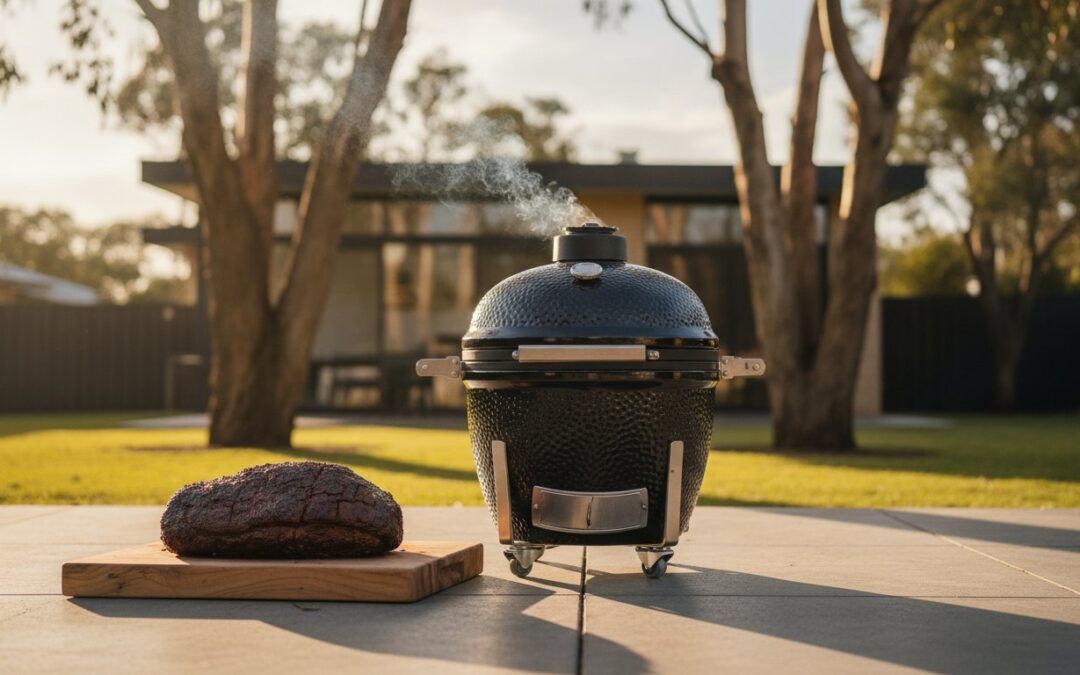
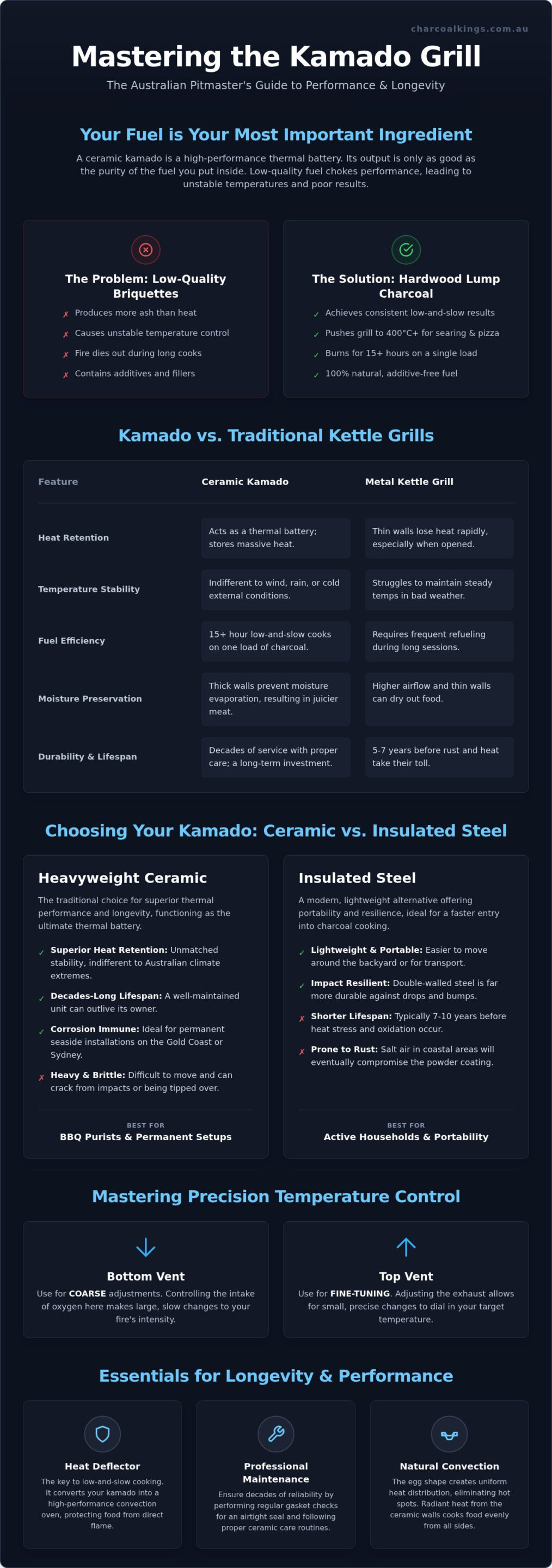
A ceramic kamado is a high-performance thermal battery. Its output is only as good as the purity of the fuel you put inside it. Many Australian backyard cooks invest thousands in a premium setup only to see it choked by low-quality supermarket briquettes that produce more ash than heat. You’ve probably felt the frustration of a temperature gauge that won’t stay steady or a fire that dies out just as the brisket hits the stall. These issues aren’t flaws of the grill; they’re the result of using inferior fuel that limits the potential of your kamado grill australia investment.
This 2026 guide shows you how to master ceramic BBQ by selecting the right hardware and pairing it with the high-density, additive-free fuel it demands. You’ll learn how to achieve consistent low-and-slow results and push your ceramic vessel to 400°C+ for perfect pizzas. We’ll cover everything from the thermal properties of Australian Ironbark to the specific maintenance routines that keep your ceramic intact for decades. Mastery of the craft starts with understanding that quality fuel is your most important ingredient.
Key Takeaways
- Understand the critical differences between heavyweight ceramic and insulated steel models to find the right balance of heat retention and portability for your backyard.
- Learn why professional-grade results from a kamado grill australia depend entirely on using high-density, additive-free hardwood lump charcoal.
- Master precision temperature control by using the bottom vent for coarse adjustments and the top vent for fine-tuning your airflow.
- Discover the essential role of the heat deflector in converting your ceramic vessel into a high-performance convection oven for low-and-slow cooking.
- Implement professional maintenance habits, including gasket checks and proper ceramic care, to ensure your grill survives decades in the Australian climate.
Why the Kamado Grill is the Ultimate Choice for Australian Pitmasters
The modern kamado is a precision-engineered evolution of the traditional Japanese cook stove. What began as a simple clay cooking vessel is now a high-tech ceramic powerhouse capable of professional-grade performance. For any serious pitmaster looking for a kamado grill australia, the appeal lies in this ancient design’s ability to outperform modern metal alternatives in every metric that matters: heat retention, temperature control, and moisture preservation. It is a tool built for those who value results over gadgets.
Ceramic is a heavy-duty insulator. Unlike thin-walled steel grills that lose heat the moment the lid is opened, a kamado acts as a thermal battery. This massive heat storage allows for incredible versatility. You can dial it down to 100°C for a 12-hour low-and-slow brisket or open the vents to hit 400°C for wood-fired pizzas that cook in under two minutes. It is a single unit that replaces a smoker, an oven, and a high-heat sear station in your backyard.
Efficiency is a hallmark of the ceramic design. Because the walls hold heat so effectively, the fire requires very little oxygen to maintain temperature. A single load of premium hardwood lump charcoal can burn for 15+ hours at smoking temperatures. You don’t have to constantly feed the fire; you let the ceramic mass do the heavy lifting.
The Physics of Ceramic Cooking
The secret is the thick, refractory walls. These prevent heat from escaping and stop moisture from evaporating. This is why meat stays juicier in a kamado than in a metal grill. The egg shape facilitates natural convection currents. Hot air rises from the coal bed, circulates around the food, and reflects off the domed lid. This creates uniform heat distribution, eliminating the hot spots common in lesser hardware. Radiant heat from the ceramic walls penetrates the meat deeply, cooking it from the inside out while maintaining a perfect exterior bark.
Kamado vs. Traditional Kettle Grills
Kettle grills are versatile but lack thermal stability. On a windy or cold day, a thin metal kettle struggles to maintain a steady temperature. A ceramic kamado is indifferent to external conditions. Its density provides a buffer against the elements. While a kettle might last five to seven years before the steel rusts through, a high-quality ceramic investment is designed to last for decades. This durability makes it a foundational piece in the broader BBQ landscape, offering a level of reliability that cheaper alternatives cannot match.
Ceramic vs. Steel Kamados: Navigating the Australian Market
Choosing between ceramic and steel defines your long-term BBQ strategy. Ceramic models are the traditional heavy-hitters. Built from thick refractory materials like cordierite, these units function as superior thermal batteries. They excel at maintaining rock-solid temperatures regardless of external conditions. In contrast, insulated steel kamados offer a lightweight, double-walled alternative. While they lack the massive heat storage of ceramic, they provide a faster entry point into the world of charcoal cooking. For anyone investing in a kamado grill australia, the decision rests on balancing thermal performance against portability and budget.
The Australian climate presents unique challenges for outdoor hardware. Intense UV radiation and high ambient temperatures in states like South Australia or Western Australia can make temperature control difficult on thin-walled grills. Ceramic handles these extremes with ease. Once the thermal mass is saturated, it remains indifferent to a 40°C afternoon. However, ceramic is heavy and brittle. A dropped lid or a tip-over during a backyard renovation can lead to permanent cracks. Steel kamados are far more resilient to impact, making them better for active households. The trade-off is rust. If you live in a coastal area like the Gold Coast or Sydney, the salt air will eventually find any weakness in a steel grill’s powder coating. Ceramic is immune to corrosion, making it the better choice for permanent seaside installations.
Durability also dictates the lifespan of your investment. A well-maintained ceramic unit can last for decades, often outliving its owner. Steel models have a shorter horizon, with an estimated lifespan of 7 to 10 years before the internal liners or outer shell may succumb to heat stress and oxidation. To maximize the life of either build, pairing your unit with high-performance BBQ hardware and protective covers is essential.
When to Choose Ceramic
Ceramic is the gold standard for overnight low-and-slow cooks. The insulation ensures you aren’t fighting the vents at 3:00 AM to keep a brisket at 110°C. It is the only choice for an integrated outdoor kitchen where the grill remains stationary. If your goals include wood-fired pizzas at 400°C+, the radiant heat from ceramic walls is irreplaceable for achieving a professional crust.
When to Consider Steel Kamados
Steel is the practical choice for those who need mobility. If you plan to take your kamado camping or frequently move it around a small patio, the weight savings are significant. Steel also responds faster to vent adjustments. Because there is less mass to heat up or cool down, you can pivot from smoking to searing much quicker than with a heavy ceramic vessel.
The Fuel Factor: Why Purity is Non-Negotiable for Kamados
A kamado is more than a grill; it’s a porous ceramic vessel that absorbs the environment around it. This makes fuel choice the most critical decision in your BBQ process. The absolute purity rule states that you must only use premium hardwood lump charcoal in these units. Unlike metal grills, ceramic walls can permanently absorb the chemical binders and petroleum-based fillers found in budget briquettes. Once those chemicals permeate the ceramic, the “chemical taint” can ruin every meal you cook for the life of the grill. You aren’t just buying fuel; you’re protecting an investment.
Performance in a kamado grill australia also depends on airflow management. High-density Australian hardwoods, such as Ironbark, are ideal because they produce minimal ash. Standard supermarket charcoal often contains high levels of bark and sapwood, which creates a thick layer of fine ash that settles in the bottom of the firebox. This ash eventually chokes the air intake, making it impossible to maintain the 15-hour low-and-slow temperatures discussed earlier. For those seeking the pinnacle of high-heat performance, Japanese-style white charcoal, or Binchotan, offers a carbon-pure burn that reaches extreme temperatures without smoke or flare-ups.
Building the Perfect Fire
Precision starts with how you stack the firebox. Always remove old ash before every cook to ensure the draft remains unobstructed. Place the largest pieces of lump charcoal at the base to create natural air gaps. For low-and-slow sessions, light the charcoal at the very top; the fire will slowly work its way down, providing a steady burn for hours. For high-heat searing or pizza, light from the bottom to allow the entire coal bed to ignite rapidly.
Selecting Smoking Woods
In the sealed environment of a kamado, smoke is concentrated. Australian hardwoods like Ironbark provide a robust, clean smoke for beef, while Red Gum offers a sweeter profile for pork and lamb. Because these grills are so efficient, you only need one or two well-seasoned chunks. Overloading with wood creates “dirty smoke,” which deposits bitter creosote on the meat. Always ensure your smoking wood is properly seasoned. Unseasoned wood introduces unwanted moisture that can interfere with the ceramic’s thermal stability and impart an acrid flavour to the food.
Mastering the Vent: Precision Temperature Control
Temperature control in a kamado grill australia is a matter of fluid dynamics. You are managing a thermal engine. The bottom vent acts as your coarse adjustment. It dictates the total volume of oxygen available to the coal bed. The top vent is your fine-tuning dial. It controls the exhaust speed and, consequently, the draw of air through the unit. Small movements of just a few millimetres on the top vent can shift the internal temperature by 5°C to 10°C. Precision is the difference between a ruined piece of meat and a professional result.
The most common mistake for new pitmasters is the “overshoot.” Ceramic is a thermal battery. It absorbs heat slowly but retains it with incredible tenacity. If you let the internal temperature climb to 150°C when you only needed 110°C, you’ll spend hours waiting for the mass to cool down. You cannot simply turn it down like a kitchen oven. You must catch the temperature on the way up. Once that ceramic mass is hot, it stays hot. This is why we recommend using high-performance BBQ hardware that provides an airtight seal for maximum responsiveness.
Australian summer conditions demand specific adjustments. When the ambient temperature hits 40°C, your kamado grill australia starts with a higher baseline. The air entering the bottom vent is already hot. You’ll find the sweet spot for a 12-hour brisket cook requires much tighter vent settings than a winter session. In extreme heat, even a tiny air leak can cause your temperatures to spike beyond your control. Check your gaskets regularly to ensure the only air entering the unit is coming through the vents.
Low and Slow Mastery (100°C – 120°C)
For smoking, the goal is rock-solid stability. Begin closing your vents when the gauge is 15°C below your target. This prevents the momentum of the rising heat from overshooting your mark. You must use a heat deflector or convector plate to block direct radiant heat from the coals. This converts the unit into a convection oven. Look for “blue smoke”-a thin, nearly invisible exhaust. This indicates a clean-burning fire and pure fuel consumption, ensuring no bitter flavours are deposited on your meat.
High-Heat Searing and Pizzas (300°C+)
High-heat cooking requires maximum airflow. Open both vents fully to saturate the coal bed with oxygen. When temperatures exceed 300°C, safety is paramount. Always “burp” the grill by lifting the lid just a few centimetres for several seconds before opening it fully. This prevents a “backdraft”-a dangerous rush of oxygen that causes a sudden fireball. At these temperatures, the radiant heat stored in the ceramic dome is what creates a professional wood-fired pizza crust, cooking the toppings at the same rate as the base.
Essential Accessories and Maintenance for Longevity
A kamado grill australia is a lifetime investment, but its performance depends on the integrity of its components. The heat deflector is the most critical accessory in your kit. This ceramic plate acts as a thermal barrier, blocking direct radiant heat from the coals and converting your unit into a convection oven. Without it, you cannot achieve the indirect environment required for low-and-slow BBQ. You must handle these plates with care; they are brittle and can crack if dropped or subjected to extreme thermal shock while cold.
Air-tightness is the foundation of temperature control. The gasket seal, usually made of high-temperature felt or wire mesh, ensures that the only oxygen entering the unit comes through the bottom vent. Check these seals every six months for signs of compression or charring. If you notice smoke escaping from the lid during a cook, the seal is compromised. Replacing a gasket is a straightforward maintenance task that restores the precision of your vent adjustments. Neglecting this leads to air leaks that make temperature stabilization impossible.
Cleaning a ceramic vessel requires a different approach than metal grills. Never use soap, water, or abrasive chemicals on the porous interior. The standard method is a high-heat burn. After a cooking session, open the vents fully and allow the temperature to reach 300°C for approximately 30 minutes. This carbonizes grease and food residue into a fine white ash. Once the unit is cold, use an ash tool to remove the debris. For storage, always use a heavy-duty, breathable cover. In Australian coastal environments, salt air and humidity can cause oxidation on the metal bands and hinges. A cover is your first line of defence against the elements.
Must-Have Hardware
Standard stainless steel grates are functional, but cast iron grates offer superior thermal mass for high-heat searing. These grates hold heat more effectively, producing professional-grade sear marks on steaks. Multi-level rack systems are also essential for maximizing the vertical space of the dome, allowing you to cook different proteins at various heights simultaneously. Ensure you have a dedicated grate lifter and a long-handled ash tool to manage the firebox without risking burns.
The Charcoal Kings Checklist
Serious pitmasters prioritize efficiency and mechanical reliability. Follow this checklist to keep your rig in peak condition:
- Source bulk firewood and charcoal to ensure you always have high-density, additive-free fuel on hand.
- Perform regular bolt tightening. The metal bands expand and contract during every heat cycle. Use a wrench to check the tension monthly to prevent the ceramic dome from slipping.
- Maintain a relationship with local specialty stockists for high-quality rubs and sauces that complement the clean smoke of hardwood fuel.
<h2 id=
Mastering a kamado grill australia requires a commitment to quality components and pure fuel. You’ve learned that ceramic is a thermal battery that demands high-density hardwood to reach its peak efficiency. Avoiding chemical additives is non-negotiable if you want to protect the porous walls of your vessel and ensure the clean taste of your cooks. By mastering vent control and maintaining your gaskets, you turn a simple grill into a precision instrument that lasts for decades.
Your results are only as good as the energy you put into the firebox. As Australia’s leading supplier of chemical-free hardwood fuels, we provide the high-performance charcoal and rugged gear needed to conquer the Australian climate. Our products are expertly sourced for maximum heat and longevity, ensuring your low-and-slow sessions remain stable for hours on end. Don’t settle for supermarket quality when professional results are within reach.
Shop Premium Hardwood Charcoal for Your Kamado Grill and start producing professional-grade BBQ in your own backyard today. The fire is waiting.
Frequently Asked Questions
Is a kamado grill better than a regular charcoal BBQ?
A kamado offers superior thermal efficiency and versatility compared to a standard kettle or grill. The thick ceramic walls function as a thermal battery, holding steady temperatures for over 15 hours on a single load of fuel. While regular BBQs lose heat to the surrounding air, the kamado excels at everything from low-and-slow smoking to 400°C searing. It is a professional-grade tool that replaces multiple outdoor appliances in one rugged unit.
Can I use normal firewood in my kamado grill?
You shouldn’t use raw logs of firewood as your primary fuel source. Firewood creates excessive flame and smoke that can lead to bitter creosote buildup on the porous ceramic interior. This ruins the flavour of future cooks. Instead, use premium hardwood lump charcoal for your heat and add small, seasoned chunks of smoking wood for aromatics. This combination provides the clean, controlled burn necessary for high-performance ceramic cooking.
Why is my kamado grill not getting hot enough?
Restricted airflow is almost always the reason a ceramic cooker fails to reach temperature. Check the firebox for ash buildup that might be choking the air intake. Low-quality charcoal often breaks down into fine debris that blocks the grates. Ensure you stack larger lump pieces at the bottom to maintain air gaps. Also, verify that both the top and bottom vents are fully open to allow maximum oxygen to reach the fire.
Do I need to use a special type of charcoal for a ceramic grill?
You must use high-density, additive-free hardwood lump charcoal for the best results. Ceramic is a porous material that absorbs the environment around it. If you use budget briquettes containing chemical binders or petroleum fillers, those toxins will permeate the walls and taint your food permanently. For your kamado grill australia, only pure hardwood fuels ensure the clean, neutral smoke profile required for professional-grade backyard BBQ results.
How do I stop my kamado from overshooting the target temperature?
The only way to prevent overshooting is to catch the temperature on the way up. Start closing your vents when the gauge is approximately 15°C below your target. Ceramic holds heat with incredible tenacity, so cooling the unit down is a slow, difficult process. By restricting oxygen early, you slow the heat momentum and allow the thermal mass to stabilize at your desired temperature without passing it.
Is it safe to leave a kamado grill outside in the rain?
While the ceramic itself is weather-resistant, leaving it uncovered is not recommended. Rain will eventually cause the metal bands, hinges, and vents to corrode, especially in salt-heavy coastal environments. Moisture can also seep into any charcoal left in the firebox, making it useless for your next cook. Always use a high-quality, breathable cover to shield your hardware from the harsh Australian sun and unpredictable rain.
Can I bake bread or pizza in a kamado?
The kamado is an elite outdoor oven for bread and pizza. Its thick walls provide the radiant heat necessary to mimic a traditional wood-fired brick oven. By using a heat deflector and a pizza stone, you can achieve temperatures exceeding 400°C for a perfect crust. The sealed environment also retains more moisture than a standard oven, which is the secret to getting a professional spring and crust on your bread.
How often should I replace the gasket on my kamado?
Most gaskets require replacement every 12 to 24 months. Frequent high-heat cooks for pizza or searing will wear out felt or wire mesh seals faster. Inspect the gasket regularly for signs of flattening, charring, or air leaks. If you notice smoke escaping from the lid during a cook, your temperature control in the kamado grill australia will suffer. A fresh, airtight seal is mandatory for maintaining the precision airflow these units are known for.