That bargain bag of imported charcoal is likely the most expensive mistake in your BBQ kit. While the price at the checkout looks attractive, the hidden costs of inconsistent temperatures and acrid smoke can ruin a high-end cut of meat in hours. If you are searching for the best charcoal for smoking brisket australia provides, the answer lies in the raw density of our native hardwoods. We understand the frustration of a 12 hour cook being sabotaged by fuel that sparks, pops, or dies out when you need it most.
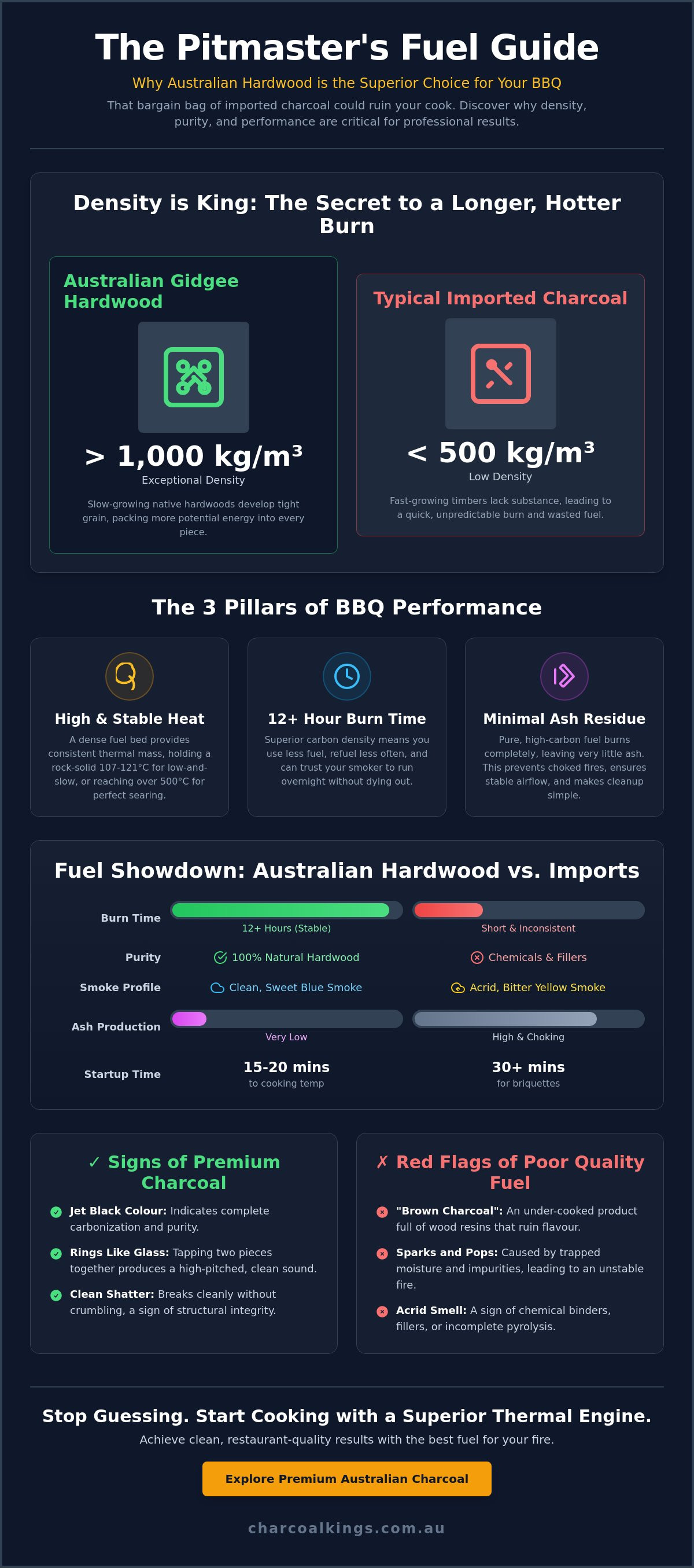
This article explores the hard truth about BBQ fuel performance. You will learn why Australian Gidgee, with a density exceeding 1,000kg per m3, outperforms imported timber by a wide margin. We break down the scientific and culinary reasons why local, chemical-free charcoal is the only choice for achieving professional results. It is about more than just heat; it is about the purity of the burn and the reliability of your thermal engine.
We will compare the burn times, heat output, and flavour profiles of local favorites against common imports. You’ll see how to maintain stable low-and-slow temperatures for your next cook without risking your safety or your reputation as a pitmaster. It is time to stop guessing and start cooking with the most efficient fuel available on the market.
Key Takeaways
- Understand why the high density of native Australian timber acts as a superior thermal engine for long-duration cooks.
- Learn to identify and avoid the hidden chemical fillers and industrial additives found in low-grade imported fuel.
- Master the performance pillars of heat, longevity, and low ash to maintain stable temperatures for 12+ hours.
- Evaluate the unique smoke profiles of Gidgee, Mallee, and Ironbark to find the best charcoal for smoking brisket australia offers.
- Discover why 100% natural hardwood lump is the only choice for achieving a clean, restaurant-quality result for your family.
The Science of Density: Why Australian Hardwoods Outperform Imports
Australian hardwood charcoal is a high-density fuel engineered by nature. It comes from slow-growing native species that survive the continent’s most brutal environments. The harsh Australian climate forces trees to grow slowly, which creates exceptionally tight grain structures in the timber. This structural integrity is the secret behind why local fuel is the best charcoal for smoking brisket australia has to offer. While softwoods from overseas grow quickly and lack substance, our hardwoods are packed with potential energy.
Carbon density is the ratio of pure carbon to volume in a lump of charcoal. Species like Gidgee and Ironbark possess a much higher carbon density than fast-growing imported softwoods or plantation timbers. When you use a fuel with superior density, you’re packing more heat into every cubic centimetre of your firebox. This translates directly to efficiency and control during your cook.
To better understand this concept, watch this helpful video:
Growth Rates and Thermal Mass
Slow-growing trees produce higher levels of lignin. This organic polymer acts as the primary fuel source for high-heat charcoal. Because Australian hardwoods take decades to mature in arid conditions, they develop a massive amount of thermal mass. This mass is what prevents temperature yo-yoing during a 12 hour brisket session. A dense fuel bed holds its heat even when you open the smoker lid or when ambient temperatures drop overnight. The higher BTU output of Gidgee means you use less fuel to maintain the same target temperature compared to lighter, imported alternatives.
The Carbonisation Process and Purity
The quality of your cook depends on the purity of your fuel. The science of charcoal production relies on a process called controlled pyrolysis. This involves heating the wood in an oxygen-free environment to bake off water, resins, and volatile gases. High-quality Australian producers monitor this process with precision to ensure only pure carbon remains. Superior carbonisation leads to a clean burn that produces sweet, blue smoke rather than acrid yellow clouds. You can tell the difference by looking at the product. “Brown charcoal” is under-cooked and still contains wood resins that ruin meat flavour. Premium hardwood lump charcoal is jet black, rings like glass when tapped, and shatters cleanly, indicating a perfect carbonisation cycle.
Heat, Longevity, and Ash: Measuring BBQ Performance in 2026
Performance in the world of professional BBQ isn’t a vague concept. It is measured by three concrete pillars: peak temperature, burn duration, and ash residue. These metrics determine whether your cook is a success or a stressful battle with your vents. High-density Australian fuel excels in all three categories because it contains more energy per lump. When you’re managing a complex cook, you need fuel that acts as a reliable thermal engine rather than an unpredictable heat source.
Start-up time is the first major differentiator. Australian hardwood lump charcoal typically reaches cooking temperature in 15 to 20 minutes. In contrast, imported briquettes often take 30 minutes or longer to ash over. This efficiency saves time and reduces the amount of fire starter required. However, there is a common misconception that hotter is always better. While our hardwoods can reach searing temperatures of over 500°C, stability is the true goal. The best charcoal for smoking brisket australia offers is one that maintains a rock-solid 107°C to 121°C for 12 hours or more without constant adjustment.
Performance Comparison: Aussie Hardwood vs. Imported Mangrove
Mangrove charcoal is a frequent import in the Australian market. It is often cheaper, but it comes with significant performance trade-offs. Mangrove and pine-based charcoals are notorious for “sparking and popping.” These mini-explosions occur when pockets of trapped gas or moisture ignite rapidly. This creates a safety hazard and can deposit tiny fragments of ash onto your meat. This instability ruins the experience of barbecuing with charcoal. Gidgee and Ironbark burn with a silent, intense glow. Because they are denser, you’ll find you use significantly less fuel by weight to achieve the same thermal result as imported alternatives.
Ash Content and Airflow Management
Ash is the silent killer of long-range cooks. High ash content is the primary enemy of airflow in ceramic grills and kettles. As the charcoal burns, the remaining minerals form a powder that settles at the bottom of the firebox. If this layer becomes too thick, it chokes the intake vents. Premium Australian hardwoods typically produce less than 3% ash by volume. This is a fraction of the residue left behind by imported products that use clay or limestone as binders. Low ash production means your vent adjustments remain precise from the first hour to the fifteenth. You won’t need to stir the coals or clear the grate mid-cook, which keeps your pit temperature stable. If you value this level of precision, consider upgrading to a premium hardwood lump for your next session.
Chemical Purity vs. Fillers: The Hidden Cost of Cheap Charcoal
Cheap imported briquettes often hide a cocktail of industrial waste. To lower production costs, manufacturers frequently use fillers like coal dust for heat, limestone to make the ash look whiter, and cornstarch as a binder to hold the shape together. These ingredients aren’t fuel; they’re contaminants. When sourcing the best charcoal for smoking brisket australia enthusiasts must look beyond the brand name and examine the ingredient list. If a bag doesn’t explicitly state “100% natural” or “no additives,” you’re likely burning chemicals in your pit.
The aroma test is the most immediate way to judge fuel quality. When you first light your chimney, pay attention to the scent. Pure Australian hardwood charcoal smells like the outback; it has a clean, woody fragrance. Low-grade fuel often emits a thick, acrid white smoke that smells like a workshop or a petrol station. This is the smell of binders and accelerants burning off. If it smells foul in the chimney, it’ll taste foul on your meat.
Some backyard cooks argue that briquettes offer better consistency. While they provide a uniform shape, they sacrifice purity. Premium Australian lump charcoal provides a superior experience because it is nothing but carbonised timber. You don’t need to trade flavour for stability when you use a high-density native hardwood that burns clean from start to finish.
The Problem with Petroleum Starters and Binders
Chemical binders do more than just smell bad. They can leave a distinct metallic or “off” flavour on delicate meats, particularly during long brisket cooks where the meat is exposed to smoke for 12 hours. Burning these petroleum-based additives in your backyard also has a negative environmental impact, releasing unnecessary pollutants into your immediate cooking area. Pure Australian hardwood is naturally resinous enough to light easily with a simple fire starter or paper. It doesn’t require chemical assistance to reach a stable burn.
Natural Lump vs. The Mystery Bag
The term “Hardwood Blend” on a bag is often a red flag. This vague labeling frequently hides low-quality scrap wood, old pallets, or even construction timber that may have been chemically treated. You should always be able to see the distinct wood grain in your charcoal lumps. This visibility is proof of its organic origin. High-quality Australian lump is easy to identify by its physical characteristics. It should have a glassy clink when pieces hit each other and a clean, sharp break rather than crumbling into dust. This structural integrity ensures that the best charcoal for smoking brisket australia offers will hold its shape and maintain airflow throughout the entire duration of your cook.
The Flavour Profile of the Outback: Mallee, Gidgee, and Ironbark
BBQ flavour starts in the soil. The concept of terroir isn’t limited to vineyards; it applies equally to the fuel in your firebox. In the Australian outback, the combination of mineral-heavy earth and severe drought cycles creates timber with a unique chemical signature. When carbonised, these native species release what pitmasters call a “noble” smoke. It is a refined, clean aroma that complements high-quality protein without the bitter, resinous aftertaste found in fast-growing softwoods. This sophisticated profile is a primary reason why native timber is the best charcoal for smoking brisket australia offers to serious cooks.
Native Australian hardwoods don’t mask the natural flavour of the meat. Instead, they provide a clean thermal environment where the fat can render and the spices can bloom. If you’ve ever tasted a brisket that had a chemical or “dirty” smoke flavour, you were likely tasting the resins of inferior timber. Switching to a high-density local fuel eliminates this risk entirely. You can view our professional grade Australian charcoal to see the specific varieties available for your next cook.
Gidgee: The Heavyweight Champion of Heat
Gidgee stands alone as a biological powerhouse. It is verified as the world’s third densest wood, with a density exceeding 1,000kg per m3. This density translates into a massive energy reserve. While it is the preferred choice for professional hibachis and intense searing, its culinary value in low-and-slow BBQ is unmatched. The flavour is intense and clean. It carries a slight sweetness that cuts through the heavy fat of a brisket. Gidgee provides a robust bark without the acridity common in cheaper, lighter fuels. It is the engine of choice for any cook lasting over 12 hours.
Ironbark and Mallee: The All-Rounders
Ironbark and Mallee Root serve as the essential all-rounders for the Australian pitmaster. Ironbark is famous for its endurance. It offers the longest, most stable burn times in offset smokers, providing a steady, mild smoke that works perfectly with beef ribs. Mallee Root is prized for its ability to create a massive, long-lasting coal bed very quickly. The gnarled structure of the root ensures it doesn’t break down into ash immediately, maintaining its shape and heat for hours. Use the guide below to match your fuel to your meat:
- Gidgee: Best for heavy beef cuts like brisket and thick steaks.
- Ironbark: Ideal for long offset cooks with pork shoulder or beef ribs.
- Mallee Root: Excellent for lamb and poultry due to its clean, lighter profile.
- Hardwood Blends: Versatile for everyday grilling and shorter smoking sessions.
Choosing the right species is about matching the intensity of the smoke to the character of the meat. Australian hardwoods provide the flexibility to do this with precision. You aren’t just burning wood; you’re seasoning your food from the inside out with the essence of the outback.
Why Charcoal Kings Sources Only the Best Australian Hardwood
Charcoal Kings doesn’t just stock fuel; we curate it. Our selection process is rigorous because we understand that a pitmaster’s reputation is only as good as their fire. We reject low-density timbers and focus exclusively on the slow-growing hardwoods that provide superior thermal mass. Every batch of our premium hardwood lump undergoes a strict quality check to ensure it meets our standards for carbon density and purity. When you buy from a specialist supplier, you aren’t just getting a bag of carbon. You’re getting the assurance of a clean, chemical-free cook for your family and friends.
Big-box retailers prioritize shelf space and low price points over thermal performance. This often results in bags filled with small fragments, excessive dust, and inconsistent wood species. We support local Australian industry by working with producers who understand the specific needs of the BBQ community. Our commitment to 100% natural production means you never have to worry about the industrial fillers or coal dust found in supermarket briquettes. It is a professional-grade product designed for those who take their craft seriously.
From the Bush to Your Barbie
Ethical sourcing is at the core of our operation. We utilize sustainably harvested Australian hardwoods that have been cleared in accordance with strict local regulations. Our sizing and grading process is what sets us apart from the competition. We ensure you receive large, usable chunks that facilitate better airflow and longer burn times. This attention to detail is why many consider our range the best charcoal for smoking brisket australia has available. Beyond our standard lump, we offer specialized products like binchotan charcoal for those seeking the pinnacle of clean, high-heat performance.
Start Your Next Cook with the Best
Professional chefs and competitive pitmasters don’t settle for supermarket fuel. They choose Australian hardwood because it offers the predictability required for restaurant-quality results. Transitioning from basic fuel to premium charcoal is simple. Start by clearing your firebox of old ash and layering our high-density lump to allow for maximum airflow. You’ll notice the difference in the first twenty minutes. The lack of acrid smoke and the incredible stability of the heat will transform your cooking experience. It is time to stop fighting your fuel and start mastering your craft. Upgrade your BBQ fuel today with Charcoal Kings and see why local hardwood is the undisputed king of the pit.
Master Your Pit with Native Hardwood
High-density Australian timber is the only fuel that provides the thermal mass required for professional results. You now understand how Gidgee and Ironbark outperform imported softwoods in heat output and burn duration. Switching to a 100% additive-free fuel ensures that your meat is seasoned by pure, noble smoke rather than industrial fillers or chemical binders. This reliability and purity is why Charcoal Kings is trusted by professional BBQ competition teams across Australia. They don’t leave their results to chance, and neither should you.
Similarly, for those managing the business side of a BBQ venture or any Australian enterprise, partnering with a reliable advisor like Business Wise ensures that compliance and accounting details are handled with the same professional care.
Achieving the perfect bark and tender texture requires the best charcoal for smoking brisket australia has to offer. Don’t let inconsistent temperatures or acrid smoke sabotage your hard work and expensive cuts of meat. Our hardwood lump is sourced directly from the outback to give you a clean, efficient, and powerful burn every time. It is time to stop settling for big-box compromises and start cooking with the authority of a master craftsman. Your family and your smoker deserve the best thermal engine available.
Experience the power of premium Australian Hardwood Lump Charcoal and elevate your next cook today. Get that fire started with confidence.
Frequently Asked Questions
Is Australian charcoal more sustainable than imported charcoal?
Yes. Australian hardwood is harvested under strict environmental regulations that prevent over-clearing and protect native ecosystems. Buying local also significantly reduces the carbon footprint associated with shipping heavy fuel from overseas. You’re supporting a regulated industry that prioritizes forest health and sustainable land management over the mass extraction often seen in unregulated international markets.
Why does imported charcoal spark and pop so much compared to Australian lump?
Imported charcoal often comes from fast-growing, porous species like mangrove or pine. These timbers contain tiny pockets of trapped air and moisture that expand and explode when they hit high heat. Australian hardwoods are too dense for these pockets to form. This results in a silent, stable burn that’s safer for your backyard and better for your grill’s longevity.
Can I use Australian hardwood charcoal in a ceramic Kamado grill?
Absolutely. High-density hardwood is the ideal fuel for ceramic cookers. The low ash production of native timber ensures your intake vents stay clear during 12 hour sessions. This prevents the airflow blockages that cause temperature drops in Kamados. It is the most efficient way to maintain the precise thermal control these grills are designed for.
How long does a bag of premium Australian Gidgee charcoal typically last?
Gidgee is exceptionally efficient due to its massive energy reserve. A single load in a large smoker can maintain stable temperatures for over 12 hours without needing a refill. It’s widely considered the best charcoal for smoking brisket australia provides because its high carbon density means you use significantly less fuel by weight compared to softwood alternatives.
Is it worth using Australian charcoal for a quick burger cook?
It’s definitely worth the switch. Even for short cooks, the absence of chemical additives ensures your food tastes like meat rather than industrial binders or accelerants. Premium charcoal reaches searing temperatures faster than supermarket bags. You’ll get a cleaner, hotter fire that’s ready to cook in under twenty minutes with no chemical aftertaste.
What is the difference between Australian Mallee Root and Ironbark charcoal?
Ironbark is the endurance champion for offset smokers, offering a mild smoke profile and incredibly long burn times. Mallee Root is prized for its ability to create a deep, glowing coal bed very quickly. Mallee is an excellent choice for lamb and poultry, while Ironbark remains a staple for heavy beef cuts and professional pitmasters.
Does Australian charcoal have a shelf life if stored properly?
Pure charcoal has no expiration date. It will remain effective for years as long as it stays completely dry. Moisture is the only enemy of your fuel. If the lumps absorb water from the air, they’ll be difficult to light and will produce steam instead of clean heat. Store your bags in a sealed container or a dry shed.
Why is some charcoal called restaurant grade?
Restaurant grade refers to the sizing and purity of the lump charcoal. It means the bag contains large, uniform chunks with minimal small pieces or dust. This grading ensures the consistent heat and maximum airflow that professional chefs require for high-volume service. It indicates a premium product that has been screened for quality and structural integrity.