
Most backyard cooks spend their entire afternoon fighting their vents while ignoring the most critical variable in the pit: the fuel itself. You’ve likely felt the frustration of watching a premium cut of meat suffer because your heat plummeted, or seeing it char because the temperature spiked out of control. It’s a common struggle that turns a relaxing cookout into a high-stress chore. Understanding how to control temperature on a charcoal grill isn’t just about sliding a metal tab; it’s a precise science of oxygen and carbon.
We’re going to fix that. You’ll master the art of heat management by understanding the critical relationship between airflow velocity, fuel quality, and coal arrangement. This guide promises to give you the expertise needed to maintain a rock-solid temperature for hours and switch easily between searing heat and low-and-slow smoking. We’ll break down the mechanics of intake vents, the benefits of additive-free Hardwood Lump Charcoal, and the specific coal setups required for total thermal stability.
Key Takeaways
- Understand the mechanical difference between your intake and exhaust vents to master both raw heat and fine-tuning.
- Discover how to control temperature on a charcoal grill using strategic coal arrangements like the Two-Zone system and the Minion Method.
- Identify the common environmental and maintenance factors, such as ash buildup and wind, that cause thermal fluctuations during a cook.
- Learn why the purity of your fuel, specifically additive-free Hardwood Lump Charcoal, is the foundation of professional-grade heat stability.
The Physics of Fire: Understanding Charcoal Heat Control
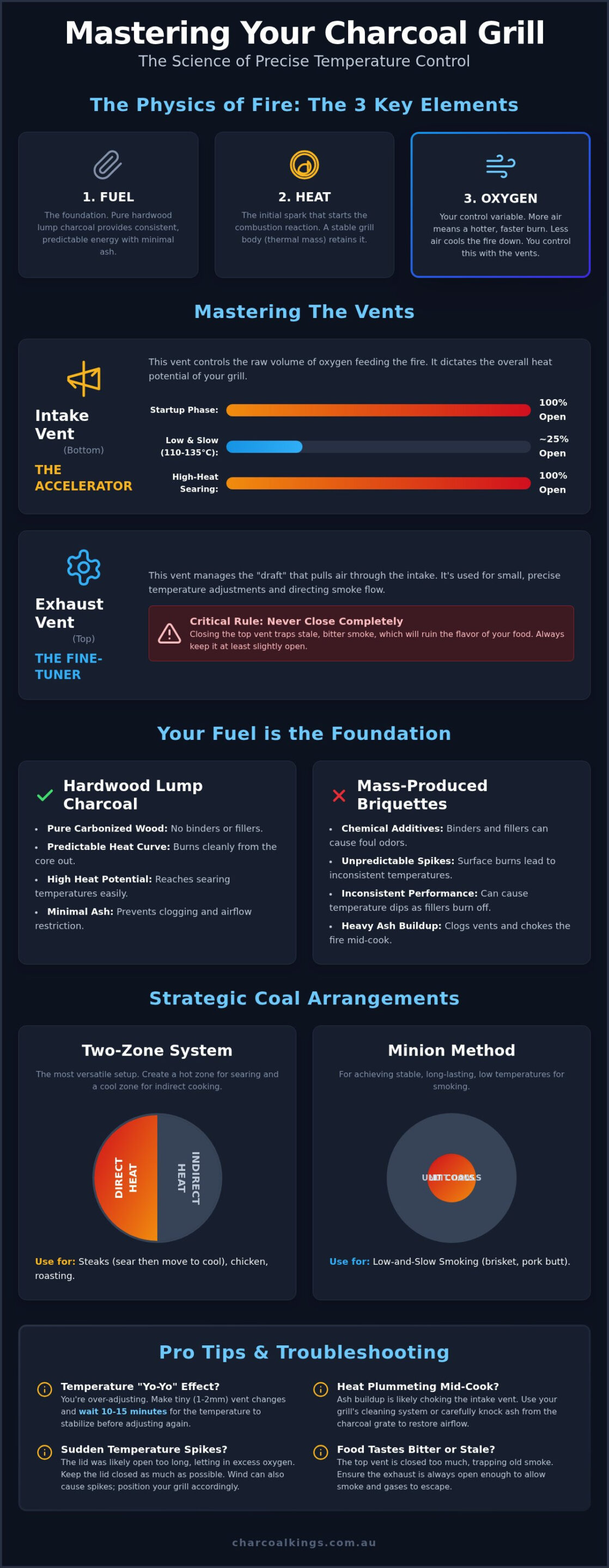
Fire is a chemical reaction, not a mystery. It requires three components in a precise balance: fuel, heat, and oxygen. If you remove one, the fire dies. If you restrict one, the reaction slows. This is the fundamental truth behind how to control temperature on a charcoal grill. Many beginners believe that adding more fuel is the only way to increase heat. In reality, the temperature is governed by the rate of combustion. A small pile of coals with massive airflow will burn hotter and faster than a large pile choked of oxygen.
Your Barbecue grill acts as a combustion chamber where thermal mass plays a vital role. Thermal mass refers to the ability of the grill body and the coal bed itself to retain heat. Heavy-duty hardware and a dense bed of coals create a heat reservoir. This reservoir provides stability, helping the pit resist outside fluctuations like wind or sudden drops in ambient temperature. Cheap, thin-walled grills lose heat quickly, forcing the fire to work harder and making precise control nearly impossible.
The Oxygen Equation
Think of oxygen as your accelerator pedal. More air creates a hotter, more aggressive burn. Less air brings the temperature down. Closing the lid is non-negotiable for consistent regulation. An open lid allows unlimited oxygen to reach the coals, causing them to burn out of control and waste fuel. Effective heat management relies on “Draft.” This is the physical process where hot air rises through the exhaust vent, creating a vacuum that pulls fresh, oxygen-rich air through the intake and directly into the coal bed. Without this flow, the fire stalls.
Fuel Density and Burn Time
Mastering how to control temperature on a charcoal grill starts with selecting a fuel that behaves consistently. Premium hardwood lump charcoal offers a predictable heat curve because it is pure carbonized wood. Unlike mass-produced briquettes that often rely on surface burns and chemical binders, lump charcoal burns from the core outward. The purity and the absence of additives ensure that your fire doesn’t suffer from random temperature spikes or foul-smelling dips caused by burning fillers. Pure fuel provides clean energy and leaves behind minimal ash. This is critical because heavy ash buildup from inferior fuels can clog your intake grates, choking the fire and causing your temperatures to plummet mid-cook.
Mastering the Vents: Your Grill’s Intake and Exhaust
Vents are the mechanical interface for heat management. They are not binary switches. Learning how to control temperature on a charcoal grill requires treating these components as precision instruments rather than simple doors. The intake and exhaust work in tandem to create a specific flow rate. If you master this flow, you master the cook. Many hobbyists make the mistake of swinging vents wide open or shut when they see the needle move. This creates a “yo-yo” effect where the temperature never settles. Small adjustments of just 1-2mm are often enough to swing the internal temperature by 10 or 15 degrees. Patience is the hallmark of a professional pitmaster. Always wait 10-15 minutes after an adjustment to see the true result on your thermometer. Heat takes time to radiate through the grill body and the coal bed.
Setting the Intake (Bottom Vent)
The bottom vent is your accelerator pedal. It dictates the raw volume of oxygen entering the firebox. During the startup phase, keep this vent wide open. This establishes a strong, healthy coal bed and ensures the fire has the oxygen it needs to ignite the core of your fuel. Once you reach your target range, you must restrict the flow to maintain stability. For low-and-slow smoking between 110°C and 135°C, restrict the intake to roughly 25% capacity. High-heat searing for steaks requires the intake to be fully open to maximize combustion and reach peak temperatures. This level of control is significantly easier when using high-quality BBQ accessories that provide airtight seals and prevent oxygen leaks from bypassing your settings.
Managing the Exhaust (Top Vent)
The top vent is your precision dial. Its primary role is managing the vacuum that pulls air through the bottom while venting exhaust gases. Never close the top vent completely while food is on the grate. Doing so traps stale, bitter smoke that ruins the organic flavour of the meat. If you encounter a temperature spike, closing the top vent to a sliver can choke the draft and drop the heat faster than adjusting the bottom alone. This exhaust also plays a critical role in establishing a two-zone fire by directing heat and smoke across the food toward the indirect side. Use the top vent to fine-tune the final 5-10 degrees of your target temperature. It is your most effective tool for subtle, real-time thermal regulation.
Strategic Coal Arrangement: The Two-Zone System
The Two-Zone system is the foundation of versatility. By piling coals on one side, you create a direct heat zone for searing and an indirect zone for convection cooking. For long-duration cooks, the Minion Method and the Snake Method are essential tools. The Minion Method involves placing a small amount of lit charcoal atop a large bed of unlit fuel. This allows the fire to migrate slowly, maintaining a steady 110°C to 135°C for hours. The Snake Method takes this further by arranging coals in a dual-layered semi-circle around the grill’s perimeter. Lighting one end creates a slow-burning fuse. This method is famous for providing over 12 hours of unattended stability in kettle-style grills.
Direct vs. Indirect Heat Zones
The direct zone is reserved for high-intensity searing at temperatures exceeding 250°C. This is where you develop crust and colour on steaks or burgers. The indirect zone functions like a convection oven. It allows you to roast large cuts or smoke delicate proteins without the risk of flare-ups. Moving meat between these zones is the most effective way to manage internal temperatures without scorching the exterior. If the surface is darkening too quickly but the center remains undercooked, the indirect zone acts as your safety net.
Lump Charcoal vs. Briquettes for Temperature Control
Fuel choice directly impacts your thermal profile. Briquettes are engineered for uniformity, offering a flat and predictable heat curve that suits beginners. However, they often contain binders and fillers that increase ash production, which can eventually choke your airflow. Hardwood Lump Charcoal is the professional choice for flavour and heat because it reaches higher peak temperatures and responds instantly to airflow adjustments. While lump requires more active management due to varying piece sizes, it provides a superior sear and a cleaner burn. Hardwood Lump Charcoal is the preferred fuel for those who prioritize purity and authentic wood-fired results. Mastering how to control temperature on a charcoal grill is significantly easier when your fuel doesn’t contain unpredictable additives.
Troubleshooting: Why Your Grill Temperature is Fluctuating
Even after mastering the vents and coal arrangements, external variables can sabotage your cook. Wind is a primary culprit. It forces air into the intake vents at higher velocities than intended, causing unexpected heat spikes. During cold Australian winters, the ambient air saps heat from the grill’s exterior, forcing the fire to work harder to maintain a baseline. Understanding how to control temperature on a charcoal grill requires acknowledging these environmental pressures. You must adjust your vent settings based on the day’s conditions, not just a fixed formula.
Your lid thermometer is likely lying to you. Factory-installed gauges measure the air temperature at the top of the dome, which can be 20 to 50 degrees different from the actual cooking surface. For true accuracy, use a digital probe positioned at the grate level. Additionally, be aware of the “Cold Meat Effect.” Placing a massive, chilled brisket or pork shoulder onto the grate acts as a thermal sink. The internal temperature of the pit will drop immediately. Resist the urge to swing the vents wide open. The grill will naturally recover as the meat warms up and the thermal mass stabilizes.
Dealing with Ash and Blockages
Ash is the silent killer of airflow. If the bottom grate is clogged, oxygen cannot reach the coal bed, and your fire will stall regardless of vent position. Always start your cook with a completely clean firebox. During long smoking sessions, use a grill tool to safely knock ash through the lower grates to keep the intake paths clear. This is where fuel selection becomes a performance factor. Cheap, filler-heavy fuels produce massive amounts of volume-clogging ash. Professional-grade, low-ash charcoal allows for much longer burns with minimal maintenance.
Recovering a Dying Fire
If your temperatures begin to plummet and the vents are already open, your fire is struggling for life. Use the “Burping” technique by opening the lid slowly to introduce oxygen without causing a dangerous flashover. If the coal bed is nearly exhausted, you must add more fuel. Introduce unlit coals for a gradual temperature climb, or add half a chimney of fully lit coals for an immediate recovery. If the fire is truly beyond saving, move the meat to an indoor oven to finish the cook safely. To avoid this frustration in the future, ensure you are using high-performance Hardwood Lump Charcoal that offers superior longevity and consistent heat output.
The Charcoal Kings Advantage: Fuel Purity and Performance
Mastering how to control temperature on a charcoal grill is a redundant skill if your fuel is unpredictable. Professional pitmasters and commercial kitchens demand additive-free, natural hardwood charcoal because it offers a consistent baseline. When you use pure carbonized wood, you remove the variables of chemical binders and industrial fillers. Australian hardwood varieties are specifically prized for their high density. This density translates to superior heat retention and a longer, more stable burn. Sourcing your fuel from a specialist supplier ensures you receive graded, high-performance product rather than the floor-sweepings often found in big-box hardware stores.
For those seeking the pinnacle of thermal stability, Binchotan Charcoal represents the ultimate in high-intensity heat. This traditional Japanese white charcoal burns at a steady, searing temperature for hours without the fluctuations common in lesser fuels. It produces virtually no smoke or odour, allowing the organic flavour of the meat to remain the focus. Whether you are running a high-volume restaurant or a dedicated home pit, the purity of your fuel dictates the precision of your temperature control. High-quality fuel responds to vent adjustments instantly, whereas inferior products often stall or spike regardless of airflow.
The Problem with Cheap Supermarket Charcoal
Mass-market charcoal is often loaded with chemical binders, coal dust, and limestone fillers. These additives are designed to make the product cheaper to produce, but they create foul-smelling smoke that taints your food. Furthermore, supermarket briquettes often feature inconsistent piece sizes. This leads to uneven airflow within the coal bed, creating “hot spots” that make how to control temperature on a charcoal grill an impossible task. The hidden cost of low-density fuel is its burn rate. You will often find yourself using twice as much supermarket charcoal to achieve the same results as a single bag of premium hardwood lump.
Choosing the Right Hardware for Heat Retention
Your fuel needs a professional environment to perform. Heavy-duty steel and ceramic grills assist in temperature stability by acting as a massive thermal reservoir. Once these materials reach their target temperature, they resist the cooling effects of wind and ambient air. It is essential to ensure your pit has airtight seals and high-quality gaskets. Leaky hardware allows “rogue air” to enter the firebox, bypassing your vent settings and causing uncontrollable heat spikes. You can explore a professional range of BBQ grills and smokers specifically designed for precision thermal management. Investing in the right combination of pure fuel and professional hardware is the only way to achieve true mastery over the fire. Happy grilling.
Master the Fire for Superior Results
Achieving total thermal stability is a skill that separates hobbyists from professional pitmasters. You now understand that heat management is a precise balance between oxygen velocity and fuel density. By mastering your intake vents and utilizing strategic coal arrangements like the Two-Zone or Snake Method, you can maintain a rock-solid environment for any cut of meat. Understanding how to control temperature on a charcoal grill removes the guesswork and ensures consistent, restaurant-quality results every time you light the pit.
For those looking to combine this level of control with a versatile outdoor setup, the Bakyard Omnipit – 2 in 1 Fire Pit & BBQ offers a robust solution that transitions seamlessly from a cozy fire pit to a high-performance charcoal grill.
Fuel quality remains the foundation of this process. Charcoal Kings is a trusted wholesale supplier to top Australian restaurants, providing 100% natural hardwood with zero chemical additives. Our products are engineered for high-intensity performance and the longevity required for long-duration cooks. You can also rely on expert advice from our seasoned pitmasters to further refine your technique. Upgrade your BBQ game with Australia’s premium hardwood charcoal and experience the difference that pure, high-density fuel makes. It’s time to stop fighting your grill and start commanding it. Get out there and master the flame.
Frequently Asked Questions
How long does it take for a charcoal grill to reach the right temperature?
It typically takes 15 to 30 minutes to reach a stable cooking temperature. The exact duration depends on your target range and the volume of fuel used. High-heat searing temperatures are reached quickly once the coals are ashed over. Stabilizing a low-and-slow pit requires more time to allow the thermal mass of the grill body to heat up and the airflow to settle.
Why does my charcoal grill keep losing heat after an hour?
Heat loss after an hour is usually caused by ash buildup or poor fuel quality. Excessive ash from inferior briquettes clogs the bottom grate and chokes the oxygen supply. Using high-density Hardwood Lump Charcoal prevents this issue because it burns cleaner and leaves minimal residue. Ensure you are also using enough fuel for the intended duration of your cook to avoid premature exhaustion.
Should I leave the lid open or closed when heating up charcoal?
Leave the lid open while the charcoal is initially igniting to provide maximum oxygen. This helps the fire establish a strong core. Once the coals have ashed over and you are ready to preheat the grill surface, close the lid and adjust your vents. Closing the lid is a critical step in how to control temperature on a charcoal grill because it creates the necessary draft for thermal regulation.
Can I reuse partially burnt charcoal to save money?
You can reuse partially burnt charcoal by knocking off the loose ash before your next cook. This ensures that the old fuel doesn’t block the intake vents. Always mix the reclaimed pieces with fresh Hardwood Lump Charcoal to ensure consistent heat output. Reusing fuel is efficient, but relying solely on old, degraded coals will lead to unpredictable temperature fluctuations and poor airflow.
What is the best temperature for smoking meat on a charcoal grill?
The ideal range for low-and-slow smoking is between 110°C and 135°C. This temperature allows the connective tissues in tough cuts like brisket or pork shoulder to break down without drying out the exterior. Maintaining this narrow range requires precise vent management and a stable fuel source. High-quality hardwood provides the clean, consistent thermal energy needed to hold these low temperatures for twelve hours or more.
How do I lower the temperature quickly if my grill is too hot?
Close your intake vent almost completely to choke the fire of oxygen. Do not open the lid to let the heat out. Opening the lid introduces a massive surge of oxygen that will actually cause the coals to burn hotter once you close it again. If the temperature is dangerously high, you can also restrict the exhaust vent to a sliver to stop the draft and drop the internal heat rapidly.
Does the type of charcoal really affect the temperature?
Fuel composition is a primary factor in how to control temperature on a charcoal grill. Hardwood Lump Charcoal reaches significantly higher peak temperatures and responds faster to airflow changes than standard briquettes. Briquettes offer a flatter heat curve but often contain additives that produce excessive ash. For professional-grade heat and purity, natural hardwood is the superior choice for both high-heat searing and long-term stability.
Is it better to use a chimney starter for temperature control?
A chimney starter is the most reliable tool for establishing a consistent baseline. It allows you to ignite a specific volume of fuel evenly before adding it to the grill. This prevents the temperature spikes caused by large sections of unlit fuel catching fire all at once. Using a chimney ensures you start every cook with a predictable amount of heat, making subsequent vent adjustments much more effective.