

Most backyard cooks believe a roaring flame is the hallmark of a successful BBQ, but that uncontrolled heat is actually your greatest food safety risk. High, erratic temperatures lead to the “burnt-yet-raw” disaster that ruins expensive cuts of meat and puts your guests at risk. You want a perfect sear without the internal danger zone, yet maintaining that balance often feels like guesswork when flare-ups take over.
We understand the frustration of fighting your vents while trying to keep a consistent heat. This guide provides the definitive 2026 checklist on how to control temperature on a charcoal grill for food safety, moving you from reactive fire-fighting to total thermal mastery. You’ll learn to harness the superior heat longevity of premium hardwood lump charcoal and manage oxygen with surgical precision.
We’re covering everything from advanced airflow tactics and fuel stacking to the latest FSANZ internal temperature requirements. By the end of this article, you’ll have the confidence to deliver repeatable, professional-grade results that are 100% safe for every person at your table.
Key Takeaways
- Understand the “Danger Zone” by maintaining internal temperatures above 60°C to stop bacterial growth and prevent the risk of raw centers in charred meat.
- Master how to control temperature on a charcoal grill for food safety by using the 15-minute rule for vent adjustments to ensure stable airflow.
- Establish a Two-Zone cooking environment to provide a dedicated safety area for managing flare-ups and finishing thick cuts of meat evenly.
- Choose 100% natural hardwood lump charcoal for a predictable heat curve that eliminates the dangerous temperature fluctuations caused by chemical additives.
- Use a high-quality digital thermometer and account for carry-over cooking during the resting phase to consistently meet FSANZ safety requirements.
Why Charcoal Grill Temperature Control is Critical for Food Safety
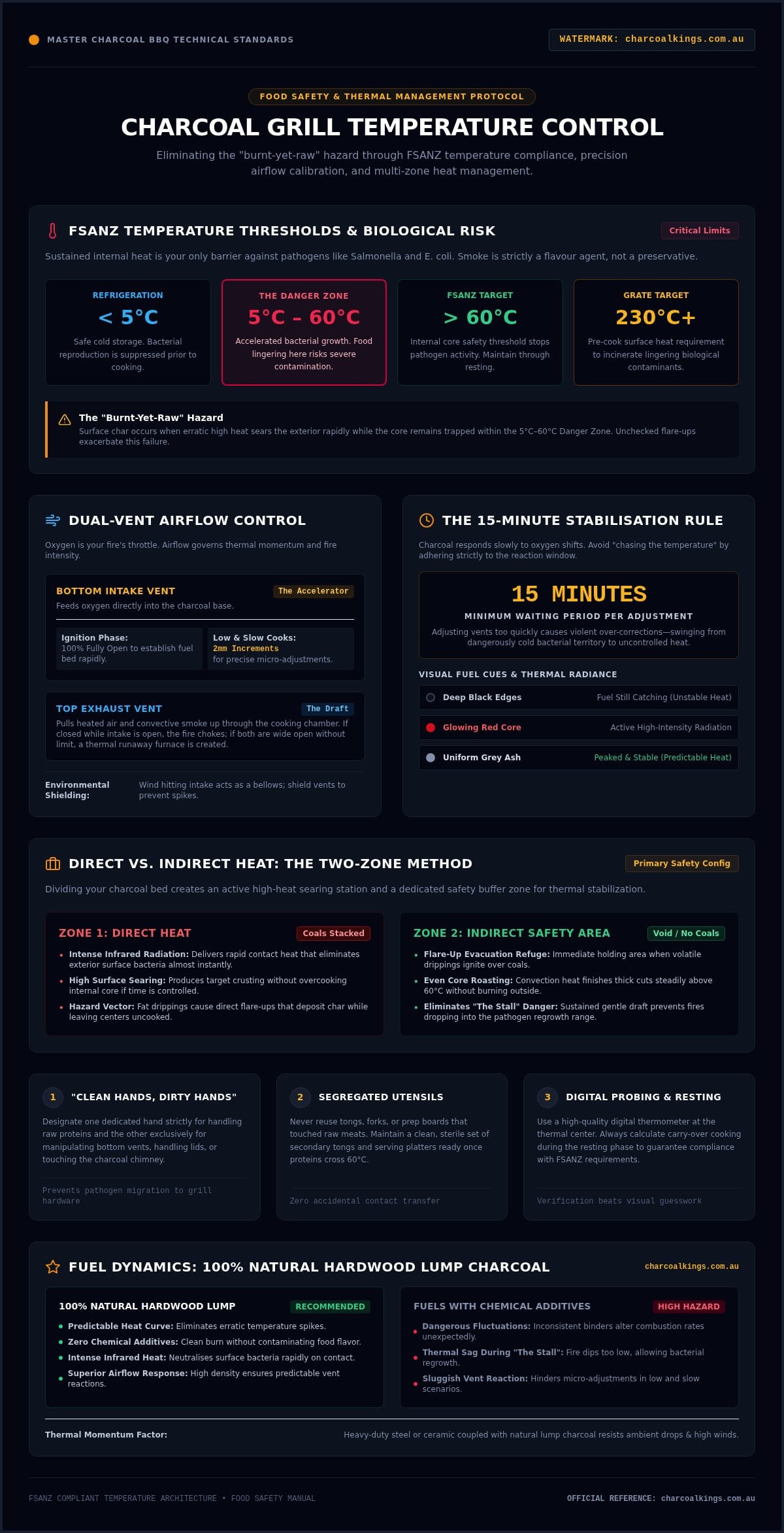
Food safety on the grill begins and ends with heat management. The “Danger Zone” is the specific temperature range between 5°C and 60°C where harmful bacteria multiply at an accelerated rate. According to FSANZ guidelines, maintaining your cook above this threshold is non-negotiable to prevent foodborne illness. When you haven’t mastered how to control temperature on a charcoal grill for food safety, you often encounter the deceptive “surface char.” This occurs when the exterior of a thick cut looks finished, but the internal temperature remains trapped in the Danger Zone, leaving pathogens alive and active.
Temperature fluctuations are particularly dangerous during “the stall” in low and slow cooks. If your fire dips too low for too long, it creates an environment ripe for bacterial regrowth. Professional-grade setups rely on “Thermal Momentum.” This is the ability of heavy-duty steel or ceramic to retain and radiate heat consistently, making charcoal grill heat management much more predictable. A grill with high thermal momentum resists the cooling effects of wind or sudden ambient temperature drops, keeping your meat out of the Danger Zone throughout the entire cooking process.
The Science of Foodborne Illness on the Grill
Heat is your primary shield against common pathogens like Salmonella and E. coli. While some hobbyists believe the smoke from Hardwood Lump Charcoal acts as a preservative, it’s strictly a flavouring agent. Smoke provides the profile you want, but only sustained internal heat ensures safety. Natural charcoal offers a distinct advantage over gas by providing intense infrared heat. This radiation creates a consistent, high-temperature sear that neutralises surface bacteria almost instantly upon contact with the grate.
Avoiding Cross-Contamination Hazards
Hygiene is just as vital as the fire itself. Use the “Clean Hands, Dirty Hands” rule: designate one hand for handling raw proteins and the other for adjusting vents or handling your charcoal chimney. You must ensure your grill grates reach at least 230°C before any food is placed on them to incinerate any lingering biological contaminants. Cross-contamination in a BBQ environment is the accidental transfer of harmful pathogens from raw meat or contaminated surfaces to ready-to-eat food through the use of shared utensils and unwashed equipment. Always have a separate set of clean tongs and platters ready for when the meat reaches its safe target temperature. Additionally, keeping your raw ingredients chilled during transport or while waiting for the grill to reach temperature is vital; using high-quality freezable lunch bags Australia can help maintain that critical cold chain.
Managing Airflow: The Secret to Controlling Charcoal Heat
Oxygen is the throttle for your fire. In a charcoal setup, heat management is a game of two vents. The bottom intake vents act as the accelerator, feeding oxygen directly to the coals. The top exhaust vents function as the draft, pulling heat and smoke up through the cooking chamber. Understanding this relationship is fundamental when learning how to control temperature on a charcoal grill for food safety. If you open the bottom but keep the top closed, the fire chokes. If both are wide open, you create a furnace that can quickly spiral out of control.
Patience is your best tool. You must follow the 15-minute rule: after any vent adjustment, wait at least 15 minutes for the charcoal to react. Adjusting too quickly leads to “chasing the temperature,” where you constantly over-correct and swing from too cold to dangerously hot. Your charcoal provides visual cues for its heat potential. Deep black edges mean the fuel is still catching. A glowing red core indicates active, high-intensity heat. A uniform coating of grey ash signals that the fuel has peaked and is providing stable, predictable radiation.
In Australia, wind is a major variable. A stiff breeze hitting your intake vents acts like a bellows, forcing air into the fire and causing massive heat spikes. Position your grill to shield the intake vents from direct gusts to maintain a steady environment. For those using high-performance Hardwood Lump Charcoal, this stability is easier to achieve due to the fuel’s natural density and purity. Consistent fuel allows for more predictable airflow responses.
Mastering the Bottom Intake Vents
The bottom vents are your primary control for the fire’s intensity. Use these steps to manage your oxygen flow:
- Step 1: Fully open the vents for ignition. This provides the maximum oxygen required to get your charcoal chimney or fuel bed established quickly.
- Step 2: For “Low and Slow” cooks, use micro-adjustments. Moving the vent in 2mm increments can be the difference between a safe 110°C and a runaway fire.
- Step 3: Close the intake completely for emergency heat reduction. Cutting the oxygen supply is the fastest way to kill a flare-up or extinguish the grill after your cook.
Mastering the Top Exhaust Vents
The top vent manages the “draft” and smoke quality. It pulls the heat from the bottom through the food. You should rarely close this vent completely during a cook. Closing it traps “stale smoke,” which creates a bitter, creosote-heavy flavour on your meat. Whether you use a traditional “Daisy Wheel” or a modern “Slide” vent, keep it at least one-quarter open to ensure a clean burn. Following USDA grilling food safety guidelines ensures that while you manage this airflow, you are also maintaining the consistent heat necessary to kill pathogens effectively.
Direct vs. Indirect Heat: The Two-Zone Safety Method
Mastering a Two-Zone fire is the most effective way to manage risk during a cook. This setup involves piling your charcoal on one side of the grill while leaving the other side completely empty. This configuration creates a “hot zone” for high-intensity searing and a “cool zone” for gentle, ambient roasting. Understanding this physical layout is essential when learning how to control temperature on a charcoal grill for food safety. The cool zone acts as your ultimate safety valve. If rendering fat causes a sudden flare-up, you can immediately move the protein to the indirect side. This prevents the exterior from burning while the fire settles, ensuring you don’t end up with a charred surface and a raw, dangerous interior.
This method is a core component of Mastering the Art of Barbecuing with Charcoal. By separating the heat source, you gain total control over the cooking curve. You can “finish” thick cuts of meat by moving them to the indirect side after an initial sear. This allows the internal temperature to rise steadily to FSANZ-recommended levels without the risk of the exterior becoming bitter or overcooked. It turns your grill into a precision tool that balances flavour with absolute safety.
Setting Up the Direct Heat Zone
The direct zone is designed for high-intensity cooking at temperatures exceeding 200°C. It is the ideal environment for thin cuts like steaks, lamb chops, or sausages that require a fast cook time to remain juicy. To achieve this, stack your Hardwood Lump Charcoal at least two or three layers deep. This concentration of fuel creates the radiant energy needed for a proper Maillard reaction. While some old-school cooks use the “hand test” to estimate heat, we always recommend relying on a digital probe. A “three-second” hand test indicates high heat, but it lacks the precision required for modern food safety standards.
Utilising the Indirect Heat Zone
The indirect zone functions like a high-performance convection oven. It is the safest environment for roasting whole chickens, briskets, or thick pork loins. By placing a drip pan on the charcoal grate beneath the meat in the cool zone, you catch rendered fat before it can ignite. This prevents grease fires and the production of acrid smoke that can ruin the meat. Success lies in the transition between zones. Start with indirect heat to bring the internal temperature close to the target, then finish with a quick sear over the direct zone. This ensures the meat is thoroughly cooked through while maintaining a professional, crispy finish.
The Food Safety Checklist: Zones, Temps, and Tools
Precision is the final step in your safety protocol. You’ve mastered airflow and zones, but without data, you’re still guessing. An instant-read digital thermometer is non-negotiable for any serious cook. Old methods like checking if juices run clear are unreliable and dangerous. To truly know how to control temperature on a charcoal grill for food safety, you must measure the thermal core of the meat. FSANZ standards for 2026 emphasize that internal heat is the only metric that matters for killing pathogens effectively.
Resting your meat is equally critical for safety and quality. Carry-over cooking occurs when the internal temperature continues to rise by 2°C to 5°C after the meat is removed from the grill. If you pull a roast at exactly its target, it may overcook; pull it too early, and it might stay in the danger zone. Hygiene doesn’t stop at the fire. You must clean your thermometer probe with an alcohol wipe or hot soapy water between every check. Inserting a probe that touched raw meat into a nearly finished roast is a direct path to cross-contamination. According to FSANZ, the safe internal temperature for Australian poultry is 74°C.
Essential BBQ Safety Tools
A dual-probe thermometer allows you to monitor the grill’s ambient temperature and the meat’s internal temperature simultaneously. This prevents unexpected spikes that could lead to surface charring while the inside stays raw. Invest in professional-grade BBQ Accessories like long-handled tongs and spatulas. These tools keep your hands away from 300°C+ heat. Heat-resistant gloves are also essential for safe charcoal manipulation when you need to bank coals or adjust your fuel bed mid-cook.
Target Internal Temperatures for 2026
Follow these FSANZ-aligned targets to ensure every meal is safe for your guests. Understanding these numbers is the core of how to control temperature on a charcoal grill for food safety during the final stages of the cook:
- Poultry: 74°C. There are no exceptions for safety here.
- Ground Meats and Sausages: 71°C. The grinding process moves surface bacteria into the centre, requiring a higher internal temperature to neutralise risks.
- Beef and Lamb: 63°C for Medium Rare, 71°C for Medium, and 77°C for Well Done.
Always insert your probe into the thickest part of the meat, avoiding bone or fat pockets. This ensures your reading reflects the actual safety of the entire cut. Reliable data combined with high-performance fuel is the only way to guarantee a perfect, safe result every time.
Choosing High-Performance Charcoal for Stable Safety
Selecting the right fuel is a technical decision that directly impacts the safety of your cook. Low-grade charcoal often contains chemical additives and fillers that cause the fire to “pulse,” creating dangerous temperature drops mid-cook. These dips can trap your meat in the bacterial danger zone for far too long. If you want to know how to control temperature on a charcoal grill for food safety, you must start with a fuel that offers a linear, predictable energy release. Impurities in cheap fuel don’t just affect flavour; they compromise the thermal stability of your entire grill environment.
Hardwood Lump Charcoal is the professional standard for a reason. It’s 100% natural and provides superior heat longevity compared to mass-produced briquettes. While briquettes offer uniformity, their high ash content can physically block your grill’s intake vents, choking the fire and causing the temperature to plummet just when you need it most. Pure lump charcoal leaves minimal residue, ensuring your airflow remains unobstructed throughout the entire duration of the cook. This allows your vent adjustments to remain responsive and accurate.
For the ultimate in thermal stability, Binchotan is unmatched. This traditional Japanese fuel burns at a consistent, high temperature for hours without the erratic flare-ups associated with lower-quality materials. It allows for surgical precision in heat management, which is why it’s favoured by top-tier chefs across Australia. You can find more detail on this high-performance fuel in our Binchotan Charcoal: The Ultimate Guide.
The Benefits of Additive-Free Fuel
- Cleaner burn: Eliminates the risk of chemical taints or acrid fumes penetrating your food during long cooks.
- Lower ash production: Prevents airflow blockages in the bottom of the grill, which is essential for maintaining the 15-minute adjustment rule.
- Predictable energy density: Ensures you know exactly how much heat a specific volume of fuel will produce, removing the guesswork from your safety protocol.
Why Charcoal Kings is the Professional Choice
We don’t compromise on purity. Our products are sourced from premium natural hardwood to ensure you get the heat longevity required for safe, professional-grade BBQ. Based in Holden Hill, SA, we supply the entire Australian BBQ community with the reliable, high-heat fuel needed to master how to control temperature on a charcoal grill for food safety. Stop fighting your fire and start commanding it with fuel that performs every time you light the chimney.
Upgrade your fuel for safer, better BBQ today at Charcoal Kings. Our commitment to quality ensures your guests are served meat that is perfectly seared and thoroughly cooked to the highest safety standards.
Master the Flame for Ultimate BBQ Safety
Mastering how to control temperature on a charcoal grill for food safety is the difference between a stressful cook and a professional result. By establishing a two-zone setup and respecting the 15-minute rule for vent adjustments, you eliminate the unpredictable heat spikes that lead to raw centers. Relying on digital accuracy rather than outdated visual cues ensures every cut meets FSANZ standards for 2026, keeping your guests safe from the danger zone throughout the entire process.
Your choice of fuel is the foundation of this control. Chemical additives in inferior products cause erratic thermal dips, while 100% natural hardwood provides the stable, high-performance energy needed for total precision. Trusted by Australian Pitmasters, our range is designed for those who value quality and performance above all else. Success on the grill is built on superior materials and technical mastery. Don’t leave your results to chance when you can command the fire with the right tools.
Shop Premium Hardwood Charcoal for Your Next Safe BBQ and take command of your grill today. Fire up with confidence knowing your heat is predictable and your food is safe. Happy grilling!
Frequently Asked Questions
What is the safest temperature to cook chicken on a charcoal grill?
The safest internal temperature for chicken is 74°C according to FSANZ 2026 standards. You should always measure this at the thickest part of the breast or thigh using a digital instant-read thermometer. Achieving this target ensures all harmful pathogens like Salmonella are neutralised. Maintaining a steady grill temperature between 180°C and 200°C allows the poultry to cook through evenly without burning the skin before the centre is safe.
How do I lower the temperature quickly if my charcoal grill is too hot?
To lower the temperature quickly, close the bottom intake vents completely to starve the fire of oxygen. Simultaneously, move your meat to the indirect “cool zone” to prevent surface charring while the internal grill environment cools down. This is a vital part of how to control temperature on a charcoal grill for food safety. Never close the top exhaust vent entirely, as this traps acrid smoke and creates bitter flavours.
Can I reuse charcoal from a previous cook for safety?
Reusing charcoal is safe and efficient if you use premium hardwood lump charcoal. Before relighting, always shake the charcoal grate or use a poker to knock off old ash. This ensures the bottom intake vents aren’t blocked, allowing for the consistent airflow required for safe temperature management. Add a handful of fresh lump charcoal to provide a reliable energy boost and ensure the fire has enough fuel for the session.
How long should I preheat my charcoal grill before adding food?
You should preheat your grill for 15 to 20 minutes after the charcoal is lit and placed in the bowl. This allows the grates to reach at least 230°C, which is necessary to incinerate any biological contaminants from previous sessions. Only add food once the charcoal is covered in a light layer of grey ash. This signifies the fuel has reached a stable state for predictable, safe heat management.
What temperature kills most foodborne bacteria on a BBQ?
Most foodborne bacteria are killed when internal temperatures reach 63°C for beef and 74°C for poultry. On the grill surface, temperatures above 230°C are required to sterilise the grates before any food touches them. Understanding these specific benchmarks is the foundation of how to control temperature on a charcoal grill for food safety. Always rely on a digital probe rather than visual cues like “clear juices” to confirm these targets are met.
Why is my charcoal grill losing heat halfway through cooking?
Heat loss is typically caused by ash buildup blocking the bottom intake vents or the use of inferior fuel containing chemical additives. These additives create unpredictable burn rates and excessive residue that chokes the fire. Switching to additive-free hardwood lump charcoal ensures superior heat longevity and a cleaner burn. Regularly clearing the ash pan during long cooks will maintain the oxygen flow needed to keep your fire established and safe.
Is it safe to use lighter fluid to start my charcoal?
We do not recommend using lighter fluid because it introduces chemical taints and creates erratic, dangerous flare-ups. These chemicals can linger on your grill grates and eventually penetrate your food. For a safe and consistent start, use a charcoal chimney starter with natural firelighters. This professional method provides a clean, even ignition that makes managing your subsequent cooking temperatures much more predictable and free from chemical contamination.
How do I check the temperature of my grill if it doesn’t have a built-in thermometer?
You should use a digital dual-probe thermometer to monitor the ambient temperature at the grate level. Built-in lid thermometers are notoriously inaccurate because they measure the air at the top of the dome rather than where the food is actually sitting. Placing a probe roughly 2cm away from your meat provides the most accurate data. This allows you to make precise vent adjustments to maintain a safe, consistent cooking environment.