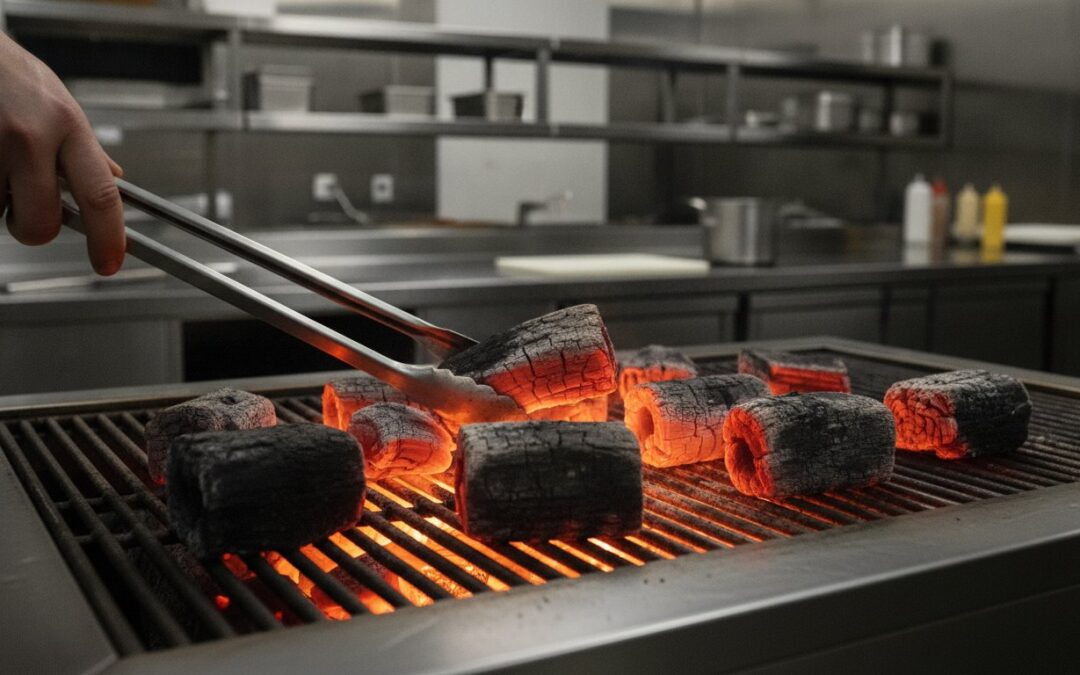
It’s 7:00 PM on a Saturday, the pass is loaded with tickets, and your pit temperature is plummeting because the latest bag of bulk charcoal is 40% dust and undersized chips. Every chef knows that a failing fire is a failing service. You need fuel that performs under pressure without the guesswork. Finding a reliable charcoal supplier for catering business operations means moving beyond the cheapest price per kilo and focusing on performance metrics that actually matter to your bottom line.
We agree that inconsistent heat levels and unreliable delivery schedules are unacceptable risks for any commercial kitchen. You deserve a partner that understands the primal nature of the craft and the technical requirements of high-volume service. This article will show you how to identify a charcoal partner that guarantees consistent heat, pure flavour, and dependable delivery for your business.
We will examine the essential criteria for auditing charcoal quality, including fixed carbon and ash content. You will also learn how to navigate the 2026 international shipping regulations affecting supply and how to secure volume-based pricing that ensures your kitchen never goes cold. It is time to stop fighting your fuel and start mastering your fire.
Key Takeaways
- Understand how standardized grading eliminates unpredictable hot spots and protects your profit margins by reducing wasted kitchen prep time.
- Identify the five non-negotiable traits of a reliable charcoal supplier for catering business success, focusing on moisture control and consistent sizing.
- Compare the performance of Hardwood Lump and Binchotan to determine which fuel type delivers the specific heat profile and flavour required for your menu.
- Learn professional storage and logistics strategies to prevent fuel degradation and ensure your commercial kitchen never faces an “out of fuel” emergency.
- Discover why selecting 100% natural fuel without chemical additives is essential for achieving a perfect Maillard reaction and maintaining a clean cooking environment.
Beyond the Flame: Why Your Choice of Supplier Impacts Your Bottom Line
Professional kitchens often treat charcoal as a simple utility, similar to electricity or gas. This perspective is a costly mistake for any serious operation. In high-end catering, charcoal is a core ingredient. A reliable charcoal supplier for catering business needs understands that the fuel dictates the final result on the plate as much as the protein itself. Your choice of supplier directly influences your food costs, kitchen safety, and brand reputation.
Fuel Consistency and Kitchen Efficiency
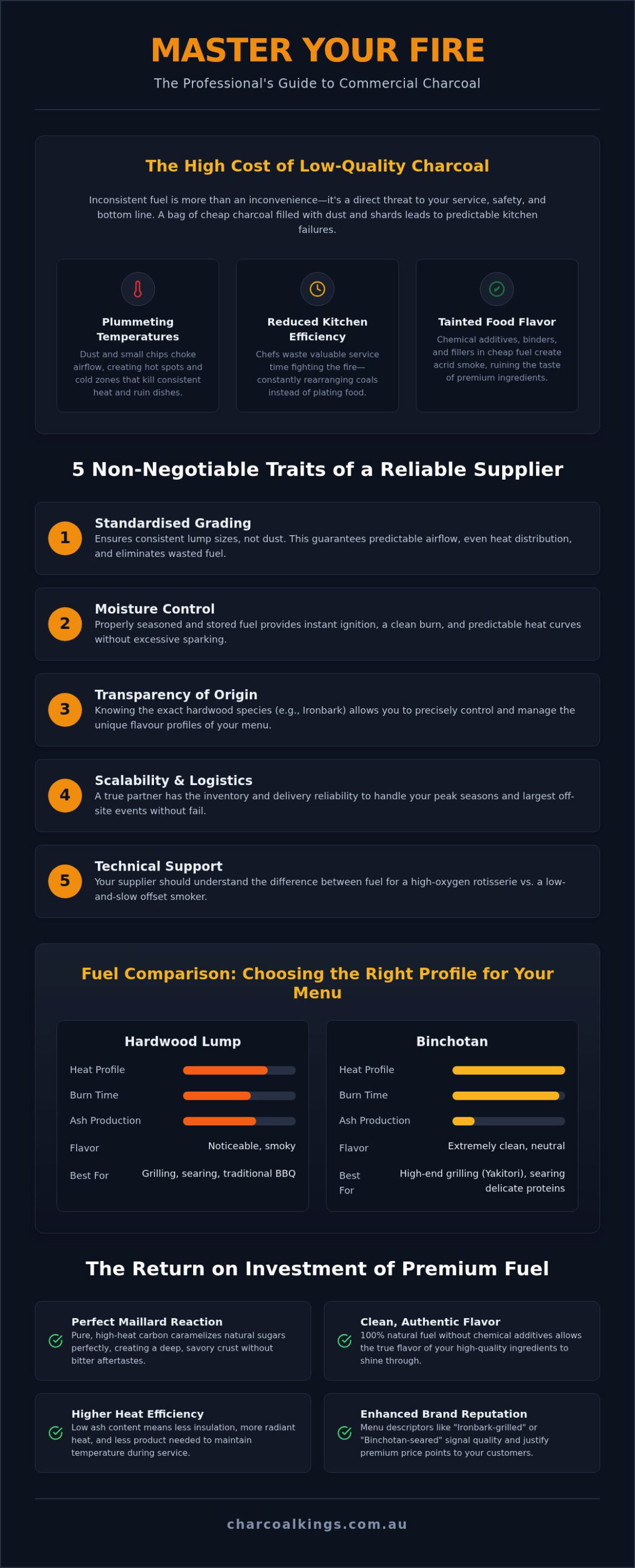
Uniform grading is not a luxury; it’s a requirement for operational success. When you buy bulk bags filled with dust and small shards, you lose money. These small pieces restrict airflow, causing unpredictable hot spots and cold zones across the grill. Chefs then waste valuable prep time constantly rearranging coals instead of focusing on plating and service. Standardized grading ensures your fire behaves exactly as expected every time you light it.
Low-quality wood or improper carbonization also leads to excessive “sparking.” This creates a hazardous environment for staff and increases the risk of embers damaging equipment or property. High-performance fuel burns clean and stays where you put it. High-density hardwood provides a sustained, intense burn that reduces the frequency of refuelling during high-volume events.
The Flavour ROI of Pure Hardwood
Clean heat is essential for a perfect sear. If your fuel contains chemical additives, binders, or fillers, you risk tainting your menu with acrid, artificial smoke. This is particularly damaging for delicate proteins like Barramundi or premium Wagyu. The absence of additives allows the natural sugars in the meat to caramelize properly, facilitating a superior Maillard reaction that delivers a deep, savoury crust without bitter aftertastes.
Looking back at the history of charcoal production, the most effective methods have always focused on removing impurities to leave behind pure carbon. Modern “cheap” charcoal often skips these quality controls, resulting in high ash content. High ash levels act as an insulator, dampening the heat and requiring more product to reach the same temperature. You end up spending more on A$ per service despite the lower initial bag price.
Premium charcoal also serves as a powerful marketing tool. Descriptors like “Ironbark-grilled” or “Binchotan-seared” signal quality to your customers. By partnering with a reliable charcoal supplier for catering business growth, you ensure that your “fire-cooked” menu items live up to the premium price point you set. Authentic fuel produces authentic flavour, and your customers will taste the difference.
5 Non-Negotiable Traits of a Reliable Charcoal Supplier
A reliable charcoal supplier for catering business operations is a partner in your kitchen’s performance. They must provide more than just a delivery service. Expert suppliers understand the technical requirements of high-volume fire cooking and the impact of fuel quality on your staff’s workflow. If a supplier can’t discuss carbonisation levels or specific hardwood densities, they aren’t equipped for the professional market.
- STANDARDISED GRADING: The bag must contain consistent lump charcoal rather than weight-padding dust.
- MOISTURE CONTROL: Properly seasoned and stored fuel ensures instant ignition and predictable heat curves.
- TRANSPARENCY OF ORIGIN: You must know exactly what species of hardwood is being carbonised to manage flavour profiles.
- SCALABILITY: Your partner must have the inventory to ramp up supply for peak seasons or massive off-site events.
- TECHNICAL SUPPORT: They should understand the operational difference between a high-oxygen rotisserie and a low-and-slow offset smoker.
Grading Standards and Sizing
Professional kitchens require RESTAURANT GRADE charcoal. This isn’t a marketing gimmick; it’s a technical specification regarding size and purity. Retail bags are often padded with “fines” or dust to meet weight requirements, which chokes your airflow and kills your fire. A professional mix provides a deliberate range of sizes. Larger lumps offer long-burning stability for overnight smokes, while medium pieces allow for rapid heat adjustments during a busy service. Avoid any supplier who uses fillers to pad out bag weight. Purity is paramount for consistent results.
Supply Chain Resilience
Effective restaurant supply chain management is the difference between a smooth service and a total disaster. In Australia, high demand during the summer months can drain national stock levels quickly. You need a partner with a robust network of local stockists who can handle last-minute emergency orders when a booking suddenly doubles in size. Evaluate a supplier’s inventory capacity before the peak season hits to ensure they can scale with your needs. For more details on selecting the right fuel for your specific equipment, see The Ultimate Guide to Fuelling Your BBQ. If you need a partner that understands these commercial pressures, explore the wholesale options at Charcoal Kings.
Hardwood Lump vs. Binchotan: Choosing the Right Fuel for Your Menu
Your menu is the primary driver for your fuel selection. A reliable charcoal supplier for catering business needs understands that a high-volume rotisserie requires different thermal properties than a precision Konro grill. Selecting the wrong fuel leads to wasted product, inconsistent cook times, and diminished flavour profiles. You must match the energy output and aromatic qualities of the charcoal to your specific cooking method.
When to Invest in Binchotan
Binchotan, often called “white charcoal,” is the gold standard for specialist Japanese techniques like Yakitori and Robata. It undergoes a unique carbonisation process where wood is fired at temperatures exceeding 1000 degrees Celsius and then rapidly cooled with a mixture of sand and ash. This creates a fuel that is nearly pure carbon with a metallic, glass-like structure. While the initial cost per bag is higher, Binchotan burns for up to 4-5 hours, providing a steady, intense heat that outlasts standard lump charcoal three to one.
The primary benefit for professional chefs is the release of far-infrared radiation. This heat penetrates deep into delicate seafood and skewered meats, sealing in moisture while creating a crisp exterior without the flare-ups caused by dripping fats. Because it is virtually smoke-free and odourless, it allows the natural flavour of premium ingredients to remain the focus. For a deep dive into this specialist fuel, read The Ultimate Guide to Japanese White Charcoal.
The Versatility of Premium Hardwood Lump
Hardwood lump charcoal is the versatile workhorse of the Australian catering industry. It lights quickly and reaches searing temperatures rapidly, making it the preferred choice for open pits and offset smokers. Unlike briquettes, which often contain binders, premium lump charcoal is 100% natural wood. This purity is essential for achieving “blue smoke,” the thin, nearly invisible exhaust that indicates clean combustion and authentic low-and-slow flavour. If you are just starting to scale your fire-based operations, check out our resource on Mastering the Art of Barbecuing with Charcoal.
When selecting your fuel, consider the following operational factors:
- Burn-Rate-to-Cost Ratio: Calculate your hourly fuel spend rather than just the price per kilo.
- Ash Production: High ash levels insulate the fire and choke airflow, requiring more frequent cleaning during service.
- Safety Compliance: Ensure your indoor charcoal usage adheres to commercial cooking fire safety standards regarding ventilation and solid fuel storage.
For operations focused on long-duration burns and maximum consistency, high-quality charcoal briquettes offer a predictable heat curve. However, for most catering environments, a reliable charcoal supplier for catering business growth will recommend a combination of hardwood lump for its rapid response and Binchotan for its unparalleled longevity and precision.
Solving the Logistics Puzzle: Delivery, Storage, and Bulk Scaling
Most catering operations fail to account for the physical challenges of pallet-sized deliveries. You need a partner capable of providing tail-lift truck services and precise delivery windows to avoid blocking narrow city laneways during peak prep times. Understanding volume-based pricing tiers is also essential. Purchasing by the pallet significantly reduces your per-kilo cost, but it requires a strategic approach to inventory management and storage.
Storage and Fire Safety
Charcoal is highly porous and acts like a sponge for atmospheric moisture. If you store your bulk supply in a damp or humid environment, you will face significant performance degradation. High moisture content leads to sluggish ignition, lower peak temperatures, and excessive, acrid smoke that can ruin the flavour profile of your menu. Always maintain a cool, dry storage area with proper pallet racking to keep bags off the floor.
Fire safety is a non-negotiable legal requirement. Storing large quantities of solid fuel requires adherence to local council regulations and commercial fire codes. Ensure your storage area is well-ventilated and kept away from ignition sources or flammable liquids. Proper organisation doesn’t just protect your staff; it ensures the integrity of your fuel remains intact until the moment it hits the grill.
Bulk Ordering Strategies
Don’t guess your monthly consumption. Track your usage based on service hours and specific grill types. A high-volume rotisserie will consume fuel at a different rate than a sealed ceramic smoker. Once you establish your burn rate, you can move toward mixed-pallet ordering. This allows you to combine Hardwood Lump, Binchotan, and Smoking Woods into a single shipment, optimising your freight costs and ensuring you have the right fuel for every menu item.
Reliability also depends on a supplier’s reach. Working with a partner that maintains a network of nationwide stockists provides a safety net for sudden increases in booking volumes. If you need to scale your operations or secure a consistent wholesale supply across Australia, contact Charcoal Kings to discuss our commercial delivery options. We focus on the heavy lifting so you can focus on the fire.
Scaling Your Catering Operation with Charcoal Kings Premium Fuels
Scaling a fire-focused business requires more than just increasing your order volume. It requires a partner that matches your obsession with quality and understands the technical demands of a high-pressure commercial kitchen. Charcoal Kings is the reliable charcoal supplier for catering business growth across Australia. We don’t just move bags; we provide the thermal foundation for your brand’s reputation. Our expertise ensures that your kitchen performance remains consistent as your operation expands.
The Charcoal Kings Difference
We take a rugged, expert-led approach to sourcing. We only provide the highest grade fuels, focusing on purity and performance. Our commitment is absolute: 100% natural materials with zero chemical additives or binders. This is a core part of our brand promise. When you use our products, you ensure that the only thing your customers taste is the high-standard, organic origin of your ingredients. We eliminate the risk of acrid, chemical-tainted smoke that often comes with inferior bulk products.
Charcoal Kings is unique because we also understand the hardware. We provide a comprehensive range of professional BBQ grills and smokers alongside our fuels. This holistic view allows us to advise you on how specific fuel types interact with your equipment. We assume a high level of expertise from our partners and speak the language of the professional pitmaster. This combination of master craftsmanship and savvy business operation is why we are the preferred partner for Australia’s top fire-focused caterers.
Next Steps for Your Business
Differentiation is the key to scaling in a competitive market. Beyond our core Hardwood Lump and Binchotan, we offer a specialized range of smoking woods, rubs, and sauces to help you develop a signature flavour profile. These tools allow you to push the boundaries of traditional BBQ and create a unique brand identity. We provide direct wholesale supply and a network of stockists to ensure you have what you need, when you need it.
Consistency starts with a consultation. We can help you audit your current fuel usage and recommend a mix of products tailored to your specific menu and kitchen setup. Whether you are running a single rotisserie or a fleet of offset smokers, we have the inventory to support your growth. It is time to stop settling for inconsistent heat and start mastering your fire with a professional partner. Partner with Charcoal Kings for your wholesale fuel needs today and secure the future of your kitchen performance. Get the fire right, and the rest will follow.
Mastering Your Fire with a Professional Partnership
Success in fire-focused catering depends on fuel that performs exactly the same way every time you light it. You’ve seen how inconsistent sizing and high moisture levels can destroy your profit margins and ruin a service. Choosing a reliable charcoal supplier for catering business operations ensures you spend your time plating food rather than fighting a dying fire. Purity isn’t just a marketing term; it’s the technical difference between a clean, savoury sear and a chemical-tainted disappointment.
Charcoal Kings provides the thermal foundation for Australia’s leading pitmasters and caterers. We offer 100% Natural Hardwood with zero additives and a comprehensive range including everything from high-heat Hardwood Lump to precision Binchotan. Our expertise in both fuel and professional BBQ hardware makes us the master of the craft. Don’t leave your kitchen’s reputation to chance with inferior bulk products that fail under pressure.
Upgrade your kitchen with Charcoal Kings Wholesale Supply and experience the reliability your brand deserves. It’s time to take control of your fire and deliver the authentic flavours your customers expect. Let’s get to work.
Frequently Asked Questions
What is the best type of charcoal for a high-volume catering business?
Hardwood lump charcoal is the industry standard for high-volume versatility. It provides the intense heat and rapid ignition required for fast service turnover. For specialist applications like yakitori or robata, Binchotan is the superior choice because it burns for up to five hours. Most professional caterers maintain a stock of both to handle different menu requirements throughout an event.
Is it cheaper to buy charcoal in bulk for a restaurant or catering company?
Yes, purchasing charcoal by the pallet or through wholesale tiers significantly reduces the per-kilo cost. Buying in bulk allows you to lock in lower rates and protects your business from supply shortages during peak Australian summer periods. A reliable charcoal supplier for catering business operations will provide volume-based pricing that helps maintain your food cost margins across large-scale contracts.
How much charcoal do I need for a 100-person catering event?
You typically require between 15kg and 25kg of hardwood lump charcoal for a 100-person event. The exact amount depends on whether you are doing high-heat searing or low-and-slow smoking. Always factor in a 20% buffer to account for environmental variables like wind or unexpected service extensions. Having extra fuel on hand is cheaper than a cold grill mid-service.
What is the difference between restaurant-grade and retail charcoal?
Restaurant-grade charcoal consists of larger, hand-picked lumps with minimal dust and small shards. Retail bags are often filled with “fines” that choke airflow and cause unpredictable temperature drops. Professional grade fuel is carbonised more thoroughly, ensuring a cleaner burn with less ash production. This consistency is vital for chefs who need to hit precise internal temperatures every time.
How should I store bulk charcoal to ensure it stays dry?
Keep your bulk charcoal in a cool, dry area and store bags on pallets to prevent moisture wicking from the floor. Moisture is the enemy of performance; it leads to sluggish lighting and excessive, acrid smoke. If your storage environment is prone to humidity, consider using heavy-duty plastic bins with airtight lids. Proper storage preserves the integrity of the fuel and ensures instant ignition.
Can I use Binchotan charcoal in a standard offset smoker?
You can use Binchotan in an offset smoker, but it is not the most cost-effective choice for that equipment. Binchotan is designed for direct, infrared grilling where its long-burning properties and steady heat shine. Offset smokers rely on high airflow and convection, which is better served by the rapid combustion of standard hardwood lump charcoal or dedicated smoking woods.
Does the type of wood used in charcoal affect the taste of the food?
The wood species directly dictates the flavour profile and aromatic intensity of your smoke. Denser Australian hardwoods like Gidgee or Ironbark produce a robust, traditional BBQ taste, while fruitwoods offer a lighter, sweeter finish. A reliable charcoal supplier for catering business success will provide transparency regarding wood species so you can match the fuel to your specific protein and menu profile.
How do I identify if my charcoal supplier is using chemical additives?
Watch for acrid, artificial-smelling smoke during the lighting phase or unusual sparking patterns that don’t match the wood type. Pure charcoal should produce a clean, woody aroma and leave behind minimal white ash. If the charcoal has a chemical aftertaste on delicate foods, it likely contains binders or fillers. Always demand 100% natural products to ensure the purity of your final dish.