
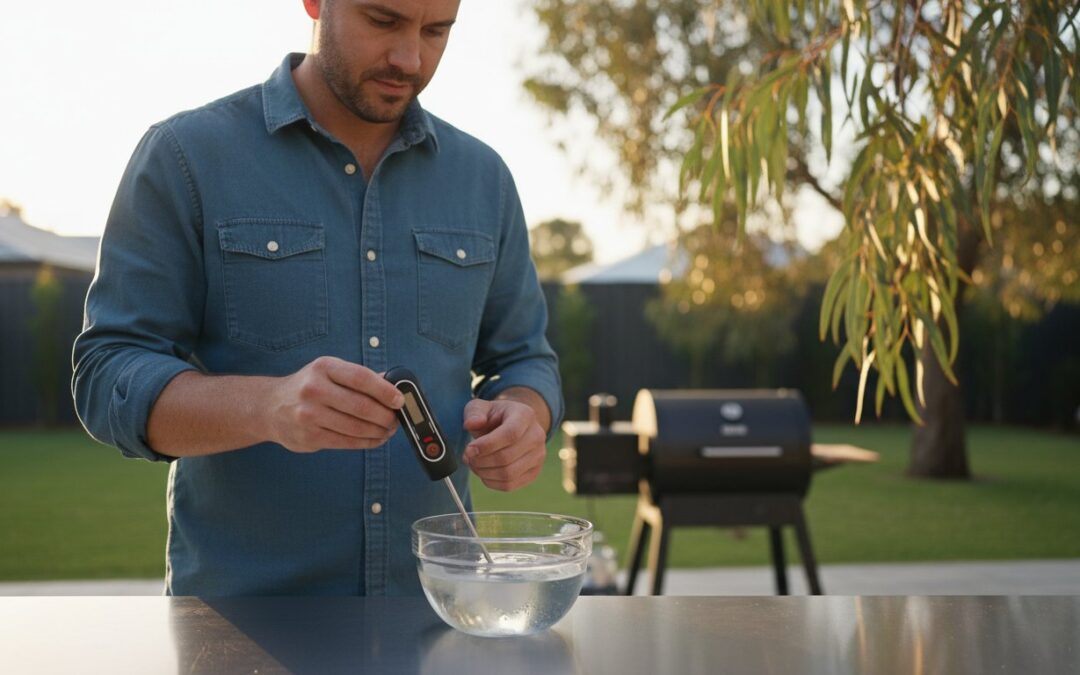
Last Saturday, a backyard pitmaster in Brisbane pulled a A$185 wagyu brisket off the smoker after 14 hours, only to find it dry as a bone because his equipment lied to him. A simple 10 degree error on a factory gauge can turn a premium cut into expensive dog food. If you aren’t regularly calibrating your bbq thermometer, you’re just guessing at the science of fire. Reliable data is the only way to ensure your meat hits that perfect internal temperature every time you light the hardwood.
We know you value performance and don’t have time for gear that fails under pressure. It’s frustrating to manage a long burn only to be let down by a cheap mechanical dial or a drifting digital probe. This guide teaches you how to master the precision of your pit with professional calibration techniques for every type of sensor. We’ll walk through the ice bath test, the boiling water method, and the specific ways to adjust mechanical nuts. You’ll gain the confidence to know exactly when to trust your gear and when it’s time to bin it for a new model. Get sizzlin’!
Key Takeaways
- Stop relying on factory-installed hood thermometers that are often inaccurate by 20°C or more and learn why manual verification is non-negotiable.
- Master the professional techniques for calibrating your bbq thermometer using the reliable ice bath and boiling water methods.
- Learn how to perform precision adjustments on your gear, from using digital offset features to the analog ‘Wrench Technique.’
- Discover the ‘Master Probe’ strategy to maintain a reference standard that ensures consistent, premium results for every cook.
- Protect your investment with expert maintenance tips on moisture prevention and proper storage for long-term sensor accuracy.
Why Calibrating Your BBQ Thermometer is Non-Negotiable
Calibration is the process of verifying and adjusting your thermometer against a known standard. It ensures the reading on your digital display or analogue dial matches the actual temperature of your meat or pit. Every serious pitmaster knows that precision is the foundation of great barbecue. Understanding the principles of thermometer calibration involves using fixed reference points, such as the freezing or boiling point of water, to reset the sensor’s accuracy.
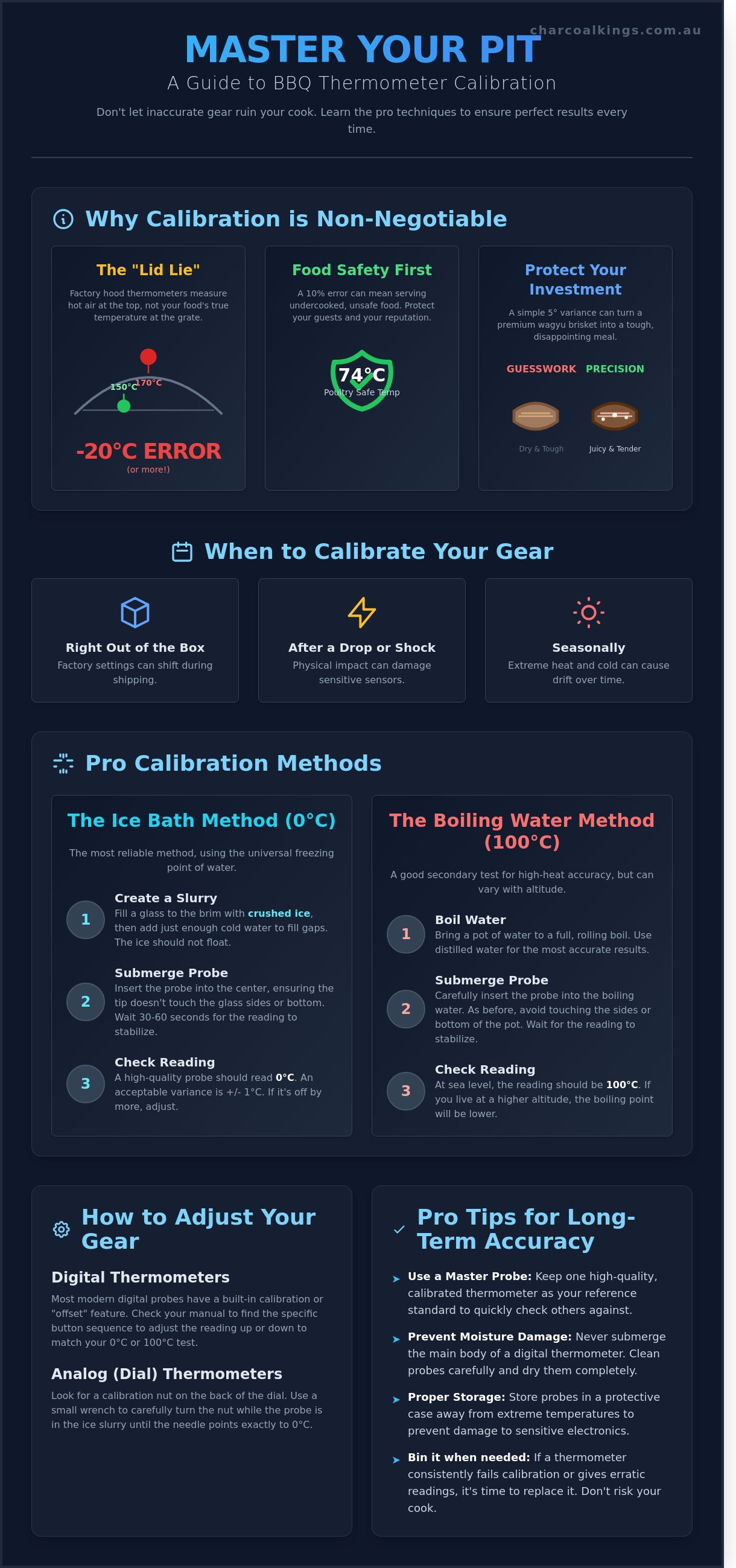
Don’t trust the factory-installed hood thermometer on your grill. These gauges are widely known as the “Lid Lie” because they are notoriously inaccurate. Most factory thermometers sit 10 to 15 centimetres above the cooking grate, measuring the hot air pooling at the top of the lid rather than the temperature where your food actually sits. Tests show these gauges are frequently off by 20°C or more. This discrepancy can lead to overcooked steaks or dangerously undercooked poultry.
Precision is also a matter of food safety and financial efficiency. Australian food standards require poultry to reach an internal temperature of 74°C to ensure it’s safe for consumption. If your thermometer is out by just 10%, you risk serving unsafe food to your guests. Furthermore, calibrating your bbq thermometer protects your investment. Accurate temperature control prevents you from wasting bags of premium hardwood lump charcoal by ensuring your cook finishes exactly when it should, rather than burning fuel for an extra two hours on a stalled piece of meat.
To better understand this concept, watch this helpful video:
The Cost of Inaccuracy in Low and Slow BBQ
Low and slow cooking is a game of chemistry and patience. A 5-degree variance can ruin the rendering of fat in a brisket, leaving you with a tough, rubbery product instead of a melt-in-your-mouth masterpiece. Accurate probes also help you distinguish between the real “Stall” and a “False Stall” caused by gear drift. You need to trust your equipment to make informed decisions about when to wrap or pull your meat. Consistency is the only way to replicate your best cooks every weekend.
When Should You Calibrate?
Calibrating your bbq thermometer isn’t a one-time event. You should check your gear right out of the box, as factory settings often shift during international shipping. If you drop your probe on the ground, perform an immediate accuracy check. Physical shocks can easily damage sensitive digital sensors. Seasonal checks are also vital in Australia. The extreme summer heat, which can see backyard temperatures hit 40°C, causes bimetallic coils in analogue gauges to expand and contract, leading to significant reading errors over time.
The Ice Bath Method: Testing the Freezing Point
The ice bath method stands as the most reliable way for backyard pitmasters to verify accuracy. It relies on a physical constant: the “ice point,” which is exactly 0°C at sea level. This makes calibrating your bbq thermometer a straightforward task that doesn’t require expensive laboratory equipment or complex software. You only need a glass, plenty of crushed ice, and chilled water to get a professional-grade reference point.
Avoid using large ice cubes from your freezer door. Large cubes leave significant gaps, causing the water temperature to fluctuate above the freezing mark. Fill your glass to the brim with crushed ice first, then add just enough chilled water to fill the spaces. The goal is a thick, slushy consistency. If the ice floats, you’ve used too much water. Pour some out and pack in more ice until the mixture is dense.
Insert your probe into the center of the slurry. Ensure the sensor, which is typically located in the first 2.5 centimetres of the tip, is fully submerged. Do not let the tip touch the bottom or sides of the glass. The container material can transfer ambient heat and skew your reading by as much as 2°C. Wait roughly 30 to 60 seconds for the digital display to stop moving before you record the final number.
Creating the Perfect Slurry
The science of the ice point is absolute. At standard atmospheric pressure, 0°C is a universal constant. Crushed ice is superior because it maximizes the surface area contact with the thermometer probe. This eliminates the “warm spots” found in containers filled with standard cubes. Stick to the no-float rule. If your ice is floating, the water at the bottom of the glass is likely closer to 4°C, which will result in a false calibration reading.
Reading the Results
Most high-quality digital probes have an acceptable variance of +/- 1°C. For a backyard cook, this small gap won’t ruin a brisket or a rack of ribs. However, if your reading is off by 3°C or more, you need to adjust the device settings. Calibrating a meat thermometer properly involves checking these offsets against a known standard. If your probe takes longer than 10 seconds to reach a stable reading in the ice bath, the sensor is likely failing or covered in carbon buildup. Record the offset on a piece of tape and stick it to the back of the unit if it lacks a manual reset button. For the best results, pair your calibrated gear with premium natural hardwood charcoal to ensure consistent pit temperatures throughout your cook.
The Boiling Water Method: Testing High-Heat Accuracy
Precision at high temperatures is non-negotiable for serious pitmasters. While the ice bath test checks the lower end of the scale, calibrating your bbq thermometer using boiling water ensures accuracy during searing or hot-and-fast sessions. If your probe is off by five degrees at the boiling point, that error often compounds when you’re pushing your pit to 250°C for a reverse-seared ribeye. Reliable data is the foundation for mastering the art of barbecuing with charcoal, where heat management defines the quality of the bark and the final internal texture of the meat.
Safety is the priority during this process. Steam burns happen in seconds, and excessive moisture can ruin the internal circuitry of expensive digital units. Always wear heat-resistant gloves and keep the digital display away from the direct path of rising steam. Professional resources like this guide on Testing Your Thermometer highlight that digital probes are particularly sensitive to water ingress. Only the tip of the probe should be submerged to avoid permanent damage. Calibrating your bbq thermometer correctly protects both your equipment and your cook.
Executing a Safe Boiling Test
Fill a deep pot with at least 15 centimetres of water and bring it to a rolling, aggressive boil. Once the water is bubbling steadily, insert your probe into the centre of the pot. Ensure the probe stays at least 5 centimetres away from the sides and the bottom. Touching the metal surface will result in a false high reading because the pot transfers heat faster than the water itself. Hold the probe steady for 30 seconds until the reading stabilises. At sea level, your target is exactly 100°C.
The Altitude Adjustment Factor
Atmospheric pressure changes the temperature at which water boils. If you’re grilling in Sydney or Perth, 100°C is your benchmark. However, pitmasters in Canberra, sitting at roughly 580 metres above sea level, will see water boil at approximately 98°C. In higher regions like Katoomba, where elevation exceeds 1,000 metres, the boiling point drops further to about 96.5°C. A simple rule of thumb for Australian conditions is to subtract 1°C from the 100°C target for every 300 metres of elevation. Failing to account for this means you’ll wrongly assume your thermometer is broken when it’s actually just obeying the laws of physics. Get your numbers right, and get sizzlin’ with confidence.
How to Adjust Your Gear: Digital vs. Analog
Identifying a temperature discrepancy is only half the battle. You have to fix it. Calibrating your bbq thermometer requires different tactics depending on whether you’re using a traditional bimetallic dial or a modern digital probe. Accuracy is the difference between a juicy result and a dry, overcooked mess. If your gear is off by even 3°C, your cook times will shift significantly.
Fixing Your Hood Thermometer
Most analog hood thermometers feature a calibration nut on the back of the dial housing. Use a small wrench or pliers to grip this nut while the probe is submerged in an ice bath. Turn the nut in small increments. A 1/16th turn usually moves the needle by 2 or 3 degrees. Don’t rush this process. Small adjustments go a long way, and over-tightening can snap the internal spring. Always re-verify the reading in the ice bath after every turn to ensure the needle lands exactly on 0°C.
Digital Calibration and Resetting
Modern digital units often include a dedicated “CAL” button or an offset feature within the digital menu. To use this, hold the button while the probe sits in 0°C water until the screen flashes or locks at the correct temperature. If your device lacks a physical button, check the manufacturer’s app for a “Temperature Offset” setting. Research shows that 85% of digital inaccuracy stems from low battery voltage. If your screen is dim or the reading jumps, replace the batteries before attempting a reset. Clean your probes regularly; a 1mm layer of carbon buildup can lag heat transfer by up to 15 seconds.
Some entry-level digital thermometers are factory-sealed and cannot be adjusted. If your unit is out by 1 or 2 degrees, use the mental offset method. Simply add or subtract that difference from your target temperature during the cook. However, if the sensor drift exceeds 5°C or the readings fluctuate wildly, the internal thermistor is likely failing. Permanent sensor drift is common in units older than three years or those exposed to temperatures above 300°C. When this happens, it’s time to invest in a replacement. A high-quality replacement probe in Australia typically costs between A$35 and A$90, which is far cheaper than spoiling a A$150 brisket.
Ready to upgrade your setup with gear that holds its calibration? Get Sizzlin’ with professional tools from Charcoal Kings.
Maintaining Precision for the Long Haul
Calibrating your bbq thermometer ensures accuracy today, but consistent maintenance protects your investment for years. Digital probes are sensitive instruments, not rugged iron tools. Moisture is the primary killer of these devices. Water seeping into the wire-to-probe crimp causes electrical resistance shifts, which leads to “HHH” error codes or 20-degree temperature swings. You must keep the transition point between the wire and the stainless steel probe dry at all costs.
Adopt a ‘Master Probe’ strategy to eliminate guesswork. Keep one high-end, laboratory-grade instant-read unit in your kitchen drawer. This unit never stays in the smoker and never gets exposed to extreme weather. Use this as your reference standard to verify your other probes every 90 days. If your pit probes don’t match the Master Probe during a quick ice bath test, you know exactly which unit needs adjustment.
Premium cooks demand premium tools. When you’re burning high-performance fuel like Binchotan charcoal, you’re managing intense, clean heat that can exceed 1,000 degrees Celsius. Precision matters when you’ve invested in top-tier fuel and A$150 Wagyu briskets. A calibrated thermometer is the only way to respect the quality of the meat and the charcoal you’re using.
- Check battery levels; low voltage causes display lag and sensor errors.
- Inspect wire insulation for melt spots or exposed copper.
- Clean the probe tip with a damp cloth to remove carbon buildup.
- Ensure the ‘Master Probe’ and pit probes match at room temperature.
Caring for Your Probes
Never submerge probes in a sink or run them through the dishwasher. Wipe them down with a damp, soapy cloth instead. Storage is equally vital. Avoid coiling wires tightly around the unit. Internal copper strands break when bent at sharp angles, leading to intermittent failures. Use probe grommets on your smoker. Closing a heavy steel lid directly on a wire will eventually crush the insulation and cause a short circuit.
Upgrading Your Kit
If your analog dial takes 30 seconds to settle, it’s time to move to digital. Professional-grade units provide readings in under 2 seconds with accuracy within 0.4 degrees Celsius. Look for an IP67 waterproof rating to handle Australian humidity and unexpected rain. Charcoal Kings recommends investing in gear that matches the quality of your fuel. Get Sizzlin’ with equipment that doesn’t leave your results to chance.
Lock In Your Accuracy For The Next Cook
Precision isn’t optional when you’re chasing the perfect bark. A variance of just 5 degrees can be the difference between a juicy result and dry meat. By mastering the 0°C ice bath and 100°C boiling water tests, you ensure your equipment never lies to you. Make calibrating your bbq thermometer a standard part of your maintenance routine every 90 days to maintain peak performance. Reliable data is the foundation of every master pitmaster’s success. Don’t leave your hard work to chance when a simple two minute test provides total certainty.
Charcoal Kings provides the rugged gear you need, all tested specifically for tough Aussie conditions. We’re premium hardwood charcoal specialists committed to quality and performance. If you need a hand, our expert Australian support team is ready to help you level up your setup. High quality results require high quality tools and the knowledge to use them correctly. It’s time to stop guessing and start cooking with total confidence.
Upgrade your BBQ kit with professional accessories from Charcoal Kings
Get Sizzlin’!
Frequently Asked Questions
How often should I calibrate my BBQ thermometer?
Calibrate your BBQ thermometer every 3 months to maintain peak accuracy. You should also test the unit immediately if you drop it or expose it to extreme temperature swings. Professional pitmasters performing 50 plus cooks a year often check their gear monthly. Frequent testing ensures your premium cuts of meat cook perfectly every time. Calibrating your bbq thermometer is a 5 minute task that prevents ruined briskets and wasted money.
Why does my hood thermometer read differently than my digital probe?
Hood thermometers measure the air temperature at the top of the lid, which is typically 15 to 30 degrees hotter than the grate level. Heat rises and pools at the peak of the BBQ. Your digital probe sits exactly where the meat is, providing the only reading that matters for food safety. Most factory hood gauges are off by 10 percent because they use cheap bimetal coils rather than precision sensors.
Can I calibrate a digital thermometer that doesn’t have a ‘CAL’ button?
You can’t physically adjust a digital thermometer without a dedicated calibration button. If your device reads 2 degrees high in an ice bath, you must manually subtract those 2 degrees from every reading during your cook. Thermometers showing a variance of more than 4 degrees should be replaced. High quality digital units from 2025 onwards usually include internal offset settings via a smartphone app instead of a physical button.
Is 100°C always the boiling point for water in Australia?
Water boils at 100°C only at sea level. In higher altitude locations like Katoomba or Canberra, water boils at approximately 96°C to 98°C. For every 300 metres of elevation, the boiling point drops by about 1 degree. Check your local elevation before calibrating your bbq thermometer using the boiling water method. This ensures your baseline is 100 percent accurate for your specific Australian backyard location.
What should I do if my thermometer is off by more than 5 degrees?
Replace the batteries first as low voltage causes 15 percent of all reading errors. If the error persists after a battery swap, use the adjustment nut on analogue dials or the digital offset feature. A thermometer off by 5 degrees or more is unreliable for low and slow smoking. If manual adjustment doesn’t fix the 5 degree gap, it’s time to invest in a new professional grade probe.
Does the type of charcoal I use affect my thermometer’s accuracy?
Charcoal type has zero impact on the mechanical accuracy of your thermometer. However, using 100 percent natural hardwood lump charcoal provides a more stable, predictable heat source than cheap chemical briquettes. Stable heat makes it easier to spot if your thermometer starts drifting. While the fuel won’t break the sensor, the high 400°C plus temperatures from Binchotan can damage probes not rated for extreme heat.
Can I use the oven to calibrate my BBQ thermometer?
Don’t use a domestic oven for calibration because most Australian home ovens fluctuate by 10 to 15 degrees during a standard cycle. The thermostat in a kitchen oven cycles the heating element on and off, creating a wave of temperatures rather than a steady point. Stick to the ice bath or boiling water methods. These provide a physical constant that doesn’t rely on the accuracy of another appliance.
What is the most accurate type of BBQ thermometer for home use?
Thermocouple digital thermometers are the gold standard for home use, offering accuracy within 0.3 degrees. These units provide a reading in under 2 seconds, which is 5 times faster than standard thermistor models. While they cost between A$120 and A$180, the precision is vital for food safety. For long cooks, a dual probe system allows you to monitor both the pit and the meat simultaneously.