Dumping an entire bag of wood chips onto your coals is the fastest way to ruin a premium cut of meat with bitter, acrid smoke. Many enthusiasts struggle with how to get more smoke flavor from charcoal grill setups without ending up with food that tastes like lighter fluid or soot. You have likely experienced the frustration of a long cook that results in a dull exterior rather than a deep, mahogany smoke ring. It is a common hurdle that separates the hobbyist from the professional.
Mastering your smoky profile requires a focus on purity and airflow rather than sheer volume. By using high-quality hardwood lump charcoal and managing clean combustion, you can achieve that sought-after blue smoke every time. This guide provides the professional techniques needed to intensify your BBQ using premium fuels and specific hardwood varieties. We will examine how to maintain consistent smoke for long cooks and choose the right wood to complement different meats, ensuring your next cookout delivers reliable, competition-grade results.
Key Takeaways
- Prioritise natural hardwood lump charcoal to eliminate chemical additives and fillers that mask the authentic smoky profile of your meat.
- Discover how to get more smoke flavor from charcoal grill cooks by matching wood chunks to your cook duration and avoiding the counterproductive habit of soaking wood.
- Master airflow management to produce “Thin Blue Smoke,” the essential sign of clean combustion that prevents bitter, acrid off-tastes.
- Optimise smoke absorption by leveraging surface science, including the use of cold meat and moisture to facilitate a deeper smoke ring.
- Implement professional ignition techniques like the Minion or Snake methods to ensure consistent fuel delivery and reliable smoke for long sessions.
The Flavour Foundation: Why Your Choice of Charcoal Matters
Your fuel is not just a heat source; it is the primary ingredient in your flavour profile. If you want to master how to get more smoke flavor from charcoal grill setups, you must start with a clean foundation. Cheap, low-grade fuel creates a chemical barrier between your meat and the wood smoke you are trying to achieve. Using natural hardwood lump charcoal ensures that your fire produces only heat and a neutral, woody base. This allows your chosen smoking woods to perform without interference from synthetic additives.
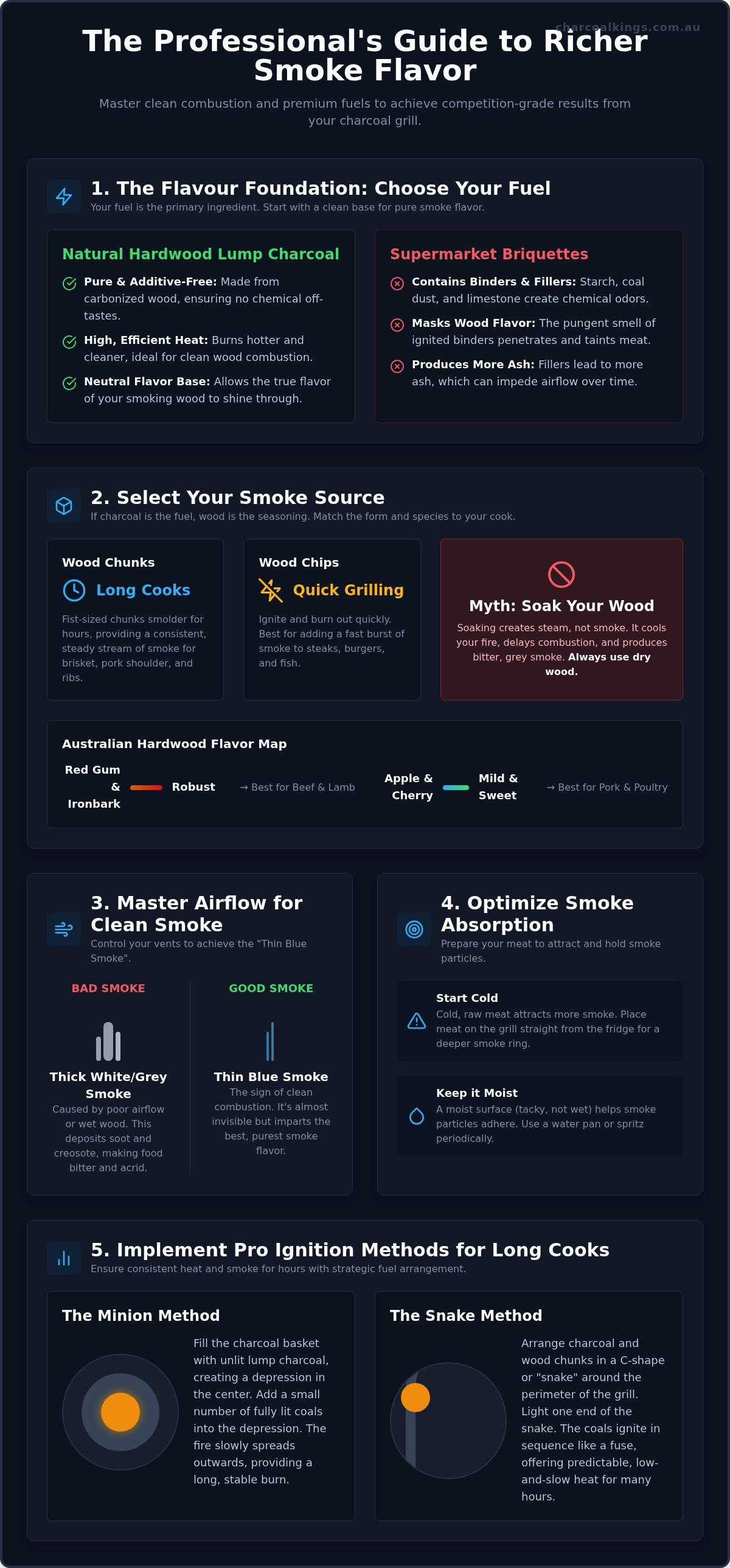
Purity is the most critical factor for clean combustion. High-density Australian hardwoods, such as Gidgee or Ironbark, are prized for their high carbon content and lack of sap. These species provide a subtle, earthy base note that complements traditional Smoking (cooking) methods. When fuel is free from fillers, the smoke remains transparent and sweet. This “no additives” requirement is not a marketing gimmick. It is a technical necessity for anyone serious about avoiding the acrid, tongue-numbing taste associated with low-quality backyard BBQ.
Lump Charcoal vs. Supermarket Briquettes
Supermarket briquettes are often manufactured using a mix of coal dust, starch binders, and limestone. When these binders ignite, they release a distinct, pungent odour that penetrates porous meat surfaces. This chemical profile masks the delicate nuances of cherry, apple, or hickory woods. Lump charcoal is different. It consists of whole pieces of timber that have been carbonised in a kiln, preserving the organic structure of the wood. It burns hotter and more efficiently, creating the high-energy environment required for wood chunks to combust cleanly. Hardwood lump charcoal is the gold standard for clean outdoor cooking.
The Role of Binchotan in High-End Grilling
For those seeking the ultimate level of control, Binchotan charcoal offers a unique alternative. Known as white charcoal, it is fired at extremely high temperatures to reach near-total purity. It produces virtually no smoke of its own, but its intense infrared heat is unparalleled. This makes it ideal for a “pure” sear where the flavour comes entirely from the meat’s natural fats dripping onto the coals. You should choose Binchotan for shorter, high-heat cooks where you want the protein to speak for itself without the heavy overlay of traditional smoke.
Selecting Your Smoke Source: Wood Chunks, Chips, and Species
Choosing the right wood is the second step in understanding how to get more smoke flavor from charcoal grill setups. If charcoal is your fuel, wood is your seasoning. The goal is to produce a clean, steady release of aromatic compounds that penetrate the meat without overwhelming it. Achieving this requires moving beyond basic supermarket bags and selecting species that complement your specific cut of protein.
Stop soaking your wood chunks. It is a persistent myth that yields zero benefit for the final product. Water cannot penetrate the dense grain of seasoned hardwood; it only sits on the surface. When you toss wet wood onto hot coals, the fire’s energy is wasted boiling off that moisture. This creates steam, which cools your grill and leads to a grey, unappetising finish. For the best results, use dry, well-seasoned wood that ignites quickly and burns cleanly.
Chunks vs. Chips: A Practical Comparison
The duration of your cook dictates the form of wood you should use. Chunks are the professional choice for any session lasting longer than two hours. A single fist-sized chunk will smoulder for a significant period, providing a consistent stream of flavour. Chips are better suited for quick-grilling items like steaks, burgers, or thin pork chops. Because they have more surface area, they ignite and exhaust their flavour profile in minutes. When learning how to get more smoke flavor from charcoal grill sessions, try burying wood chunks at different depths in your charcoal. This ensures new wood ignites as the fire progresses, providing a continuous smoke source.
The Australian Hardwood Flavour Map
Australian hardwoods are the backbone of local BBQ, offering a distinct profile you won’t find in imported varieties. Red Gum and Ironbark are the heavy hitters. They provide a robust, earthy smoke that stands up to the rich fats in beef brisket or lamb shoulder. For poultry or pork, switch to fruitwoods like Apple or Cherry. These species offer a sweeter, milder finish that won’t mask the delicate flavour of the meat. High-density timber is essential for a reliable burn. Following established guidelines for Smoking Meat and Poultry ensures you maintain safe internal temperatures while these hardwoods do their work.
The density and firewood quality of your smoke source directly impact the thickness of your smoke. Well-seasoned wood with low moisture content produces the desired translucent blue smoke. If your wood is green or damp, you will face heavy, white clouds that leave a bitter residue. Explore our range of premium smoking woods to find the perfect match for your next low-and-slow session.
Airflow Mastery: Achieving the ‘Thin Blue Smoke’
Achieving the perfect infusion isn’t about the amount of smoke. It’s about the quality of the burn. Many beginners think thick, billowing white clouds are the goal when learning how to get more smoke flavor from charcoal grill setups. This is a mistake. White smoke indicates incomplete combustion. It is full of large particles and unburnt compounds that leave a bitter, ashy taste on your food. You want “Thin Blue Smoke.” This nearly invisible, translucent haze is a sign of a clean, hot fire that is efficiently breaking down wood lignin into delicious aromatic compounds.
Airflow is the engine of your grill. If you trap smoke inside by closing all the vents, it becomes stagnant. Stagnant smoke cools and condenses, coating your meat in a thick, waxy substance. This is the “Stagnant Smoke” Trap. To avoid this, you must maintain a constant flow of fresh oxygen. This ensures your wood chunks smoulder at the correct temperature rather than smouldering out or igniting into a flare-up. Managing the firebox requires patience. Introduce chunks gradually to maintain a steady temperature and prevent the fire from being smothered.
The Science of Creosote
Creosote is the enemy of good BBQ. It is a bitter, black soot that forms when wood is burnt without enough oxygen. If you choke your vents too much to lower the temperature, you create dirty combustion. This results in a tongue-numbing sensation and a dark, acrid bark. Understanding the smoky science behind grilled food reveals that flavour comes from gases, not just soot. Always perform a smell test. Good smoke should smell sweet and pleasant, like a campfire, not like burning plastic or heavy chemicals. Mastering this balance is essential for anyone mastering how to get more smoke flavor from charcoal grill units during long cooks.
Vent Management for Maximum Infusion
Follow the “Top-Down” rule for your exhaust vents. Keep your top vent at least halfway open at all times. This allows exhaust gases to escape and prevents creosote build-up. Use your bottom intake vent as the primary throttle for both temperature and smoke density. By opening the intake, you provide more oxygen to the coals, increasing heat and encouraging cleaner wood combustion. This creates a natural convection current. It pulls fresh air in from the bottom and draws smoke across the meat surface before exiting through the top. This movement is the secret to deep, clean flavour penetration and a professional-grade finish.
The Meat Factor: Surface Science and Smoke Absorption
The meat is the final variable in the equation. You can have the cleanest fire and the best wood, but if the meat surface is not prepared, the smoke will simply bounce off. One of the most effective ways regarding how to get more smoke flavor from charcoal grill cooking is to start with cold meat. Cold surfaces facilitate condensation. Smoke particles are microscopic solids and liquids that stick more effectively to wet, cold surfaces than dry, warm ones. Taking your brisket or ribs straight from the fridge to the grill provides a significant advantage in flavour accumulation.
The “Sticky Surface” Principle is essential for a professional finish. As the cook progresses, the meat surface dries out and forms a “pellicle” or bark. Once this bark is set, smoke absorption slows down significantly. This is why professional pitmasters use spritzes or mops. By keeping the surface moist with a spray of apple juice, water, or vinegar, you extend the window of time that smoke can adhere to the protein. A damp surface acts like a magnet for aromatic compounds.
The Smoke Ring vs. Smoke Flavour
Many beginners confuse the pink smoke ring with actual flavour. The smoke ring is a chemical reaction between nitrogen dioxide in the smoke and myoglobin in the meat. This reaction usually ceases once the internal temperature hits approximately 60°C. You can produce a deep smoke ring using curing salts without any wood at all. This proves it is a visual prize rather than a taste profile. To enhance the ring for competition-style results, keep the meat cold and the environment humid, but remember that the true smoky profile comes from the quality of your wood and charcoal.
Temperature and Timing
The first two hours are your primary window for flavour infusion. Once the meat reaches 60°C and the surface moisture evaporates, the rate of smoke intake drops. A water pan is a critical tool here. It adds humidity to the cooking chamber, which prevents the meat surface from drying too quickly. This keeps the exterior receptive to smoke for a longer duration. If you want to take your results to a professional level, invest in high-quality BBQ accessories to manage your cook environment and ensure every session delivers maximum flavour.
Actionable Steps for Your Next Cook: The Pro Checklist
A successful cook is the result of a repeatable process. You cannot expect professional results if you ignore the basics of grill maintenance and fuel management. A dirty grill is the primary cause of bitter, “off” flavours. Residual grease from previous cooks becomes rancid and produces acrid smoke that masks your premium wood notes. Remove all old ash to ensure your intake vents function correctly. Once clean, use a reliable ignition strategy. The ‘Minion Method’ involves lighting a small amount of charcoal and placing it atop unlit fuel, while the ‘Snake Method’ creates a ring of fuel that burns sequentially. Both ensure you know how to get more smoke flavor from charcoal grill setups by providing a steady, long-term burn.
Timing is everything. Never put your meat on the grill while the smoke is thick and white. Wait for the ‘sweet spot’ where the exhaust becomes translucent and blue. This indicates the fire has reached a stable temperature and is burning cleanly. Once the meat is on, maintain a steady temperature. Fluctuations cause wood chunks to ignite rather than smoulder. This leads to flare-ups that scorch the exterior and ruin the smoky profile you have worked to build.
Advanced Setup Techniques
To truly master barbecuing with charcoal, you must use 2-zone cooking. This involves placing all your fuel on one side of the grill to create a direct heat zone and an indirect convection zone. Place your wood chunks strategically along the fuel path for a timed smoke release. This ensures fresh wood ignites during the critical first hours of the cook. A professional BBQ scraper is essential for this process. Use it to clear the grates and the firebox floor before every session to maintain a neutral flavour environment.
The Charcoal Kings Promise
Our community in Holden Hill, SA, understands that quality is non-negotiable. We specialise in natural hardwood lump charcoal that contains zero chemical additives or fillers. This purity is what allows the natural characteristics of Ironbark or Gidgee to shine. Buying in bulk ensures you have a consistent flavour profile across different seasons, avoiding the variability of low-grade supermarket brands. Treat every session as a craft. When you use professional-grade materials and strategic airflow, you don’t just cook; you produce superior BBQ that stands apart from the rest.
Elevate Your Next BBQ Session
Mastering how to get more smoke flavor from charcoal grill setups is a matter of technical discipline and fuel quality. It starts with the foundation of additive-free hardwood lump charcoal and ends with the precise management of thin blue smoke. By focusing on surface moisture and maintaining a clean firebox, you transform a standard cookout into a professional-grade experience. These techniques ensure that every cut of meat carries a deep, clean smoky profile without the bitterness of creosote or chemical binders.
Consistency is the hallmark of a master pitmaster. Using the right Australian hardwood species and strategic vent control allows you to replicate competition-level results in your own backyard. It’s about treating the fire as an ingredient rather than just a heat source. Success requires the best materials and a commitment to the craft. When you eliminate the variables of low-grade fuel, you gain total control over your output.
Upgrade your flavour profile with Charcoal Kings Premium Hardwood Charcoal. Our products consist of 100% Natural Hardwood with Zero Chemical Additives. We provide Expert-Selected Australian Species designed for maximum performance and purity. Fire up your grill and lead the pack at your next session.
Frequently Asked Questions
Does soaking wood chips actually help get more smoke flavour?
No, soaking wood chips does not help. It creates steam rather than high-quality smoke. Water cannot penetrate the grain of seasoned hardwood; it only sits on the surface. When wet wood hits the coals, it lowers the grill temperature and delays the combustion process. This results in a grey, unappetising finish on your meat. For the best results, use dry, seasoned wood chunks to ensure immediate, clean ignition and a superior smoky profile.
What is the best type of charcoal for a long, smoky cook?
Natural hardwood lump charcoal is the superior choice for long, smoky sessions. High-density Australian species like Gidgee or Ironbark provide the stable heat required for low-and-slow cooking. Unlike cheap alternatives, premium lump contains zero chemical additives or fillers that mask the natural wood notes. It burns cleaner and longer, allowing your smoking woods to do the work. This is the foundation for anyone learning how to get more smoke flavor from charcoal grill setups.
Why does my BBQ meat sometimes taste bitter or like chemicals?
A bitter or chemical taste usually stems from low-quality fuel or poor combustion. Cheap briquettes often contain starch binders and coal dust that release acrid fumes. Another cause is “dirty” white smoke, which happens when wood smoulders without enough oxygen. This creates creosote, a bitter soot that coats your food. To prevent this, always use additive-free hardwood lump and ensure your vents are open enough to maintain a clean, translucent burn.
Can I get a good smoke flavour on a quick-cooking steak?
You can achieve excellent results on quick-cooking items by using wood chips instead of chunks. Because chips have more surface area, they ignite instantly and release a concentrated burst of aromatic smoke. This is ideal for steaks or burgers that only spend minutes on the grate. Place a handful of chips directly onto the hot coals just before you put the meat on. The high-heat environment ensures the smoke penetrates the surface quickly.
How do I know if I’m getting ‘clean’ smoke or ‘dirty’ smoke?
You can identify clean smoke by its translucent, “Thin Blue” appearance. It should be nearly invisible. If you see thick, billowing white or grey clouds, the fire is struggling with incomplete combustion. Dirty smoke smells pungent and acrid, while clean smoke has a sweet, pleasant campfire aroma. Mastering this visual cue is a critical step for those mastering how to get more smoke flavor from charcoal grill units during long, technical cooks.
Does the colour of the smoke really matter for the taste of the food?
Smoke colour is the most reliable indicator of final taste. White or yellow smoke contains unburnt carbon and soot particles that leave a waxy, bitter residue on your food. This is often caused by green wood or restricted airflow. In contrast, blue smoke consists of microscopic gases that provide a sweet, mahogany finish. Always wait for the smoke to turn blue before placing your meat on the grill to ensure a professional-grade outcome.
Should I keep the lid of my charcoal grill open or closed for more smoke?
You must keep the lid closed to maximise smoke infusion. A closed lid creates a convection current that draws smoke across the meat’s surface before it exits through the top vent. It also allows you to control the combustion rate by adjusting the intake and exhaust vents. Opening the lid frequently causes temperature spikes and lets the aromatic gases escape, which significantly reduces the intensity of the smoky profile you are trying to build.
What are the best Australian hardwoods for smoking beef brisket?
Ironbark and Red Gum are the undisputed kings for smoking beef brisket in Australia. These high-density hardwoods produce a robust, earthy smoke that can stand up to the rich fats and heavy seasoning of a large brisket. They provide a consistent burn and a deep, mahogany bark that fruitwoods cannot match. For a professional finish, ensure your wood is well-seasoned and free from sap, allowing the clean, natural timber notes to dominate the flavour.