Lighting your charcoal grill on the wrong day in Victoria can cost you over $46,000 or lead to a two-year prison sentence. It’s a heavy price for a weekend cookout. Australian authorities don’t gamble with summer safety. You’ve likely felt the frustration of checking multiple websites just to see if you’re following the latest fire ban regulations for bbq. The state-by-state differences are confusing. The fear of a massive fine is enough to keep any pitmaster on edge. We understand that you value performance and purity in your fuel. You shouldn’t have to guess when it’s safe to light up.
This guide simplifies the 2026 rules so you can cook with confidence all summer long. You’ll master the critical distinctions between a Total Fire Ban and a Fire Danger Season across every Australian territory. We provide a straightforward breakdown of how to set up a legal BBQ zone and exactly when it’s safe to fire up the Binchotan or hardwood lump charcoal. From clearance requirements in NSW to wind speed limits in Victoria, you’ll have the facts needed to keep your session legal, safe, and high-performing.
Key Takeaways
- Identify the critical differences between a standard Fire Danger Season and a high-alert Total Fire Ban to ensure your grill stays legal.
- Master the latest 2026 fire ban regulations for bbq to avoid massive fines and navigate state-specific restrictions with confidence.
- Understand the “Off Switch” rule and why solid fuel setups are strictly prohibited during peak fire danger periods.
- Learn how to establish a “Zero Flammable” zone with proper clearances to maintain a safe environment for charcoal grilling.
- Discover why high-purity, additive-free fuels provide the predictable performance and safety required for successful summer sessions.
Total Fire Ban vs. Fire Danger Season: Knowing the Difference
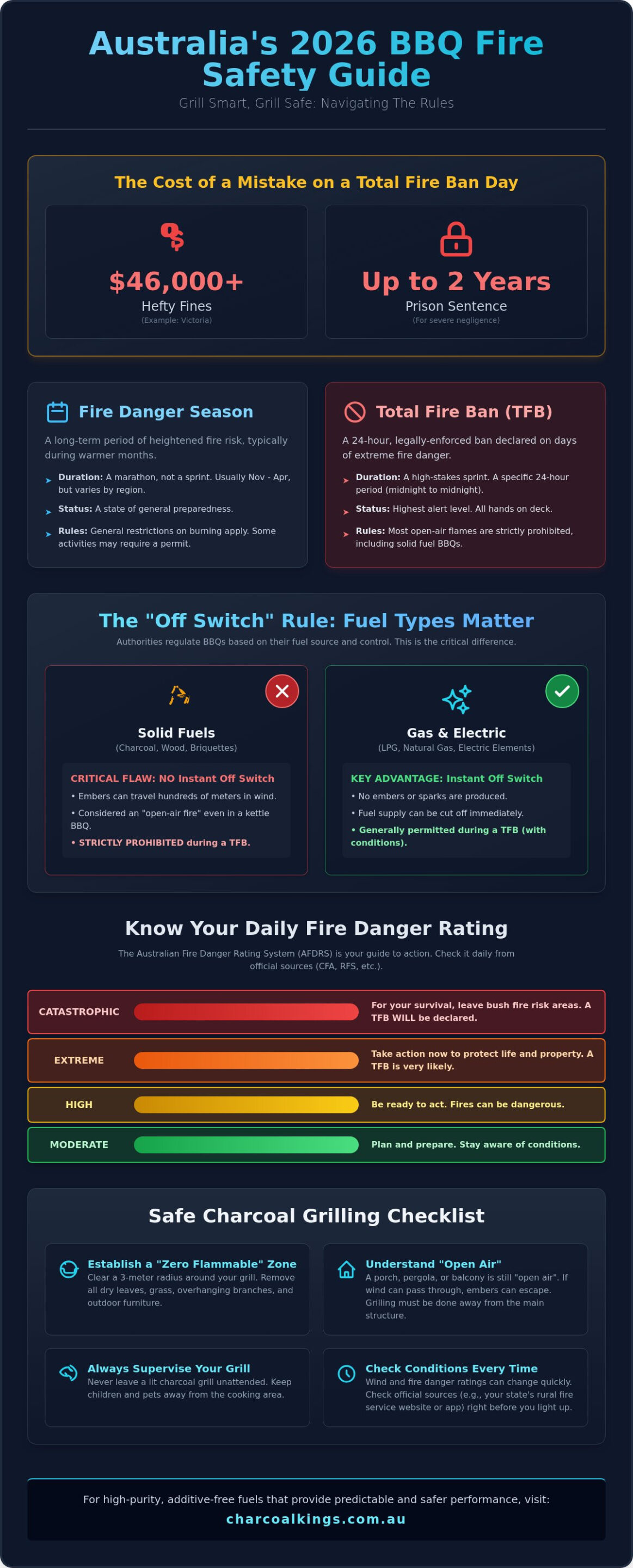
Fire Danger Season is a marathon. A Total Fire Ban is a high-stakes sprint. The Fire Danger Season typically runs from November through April, though local fire authorities adjust these dates based on specific regional fuel loads and moisture levels. During this period, general restrictions on burning apply to prevent accidental ignitions. A Total Fire Ban (TFB) is a different beast. It’s a legal declaration for a specific 24-hour period where the risk of fire is so high that most outdoor activities involving flame or sparks are strictly prohibited.
Authorities declare these bans when a combination of high temperatures, low humidity, and strong winds occurs. Looking back at the history of Australian bushfires, it’s clear why these measures are necessary to protect life and property. The legal weight of a TFB is significant. Ignorance of the law is no defense. If you ignore fire ban regulations for bbq on a TFB day, you face heavy fines that can exceed $46,000 in states like Victoria. In severe cases of negligence, you may even face criminal charges and up to two years of imprisonment.
To better understand why authorities declare these high-alert days, watch this helpful video:
What Constitutes an “Open Air” Fire?
Many backyard pitmasters mistakenly believe that a covered porch or a pergola makes their grill safe. This is a dangerous assumption. Fire authorities like the RFS and CFS define the “open air” as any area that isn’t fully enclosed by fire-resistant walls and a permanent ceiling. If the wind can move through the space, it’s considered open air. The primary concern is the movement of embers. Even high-quality hardwood lump charcoal produces sparks that wind can carry hundreds of meters beyond your property. These embers can land in dry gutters or long grass, starting a blaze far from your sight.
How to Check the Daily Fire Rating
You must verify the fire danger rating for your specific district every single morning during summer. The 2026 Australian Fire Danger Rating System (AFDRS) uses a standardized scale: Moderate, High, Extreme, and Catastrophic. When the rating reaches Extreme or Catastrophic, a TFB is almost always declared for that region. Don’t guess. Use official sources like the RFS (NSW), CFA (VIC), CFS (SA), or DFES (WA). These agencies provide real-time maps and apps that tell you exactly what’s permitted. Following fire ban regulations for bbq is your responsibility as a member of the grilling community. Staying informed is the only way to ensure your cookout doesn’t turn into a legal or environmental disaster.
Solid Fuel vs. Gas and Electric: The BBQ Regulation Rulebook
The 2026 summer season demands a technical understanding of your equipment. Under Australian law, fire authorities categorize barbecues based on their fuel source and control mechanisms. Solid fuel includes wood, hardwood lump charcoal, and heat beads. These fuels are the backbone of traditional grilling; however, they lack an “off switch.” This fundamental difference is why Total Fire Ban rules strictly prohibit solid fuel use in the open air. Gas and electric units are treated differently because they can be extinguished instantly.
A common misconception among enthusiasts is that closing the lid on a kettle BBQ or ceramic smoker makes it “enclosed.” It doesn’t. From a regulatory perspective, an enclosed fire must be inside a permanent structure with fire-resistant walls. If your charcoal grill is on a deck or in a backyard, it’s an open-air fire. Even in high-risk zones, authorities may occasionally ban gas BBQs if conditions are catastrophic. It’s your job to check local council by-laws before striking a match. Following fire ban regulations for bbq is about more than avoiding fines; it’s about professional-grade safety management.
The Problem with Solid Fuel During Bans
Solid fuel presents three primary risks that gas cannot replicate. First, the movement of unpredictable embers is the leading cause of accidental ignitions. Even a small spark from a charcoal chimney can travel significant distances in 40 km/h winds. Second, solid fuel has an incredibly slow cooling time. A pile of ash might look dead, but it can retain enough heat to ignite dry grass hours after you’ve finished eating. Finally, there’s no instant shut-off. If a fire starts nearby, you can’t simply turn a dial to neutralize your fuel source. This is why fire ban regulations for bbq focus so heavily on solid fuel restrictions during peak danger periods.
Conditions for Using Gas or Electric BBQs
If a Total Fire Ban is in place, you may only use gas or electric BBQs under strict safety protocols. You must maintain a 2-metre clearance of all flammable material. This means clearing away dry leaves, long grass, and overhanging branches. You can’t leave the grill for a second. Continuous adult supervision is a legal requirement. You must also have a continuous water supply, such as a connected hose or a fire extinguisher, within reach. These rules ensure that any potential flare-up is managed immediately. When the bans are lifted and it’s safe to return to traditional methods, using high-purity Hardwood Lump Charcoal ensures a clean, predictable burn with minimal sparking.
State-by-State BBQ Guidelines: A Quick Reference for 2026
Australia’s fire authorities share a unified goal: preventing catastrophic ignitions. While state borders exist, the core fire ban regulations for bbq are largely consistent across the country. Solid fuel is strictly prohibited during any declared Total Fire Ban. This applies to residential backyards, public parks, and campsites. Travelers moving between states must remain vigilant. A permit in one territory doesn’t grant immunity in another. Even the ACT maintains specific gas and electric BBQ regulations that mandate strict supervision and clearance during high-risk periods.
New South Wales and Victoria
The Rural Fire Service (RFS) in NSW operates with zero tolerance for solid fuel during a TFB. They distinguish between “No Burn” days, which target smoke pollution, and TFBs, which target safety. Solid fuel is a hard “No” during any TFB. In Victoria, the Country Fire Authority (CFA) mandates a 3-metre clearance of all flammable vegetation around your BBQ area. You must also have at least 10 litres of water or a working hose immediately available. Eastern states impose some of the country’s harshest penalties. Compliance isn’t optional. It is a legal requirement to protect the community.
South Australia and Western Australia
South Australia’s Country Fire Service (CFS) uses a “What can I do” framework to guide residents. During the Fire Danger Season, solid fuel is often permitted if specific clearance rules are met. This changes instantly once a TFB is declared. Western Australia’s Department of Fire and Emergency Services (DFES) issues notifications that can carry fines up to $25,000 for violations. Always check local council bylaws. Residents in metro areas like Holden Hill often face additional restrictions on smoke and fuel types that differ from statewide mandates. WA authorities focus heavily on these notifications to manage bans outside of the traditional fire season.
Queensland and Tasmania
Queensland Fire and Emergency Services (QFES) frequently issues local fire bans that target specific council areas. This localized approach accounts for massive climate variations between the humid north and the dry south. In Tasmania, the Fire Service (TFS) declares TFBs based on wind speeds and fuel dryness. Managing humidity and wind factors is critical in these regions. Even in cooler southern climates, the risk of a charcoal ember sparking a blaze is high. Mastering fire ban regulations for bbq requires checking your state’s official app every morning before you prep your ingredients.
Essential Safety Protocols for Charcoal Grilling in Australia
Safe barbecuing with charcoal is a matter of discipline. It starts long before the fuel hits the grate. While previous sections focused on legal compliance, safety is about professional execution. Even when fire ban regulations for bbq allow for solid fuel, you must maintain a “Zero Flammable” zone. This means removing all dry leaves, dead grass, and overhanging branches within a 3-metre radius of your grill. One stray spark from a chimney starter can ignite parched vegetation in seconds. Professional pitmasters don’t take chances with messy environments.
Monitoring local weather is non-negotiable. If wind speeds exceed 10 km/h, reconsider lighting up. High winds increase the oxygen supply to your coals, leading to unpredictable temperature spikes and a higher volume of flying embers. You must be aware of the wind direction to ensure sparks aren’t blowing toward your home or neighboring properties. Proper ash disposal is the final step in a safe session. Never dump hot coals in a plastic bin or garden bed. Coals retain heat for over 48 hours. They must be fully extinguished and cold to the touch before they leave your sight.
Setting Up Your BBQ Zone
Your grill needs a stable, non-combustible foundation. Concrete or brick pavers are the only acceptable surfaces for heavy-duty smokers or kettle grills. Never cook on a wooden deck during the Fire Danger Season. Follow the 5-metre overhead rule; ensure there are no eaves, patio roofs, or flammable awnings directly above the heat source. Keep a dedicated “Fire Kit” within arm’s reach. This should include a bucket of sand for grease fires, a continuous water supply for spot fires, and a fire blanket. Preparation prevents disasters.
Safe Ignition and Extinguishing
Avoid liquid fire starters. These chemicals are volatile and increase the risk of massive flare-ups that are difficult to contain. Use natural fire starters or a chimney starter for a clean, controlled ignition that respects the fire ban regulations for bbq. When the cook is finished, use the “Lid-Down” method. Close all intake and exhaust vents to starve the fire of oxygen. This is the safest way to neutralize your fuel. Verify the temperature the next day. If the ash isn’t stone cold, it stays in the grill. Upgrade your setup with professional-grade BBQ Accessories to manage your fire with precision and safety.
Selecting High-Performance Fuel for Safe Summer Grilling
Safety is a performance metric. When you use high-purity fuel, you reduce the variables that lead to accidents. Cheap, grocery-store briquettes often contain chemical binders and fillers. These additives cause unpredictable “popping” and excessive sparking. For the serious pitmaster, Hardwood Lump Charcoal is the only logical choice. It offers a predictable burn rate and minimal sparking because it lacks the impurities found in mass-produced alternatives. Mastering the technical side of your fuel ensures you remain compliant with the strictest fire ban regulations for bbq while maintaining superior heat standards.
Your choice of wood also impacts your safety profile. Certain types of firewood are notorious for spitting and throwing embers. Avoid softwoods or unseasoned timber during the summer months. These materials contain pockets of moisture and resin that explode when heated, sending hot fragments far beyond your grill. Stick to seasoned hardwoods that burn clean and steady. If you demand the highest heat with the lowest possible ember risk, Binchotan Charcoal is the professional standard. It’s often called “White Charcoal” due to its unique carbonization process, resulting in a fuel that burns for hours without smoke or sparks.
The Science of Clean Burning
Purity isn’t just about flavor; it’s about control. Dense hardwood lump charcoal requires less handling during a long cook. Every time you open the lid to add fuel, you introduce oxygen and increase the risk of ember escape. Using high-density fuel means you set it and forget it. Binchotan takes this further. Its metallic density provides a steady, infrared heat that won’t flare up. This level of stability is vital when following fire ban regulations for bbq in high-risk regions. You get the heat you need without the volatility of inferior, additive-heavy products.
Preparing for the Post-Ban Season
A Total Fire Ban is the perfect time for equipment maintenance. While your smokers are cold, inspect them for rust, gaps, or damaged seals. Ash leaks are a major fire hazard. A small hole in the base of your kettle can drop hot particles onto dry ground. Use this downtime to stock up on premium fuels so you’re ready the moment the restrictions lift. Ensure your charcoal is stored in a dry, airtight container. Moisture-damaged fuel is difficult to light and prone to spitting once it finally catches. When the ban is lifted, you’ll be ready to fire up with a setup that’s safe, efficient, and professional. Get your gear ready. The season won’t wait. Happy grilling!
Master the Heat and Stay Compliant
You now have the technical knowledge to navigate the complex landscape of fire ban regulations for bbq. Understanding the difference between a Fire Danger Season and a 24-hour Total Fire Ban is the foundation of a responsible cookout. It’s about more than just avoiding fines; it’s about professional-grade safety management. By maintaining a clean, non-combustible zone and choosing high-performance fuels, you ensure every session is safe and efficient. Purity is the ultimate safety feature. Using additive-free fuels reduces the risk of unpredictable sparks and ensures a steady, controlled burn. You’ve learned that state-specific rules and proper ash disposal are non-negotiable for the serious griller. Our team of seasoned pitmasters provides the expert advice you need to keep your grill performing at its peak. We offer Australia-wide shipping on our entire range of 100% Natural Hardwood. There are no additives or fillers in our products, ensuring a clean burn every time. Get your setup ready and enjoy a safe, high-performance summer.
Upgrade to Premium Hardwood Charcoal for Your Next Safe Session
Frequently Asked Questions
Can I use a Weber charcoal BBQ during a Total Fire Ban?
No, you cannot use a Weber or any other charcoal-fired BBQ in the open air during a Total Fire Ban. Authorities classify these as solid fuel appliances because they lack an instant shut-off mechanism and produce unpredictable embers. Using one violates fire ban regulations for bbq and carries severe legal penalties. You must wait until the ban is officially lifted before lighting any form of charcoal or wood fuel.
What is the fine for lighting a BBQ during a fire ban in Australia?
Penalties for non-compliance are severe and vary by state. In Victoria, fines for lighting a fire during a Total Fire Ban can exceed $46,000, with potential imprisonment for up to 24 months. In the Northern Territory, lighting a fire without a permit can result in a fine of up to $77,000. These figures represent the maximum penalties for negligence that endangers the community. Always check your local fire authority for the current schedule of infringements.
Can I use a pizza oven that burns wood during a TFB?
No, wood-fired pizza ovens are strictly prohibited during a Total Fire Ban. Like charcoal grills, they are solid fuel appliances that generate embers and cannot be instantly extinguished. Even if the oven is partially covered by a patio roof, fire authorities like the RFS and CFA still consider it an open-air fire. Stick to electric or gas alternatives that meet specific safety clearance and supervision requirements during these high-risk periods.
Is a Hibachi grill allowed on my balcony during fire season?
A Hibachi grill is prohibited on a balcony during a Total Fire Ban because it uses solid fuel. During a standard Fire Danger Season, usage depends on your local council bylaws and specific clearance rules. Most apartment complexes also have strict fire safety policies regarding open flames on balconies. You must ensure a 2-metre clearance of all flammable materials and have a continuous water supply nearby if charcoal usage is permitted in your area.
What should I do if my BBQ starts a fire during a ban?
Call 000 immediately if your BBQ ignites a fire that you cannot instantly contain. Do not attempt to fight a fast-moving grass or structure fire yourself. Provide the operator with your exact location and the type of fuel involved. After the emergency is managed, you must report the incident to your local fire authority. Attempting to hide a fire started during a ban can lead to increased criminal charges and higher liability.
Does a “No Burn Day” mean I can’t use my smoker?
A “No Burn Day” usually targets air quality and smoke pollution rather than immediate fire risk. You can typically use your smoker on these days unless a Total Fire Ban is also in effect. However, you must ensure your unit is operating efficiently to minimize smoke output. Always cross-reference the air quality notification with the current fire danger rating to ensure you are following all fire ban regulations for bbq and local environmental laws.
How long do I need to wait for coals to cool before they are safe?
You should wait at least 48 hours before disposing of used coals. Hardwood lump charcoal and briquettes retain heat long after the visible glow has vanished. Closing the vents on your grill will starve the fire of oxygen, but the thermal mass remains dangerous. Always verify the ash is stone cold to the touch before moving it to a metal bin. Never dump warm ash into garden beds, long grass, or plastic containers.
Are electric smokers exempt from Total Fire Ban regulations?
Electric smokers are generally permitted during a Total Fire Ban provided they are used under strict conditions. You must operate the unit on a non-combustible surface like concrete, typically within 20 metres of a permanent dwelling. A responsible adult must provide continuous supervision, and a 2-metre area around the smoker must be cleared of all flammable material. Check your state’s specific “Can I or Can’t I” guide for localized variations and mandatory water supply rules.