A 12-hour low-and-slow cook is a high-stakes investment in time and money that you cannot leave to chance. Consistency is the soul of great BBQ. While many hobbyists chase the intense, erratic heat of lump wood, the professional’s secret to a flawless bark and predictable finish lies in the engineered precision of high-quality briquettes. You have likely felt the frustration of a temperature spike ruining an expensive brisket or struggled with the acrid chemical smell of inferior fuel. It is a common pain point that separates the backyard cook from the seasoned pitmaster.
We believe in a no-nonsense approach to BBQ where purity and performance are non-negotiable. This guide will help you master the science of charcoal fuel to achieve professional-grade temperature control and legendary flavour in every session. You will learn how to select fuel with zero chemical binders, light your grill efficiently, and maintain stable heat for the longest smoking sessions. We are moving beyond the basics to provide the technical expertise needed for a clean-tasting, predictable burn every time you fire up the smoker.
Key Takeaways
- Discover why the uniform density of professional-grade briquettes delivers the predictable, “set and forget” heat required for flawless 12-hour smoking sessions.
- Master the chimney starter technique to achieve a clean burn and identify the exact moment your fuel is ready for the meat.
- Identify the difference between clean hardwood fines and chemical-laden fillers to ensure a legendary flavour profile without acrid aftertastes.
- Learn the strategic advantages of choosing compressed fuel over lump charcoal for long-duration cooks and superior temperature control.
What are Charcoal Briquettes and How are They Made?
Briquettes are the precision fuel of choice for pitmasters who demand total control over their fire. Unlike lump charcoal, which consists of irregular wood chunks, these units are uniformly shaped blocks made from compressed hardwood fines. This manufacturing process creates a high-density fuel source that delivers a predictable, steady burn. To understand the broader industrial context, one might ask What are briquettes? but for the BBQ enthusiast, the answer is simple: they are the key to consistency.
Australian BBQ culture has evolved from simple backyard grilling to sophisticated low-and-slow techniques. In this transition, this compressed fuel has become a staple. It offers a reliable alternative to the erratic heat spikes often associated with raw wood or poor-quality lump. Professional cooks rely on this stability to manage long sessions without constant intervention.
To better understand this concept, watch this helpful video:
The journey from timber to fuel begins with carbonisation. Hardwood is heated in an oxygen-depleted environment to remove moisture and volatile gases, leaving behind pure carbon. These carbonised fines are then mixed with a natural binder and compressed under extreme pressure. High-quality manufacturers use cornstarch as a binder to ensure the product remains food-safe and free from acrid odors. This purity is vital for maintaining the integrity of your meat’s flavour.
The Anatomy of a High-Quality Briquette
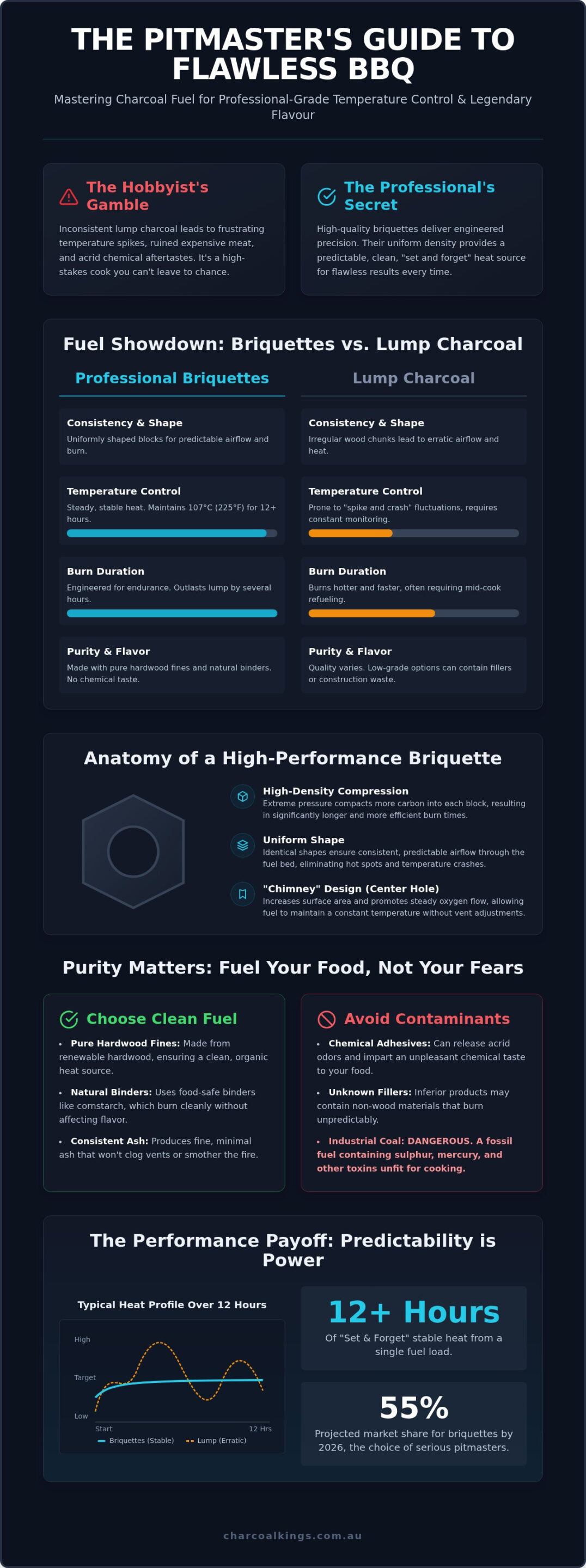
Density is the primary metric for performance. Heavier blocks contain more carbon per cubic centimetre, which translates directly to longer burn times. Premium varieties often feature a hexagonal shape with a hole through the centre. This chimney design increases the surface area and promotes consistent oxygen flow, allowing the fuel to maintain a steady temperature without frequent vent adjustments. Purity is the hallmark of professional fuel; we avoid chemical adhesives that produce artificial smells.
Briquettes vs. Coal: Clearing the Confusion
There is a dangerous misconception that industrial coal and BBQ fuel are interchangeable. They are not. Industrial coal is a fossil fuel containing sulphur, mercury, and other heavy metals that are toxic if ingested. Cooking meat over mineral coal is a health hazard. Genuine BBQ fuel is made from renewable hardwood, providing a clean heat source that respects the flavour of the meat. Choosing hardwood-based products ensures your BBQ remains a safe, organic experience rather than a chemical experiment.
The Performance Advantage: Why Consistency Wins
Predictability is the foundation of professional BBQ. When every piece of fuel is identical in size and density, the airflow through the fuel bed remains constant. This eliminates the “spike and crash” temperature fluctuations common with irregular lump charcoal. It’s a primary reason why these products are projected to account for 55% of the BBQ charcoal market by 2026. For a 12-hour brisket cook, this stability is the difference between a succulent result and a dry, ruined cut. High-quality briquettes provide the thermal endurance needed for these marathon sessions, often outlasting lump charcoal by several hours due to their compressed carbon structure.
Managing ash is a critical part of long smoking sessions. While all charcoal produces ash, the uniform degradation of a compressed block ensures that air channels stay open longer. Understanding the common additives in charcoal briquettes is essential for performance; pure products leave behind a consistent ash that won’t clog your grates or introduce off-flavours. If you’re preparing for a weekend cook, sourcing premium hardwood fuel ensures your equipment performs exactly as intended.
Thermal Mass and Heat Retention
Think of each unit as a thermal battery. Because they’re manufactured under extreme pressure, they possess a higher density than standard wood chunks. This density translates to a higher BTU output per cubic inch. Professional pitmasters rely on this specific heat retention to maintain a steady 225°F (107°C) for half a day or more. High compression ensures that energy is released slowly and steadily, providing a reliable heat floor that prevents the fire from extinguishing during the stall.
Stacking for Success: Managing the Fire
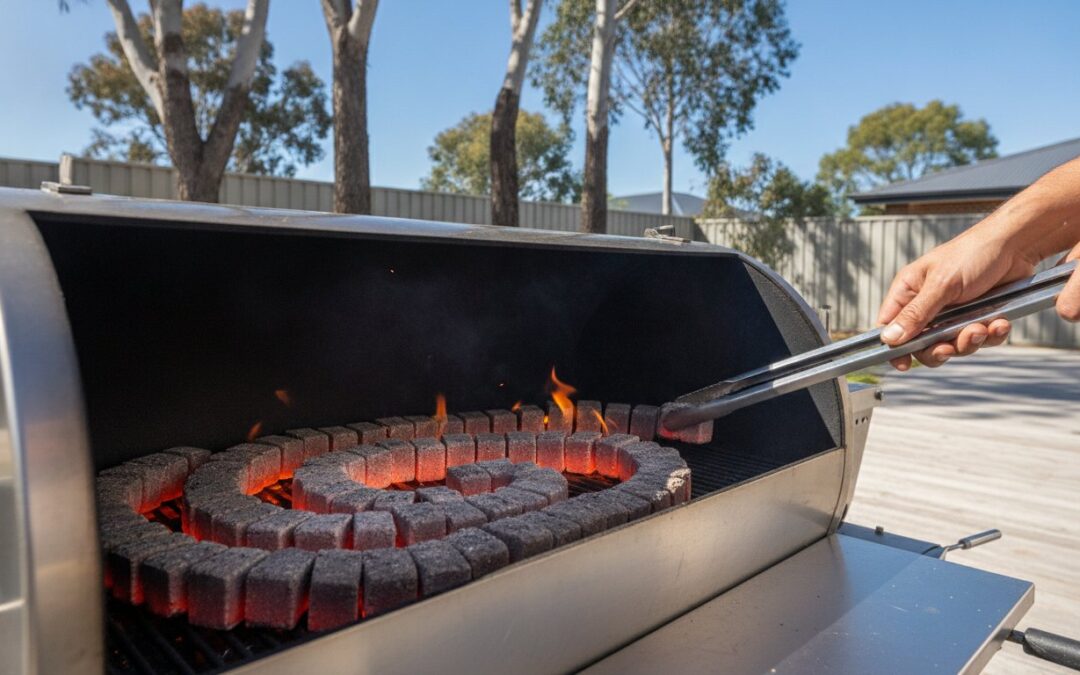
How you arrange your fuel dictates the burn rate. Tight packing is the preferred method for long-duration cooks. By minimising the gaps between each piece, you limit the oxygen available to the fire, forcing it to crawl through the stack rather than racing through it. This technique prevents “dead spots” where the fire might fail to jump from one piece to the next. In smaller kettle grills, the consistent size of the fuel allows for a precise “snake method” setup, ensuring the airflow remains unblocked from start to finish. Using uniform briquettes makes these advanced stacking techniques far more effective than they’d be with irregular charcoal.
Briquettes vs. Lump Charcoal: Which Fuel Should You Choose?
Choosing between lump charcoal and briquettes depends entirely on your cooking objective. Lump charcoal provides intense, immediate heat and a heavy wood smoke profile, making it the superior choice for fast searing. However, its irregular size leads to unpredictable burn rates and frequent temperature fluctuations. In contrast, the engineered nature of compressed fuel offers a clean, neutral heat that allows the flavour of your meat and smoking woods to take centre stage. For a deeper dive into the mechanics of different fuels, see our Ultimate Guide to BBQ Charcoal. This neutrality is a massive advantage when using specific smoking woods like hickory or cherry, as the fuel won’t compete with the aromatic profile of the timber.
Longevity is the deciding factor for Australian pitmasters managing 12-hour cooks. While lump charcoal burns hot and fast, it often requires frequent refuelling, which disrupts the temperature of the cooking chamber and risks “dirty” smoke from unlit fuel. The uniform density resulting from how charcoal briquettes are made ensures a linear energy release. This translates to superior cost-efficiency for the hobbyist and professional alike. When you calculate the burn-time-per-dollar, the higher density of a compressed block typically outperforms lump charcoal for any cook exceeding four hours. You spend less on fuel and more on quality meat.
When to Reach for the Briquette Bag
Low-and-slow roasts like brisket, pulled pork, and lamb shoulder require the “set and forget” reliability that only uniform fuel can provide. These products excel in specific hardware where airflow management is critical. In kettle grills, they’re perfect for the “snake method” to maintain low temperatures. Bullet smokers benefit from the consistent vertical burn, and gravity feeds rely on the uniform shape to prevent bridging in the fuel hopper. Using these allows you to manage overnight cooks with total confidence, knowing the fire won’t choke or spike while you sleep.
Binchotan: The Premium Alternative
For those seeking the absolute peak of performance, Binchotan—often called Japanese white charcoal—represents the ultimate fuel. While standard briquettes are the workhorse of the BBQ world, Binchotan is the “Blk Gold” standard for precision. It burns for an incredibly long duration, often exceeding five hours of intense, steady heat with almost zero smoke or odour. This makes it the essential choice for Hibachi and Konro grilling where the focus is on the ingredient’s natural juices. If you want to elevate your technical skills and understand this high-carbon fuel, explore the Binchotan Charcoal Guide.
Mastering the Burn: Lighting and Stacking Techniques
Lighting your fuel correctly is the first step toward a successful cook. A chimney starter is the only acceptable tool for this task. Liquid accelerants and chemical firelighters compromise the purity of your meat, leaving behind an acrid aftertaste that ruins expensive cuts. A chimney uses the principle of convection to ignite the fuel quickly and evenly. You are looking for the “ashed over” state, where a light grey coating of ash covers the fuel. This indicates the briquettes have reached peak ignition and are ready to be transferred to your grill. For those just starting their journey, learn more in our Beginner’s Guide to Barbecuing with Charcoal.
Airflow control is your primary throttle. Use the bottom vents of your grill to dictate how much oxygen reaches the fire. Opening the vents increases the temperature, while closing them chokes the fire for a cooler, longer burn. The top vent should remain at least partially open to allow exhaust gases to escape, preventing a bitter creosote buildup on your food. To achieve these results, equip your pit with professional-grade BBQ accessories.
The Minion Method for Long Cooks
The Minion method is the industry standard for 8-12 hour smoking sessions in bullet smokers and large offsets. Fill your fire basket with unlit fuel and place a small cluster of 10-15 lit coals in the centre. As the lit coals burn down, they gradually ignite the surrounding unlit pieces. This creates a slow, controlled chain reaction that maintains a steady low temperature for half a day. A common mistake is starting with too many lit coals. This causes the temperature to spike early, making it nearly impossible to settle back into the 225°F (107°C) range required for brisket.
The Snake Method for Kettle Grills
Kettle grill owners rely on the Snake Method for precision temperature control. Arrange a double layer of unlit briquettes around the perimeter of the charcoal grate in a 2×2 configuration. This “fuse” of fuel should wrap around roughly three-quarters of the grill. Place 2-3 chunks of smoking wood at the start of the snake for layered flavour. Light one end of the snake with a few hot coals. The fire crawls slowly along the fuse, providing hours of hands-off cooking. This technique is the secret to a perfect pork butt, offering a stable heat floor that prevents the fire from extinguishing during the stall.
Purity Matters: Why Not All Briquettes Are Equal
The “Supermarket Smell” is a warning sign every pitmaster should recognize immediately. When you light budget fuel and smell acrid chemicals, you’re smelling mineral coal, limestone fillers, and chemical accelerants. These additives don’t just produce unpleasant smoke; they deposit a bitter film on your meat that no amount of rub or sauce can hide. We focus exclusively on 100% natural hardwood fines to eliminate this risk. Purity is the signature of our brand promise. We are the authoritative source for Firebrand products in Australia because they deliver the clean, high-density performance required for professional results. Using premium briquettes ensures that the only flavour in your BBQ comes from the meat and your chosen smoking woods.
The binder used to hold the fuel together dictates the quality of the burn. Cheap brands use industrial adhesives that fail at high temperatures, causing the fuel to crumble. We only support products that use natural cornstarch binders. This organic approach ensures the fuel remains food-safe and structurally sound throughout a 12-hour cook. When you prioritize purity, you’re not just buying fuel; you’re investing in the integrity of your final product. Clean heat is the only way to achieve a legendary bark and a pure smoke ring.
Identifying Quality in the Bag
Perform the “Dust Test” before you commit to a brand. High-quality fuel should be rock-solid and produce very little powder in the bag. If the bottom of the sack is filled with grey dust, the product lacks the compression needed for a consistent burn. Read the ingredients list carefully. You want to see “hardwood” and “natural starch” only. Avoid any product listing “mineral carbon” or “accelerants.” Finally, observe the ash during the cook. Clean-burning fuel leaves behind a fine, light grey ash. Dark, clumpy ash indicates high soil content or industrial fillers that will eventually choke your grill’s airflow.
Eco-Friendly and Sustainable BBQ
Sustainability is a core component of the modern BBQ craft. Sourcing renewable Australian hardwood ensures that your passion for fire doesn’t come at the cost of the environment. Supporting local specialist suppliers like Charcoal Kings at our Holden Hill warehouse ensures you receive fuel that is both ethically sourced and technically superior. By choosing high-density, long-burning products, you actually reduce your total consumption, which lowers your environmental footprint over time. For a comprehensive look at responsible fuel sourcing, read our guide to Sustainable Firewood and Charcoal. Master the fire with the right fuel and let the results speak for themselves.
Take Control of Your Next Long Cook
Achieving professional-grade BBQ results requires moving past guesswork and embracing technical precision. You now understand how the uniform density and high-pressure carbonisation of premium briquettes provide the thermal stability needed for 12-hour smoking sessions. By prioritising purity and avoiding chemical binders, you ensure your meat’s natural flavour remains the focus of every bite. Whether you are deploying the Snake Method in a kettle or managing the Minion Method in a bullet smoker, consistent fuel is your most valuable tool in the pit.
As specialists in Binchotan and premium hardwood fuels, we offer the expertise required to elevate your craft from hobbyist to master. Our Holden Hill BBQ masters provide direct support to retail and wholesale customers across the country. We are your reliable source for Firebrand products and professional-grade accessories, ensuring you have the right equipment for any offset or hibachi grill.
Shop Premium Hardwood Briquettes at Charcoal Kings and take advantage of our Australia-wide shipping to fuel your next legendary session. Fire up your smoker with total confidence and let the quality of your cook speak for itself.
BBQ Fuel: Frequently Asked Questions
Are briquettes better than lump charcoal for smoking?
Briquettes are superior for long, low-and-slow smoking sessions due to their uniform shape and density. This consistency allows for predictable airflow and temperature control over 12 or more hours. While lump charcoal burns hotter and faster, it’s prone to temperature spikes that can ruin delicate cuts like brisket. For a “set and forget” experience, the engineered precision of compressed fuel is the professional choice.
How long do BBQ briquettes last once lit?
High-quality hardwood briquettes typically burn for 4 to 6 hours when used for direct grilling. However, when managed with low-and-slow techniques like the Snake or Minion methods, they can provide steady heat for up to 12 hours. The exact duration depends on your grill’s insulation and airflow settings. Professional-grade products with high carbon density always outlast budget supermarket alternatives.
Can I reuse partially burnt briquettes?
You can reuse these fuel blocks if they haven’t completely turned to ash. Close all vents on your grill to extinguish the fire by starving it of oxygen. Once cooled, shake off the excess ash and store the remaining pieces in a dry container. Mix these old pieces with fresh fuel for your next session to maintain heat efficiency and reduce waste while ensuring a clean burn.
Do briquettes contain harmful chemicals?
Premium hardwood varieties from specialists like Charcoal Kings contain zero harmful chemicals or mineral additives. We focus on 100% natural hardwood fines bonded with organic cornstarch. Budget brands often use limestone, mineral coal, and chemical accelerants that produce acrid smells and off-flavours. Always check the label for “100% natural” to ensure your BBQ remains food-safe and clean-tasting without artificial aftertastes.
How many briquettes do I need for a standard BBQ session?
A standard chimney starter holds roughly 50 to 70 units, which is sufficient for most direct grilling sessions. For a long smoking session using the Snake Method, you might need 80 to 100 pieces arranged in a perimeter fuse. The quantity varies based on your specific grill size and target temperature. It’s always better to have a small surplus ready in your chimney than to lose heat mid-cook.
Why are my briquettes producing so much smoke when lighting?
Excessive smoke usually indicates moisture in the fuel or the presence of chemical binders in low-quality brands. If the fuel is damp, it will smoulder and produce thick white smoke until the moisture evaporates. High-quality, dry hardwood fuel should produce minimal smoke once the initial ignition phase in the chimney starter is complete. Ensure you store your fuel in a moisture-proof container to prevent this issue.
What is the best way to store charcoal briquettes in Australia?
Store your fuel in a cool, dry place inside an airtight container or a heavy-duty plastic bin. Australia’s humidity can cause charcoal to absorb moisture, making it difficult to light and prone to sparking. Avoid leaving bags on concrete garage floors, as moisture can seep through the paper. A sealed container at our Holden Hill warehouse or your home ensures the fuel stays ready for immediate ignition.
Can I use briquettes in a Hibachi grill?
You can use them, but they aren’t the traditional choice for a Hibachi or Konro. While they provide steady heat, Binchotan is the preferred “Blk Gold” standard for these grills due to its extreme longevity and infrared heat. If you use standard compressed fuel, choose high-density hexagonal varieties with a centre hole. These provide better airflow in the small, confined chambers of a Hibachi grill.