Your Kamado Joe is a high-performance precision instrument, but choosing anything but the best charcoal for kamado joe australia turns it into an expensive ceramic paperweight. You’ve likely felt the frustration of a 12-hour brisket stall because your airflow died under a mountain of cheap, crumbly ash. It’s a common problem for Aussie pitmasters who settle for generic supermarket briquettes that burn out before the bark has even set. You deserve a fuel that matches the engineering of your grill.
High-density Australian hardwoods like Gidgee, the third densest timber in the world, offer the thermal stability needed for true set-and-forget cooks. This guide will help you discover the specific lump charcoals that deliver 12-hour burns, minimal cleanup, and a pure wood-fired flavour profile. We’ll break down why professional-grade hardwoods outperform imported alternatives and how to ensure your vents stay clear for every low-and-slow session. Stop fighting your fuel and start mastering your craft with the right carbon source for your ceramic cooker.
Key Takeaways
- High-density hardwood lump charcoal acts as a thermal battery, providing the stable heat required for long, low-and-slow cooks.
- Premium lump is the best charcoal for kamado joe australia because it prevents the ash suffocation issues common with standard sawdust briquettes.
- Gidgee and Ironbark offer superior density, delivering 12-hour burns without the need for constant fuel replenishment or temperature adjustments.
- Proper stacking techniques, such as the Jigsaw method, ensure maximum airflow and efficient fuel consumption in your ceramic grill.
- Pure, additive-free charcoal ensures that your expensive cuts of meat are never ruined by acrid, chemical smoke.
The Science of Ceramic Grilling: Why Fuel Density Matters
A Kamado Joe operates as a thermal battery, not a standard grill. The thick ceramic walls are engineered to store massive amounts of energy and radiate it back toward your food. This process requires a fuel source with high energy density to maintain equilibrium. If you use low-density charcoal, the fire burns too fast. This causes aggressive temperature spikes that the ceramic cannot regulate effectively. Achieving the perfect cook depends on using the best charcoal for kamado joe australia, specifically varieties that provide a sustained, high-BTU output without rapid volume loss.
The term ‘Specific Gravity’ in charcoal refers to the ratio of the fuel’s density to water; a higher value indicates a tighter wood grain that translates directly into a longer, more predictable burn time. High carbon purity is also essential for a clean start. Inferior products often contain volatile organic compounds that produce acrid black smoke during ignition. Understanding The Science of Charcoal reveals why fully carbonised hardwood is the only choice for ceramic owners. It ignites cleanly and protects your meat from bitter soot.
To see how premium fuel performs in a real-world scenario, watch this detailed breakdown of what to look for in a bag:
Thermal Mass and Heat Retention
Ceramic walls absorb and radiate energy based on the fuel’s thermal output. High-heat searing for steaks requires a different carbon structure than a 12-hour low-and-slow smoke. Denser woods provide the steady infrared heat that ceramics crave. Low-quality fuels often spark or pop aggressively. These sparks aren’t just a nuisance; they can lead to uneven heat spots that stress the ceramic over time. Investing in the best charcoal for kamado joe australia ensures your grill’s longevity and consistent performance across all temperature ranges.
Purity vs. Fillers: The Hidden Cost of Cheap Fuel
Chemical binders found in standard briquettes are a direct threat to your ceramic gaskets. These additives release corrosive gases that can harden and degrade felt or wire-mesh seals. Pure hardwood lump charcoal contains zero additives, ensuring you get the clean blue smoke required for high-end BBQ results.
- Pure hardwood lump contains zero additives or chemical fillers.
- Clean blue smoke is only possible with 100% natural, fully carbonised fuel.
- Un-carbonised wood ruins the flavour profile of your meat with yellow, woody smoke.
Always inspect your charcoal for brown, woody sections. If you find these pieces, the wood is un-carbonised. It will produce a foul smoke that tastes like a campfire gone wrong. Stick to professional-grade hardwoods to guarantee a clean, competition-standard result every time you light your Kamado Joe.
Lump Charcoal vs. Briquettes: The 2026 Verdict for Kamado Owners
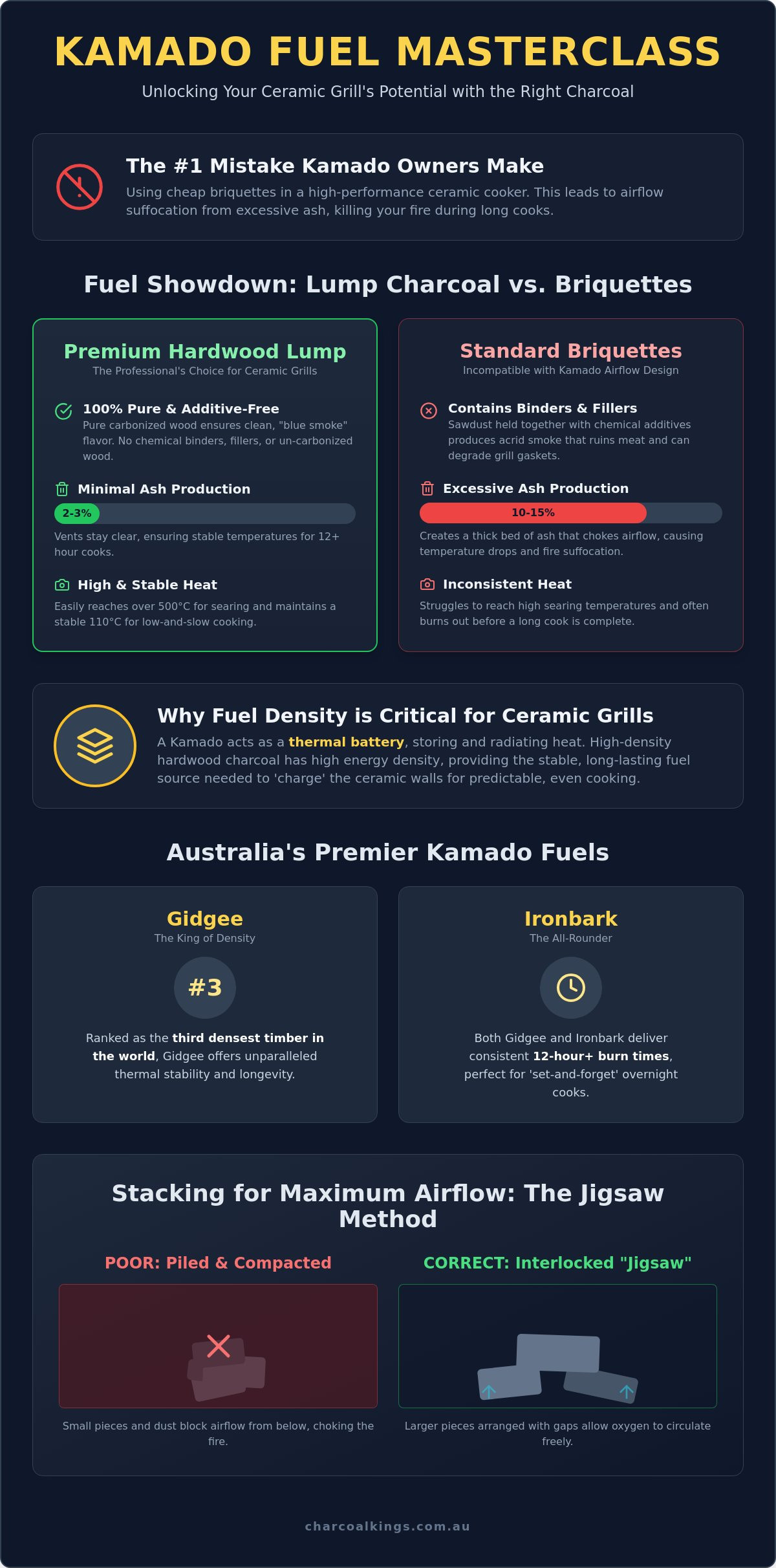
Choosing the best charcoal for kamado joe australia requires understanding the physical limitations of ceramic fireboxes. Standard sawdust briquettes are often marketed as a consistent fuel source. However, they are fundamentally incompatible with the precision airflow requirements of a Kamado Joe. The primary issue is ash volume. Briquettes contain binders and fillers that do not burn away. This leaves behind a thick, heavy residue that physically chokes the small air intake holes at the base of your grill. When oxygen flow is restricted, your temperature drops, and your fire eventually suffocates.
Premium hardwood lump charcoal typically produces between 2% and 3% ash by volume. In contrast, standard briquettes can produce 10% to 15% ash. In a 12-hour brisket cook, that difference determines whether you are sleeping soundly or frantically poking a vent tool into the firebox at 3 AM. High-quality lump also delivers a superior BTU output. While standard briquettes struggle to maintain high heat, premium lump can easily exceed 500°C for searing steaks while remaining stable at 110°C for low-and-slow sessions.
Airflow Management and Ash Production
Visualise the base of your firebox. Every centimetre of ash that accumulates acts as a barrier to fresh oxygen. High-quality lump charcoal maintains its structural integrity as it burns. This allows air to circulate freely around the remaining fuel pieces. For a deeper look at managing these variables, read our guide on Mastering the Art of Barbecuing with Charcoal. Keeping your intake path clear is the only way to maintain the stable temperatures these grills are famous for.
Temperature Control Precision
Lump charcoal is essentially pure carbon. It responds almost instantly to vent adjustments. If you open the top vent, the temperature climbs immediately. Compressed briquettes have a much slower response time due to their density and chemical makeup. There is also the factor of reusability. At the end of a cook, you can close your vents to extinguish the fire. The remaining lump charcoal can be relit for your next session. High-density hardwoods can often be reused multiple times, significantly reducing the true cost per hour of cook time. While the initial bag price might be higher, the efficiency of premium hardwood lump makes it the smarter financial choice for serious pitmasters.
Some users suggest using briquettes for short, high-heat cooks like burgers. We advise against this. The risk of chemical scent transfer from binders remains high, and the cleanup is always more intensive. There is no scenario where a compressed sawdust product outperforms a natural hardwood lump in a ceramic environment. Stick to pure carbon for the best results.
Top Australian Hardwoods: Gidgee, Ironbark, and Quebracho
The Australian market offers unique access to some of the densest timbers on the planet. For ceramic grill owners, density is the primary metric for success. Gidgee stands as the undisputed king of the best charcoal for kamado joe australia. It is the third densest timber in the world, with a density exceeding 1,000kg per m3. This makes it approximately 50% denser than standard Ironbark. This physical weight translates directly into energy storage; a single load of Gidgee lump provides the sustained thermal output required for 14-hour brisket sessions without a single temperature dip.
Quebracho Blanco, an import from South America known as the ‘Axe Breaker’, serves as a formidable alternative. While Gidgee offers a slightly more neutral profile, Quebracho provides a robust, traditional BBQ scent. Both hardwoods are superior to Mallee or Ironbark for low-and-slow cooks. Ironbark remains a reliable, budget-friendly choice for shorter 4-6 hour cooks, such as roasting a whole chicken or reverse-searing thick ribeyes. In 2026, sustainability is a non-negotiable factor. We prioritise ‘dead-finish’ wood, which refers to timber that has died naturally in the arid interior and seasoned for years under the Australian sun. This process ensures the moisture content is near zero, resulting in a cleaner, hotter burn.
The Gidgee Advantage for Low-and-Slow
Gidgee’s mineral density creates a unique ‘glow’ rather than a flickering flame. This radiant heat is exactly what a ceramic firebox needs to maintain equilibrium. Because it burns so cleanly, the flavour profile is exceptionally neutral. This allows your specific choice of smoking woods, like hickory or cherry, to define the taste of the meat rather than the charcoal overpowering it. If you find high-density lump difficult to light, try mixing it with a handful of softer hardwood pieces to act as a fire-starter. Once the Gidgee catches, it won’t go out until the fuel is completely consumed.
Lump Size Matters: The ‘Big Block’ Philosophy
Piece size distribution is just as critical as wood species. You need ‘fist-sized’ chunks at the base of your firebox to maintain the airflow paths discussed in the previous section. Small crumbs, or ‘fines’, are the enemy of the Kamado Joe. They settle into the air holes of the fire grate and act like a physical plug.
- Place the largest ‘Big Block’ pieces directly over the air intake holes.
- Layer medium chunks in the centre of the pile.
- Save the small pieces for the top of the stack where they won’t impede oxygen flow.
If you reach the bottom of the bag and find mostly small fragments, don’t throw them away. Use them for quick, high-heat grilling sessions like searing steaks or cooking skewers where airflow is less critical for a 20-minute cook. For long sessions, large-format lump is the only way to guarantee a 12-hour burn.
How to Stack Your Kamado Joe for Maximum Efficiency
Efficiency in a ceramic grill depends entirely on the architecture of your fire. Even the best charcoal for kamado joe australia will fail if you dump it into the firebox without a strategy. Proper stacking ensures that oxygen reaches the core of the fire, preventing the stalls and temperature drops that ruin long cooks. Follow these four steps to build a professional-grade fuel stack.
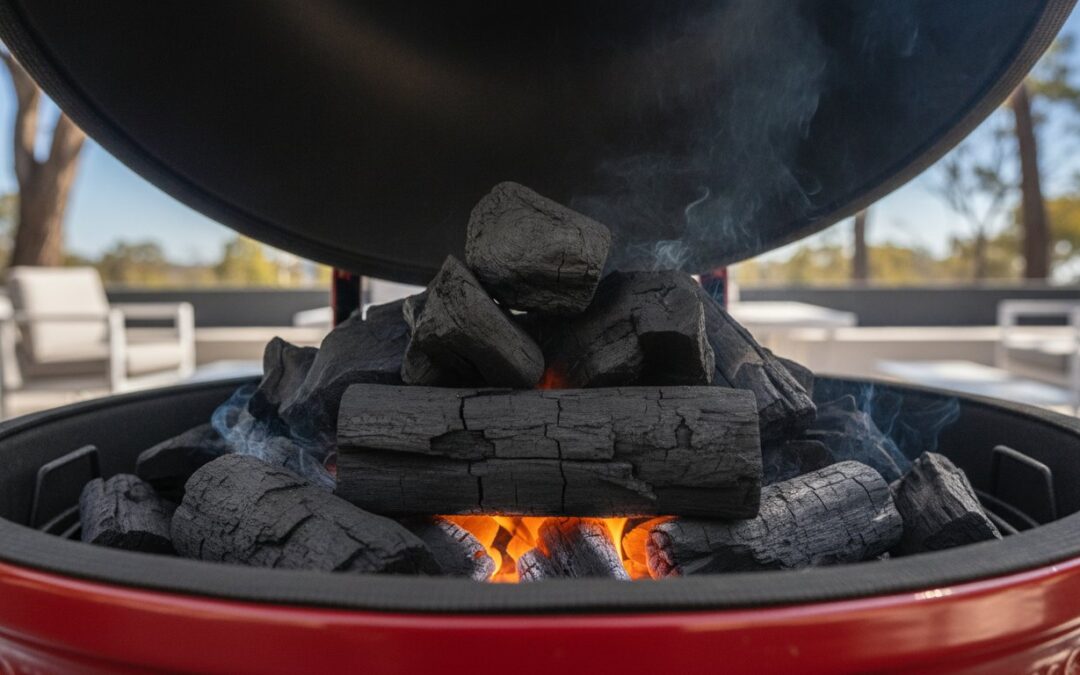
Step 1: Clean the firebox. Use your ash tool to clear every remaining bit of residue from the previous cook. Ensure the air grate holes are completely unobstructed. Step 2: The Jigsaw method. Hand-pick the largest, fist-sized lumps from your bag. Place these pieces directly over the air holes in the fire grate. This creates a structural foundation that prevents smaller fragments from falling through and choking the intake. Step 3: Build the crater. Pour medium-sized pieces around the perimeter, leaving a small depression in the center. This crater is where you will place your natural fire starter to ensure the fire spreads outward and downward evenly. Step 4: Integrate smoking wood. Bury three to four large wood chunks at various depths within the stack. Do not use chips; they burn off too fast. Chunks hidden in the charcoal will ignite at different stages of the cook, providing a consistent stream of flavour.
Stacking for the 12-Hour Smoke
For low-and-slow sessions, you need a ‘Vertical Burn’ strategy. By lighting the charcoal at the top center, the fire moves downward slowly. This technique prevents the entire basket from igniting at once, which would cause an uncontrollable temperature spike. Ensure there are no hollow spots in your stack. Large gaps can cause the fire to ‘bridge’ and lose contact with unburnt fuel, leading to a mid-cook flameout. You can enhance the flavour profile by integrating specific varieties from our Smoking Woods collection throughout the fuel bed.
Stacking for the 400°C Pizza Sear
High-heat grilling requires maximum airflow. Instead of large chunks, use medium-sized pieces toward the top of the stack to increase the total burning surface area. If you need extreme, sustained heat for multiple pizzas, Binchotan is a ‘cheat code’ for ceramic grills. It burns hotter and longer than standard lump, allowing you to maintain a 400°C environment without constantly refuelling. Refer to our Binchotan Guide to master these extreme heat techniques. To get the best results from your grill, always start with premium hardwood lump charcoal that provides the density required for these professional methods.
Why Charcoal Kings is Australia’s Choice for Kamado Fuel
Charcoal Kings is the definitive source for the best charcoal for kamado joe australia, offering products engineered for the unique thermal demands of ceramic cooking. Your grill is a precision investment. We provide the fuel that protects that investment. Our “No Additives” promise means you get 100% natural hardwood with zero chemicals, fillers, or artificial binders. This purity ensures your Kamado Joe remains free from corrosive residues and acrid chemical odors. We maintain quality through a rigorous Pitmaster Grade sorting process. Our team manually inspects our stock to ensure lump size consistency. You won’t find bags filled with useless dust or small crumbs that choke your airflow.
We eliminate the logistical headache of traditional shopping with direct-to-door delivery across Australia. You don’t have to lug heavy 15kg or 20kg bags from a retail shop to your vehicle. Our Holden Hill team provides expert support for every specific grill model, from the Classic Joe II to the Konnected Joe. If you have technical questions about airflow management or specific wood burn rates, we provide the definitive answers you need to succeed. We are pitmasters serving pitmasters.
Hardwood Lump Charcoal: Our Flagship Blend
Our flagship lump is sourced specifically for ceramic users who require extreme density and minimal ash production. This is the “Restaurant Grade” difference. Professional chefs in commercial kitchens across the country use our fuel because it provides predictable, intense heat for 12 hours or more. In 2026, we have expanded our sustainability initiatives to ensure all Australian timber is harvested through invasive species management and “dead-finish” recovery programs. This commitment protects the local landscape while providing you with a superior carbon source that burns hotter and cleaner than any imported alternative. You get maximum performance with a clear conscience.
The Complete BBQ Ecosystem
A master-level cook requires more than just high-quality fuel. Our range of rubs, sauces, and cures is designed to complement the clean, subtle smoke profile of our hardwood lump. Whether you are prepping a competition-grade brisket or quick-searing thick ribeyes, our BBQ accessories help you manage your fire with total precision. We also provide dedicated wholesale opportunities for Australian BBQ businesses and competition teams who require a reliable, large-scale supply of consistent fuel. We support the craft at every level.
Experience the difference that professional-grade carbon makes in your ceramic grill. Shop the range of Premium Hardwood Lump Charcoal and take the guesswork out of your next low-and-slow session. Get the fire right. Every time.
Master the Fire in Your Ceramic Grill
Achieving a perfect 12-hour brisket or a 400°C pizza sear is impossible without the right carbon source. You’ve learned that high-density hardwoods like Gidgee and Ironbark provide the thermal mass necessary to turn your Kamado Joe into a true set-and-forget cooker. By avoiding the ash-heavy fillers found in standard briquettes, you ensure your air vents remain clear and your temperatures stay stable. Proper stacking and the Jigsaw method complete the strategy for total thermal control.
We provide the best charcoal for kamado joe australia, featuring a 100% natural hardwood, low ash formula that is trusted by Australia’s top pitmasters. Our Pitmaster Grade sorting process ensures you receive the large chunks needed for maximum airflow and sustained heat. Don’t let inferior, chemical-laden fuel ruin an expensive cut of meat or clog your firebox with excessive residue. Your grill is a precision tool; it deserves a fuel that matches its engineering.
Fuel your Kamado Joe with Australia’s Best Hardwood Lump Charcoal and experience the difference of professional-grade purity. It’s time to light the fire and take your outdoor cooking to the next level. Your next masterpiece starts with the right fuel.
Frequently Asked Questions
Can I use briquettes in my Kamado Joe?
You should avoid using briquettes in a ceramic grill. The high ash content, often exceeding 10% by volume, physically chokes the narrow air intake holes at the base of the firebox. This restriction kills oxygen flow and prevents stable temperature control. Hardwood lump is the best charcoal for kamado joe australia because it produces minimal residue and allows for consistent airflow during long, 12-hour sessions. Stick to pure carbon for professional results.
How much charcoal should I put in my Kamado Joe for a brisket?
Fill your firebox to the top of the ceramic fire ring for a 12 to 14 hour brisket cook. Ceramic grills are highly efficient; they only consume the fuel necessary to maintain the set temperature. Filling the basket ensures you have enough thermal mass to survive the stall without opening the lid to refuel. Always use large lump pieces at the base to keep the intake path clear for the duration of the cook.
Why is my charcoal sparking when I light it?
Sparking occurs when charcoal contains trapped moisture, sap, or pockets of un-carbonised wood. As these pockets heat up, they expand rapidly and pop. High-quality, fully carbonised hardwood lump rarely sparks. If your fuel pops aggressively, it likely contains fillers or was produced from low-density softwoods. Using premium Australian hardwoods like Gidgee ensures a stable, spark-free ignition that won’t damage your ceramic gaskets or clothing.
Is it okay to reuse charcoal that didn’t burn all the way?
You can and should reuse unburnt charcoal. Once your cook is finished, close all vents to starve the fire of oxygen and extinguish the coals. Before your next session, stir the remaining coals to knock off loose ash and ensure the air grate is clear. Reusing high-density lump is a key advantage of the best charcoal for kamado joe australia, as it significantly reduces your overall cost per hour of cook time.
What is the best way to light charcoal in a ceramic grill?
Use a natural fire starter or an electric heat gun in the center of the charcoal stack. Never use liquid fire starters or petrol-based fluids. Ceramic is porous and will absorb chemical odors, which then transfer to your food in every subsequent cook. Lighting a single point in the center allows the fire to spread outward slowly, which is the ideal method for maintaining the low-and-slow temperatures required for smoking.
How do I stop my Kamado Joe from producing thick white smoke?
Thick white smoke is caused by volatile organic compounds burning off during the initial ignition. You must wait for the “clean burn” phase, characterized by nearly invisible blue smoke, before adding meat to the grill. This process usually takes 15 to 20 minutes. If white smoke persists, your charcoal may be damp or contain un-carbonised wood. High-purity hardwood lump reaches a clean state faster than generic supermarket alternatives.
Does the type of wood in the charcoal affect the taste of the meat?
The wood species provides a base flavour profile, but high-quality charcoal should be relatively neutral. Denser woods like Ironbark offer a traditional, rugged BBQ scent, while Gidgee is prized for its clean, neutral output. This neutrality is a benefit. It provides a blank canvas for your chosen smoking wood chunks to define the final flavour. Avoid cheap charcoal with chemical binders, as these impart a bitter, acrid taste to expensive cuts.
Why is Gidgee charcoal considered the best in Australia?
Gidgee is the third densest timber globally, offering a massive thermal output and an incredibly long burn time. It provides a steady, radiant heat that ceramic walls absorb and store efficiently. Because it is an Australian native hardwood, it is perfectly suited to the local climate and cooking styles. Pitmasters choose Gidgee for its ability to maintain 110°C for over 14 hours while producing almost zero ash residue during the process.