The most expensive cut of Wagyu is worthless if your fuel fails to deliver a clean, consistent heat. Many pitmasters believe there’s a single “right” answer in the debate of lump charcoal vs briquettes, but the truth is about matching carbon density to your specific gear. You’ve likely dealt with the headache of inconsistent temperatures or excessive ash clogging your smoker’s vents during a long cook. It’s a common struggle that often results in wasted meat and a lot of unnecessary frustration.
We understand that performance and purity are non-negotiable for a serious BBQ. This article provides the definitive framework for choosing your fuel based on burn time, heat intensity, and flavor requirements. We’ll compare the 700°C searing power of raw hardwood lump against the predictable four-hour endurance of high-quality briquettes. You’ll learn how to avoid chemical smells and manage airflow effectively to ensure you achieve a perfect burn every time you light the grill. Whether you’re chasing a high-heat sear or a low and slow masterpiece, the right fuel makes the difference.
Key Takeaways
- Understand why 100% natural hardwood lump is the superior choice for high-heat searing and rapid response in ceramic grills.
- Learn how the engineered consistency of premium briquettes provides a flat heat curve for reliable “low and slow” sessions.
- Master the definitive lump charcoal vs briquettes performance metrics to match your fuel’s heat output to your specific BBQ hardware.
- Discover the importance of additive-free fuel in preserving the natural flavor profiles of your meat without chemical interference.
- Identify the specific hardware requirements that dictate fuel choice to prevent airflow blockages and maintain temperature control.
The Fundamental Duel: What Sets Lump Charcoal and Briquettes Apart?
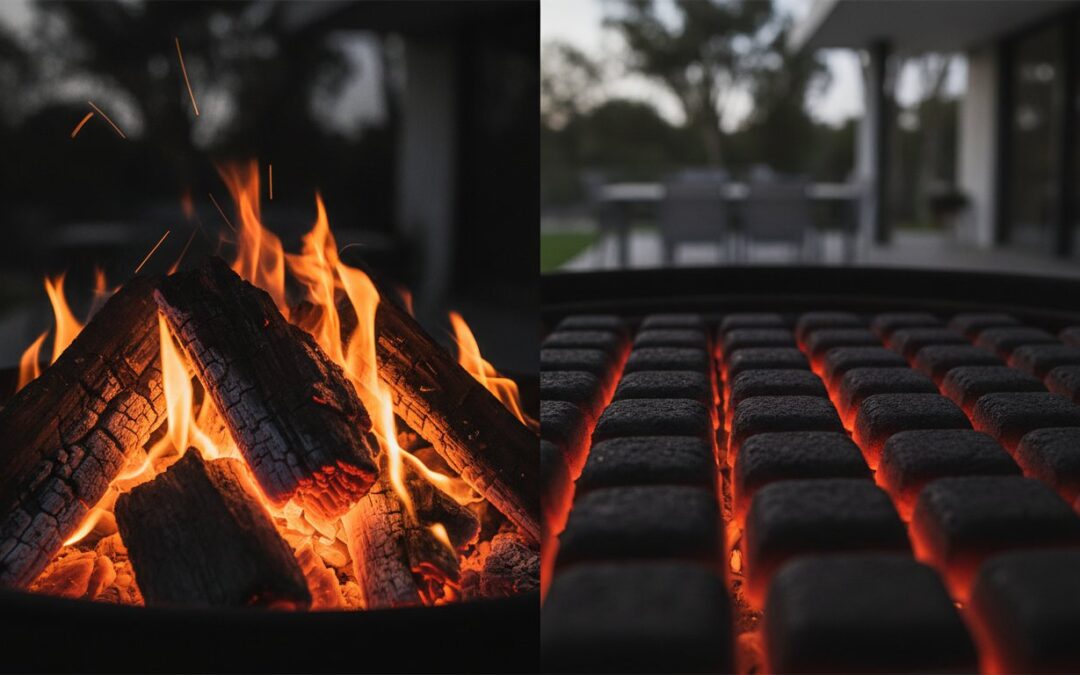
Choosing between lump charcoal vs briquettes is the first critical decision every pitmaster faces. The difference lies in the manufacturing process and the resulting carbon density. Hardwood lump charcoal is the direct result of carbonising raw timber in an oxygen-free environment. This process removes water and volatile compounds, leaving behind nearly pure carbon. In contrast, briquettes are manufactured products. They consist of charcoal fines and wood by-products compressed into uniform shapes using specific binders.
To understand the core of the debate, one must ask: What is charcoal? At its most basic level, it is the solid residue remaining after the carbonisation of organic matter. In the Australian market, the “all-natural” label is a vital indicator of quality. Premium fuels avoid the fillers found in budget supermarket brands. While lump charcoal retains the irregular, organic shapes of the original branches and logs, briquettes offer a geometric uniformity that appeals to those seeking predictable stackability and airflow.
To better understand this concept, watch this helpful video:
Hardwood Lump Charcoal: The Purest Form of Fire
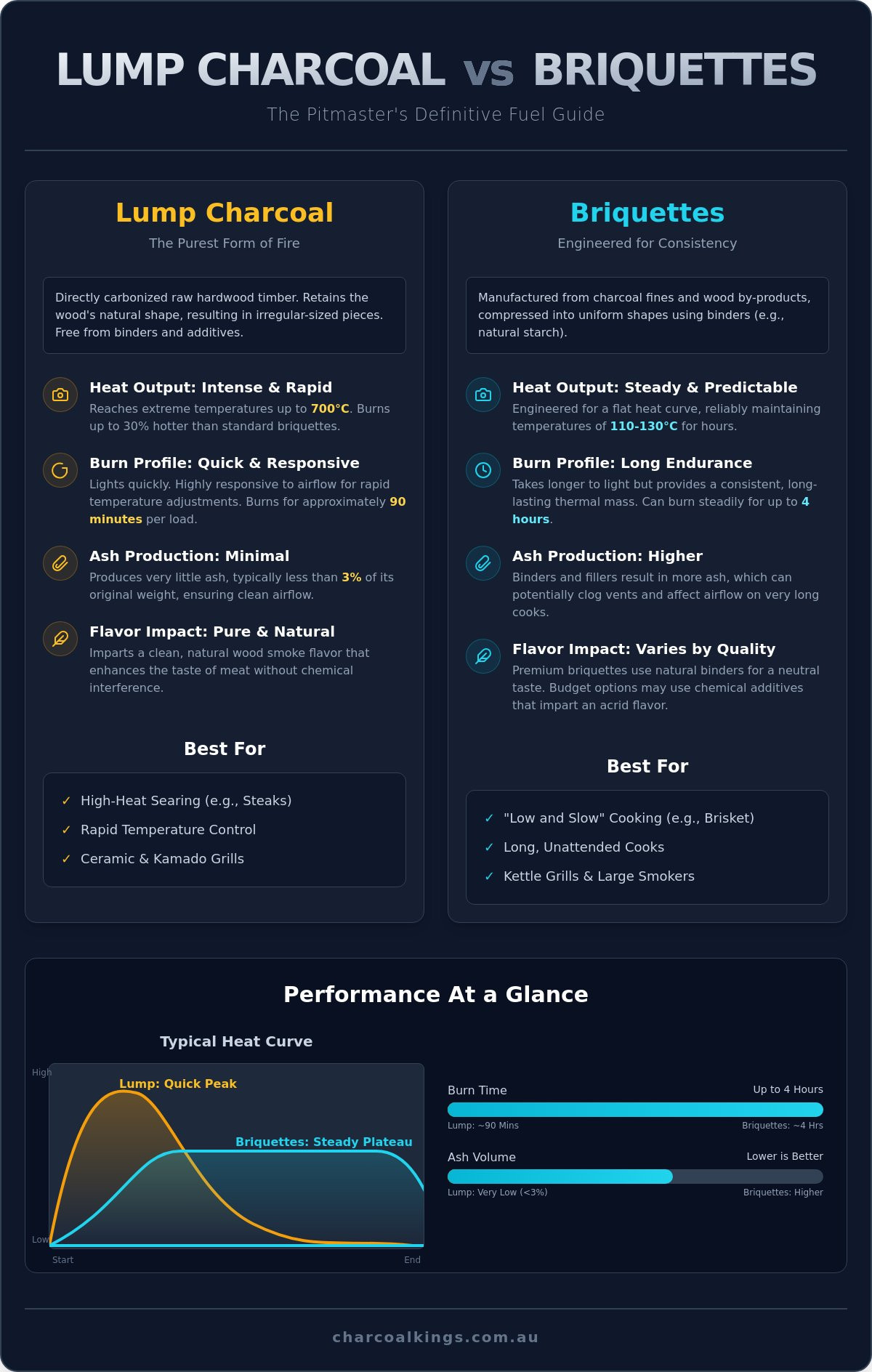
Hardwood lump charcoal is the gold standard for purity and intense heat. Because it is derived from whole pieces of timber, it maintains the original cell structure of the wood. This results in a fuel that lights quickly and reaches extreme temperatures. High-quality Australian hardwoods like Gidgee or Ironbark are preferred for their incredible density. These species produce a lump charcoal with high carbon content and minimal ash production, typically less than 3% of its original weight. The lack of additives ensures a clean, natural wood aroma that enhances the flavour of the meat rather than masking it with chemical fumes.
Charcoal Briquettes: Engineered for Consistency
Briquettes are engineered to provide a predictable burn rate and uniform heat distribution. This consistency is the primary selling point for commercial pitmasters and hobbyists alike. Each briquette is identical in size and density, allowing for precise temperature control over several hours. The role of binders is the most significant variable in this category. Premium options use natural cornstarch to hold the charcoal fines together. Budget brands often rely on chemical additives or coal dust, which can impart an unpleasant acrid taste to delicate foods. When sourced correctly, a high-quality briquette provides a steady, “flat” heat curve that is ideal for long, low and slow cooks.
Heat, Burn Time, and Control: The Performance Metrics That Matter
Performance isn’t just about how hot the fire gets. It’s about how that heat behaves over time. When comparing lump charcoal vs briquettes, the primary metrics are peak temperature, endurance, and ash volume. High-quality lump charcoal can reach temperatures of 700°C in just 15 minutes. This makes it significantly hotter than standard briquettes, which are engineered for a different purpose entirely. According to The New York Times’ charcoal review, the choice often depends on whether you value raw power or steady predictability.
The Heat Curve: Peak Intensity vs. Steady Endurance
Lump charcoal offers rapid ignition and intense initial heat. It’s highly responsive to oxygen. If you open your vents, the temperature spikes almost immediately. However, this intensity comes with a quicker taper. A standard load of lump typically burns for about 90 minutes before requiring a top-up. Briquettes take longer to light but provide a reliable, long-lasting thermal mass. They’re designed to hold a consistent temperature, often maintaining a steady 110 to 130°C for up to four hours. The carbon density of the fuel dictates the duration of the burn, with denser Australian hardwood lump providing more energy per fragment than compressed sawdust alternatives.
- Lump Charcoal: Reaches 700°C quickly. It burns up to 30% hotter than standard briquettes.
- Briquettes: Engineered for endurance. Maintains 250°F (121°C) for extended periods.
- Response Time: Lump reacts faster to air vent adjustments due to its irregular surface area.
Temperature Management for Different BBQ Styles
The cooking method determines which fuel reigns supreme. For high-heat searing, lump is the only choice. It provides the infrared energy needed to create a perfect crust on a steak without overcooking the centre. For low and slow sessions, briquettes offer a distinct advantage. Their uniform shape allows for techniques like the Minion Method, where fuel burns progressively over 12 hours. This is essential for large cuts like brisket that require a flat heat curve. For a deeper dive into these techniques, check out Charcoal: The Ultimate Guide to Fuelling Your BBQ.
Ash production is another critical factor for temperature control. Premium hardwood lump produces less than 3% ash by weight. Briquettes leave behind 10% to 15% ash volume because of the binders used to hold them together. In many smokers, this excessive ash can clog air vents and choke the fire. If you want a cleaner burn and better airflow, sourcing additive-free options from charcoalkings.com.au ensures your vents stay clear and your temperatures remain stable throughout the cook.
The Purity Factor: Addressing Additives, Ash, and Flavour
The debate over lump charcoal vs briquettes often centres on purity, yet many pitmasters operate on outdated assumptions. There’s a persistent myth that all manufactured fuel is “dirty” or laden with chemicals. While this is true for budget supermarket brands, the premium tier of the Australian market has evolved. High-performance briquettes now exist that bridge the gap between convenience and organic purity. Understanding what’s inside your fuel is the only way to protect the flavour of expensive cuts like brisket or Atlantic salmon.
Natural Binders vs. Chemical Accelerants
Premium fuel manufacturers have replaced harsh chemicals with food-grade alternatives. High-quality Australian briquettes typically use vegetable binders like cornstarch to maintain their shape. This ensures the fuel remains neutral and doesn’t impart an acrid, metallic taste to your food. In contrast, cheap alternatives often contain coal dust, limestone, and paraffin to speed up ignition and reduce costs. At Charcoal Kings, our purity promise is built on the total absence of these additives. We believe your fuel should never compete with your seasoning. If you smell a chemical “starter fluid” aroma during ignition, those toxins are likely settling on your meat.
Lump charcoal is naturally free of binders, but it brings its own purity challenge: the “popping” problem. This occurs when small pockets of moisture or air remain trapped within the wood during the carbonisation process. When heated rapidly, these pockets expand and cause the charcoal to spark or crack. You can avoid this by sourcing well-seasoned hardwood lump that’s been processed correctly. High-carbon fuels spark less because the volatile organic compounds have been thoroughly removed.
Flavour Profiles: The Smoke Factor
Lump charcoal provides a subtle, authentic wood-smoke flavour that mimics a traditional campfire. This makes it ideal for short cooks where you want the fuel to contribute to the final profile. Briquettes are intentionally more neutral. This neutrality is a strategic advantage for serious smokers. It allows specific smoking woods like Hickory, Apple, or Mesquite to take centre stage without interference from the base fuel. You can identify clean-burning fuel by the colour of the smoke. Thin, blue smoke indicates efficient combustion and pure fuel. Thick, white, or yellow smoke is a warning sign of unburnt binders or moisture.
- Ash Volume: Lump charcoal leaves less than 3% residue, making cleanup effortless.
- Stability: Briquettes produce 10% to 15% ash. This volume can insulate the remaining fuel and eventually choke the fire if your grate design doesn’t allow for adequate fallout.
- Flavour Integrity: Use lump for a raw wood finish; use additive-free briquettes when you want total control over your secondary smoke profile.
Managing ash is vital for long-cook temperature stability. Excessive ash buildup blocks the oxygen flow required to maintain a steady burn. While lump is the clear winner for airflow, premium briquettes with natural binders still outperform the “quick-light” varieties that rely on heavy chemical coatings. Choose your fuel based on the level of intervention you’re willing to provide during the cook.
Choosing Your Fuel Based on Your BBQ Hardware
Your choice in the lump charcoal vs briquettes debate is often decided by the steel or ceramic sitting on your patio. If you are in the market for a home that features the ultimate outdoor kitchen space, Regal Gateway Property can help you find the right residence in Western Australia. Every grill has a specific airflow design. Using the wrong fuel can lead to restricted oxygen or mechanical failures in automated systems. You must match the carbon density and physical shape of your fuel to the intake requirements of your hardware. Performance is a result of how well your fuel breathes within its environment.
Fuel Matching for Specific Grills
Ceramic cookers, such as Kamados, are high-efficiency environments that thrive on unrestricted airflow. Hardwood lump is essential here. Because lump produces minimal ash, it prevents the fire bowl from becoming a graveyard of residue that chokes your bottom vent. Conversely, gravity-fed smokers require the uniform size of briquettes. The geometric consistency ensures a smooth, predictable descent through the hopper. Lump pieces are too irregular and often “bridge,” leaving your smoker cold in the middle of the night. For more advice on selecting the right kit, see The Ultimate BBQ Buying Guide.
Offset smokers use charcoal differently. In these heavy-duty units, the fuel serves as a “coal bed” to ignite and maintain hardwood splits. A mix of both fuels works well in this scenario. For tabletop grilling or Japanese-style cooking, standard fuels often fall short. Binchotan is the elite alternative to standard lump for Hibachi use. It is a high-carbon, flameless fuel that emits steady infrared heat for hours without the sparking or smoke associated with lower-grade timber.
The Hybrid Approach: Mixing Fuels
Experienced pitmasters often use a hybrid strategy in kettle BBQs. By using briquettes as a base for the Minion Method, you secure a predictable burn time of four to six hours. Adding a layer of hardwood lump on top provides the intense initial heat and authentic wood aroma that manufactured fuels can lack. You can blend fuels to achieve both the thermal stability of a compressed product and the organic flavour profile of raw timber. This layering technique is particularly effective in a Weber kettle where space is limited but performance is paramount.
If you’re running a commercial kitchen or a high-volume backyard setup, reliability is your primary currency. Don’t let poor fuel choice ruin a premium cook. Match your carbon to your cooker and maintain total control over your fire. Ready to upgrade your next session? Explore our range of premium BBQ fuels at Charcoal Kings and find the perfect match for your grill.
The Professional Verdict: Why Quality Always Trumps Convenience
Success at the grill is a calculation of fuel efficiency and thermal stability. While many beginners reach for the most accessible bag at the local supermarket, seasoned pitmasters know that low-cost options often result in higher total expenditure. In the battle of lump charcoal vs briquettes, the professional verdict is simple: match the fuel to the cook, but never compromise on the carbon quality. High-carbon, additive-free fuels are the only way to ensure your hardware performs as intended.
Cost vs. Value: The Real Price of BBQ Fuel
Standard retail briquettes often contain up to 20% fillers by weight. These include limestone, coal dust, and chemical binders that contribute nothing to the heat of your fire. You’re effectively paying for ash production. Premium Australian hardwood lump is more efficient because every gram is combustible carbon. It burns hotter and leaves behind less than 3% residue. When you compare the burn time per kilogram, high-performance fuel requires less volume to reach and maintain your target temperature. This is why professional kitchens across Australia rely on Charcoal Kings for their service. Using pure fuel prevents clogged vents and ensures that the flavour of the meat remains the hero of the dish.
Final Recommendations for Your Next Cook
Choosing between lump charcoal vs briquettes depends on your specific goals for the day. For those tackling their first 12-hour brisket, premium additive-free briquettes are the best choice. Their engineered shape provides the flat heat curve necessary for long-term stability. If you’re searing a thick-cut ribeye on the weekend, hardwood lump is the only option that delivers the required infrared intensity for a world-class crust. We recommend a “Right Fuel, Right Occasion” framework to maximize both performance and value.
- Low and Slow: Use briquettes for consistent endurance and predictable airflow.
- High-Heat Searing: Use hardwood lump for maximum temperature and natural aroma.
- Specialty Grilling: Use Binchotan for flameless, high-heat precision.
To maintain peak performance in the Australian climate, storage is critical. Our high humidity can cause charcoal to absorb moisture, leading to poor ignition and excessive sparking. Store your fuel in airtight containers in a cool, dry area. This preserves the carbon structure and ensures a clean light every time. Ready to see the difference that high-performance carbon makes? Browse our range of Premium Hardwood Lump and Briquettes and elevate your BBQ game today.
Master Your Fire with the Right Carbon
Choosing between lump charcoal vs briquettes isn’t a matter of opinion; it’s a technical decision based on your desired heat profile and hardware. You have the definitive framework to select raw hardwood lump for high-heat intensity or premium briquettes for unwavering endurance. Purity remains the foundation of superior flavor. Avoid chemical additives and fillers to ensure your meat remains the focal point of every cook. High-performance BBQ requires high-performance fuel.
Charcoal Kings provides 100% natural hardwood with zero chemical additives. Our products are trusted by Australia’s leading commercial pitmasters for their consistency and high carbon density. We offer fast nationwide shipping from our South Australian warehouse to keep your grills running year-round. Professional results demand professional-grade materials.
Upgrade your BBQ game with Charcoal Kings Premium Fuels and take total control of your next cook. It’s time to fire up and achieve the results your hard work deserves.
Frequently Asked Questions
Which burns longer, lump charcoal or briquettes?
Briquettes burn longer because they are engineered for density and uniform thermal mass. A standard load can maintain a steady temperature for up to four hours without intervention. Lump charcoal burns significantly hotter but has a shorter duration, usually lasting about 90 minutes. This makes briquettes the preferred choice for extended cooking sessions where stability is the priority over raw peak temperature.
Can I mix lump charcoal and briquettes in the same BBQ?
You can definitely mix both fuels to achieve a balance of stability and flavour. Many pitmasters use briquettes as a long-burning base and add lump charcoal for an intense initial sear or a natural wood aroma. This hybrid method is highly effective in kettle BBQs. It allows you to benefit from the predictable burn of manufactured fuel while enjoying the organic performance of raw hardwood.
Why does some lump charcoal spark and pop when lighting?
Sparking occurs when small pockets of moisture or air remain trapped inside the wood during the carbonisation process. When these pockets heat up rapidly, they expand and cause the charcoal to pop. High-carbon fuels that have been processed correctly will spark far less. Sourcing premium Australian hardwood lump ensures that most volatile compounds have been removed, resulting in a much safer and cleaner ignition experience.
Are charcoal briquettes toxic?
Premium briquettes are entirely safe and non-toxic when they use natural binders like cornstarch. The toxic reputation comes from cheap supermarket brands that often contain coal dust, limestone, or paraffin accelerants. These additives can impart a chemical taste to your food. At Charcoal Kings, our purity promise ensures that our fuels contain zero chemical additives, protecting both your health and the integrity of your meat’s flavour.
Why should I use lump charcoal in a Kamado or Big Green Egg?
Lump charcoal is the only viable fuel for ceramic grills because it produces very little ash. Briquettes leave behind a large volume of residue that can easily block the small air intake holes in the fire grate. This blockage restricts oxygen flow and makes it impossible to maintain the high temperatures these grills are famous for. Using lump charcoal vs briquettes in a Kamado ensures your airflow remains unrestricted for the duration of the cook.
What is the best charcoal for low and slow smoking?
High-quality briquettes are the best option for low and slow smoking because they provide a flat heat curve. They are designed to burn at a consistent rate, making it easier to hold your smoker between 110 and 130°C for 12 hours or more. While lump charcoal can be used, its irregular shapes can lead to temperature fluctuations that require more frequent vent adjustments during a long cook.
How should I store charcoal to keep it fresh in Australia?
The best way to store your fuel is in an airtight plastic bin kept in a dry, shaded area. Australian humidity is a major enemy of charcoal performance. If the carbon absorbs moisture from the air, it becomes difficult to light and will produce excessive smoke and sparks. Keeping your bags off the ground and sealed tight ensures your fuel remains at peak performance regardless of the local weather conditions.
Do I need to use a chimney starter for both types of fuel?
A chimney starter is highly recommended for both lump charcoal and briquettes to avoid the use of chemical lighter fluids. It is the most reliable tool for achieving a fast, even ignition using only paper or natural firelighters. Using a chimney ensures that your fuel is fully ashed over before it hits the grill. This prevents any unburnt binders or carbon from affecting the initial flavour of your meat.