There is nothing more frustrating than a fire that refuses to start. You have premium logs or quality lump charcoal ready to go, but you’re left with a plume of smoke, a pile of messy newspaper, and a fire that just smoulders. Wasting expensive fuel trying to ignite a cold fireplace or BBQ is a common, costly mistake. The problem isn’t your logs; it’s the missing link in your process. The non-negotiable secret to a fast, powerful flame is starting with the right kindling wood.
This guide provides the definitive solution. We will show you exactly what makes for quality kindling, why it’s essential for getting your charcoal roaring, and how to build a fire structure that works every single time. Forget relying on chemical firelighters that taint your food or struggling with unreliable methods. You will gain the expert knowledge to light your fireplace or grill quickly and efficiently, using only natural materials. It’s time to master the flame and get things burning hot and fast.
What is Kindling Wood and Why is it Essential?
Mastering fire is a fundamental skill, whether you’re firing up a premium offset smoker or a backyard fire pit. The secret to a fast, powerful, and clean-burning fire isn’t the log; it’s the bridge fuel that gets you there. This is the essential role of kindling. Think of it as the critical middle step in a fire’s ‘food chain’: your tinder catches the initial spark, the kindling takes that small flame and builds it into a stable fire, which then has the power to ignite your main fuel like hardwood logs or lump charcoal. The basic principles have remained consistent throughout the history of firemaking; you must build heat incrementally.
To see how to prepare this essential fuel safely and efficiently, watch this practical demonstration:
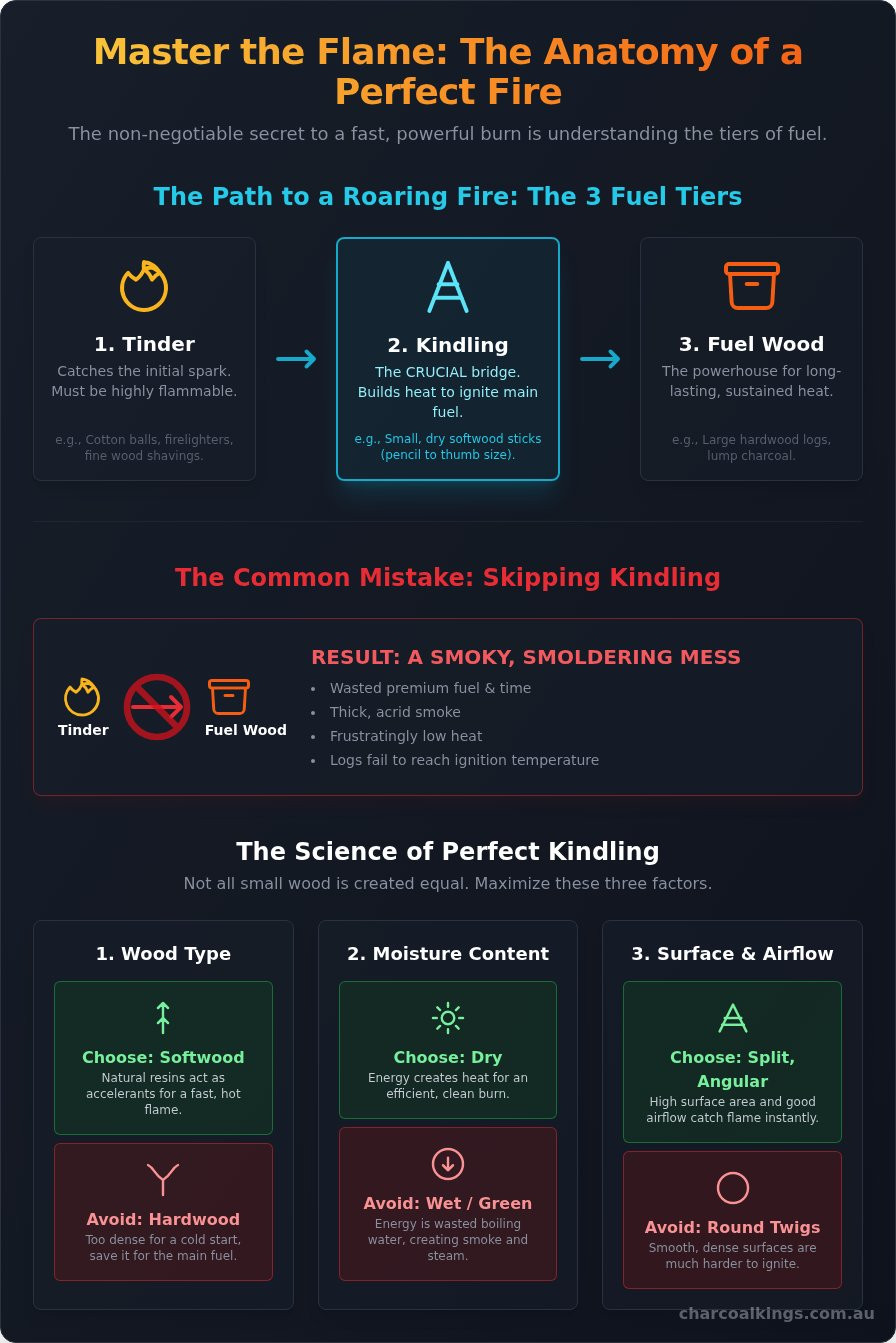
Tinder vs. Kindling vs. Fuel Wood: Understanding the Tiers
Understanding the distinct roles of each fuel type is non-negotiable for consistent results. Each tier is defined by its size and combustibility, building on the last to create a strong, self-sustaining fire.
- Tinder: The initial flame source. It must be highly flammable to catch a spark from a lighter or ferro rod. Examples include cotton balls, commercial firelighters, or very fine, dry wood shavings.
- Kindling: The bridge. This is typically small, dry sticks ranging from pencil to thumb thickness. Its job is to catch fire from the tinder and burn hot enough for long enough to ignite the main fuel.
- Fuel Wood/Charcoal: The powerhouse. These are your larger split logs or premium lump charcoal that provide sustained, long-lasting heat for cooking or warmth.
The Consequences of Skipping the Kindling Stage
Attempting to light large logs directly from a firelighter is the most common cause of fire-starting failure. The result is predictable: a frustrating, smouldering pile that produces thick, acrid smoke but very little heat. This inefficient process wastes your premium fuel and, more importantly, your time. Without a proper base of hot coals established by quality kindling wood, the larger logs simply won’t reach their ignition temperature. You’ll be left constantly tending a weak, struggling fire instead of enjoying the powerful, clean burn you need.
The Science of a Perfect Fire: How Quality Kindling Works
Building a powerful, long-lasting fire isn’t magic-it’s science. The foundation of all combustion is the ‘fire triangle’, a simple principle that dictates the three elements every fire needs to ignite and burn:
- Heat: The initial spark or flame.
- Fuel: The material that burns.
- Oxygen: The oxidiser that feeds the reaction.
A pile of large logs has fuel, but it struggles to generate enough heat and access enough oxygen to ignite properly. Quality kindling wood is the essential bridge. It is engineered by nature and proper preparation to manipulate the fire triangle, creating the perfect conditions for rapid, intense combustion that brings your main firewood to life.
Surface Area: The Secret to a Fast Catch
The primary advantage of kindling is its high surface-area-to-volume ratio. More surface area means more of the wood is directly exposed to your initial heat source. Think of it like trying to light a thick phone book with a single match-it won’t work. But a single page from that book will ignite instantly. A large log is the phone book; a bundle of kindling sticks are the individual pages. This is precisely why split kindling with sharp, angular edges catches fire far more effectively than smooth, round twigs.
Airflow and Oxygen: Letting Your Fire Breathe
Fuel without oxygen is useless. A fire needs to breathe, and the structure of your kindling pile is what gives it lungs. Piling large, dense logs on a starter flame will smother it, cutting off the crucial supply of air. In contrast, stacking kindling in a teepee or log cabin formation creates channels and gaps. These gaps allow air to circulate freely, feeding the flames with a constant supply of oxygen. Understanding the basics of how to start a fire begins with this principle. The result is a hotter, more efficient, and cleaner burn with significantly less smoke.
By maximizing surface area for heat absorption and ensuring ample airflow for oxygen, your kindling wood creates a short, intense burst of energy. This rapidly raises the temperature within the fire pit or fireplace, generating the critical heat required to ignite your larger, denser logs and establish a self-sustaining fire.
Choosing the Best Kindling: Not All Small Wood is Equal
The success of your fire starts long before you strike a match. The quality of your kindling directly impacts how quickly and efficiently your fire catches, burns, and transitions to your main fuel logs. While it might be tempting to grab any small twig or scrap from the backyard, this is a recipe for a frustrating, smoke-filled failure. The best performance comes from understanding three key factors: wood type, moisture content, and consistency. Using random, damp wood is a gamble; using premium, properly prepared kindling wood is a guarantee.
Softwood vs. Hardwood for Kindling
For starting a fire, softwood is the undisputed champion. Woods like pine and fir are less dense and packed with natural resins. These resins act as a potent, built-in fire accelerant, allowing the wood to ignite with minimal effort and produce a hot, fast flame. While hardwoods like Oak or Australian Ironbark are excellent for long-lasting coals, their density makes them extremely difficult to light from a cold start. Save the hardwood for the main event and always start with softwood kindling.
The Critical Importance of Dryness
Moisture is the single biggest enemy of a successful fire. Attempting to burn wet or ‘green’ wood is a waste of time and energy. Instead of producing heat, the fire wastes its power boiling off the internal moisture, resulting in excessive smoke, steam, and sputtering hisses. Look for wood that is either ‘seasoned’ (air-dried over many months) or, for superior results, ‘kiln-dried’. Kiln-dried kindling has a guaranteed low moisture content, ensuring it catches instantly and burns fiercely.
Wood and Materials to Absolutely Avoid
Never compromise on safety or the integrity of your equipment. Burning the wrong materials can release toxic chemicals or damage your fireplace, grill, or pizza oven. Always avoid the following:
- Treated or Painted Wood: Timber from old pallets, fences, or furniture (like MDF or particleboard) can release arsenic, cyanide, and other toxic chemicals when burned.
- Driftwood: Wood found on the beach contains high levels of salt, which becomes highly corrosive when burned and can quickly rust out metal components.
- Poisonous Plants: Never burn wood from unknown vines or shrubs, as some can release harmful irritants into the smoke.
- Flammable Liquids: Using petrol or kerosene to start a fire is extremely dangerous and can lead to explosive flare-ups. Stick to natural firelighters and quality kindling wood.
How to Use Kindling for Different Types of Fires
The fundamental principle of fire starting is universal: use a small, fast-burning material to ignite a larger, slower-burning fuel. However, the application of this principle changes with the environment. Proper structure and airflow are non-negotiable for success, whether you’re firing up the barbie, the fireplace, or a campfire under the stars. The goal is always to build a stable, hot base that efficiently ignites your main fuel source.
For Charcoal BBQs and Smokers
For a clean, chemical-free start, nothing beats natural kindling. Avoid lighter fluid that taints your food. Instead, use your kindling in a charcoal chimney starter. Place a few pieces of kindling and a natural firelighter at the bottom, fill the chimney with charcoal, and light it. For offset smokers, build a small teepee of kindling in the firebox to create a hot, fast-burning base. This established coal bed will ignite your main fuel logs efficiently, delivering pure smoke flavour.
Fuel your next BBQ with our premium lump charcoal.
For an Indoor Fireplace or Wood Stove
An efficient indoor fire requires a solid foundation built with quality kindling wood. Two classic methods work best:
- The Log Cabin: Place your tinder in the centre. Stack two pieces of kindling parallel on either side, then two more on top and perpendicular, like a small cabin. Light the tinder in the middle for a steady, controlled burn.
- The Teepee: Build a cone-shaped structure with your kindling around a central pile of tinder. This creates a fast, hot flame ideal for quick ignition.
Always ensure your flue or damper is fully open for maximum airflow. Once the kindling is burning fiercely, carefully add your larger logs.
For a Campfire
Safety and structure are paramount for a successful campfire. Start by clearing a patch of bare ground, free from leaves, grass, and overhanging branches. The teepee structure is the most reliable method in the outdoors. Build a larger and more robust kindling teepee than you would for an indoor fire to combat wind and moisture. Once the kindling has caught and is producing a strong flame, begin to gradually add larger sticks, followed by your main firewood logs, maintaining the structure as you build.
DIY Kindling vs. Buying Pre-Cut Bags: A Realistic Comparison
When it comes to starting a fire, the choice between processing your own kindling wood and buying it pre-packaged is a common dilemma. While the DIY approach has a certain rustic appeal, it’s essential to weigh the practicalities. The right choice depends entirely on your resources, time, and what you value most: cost savings or high-performance convenience.
The Pros and Cons of Making Your Own
Creating your own kindling can be rewarding, but it demands a significant trade-off. While it may seem cheaper, the hidden costs in time and effort quickly add up.
- Cost: The main advantage is potential savings, but only if you have a free and legal source of suitable, untreated hardwood. Sourcing and transporting this wood still requires effort.
- Time and Labour: Splitting logs into small, consistent pieces is physically demanding and time-consuming work. What takes a professional machine seconds can take you hours with a hatchet.
- Tools and Safety: You need the right equipment, such as a sharp axe or a dedicated kindling splitter, and the knowledge to use them safely. Improper technique can easily lead to injury.
- Quality Control: This is the biggest challenge. It is difficult to guarantee your wood is properly seasoned with a low moisture content. Using damp or resinous wood results in a smoky, frustrating fire that struggles to catch.
The Benefits of Buying Quality Bagged Kindling
For those who value reliability and efficiency, buying professionally prepared kindling is the superior choice. It eliminates guesswork and streamlines the entire process of building a perfect fire, whether for your pizza oven, smoker, or fireplace.
- Unmatched Convenience: Your kindling arrives ready to use. There is no chopping, no mess, and no wasted time. Simply open the bag and build your fire. This convenience is invaluable when you want to get cooking or warm up quickly.
- Guaranteed Dryness: Reputable suppliers offer kiln-dried kindling. This process removes excess moisture, ensuring the wood lights instantly, burns hot, and produces minimal smoke for a clean, efficient start.
- Perfect Consistency: Each piece is uniformly sized and shaped. This predictability allows you to build a stable fire structure that promotes optimal airflow, leading to a faster and more reliable ignition of your main fuel source.
Ultimately, the decision comes down to what you prioritise. If your goal is a fast, reliable, and smoke-free fire every single time, the quality and convenience of pre-cut kindling is the clear winner. Save time and get a perfect fire every time. Shop for kindling now.
Ignite with Confidence: Your Final Word on Kindling
You now hold the knowledge to master the art of fire-starting. Remember, kindling is the critical bridge between a tiny spark and a roaring fire, and its quality is non-negotiable. Choosing dry, properly sized wood over damp, inconsistent sticks is the single most important factor for success. This understanding transforms the process from a frustrating gamble into a reliable skill, whether you’re lighting a winter hearth or firing up the barbie.
While DIY has its place, for a truly dependable start, nothing beats professionally prepared kindling wood. At Charcoal Kings, we eliminate the guesswork. Our premium kindling is expertly kiln-dried for a fast, reliable catch and is 100% natural and chemical-free. This ensures a clean, pure burn that’s perfect for your BBQ, pizza oven, or fireplace. It’s time to take control of your flame from the very first spark.
Get Sizzlin’! Shop our range of premium kindling and charcoal.
Frequently Asked Questions About Kindling Wood
What is the difference between kindling and tinder?
Tinder and kindling serve two distinct functions in fire building. Tinder consists of fine, easily flammable materials like wood shavings or cotton that catch the initial spark. Kindling is the next stage: small sticks and split wood that ignite from the tinder. It acts as the crucial bridge, generating enough sustained heat to light your larger firewood or charcoal. A successful fire requires both, used in the correct sequence for reliable ignition and performance.
Can I use cardboard or newspaper instead of kindling wood?
While newspaper and cardboard can ignite a fire, we do not recommend them. These materials burn too quickly, often failing to generate the sustained heat required to light proper firewood. They also produce excessive ash and can release harmful chemicals from inks and glues into the air and onto your food. For a clean, efficient, and natural burn, always use properly prepared, dry kindling wood. It delivers superior performance without the unwanted by-products.
How much kindling do I need to start a fire?
The amount of kindling depends on the size of your fire and the dryness of your main fuel. A solid rule of thumb is to start with a two-handed bundle of kindling sticks, roughly 20-30cm long. This provides enough material to build a small teepee or log-cabin structure over your tinder. This structure creates the airflow and concentrated heat needed for a fast, reliable ignition of your larger logs or lump charcoal.
What is the best way to store kindling wood to keep it dry?
Dryness is critical for performance. Wet kindling produces smoke, not fire. The best storage method is to keep it elevated off the ground to prevent moisture absorption and under a roof to protect it from rain. A woodshed, garage, or a covered rack with open sides is ideal. This ensures good air circulation, which prevents mould and keeps your kindling perfectly seasoned and ready for immediate, high-performance use when you need it.
Is it safe to use fatwood or other natural fire starters as kindling?
Yes, fatwood is a superior, all-natural fire starter. It is wood from the stump of pine trees that is heavily saturated with flammable resin. This high resin content means it ignites very easily and burns with a hot, sustained flame, making it an excellent form of kindling. It is a premium, chemical-free option that guarantees a fast and reliable start to your fire, embodying the performance and quality you should expect from your materials.
Why does my kindling produce a lot of smoke?
Excessive smoke from kindling has one primary cause: moisture. If your wood is “green” or has been exposed to damp conditions, the fire will burn off water before it can burn the wood. This process creates steam and heavy smoke instead of a clean, hot flame. To prevent this, always use properly seasoned, dry kindling wood. Poor airflow can also contribute, so ensure your kindling is stacked to allow oxygen to fuel the fire effectively.