
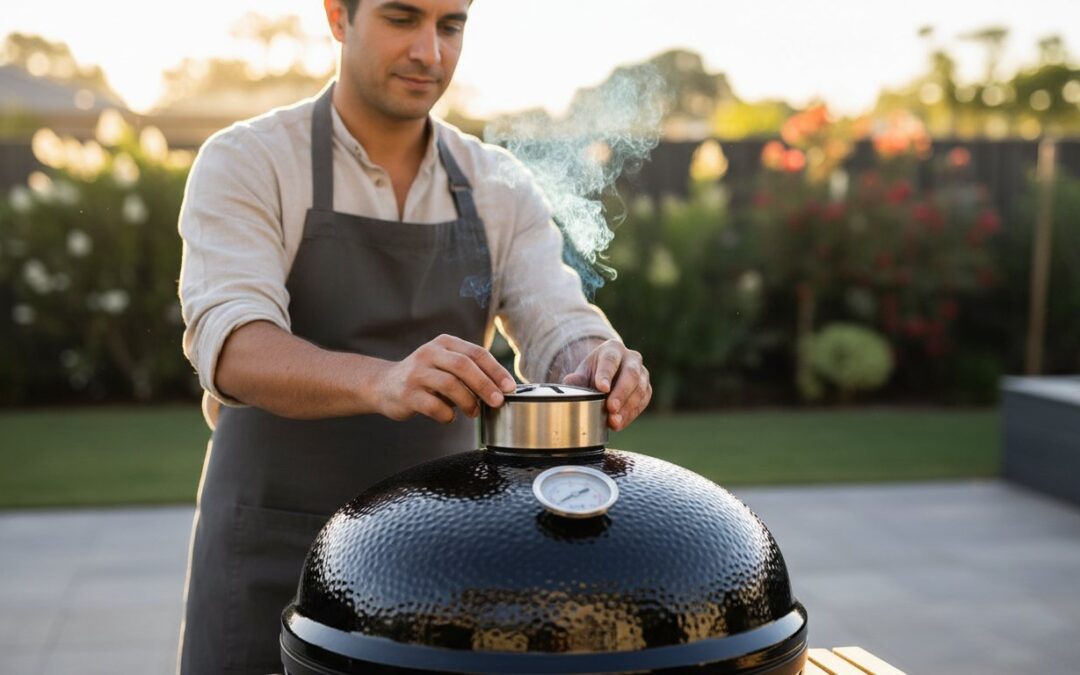
Watching your kamado’s temperature spike unexpectedly is a gut-wrenching feeling, especially with a prime cut of brisket on the grates. You follow the instructions, but the heat either plummets or rages out of control. The vents are a mystery, and lighting the charcoal feels like a gamble. It’s time to end the frustration. True mastery of your ceramic grill isn’t black magic; it’s about understanding the fundamentals. This guide delivers exactly that: straightforward kamado temperature control for beginners, putting you in command from start to finish.
This is your no-nonsense manual for perfect results. We’ll show you precisely how the top and bottom vents work together, so you know exactly which one to adjust and when. You will learn proper fuel management techniques using quality natural charcoal to lock in a stable temperature for hours of low-and-slow cooking, or how to unleash searing heat in minutes. By the end of this guide, you won’t just be following a recipe; you’ll be conducting the fire with complete confidence. Let’s get sizzlin’.
Key Takeaways
- Your kamado’s top and bottom vents are the only controls you need to master for precise heat management.
- The quality of your lump charcoal directly impacts temperature stability; using premium fuel is critical for predictable results.
- The secret to kamado temperature control for beginners is making small, patient adjustments to manage the grill’s powerful thermal mass.
- Discover a repeatable, step-by-step process for hitting and holding perfect temperatures for both low-and-slow smoking and high-heat searing.
First Principles: Why Kamado Temperature Control is Different
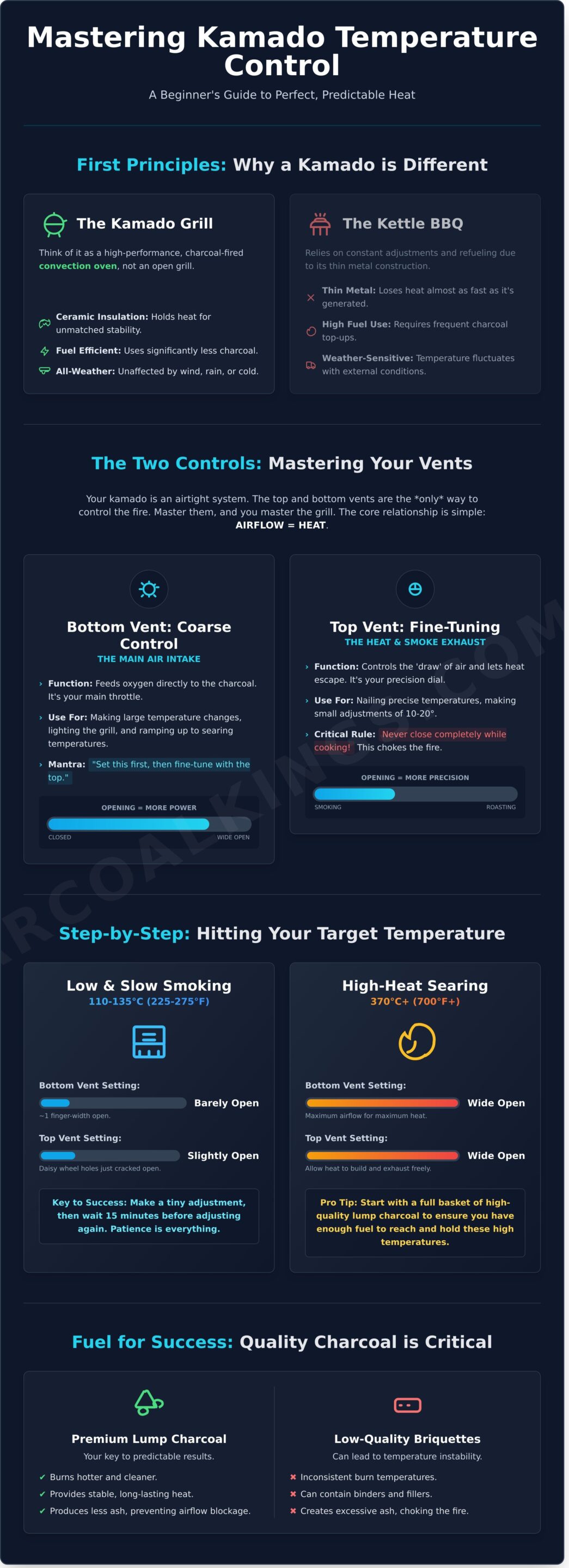
If you’re coming from a standard kettle BBQ, the first rule of kamado cooking is to forget what you know about fire management. A thin metal grill loses heat almost as fast as it generates it, requiring constant fuel top-ups and vent adjustments. A kamado is a different beast entirely. Think of it less like an open grill and more like a high-performance, charcoal-fired convection oven.
Mastering kamado temperature control for beginners starts with understanding its unique design. The game is not about constantly fighting the fire; it’s about setting a stable, predictable environment and letting the grill do the work. For a practical look at how these principles work, watch this excellent overview:
The airtight construction and incredible thermal mass of a kamado mean that small, patient adjustments are the key to success. Once a kamado is at your target temperature, it wants to stay there. Your job is simply to guide it, not to fight it.
The Power of Ceramic Insulation
The heart of the kamado is its thick ceramic body. This material is a poor conductor but an excellent insulator, meaning it absorbs, holds, and radiates heat with incredible efficiency. This efficiency is a core part of the Kamado grill history and design, which has been refined over centuries. This results in several key advantages:
- Unmatched Stability: The ceramic acts like a thermal battery, eliminating hot spots and providing incredibly even cooking temperatures for hours.
- Fuel Efficiency: Because very little heat escapes, you’ll use significantly less premium lump charcoal compared to a kettle, especially during long, low-and-slow cooks.
- All-Weather Performance: Wind, rain, or a cold winter day in Melbourne won’t dramatically affect the internal temperature, unlike with a thin metal cooker.
Airflow is Everything: The Oxygen-Fire Relationship
Your kamado’s fire has one simple need: oxygen. You control the supply using the top and bottom vents, and this is the foundation of kamado temperature control. The relationship is direct and absolute:
- More Oxygen (Open Vents) = A bigger, hotter fire.
- Less Oxygen (Closed Vents) = A smaller, cooler fire.
Because the kamado is so airtight, these vents are your only throttle and brake. A tiny adjustment-even just a few millimetres-can raise or lower the temperature significantly over time. Learn to trust your vents and make small, patient changes.
The Two Controls: Mastering Your Top and Bottom Vents
The Two Controls: Mastering Your Top and Bottom Vents
Forget complex dials and electronics. The genius of a kamado grill lies in its simplicity. You have two controls: a bottom vent and a top vent. That’s it. For effective kamado temperature control for beginners, mastering how these two vents work together is the single most important skill you will learn. They are a team, regulating airflow to give you precise command over your fire. Understanding their individual roles is the first step towards consistent, perfect results on the grill.
Bottom Vent: Your Coarse Temperature Control
Think of the bottom vent as your primary power source. Located at the base of your kamado, this is the main air intake that feeds oxygen directly to your lump charcoal. The more you open it, the more air rushes in, and the hotter your fire burns. Use this vent for making large temperature adjustments, like when you’re first lighting the grill or need to ramp up the heat for searing. Always set your bottom vent first, then make small, patient adjustments from there.
Top Vent: Your Fine-Tuning and Exhaust
If the bottom vent is about raw power, the top vent is about precision. This vent controls how quickly heat and smoke escape from the dome. It fine-tunes the ‘draw’ of air through the grill, allowing you to make small, specific temperature changes of 10-20 degrees. As many experts explain in any good Beginner’s guide to Kamado cooking, this is your key to locking in that perfect low-and-slow temperature. One critical rule: never close the top vent completely while cooking, as this can extinguish your fire and create bitter-tasting smoke.
A Simple Analogy for Beginners
To simplify kamado temperature control for beginners, use this analogy: your kamado is like a car engine. The bottom vent is the accelerator, feeding fuel (air) to the engine to generate power. The top vent is the tachometer, refining the engine’s output and keeping it running smoothly at the desired level. By learning to use both the accelerator and the tachometer in tandem, you gain total control over your grill’s performance, from a low idle to a full-throttle sear.
Fueling for Success: The Right Charcoal for Stable Temps
You can have the best kamado grill in Australia and master your vent settings, but if you use poor-quality fuel, you will constantly fight for stable heat. This is where many people make their first mistake with kamado temperature control for beginners. The charcoal you choose is the foundation of your entire cook. Low-grade fuel burns unpredictably, produces excessive ash that chokes airflow, and can introduce unwanted chemical flavours to your food. To achieve mastery, you must start with a premium, natural fuel source.
Lump Charcoal vs. Briquettes in a Kamado
For a ceramic cooker, there is no debate: lump charcoal is the superior choice. Unlike briquettes, which are uniform blocks made from charcoal dust and chemical binders, natural lump charcoal consists of real pieces of carbonised hardwood. This structural difference is critical for performance and flavour.
- Lights Faster & Burns Cleaner: Natural lump contains no additives, resulting in a purer heat source. A clean burn is essential to the science of grilling, ensuring the authentic flavour of your wood and food shines through without chemical interference.
- Produces Less Ash: Briquettes create a significant amount of fine ash that can block the lower air vents, starving your fire of oxygen and causing sudden temperature drops. Lump charcoal’s minimal ash production ensures consistent, reliable airflow for hours.
How Much Charcoal to Use?
The amount of fuel directly impacts your potential temperature range and burn time. While every cook is different, these are solid guidelines for filling your firebox:
- For Low and Slow (110°C – 135°C): Fill the firebox about halfway. This provides more than enough fuel for a long, steady burn without making the temperature difficult to keep low.
- For High-Heat Searing (260°C+): Fill the firebox to the top of the ceramic ring. This creates a large, hot coal bed perfect for searing steaks or cooking pizzas.
Always start with a fresh load of charcoal for every cook. Simply topping up old, ash-filled charcoal will impede airflow and sabotage your efforts at stable temperature control.
Arranging Charcoal and Lighting
How you light the charcoal is just as important as how much you use. The goal for most cooks is a slow, controlled fire that grows gradually. Create a small well in the centre of your charcoal pile and place a single natural firelighter inside. By lighting only one small spot, you allow the fire to establish slowly, making it much easier to lock in your target temperature. Never use lighter fluid in a ceramic grill; the porous ceramic will absorb the fumes and permanently taint your cooker and your food.
Get consistent results with premium lump charcoal.
Step-by-Step Guide: Setting Two Essential Temperatures
Theory is one thing; execution is another. This section puts the principles into practice for two essential cooking styles. Mastering kamado temperature control for beginners is about building repeatable habits. Follow these steps for consistent results every time. Remember the golden rule: patience is key. It is always easier to bring the temperature up slowly than to fight it back down after overshooting your target.
Targeting Low and Slow (225-275°F / 107-135°C)
This is the ideal range for smoking classics like brisket, ribs, and pulled pork. The goal is stable, indirect heat. Always use your heat deflector for low-and-slow cooking. This creates the perfect oven-like environment. For the cleanest burn and most reliable heat, start with a full fire basket of premium natural lump charcoal.
- Step 1: Light your charcoal. Start with both the bottom draft door and the top vent fully open to maximize initial airflow.
- Step 2: Monitor the dome thermometer. When the temperature reaches about 175°F (80°C), or roughly 50°F below your target, it’s time to start restricting the air.
- Step 3: Close the bottom vent until it is open about one inch. Adjust the top vent to a small opening, about the width of a pencil.
- Step 4: Let the temperature stabilize. This can take 15-20 minutes. Make tiny adjustments to the top vent if necessary, then wait again. Do not rush this stage.
Targeting High-Heat Searing (500°F+ / 260°C+)
For a perfect steakhouse crust, you need roaring, direct heat. This process is much faster and focuses on feeding the fire as much oxygen as possible. This is a straightforward but vital skill for any kamado owner.
- Step 1: Remove the heat deflector. You want your cooking grate directly exposed to the intense heat of the coals.
- Step 2: Leave both the bottom and top vents 100% open. Your goal is maximum airflow to create a furnace.
- Step 3: Let the temperature climb freely. With both vents wide open, it will rise very quickly.
- Step 4: As the temperature soars past your target (e.g., 550°F), begin closing the vents slightly to hold it there. A kamado’s thick ceramics retain a massive amount of heat, so it’s best to let it get blazing hot and then tame it back down to your desired searing temperature.
Beginner Troubleshooting: What to Do When Temps Go Wrong
Even seasoned pitmasters have days where the temperature doesn’t want to cooperate. The most common mistake in kamado temperature control for beginners is overcorrecting. A wild temperature swing is almost always caused by a hasty, aggressive vent adjustment. The golden rule is patience: make one small change, then wait 15-20 minutes to see the result.
Mastery comes from understanding how your kamado breathes. Here are the most frequent problems you’ll encounter and the direct, no-nonsense fixes to get you back on track.
Problem: The Temperature is Too High and Won’t Come Down
You let the fire get away from you and it overshot the target. This is a classic rookie mistake. The thick ceramic walls of your kamado are now heat-soaked, and bringing the temperature down means slowly reducing the fire’s oxygen supply. Do not chase the temperature down with drastic changes.
- Step 1: Close the bottom vent to about half of its current opening. This is your primary air intake control.
- Step 2: Wait at least 15 minutes. The temperature will fall slowly. Be patient.
- Step 3: If the temperature is still well above your target, close the top vent a fraction more to further restrict airflow.
Problem: The Temperature is Dropping
A falling temperature means your fire is being starved of either oxygen or fuel. Before making a major adjustment, run this simple checklist. The fix is usually quick and easy.
- Check Oxygen: Open the bottom vent slightly, perhaps by 5-10mm. This will feed more air to the coals.
- Check for Ash: On longer cooks, ash can build up and block the bottom vent. Use your ash tool to carefully rake the coals and clear any blockage.
- Check Fuel: For cooks lasting many hours, you may simply be running low on fuel. You may need to add more premium lump charcoal to maintain a hot, steady fire.
Problem: I Have Thick, White, Bitter Smoke
This is ‘bad’ smoke. If your kamado is billowing thick, white smoke, your fire is not burning cleanly and efficiently. This smoke will deposit a bitter, acrid flavour on your food. It typically happens when you close the vents too much before the fire is properly established.
The solution is simple: wait. Ensure your top vent is at least partially open to allow for proper exhaust. Give the fire the air it needs to stabilise. Do not put your food on the grill until the smoke thins out and becomes a pale, almost invisible blue. That’s the clean smoke that delivers incredible flavour.
Mastering Your Kamado: The Final Word
Controlling your kamado grill isn’t black magic; it’s a science of airflow and fuel. Remember the two golden rules: your bottom vent is the accelerator for major temperature changes, and the top vent is for fine-tuning. This simple principle is the foundation of kamado temperature control for beginners. With practice, managing your temperatures will become second nature, allowing you to focus purely on the flavour.
But even perfect vent control can be undermined by poor fuel. For ultimate stability and a clean burn, the quality of your charcoal is non-negotiable. It’s the secret weapon used by professional pitmasters and top restaurants across Australia who demand consistent performance. Our 100% natural hardwood charcoal contains no chemicals, ensuring only pure, smoky flavour in every cook.
Ready to lock in those temperatures like a pro? Shop our range of premium lump charcoal for ultimate temperature stability. As experts who live and breathe BBQ, we’re here to help you succeed. You have the knowledge-now get out there and get sizzling.
Frequently Asked Questions About Kamado Temperature Control
How long does it take for a Kamado to heat up?
A Kamado can reach 120°C (250°F) for low-and-slow cooking in about 15-20 minutes. For high-heat searing at 370°C (700°F), expect 25-30 minutes. The exact time depends on the amount of lump charcoal used and ambient weather conditions. Using premium natural hardwood charcoal ensures a faster, more stable heat-up, which is a key part of mastering kamado temperature control for beginners.
How do you shut down a Kamado grill after cooking?
Shutting down a Kamado is straightforward. Simply close both the top and bottom vents completely. This starves the fire of oxygen, extinguishing the hot coals. The remaining unburnt lump charcoal can be saved for your next cook. The ceramic shell will retain heat for several hours, so always allow the grill to cool down completely before covering or moving it.
Is it okay to use a Kamado in the rain or snow?
Yes, a Kamado’s thick ceramic construction provides excellent insulation, making it effective in all weather, including Australian rain or even snow in colder regions. However, prevent water from entering the top vent to avoid a steam flash when opening the lid. Avoid rapid temperature changes, like splashing cold water on a hot dome, which can cause the ceramic to crack. Always operate with care in wet conditions.
Why did my Kamado temperature spike when I opened the lid?
Opening the lid introduces a sudden rush of oxygen to the fire, causing the charcoal to burn hotter and the temperature to spike. This is a common challenge in kamado temperature control for beginners. To minimise this, open the lid only when necessary and for short periods. The temperature will stabilise again once you close the lid and the vents regain control of the airflow.
How often should I clean the ash out of my Kamado?
For optimal performance, clean the ash out before every cook. A buildup of ash can block the bottom vent, restricting airflow and making temperature control difficult. This leads to an inefficient burn and inconsistent heat. Use an ash tool to rake the ash into the collection tray for quick and easy disposal, ensuring your Kamado is ready for a clean burn every time.
Can I reuse charcoal that’s left over from a previous cook?
Absolutely. Reusing leftover charcoal is one of the key efficiencies of a Kamado grill. After shutting down the vents, the unburnt charcoal is preserved. Before your next cook, simply stir the old charcoal to knock off any loose ash, top it up with fresh premium lump charcoal, and light it. This method is cost-effective and reduces waste, especially when using high-quality, long-burning hardwood charcoal.