
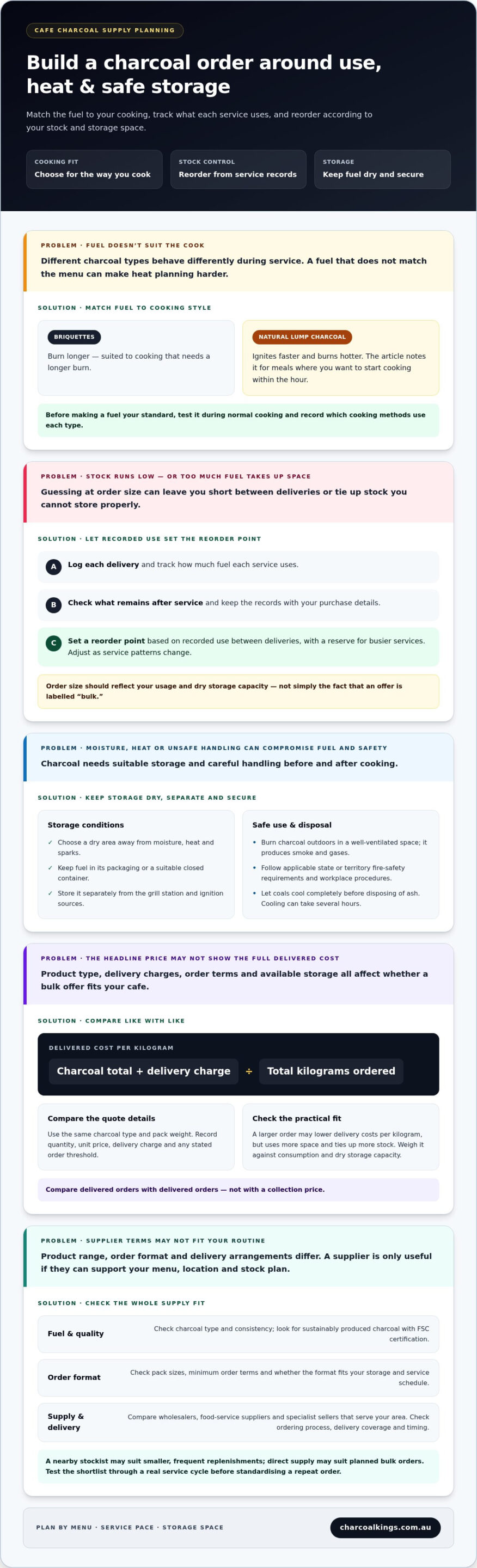
Consistency starts with matching fuel to your cooking. Setting up a regular charcoal order for my cafe means tracking how much fuel each service uses, choosing briquettes or natural lump charcoal for your cooking style, and replenishing stock before it runs low. Briquettes burn longer, while natural lump charcoal ignites faster and burns hotter.
Reliable heat matters, but ordering more fuel than you can store properly ties up space and stock. This guide explains how to compare charcoal types, estimate usage from your service records, and set a repeat order around stock levels. You’ll also find practical ways to keep charcoal dry and stored safely, so it is ready for the next cook. Build a routine around your menu, cooking pace and storage space rather than relying on a standard order size.
Key Takeaways
- Match charcoal to your cooking: briquettes suit longer cooks, while natural lump charcoal lights faster and burns hotter.
- Track fuel use across services, then set a reorder point that leaves enough stock for your next delivery cycle.
- Store charcoal dry and securely, and keep it separate from heat sources to protect fuel quality and support safe handling.
- Compare bulk supply options by charcoal type, order requirements and delivery terms, including how delivery affects your total cost.
Charcoal storage and supply planning
Build a repeat order around measured service use, suitable storage and the fuel your cooking requires. If I were setting up a regular charcoal order for my cafe, I’d start by logging each delivery and checking the remaining stock after service.
Australian cafes should follow applicable state or territory fire-safety requirements and workplace procedures for commercial charcoal use. Keep fuel away from ignition sources, and burn charcoal outdoors in a well-ventilated space because it produces smoke and gases.
- Choose a dry storage area away from heat, sparks and moisture. Keep charcoal in its packaging or a suitable closed container, separate from the grill station. Let coals cool completely before disposing of ash. Cooling can take several hours.
-
Compare Supplier Quality and Delivery Options
Compare fuel type, consistency, order terms and delivery arrangements. Look for sustainably produced charcoal with FSC certification. Make sure the pack format fits your storage space and service schedule. Test the fuel during normal cooking before standardising a repeat order, as briquettes and natural lump charcoal behave differently.
-
Compare Bulk Prices and Delivery Costs
Compare the full delivered cost, including delivery charges and order thresholds. Use purchase records and service logs to calculate your usage, then weigh order size against dry storage capacity. A larger order may lower delivery costs per kilogram, but only if your cafe can store and use the fuel appropriately.
-
Find Australian Bulk Charcoal Suppliers
Compare Australian wholesale suppliers, food-service suppliers and specialist sellers that serve your area. Review their fuel range, ordering process and delivery arrangements. Match delivery timing to your stock levels, and don’t choose an order size simply because it is labelled bulk. Let your usage and storage capacity guide the decision.
- Set a reorder point based on recorded use between deliveries, with a reserve for busier services. If I were setting up a regular charcoal order for my cafe, I’d note which cooking methods use each fuel and adjust the plan as service patterns change.
Where can cafes in Australia buy charcoal in bulk?
Build a shortlist of Australian charcoal wholesalers, direct suppliers and stockists, then compare how well each fits your cafe’s ordering routine.
- Start with suppliers that sell charcoal to food-service businesses or wholesale customers. Some Australian suppliers sell directly online, while others distribute through stockists. Compare these options by how easily you can place repeat orders, arrange delivery and choose the fuel your kitchen uses. A nearby stockist may suit smaller, frequent replenishments; direct supply may suit planned bulk orders.
- Match the supplier’s range to your menu and cooking setup. A cafe serving grilled steaks may prioritise fuel suited to searing, while a menu with longer cooks may need a different charcoal format. Choose a supplier that carries the type your team uses consistently. Avoid splitting routine orders across several sources unless each has a clear purpose.
- Assess wholesale ordering against your storage space and stock records. Compare pack sizes, minimum order terms and delivery arrangements with your receiving area. For example, a cafe with limited dry storage may prefer manageable replenishments, while a larger kitchen can plan orders around recorded consumption and available space.
- Compare suppliers that serve your Australian location, including their delivery arrangements for your premises. Find out how orders are placed, which areas they cover and how delivery timing fits your stock plan. Keep these details alongside your usage records. This makes it easier to establish a reliable ordering routine instead of relying on last-minute purchases.
- Test your shortlist against a real service cycle before making one supplier your regular source. Record the charcoal type used, what remains after service and whether the order format suits your storage. A consistent routine makes repeat ordering easier to manage. To compare fuel choices for cafe cooking, explore charcoal supply options.
For meals where you want to start cooking within the hour, choose lump charcoal. Check that the timing suits your cafe’s service rhythm, and use fuel that matches the kitchen’s planned cooking style.
What are the bulk prices for charcoal in Australia, including delivery?
- Compare written quotes for the same charcoal type and pack weight. Hardwood lump charcoal and briquettes are different products, so their prices are not directly comparable. Record the quantity, unit price, delivery charge and any stated order threshold for each Australian supplier. This gives your cafe a consistent way to compare bulk offers without relying on the headline price alone.
- Calculate the delivered cost per kilogram for each quote. Add the stated delivery charge to the charcoal total, then divide by the total kilograms ordered. Compare a delivered order with another delivered order, not with a collection price. Keep the calculation with the supplier’s quote so you can repeat it when pack sizes or delivery terms change.
- Separate charcoal costs from delivery charges when comparing suppliers. Check whether the delivery charge varies with order size, distance or delivery arrangements. A larger order may lower delivery costs per kilogram, but it also uses more storage space and ties up more stock. Base your decision on your cafe’s consumption and dry storage capacity, not bulk wording alone.
- Use your service records to assess how each fuel suits your cooking. Briquettes burn longer than lumpwood charcoal, while natural lump charcoal ignites faster and burns hotter. If your menu relies on quick searing, compare fuel suited to that task. For longer cooks, factor in burn duration and whether you need to top up lumpwood during service.
- Build a quote comparison sheet with the supplier, fuel type, pack weight, charcoal subtotal, delivery charge and delivered cost per kilogram. Update it when you receive a new quote or change the order size, then compare the result with actual stock use. This helps distinguish a lower quoted price from better overall value for your cafe.
How do charcoal suppliers compare on quality, minimum order and delivery options?
Compare suppliers against the same three criteria: fuel quality, order terms and delivery fit. A simple scorecard makes the differences clearer than product descriptions alone.
- Assess quality by checking the charcoal type, product information and stated origin. Prioritise sustainably produced charcoal with FSC certification. Compare the same fuel type across suppliers, as briquettes and natural lump charcoal behave differently in cooking. Record what your team uses and how consistently it performs during service instead of judging quality by packaging or claims alone.
- Compare minimum order terms with your cafe’s storage space and usage records. Note the smallest order, pack sizes and whether products can be combined. A minimum order that exceeds your dry storage capacity can create handling problems. A smaller order may suit your operation better, even if a larger one seems more convenient.
- Check delivery arrangements for your premises before choosing a regular supplier. Compare delivery areas, charges, timing and receiving requirements. Consider whether staff can accept deliveries during the relevant hours and move fuel into dry storage promptly. For a cafe with limited access, a practical delivery method matters as much as the charcoal range.
- Use a scorecard to compare each supplier’s fuel choice, quality information, minimum order, delivery cost and delivery fit. Mark each item as suitable or unsuitable for your needs, then compare the strongest options with your actual stock records. This keeps the decision focused on operational fit, not one attractive feature.
- Trial your preferred option through a normal service cycle before making it your regular supply. Record the fuel used, cooking performance and remaining stock. Review the delivery process and whether the order fits your storage area. Repeat the comparison if your menu or service pattern changes, as these shifts can affect which fuel and order terms suit your cafe.
Use your scorecard to review charcoal supply options for your cafe’s cooking needs.
Charcoal Kings: Hardwood Lump Charcoal
Charcoal Kings offers cafes fuel options to match their menu and cooking style. Hardwood Lump Charcoal suits cooks seeking natural lump fuel, while Charcoal Briquettes offer another option for longer cooking. Binchotan Charcoal suits kitchens looking for a distinct charcoal type. Match the fuel to your grill, service pace and storage routine before setting a repeat order.
If you’re updating your equipment as well as your fuel supply, Charcoal Kings also sells BBQ Grills and Smokers. Keep your choices practical: the right fuel and equipment are those your team can use consistently for its cooking needs.
Visit charcoalkings.com.au to explore the charcoal options.
Make your next order part of a steady routine
A supply plan should suit your menu, service rhythm and storage space. As these change, use your order records to adjust the routine rather than letting an old estimate dictate each purchase. This keeps future decisions grounded in what your cafe actually uses.
If you’re setting up a regular charcoal order for your cafe, start by reviewing which fuel suits your cooking and what supply pattern you can manage. Charcoal Kings offers charcoal options for cafes, including Hardwood Lump Charcoal, Charcoal Briquettes and Binchotan Charcoal.
Contact Charcoal Kings about cafe orders to discuss your charcoal requirements. A clear plan gives your team a stronger starting point for each service, and you can refine it as your cafe’s needs evolve.
Frequently Asked Questions
What types of charcoal are suitable for commercial cafe use?
Hardwood lump charcoal and briquettes suit different cafe cooking routines. Lump charcoal works well for quick searing, while briquettes suit longer cooking. Binchotan is another option for menus built around its particular cooking style. Match fuel to your grill, menu and service pace, then keep the type consistent while your team assesses its performance in daily use.
How much charcoal does a cafe typically use per week?
A cafe’s weekly charcoal use depends on its menu, service volume, cooking method and grill use. Calculate it from your own records: note the fuel loaded before service, any top-ups and the unused amount afterwards. Log busy and quiet services separately. After several ordering cycles, your records will give you a useful estimate for your cafe, rather than an unreliable industry-wide figure.
How do I set up a recurring charcoal order with a supplier?
Turn service records into a reorder trigger and repeat-order quantity. When setting up a regular charcoal order for my cafe, I’d choose a stock level that leaves time to reorder before supplies run short. Give your supplier the charcoal type, pack format and quantity you need. Review the plan after each cycle: setting up a regular charcoal order for my cafe works best when it reflects actual use and storage capacity.