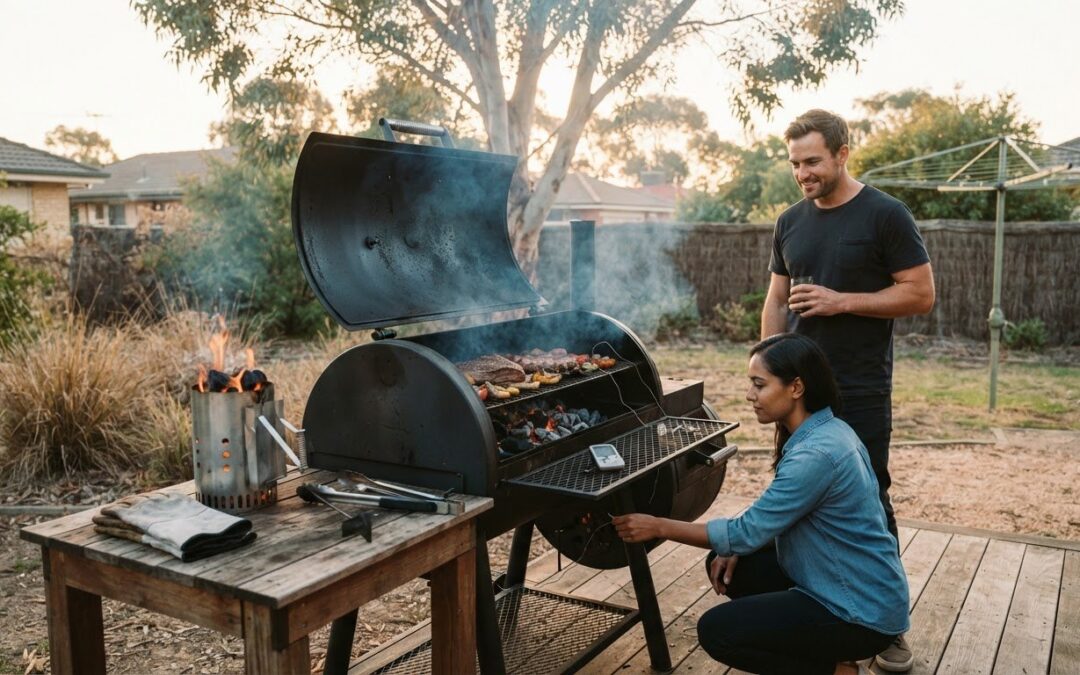
A charcoal smoker that loses heat mid-cook doesn’t always need more fuel. Adding charcoal before checking the fire can create harsh smoke or a sudden temperature spike. To learn how to restart a charcoal smoker mid cook, first work out whether the coals are running low, airflow is restricted, ash is choking the fire, or a powered fan or controller has stopped.
It’s unsettling to watch the temperature fall while food is still cooking, especially when you’re unsure whether to open the smoker, add fuel, or leave everything alone. Start with a quick diagnosis rather than a rushed handful of charcoal. A steady fire and minimal handling give you a better chance of keeping the cook on track.
This guide explains what to check, how to restore heat with fully lit coals from a chimney starter, and how to avoid unnecessary smoke and temperature swings. It also covers what to check if a fan or controller stops working, plus a pre-cook checklist to help prevent the same problem next time.
Key Takeaways
- Check for low fuel, restricted airflow, damp charcoal, or equipment failure before choosing a fix.
- Learn how to restart a charcoal smoker mid cook by matching your response to the smoker and the cause of heat loss.
- Make measured adjustments to limit temperature swings and avoid unnecessary smoke.
- Know what to check when a fan or controller stops working, and how to restore airflow safely.
- Use a pre-cook checklist to catch fuel, vent, thermometer, and power issues before a long smoke.
Why a charcoal smoker loses heat mid-cook, and what to check first
A falling temperature can put a long cook under pressure, but it doesn’t automatically mean the fire is out. Glowing coals may still be producing heat while restricted airflow, damp fuel, ash, or a failed fan slows the smoker’s recovery. Diagnose the cause before adding charcoal. Wear heat-resistant gloves around hot parts, keep clear of the firebox, and don’t move a loaded smoker unless there’s an immediate safety concern.
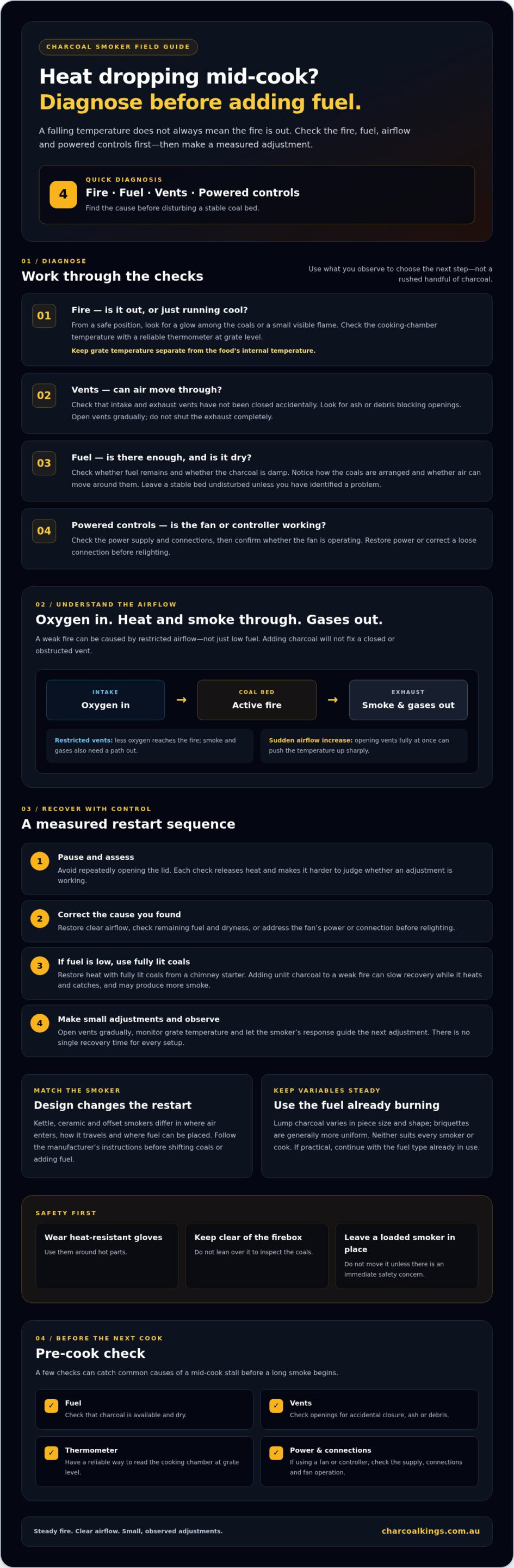
Start with four checks: fire, fuel, vents, and powered controls. This sequence helps you decide whether the smoker needs more fuel, better airflow, or an equipment adjustment before you disturb the coal bed.
A short visual guide can help make the checks easier to follow:
Is the fire out, or is the smoker simply running cool?
From a safe position, look for a glow among the coals or a small visible flame. Don’t lean over the firebox to inspect it. Check the cooking-chamber temperature with a reliable thermometer positioned at grate level. Keep that reading separate from the food’s internal temperature, which measures the food rather than the cooking chamber.
If the grate temperature is slow to climb, the fire may still be alive. A weak response can point to low fuel or poor airflow, not necessarily a fully extinguished coal bed. Avoid opening the lid repeatedly. Each check releases heat and makes it harder to judge whether your adjustment is working.
Check airflow, fuel, and powered components
Look at the intake and exhaust vents first. Confirm they haven’t been closed accidentally, and check for ash or debris blocking the openings. Charcoal needs oxygen to keep burning. The smoking process also relies on heat and smoke moving through the cooker, so don’t shut the exhaust vent completely while trying to correct a low reading.
Next, check whether fuel remains and whether it’s dry. Damp charcoal may struggle to catch and burn steadily. Look at how the coals are arranged and whether air can move around them, but leave a stable bed undisturbed unless you’ve identified a problem. If the smoker uses a fan or controller, check the power supply and connections, then confirm whether the fan is operating. Restore power or correct a loose connection before relighting. These checks help you decide how to restart a charcoal smoker mid cook without making unnecessary changes.
How charcoal, airflow, and smoker design affect a restart
A restart means restoring a stable bed of active coals and a clear path for air to move through the smoker. It isn’t simply a matter of adding more fuel. A smoker with fuel still in the firebox can run cool if its intake is shut or obstructed. Steady heat depends on the balance between oxygen, burning coals, and airflow through the cooker.
Smoker design affects where air enters, how it travels, and where additional charcoal can be placed. A kettle, a ceramic cooker, and an offset smoker don’t all handle fuel or airflow the same way. Check the manufacturer’s instructions before shifting coals or adding fuel. There’s no single recovery time that applies to every setup, so watch the grate temperature and adjust based on how your smoker responds.
Why airflow matters more than adding fuel immediately
The intake vent controls how much oxygen reaches the fire. The exhaust lets smoke and gases leave, helping draw air through the cooker. If the vents are too restricted, adding charcoal won’t address the underlying problem. Open vents gradually rather than fully at once, since a sudden increase in airflow can push the temperature up sharply. Adding unlit charcoal to a weak fire can also slow recovery while the fresh fuel heats and catches, and may produce more smoke.
Lump charcoal and briquettes during a mid-cook recovery
Lump charcoal varies in piece size and shape, while briquettes are generally more uniform. Neither is right for every smoker or cook. If practical, continue with the fuel type already burning so you’re not changing several variables during recovery. Charcoal Kings’ guide to lump charcoal offers more background on that fuel type.
To understand how heat and smoke relate to the broader smoking process, keep airflow in mind as well as the fuel. Monitor the grate temperature and the food separately, and follow Australian food-safety guidance for the specific food you’re cooking.
For your next cook, choose dry fuel that suits your smoker and keep enough of the same type available for a measured top-up. Charcoal Kings supplies hardwood lump charcoal and briquettes, as well as smokers and BBQ equipment. Understanding your cooker’s airflow and layout is the foundation of how to restart a charcoal smoker mid cook without making an uncontrolled change.
Choose a recovery method that fits the smoker and the problem
Match the fix to what you found during diagnosis. If active coals remain but airflow is restricted, adjust the vents gradually and watch the grate temperature. If the coal bed is nearly spent, a small amount of fully lit charcoal may be more controlled than piling unlit fuel onto a weak fire. A chimney starter can prepare lit charcoal, but use it only if it suits your smoker’s design and the manufacturer’s instructions.
Don’t pour lighter fluid or other accelerants onto hot coals, and don’t use an ignition method the smoker’s manufacturer hasn’t approved. Poor lighting and rushed heat management are among the common charcoal grilling mistakes that can complicate recovery. Choose one response, then give the smoker time to show how it reacts before making another change.
| Symptom | Likely cause | First response | What to avoid |
|---|---|---|---|
| Coals are glowing, but heat is low | Restricted airflow | Open the intake vent a little and reassess | Opening every vent fully at once |
| Few or no active coals remain | Depleted fuel | Add a controlled amount of fully lit fuel if suitable | Dumping a large load of unlit charcoal onto the fire |
| Fan or controller has stopped | Power or connection issue | Check the supply, connection, and device manual | Assuming the controller will resume automatically |
| Fuel won’t catch or burn well | Damp fuel or poor lighting | Use dry replacement fuel and an approved lighting method | Adding accelerant to hot coals |
When to adjust vents, add fuel, or relight separately
Adjust the vents first if the fire is active and airflow appears limited. If the fuel bed is genuinely depleted, add fully lit charcoal in a measured amount, following the smoker’s guidance on placement. Some designs allow fuel to be lit separately in a chimney starter; others may require a different approach. Don’t assume a method that works for one smoker is safe for another.
When a power interruption affects a fan-assisted smoker
A stopped fan or controller doesn’t necessarily mean the charcoal fire has gone out. Check the power supply and connections, then consult the device manual before changing to manual vent control or restarting electrical components. Settings and restart behaviour vary by model, so don’t assume the unit will retain its settings or resume by itself.
For how to restart a charcoal smoker mid cook, choose the controlled option that addresses the cause without adding unnecessary fuel or forcing a temperature spike. If you’re preparing for another cook, explore charcoal fuel and BBQ equipment suited to your setup.
How to restart a charcoal smoker mid-cook: a safe step-by-step method
Keep the response controlled. Before opening the cooker, make sure it’s stable and you have heat-resistant gloves and the tools you need within reach. Keep the lid closed between checks to preserve heat and avoid repeated temperature swings.
The recovery sequence from first check to stable temperature
- Secure the cook. Check that the smoker is stable on a safe surface. Keep children, pets, and loose items clear of hot parts and ash.
- Check the readings. Use a reliable probe or thermometer to monitor the cooking grate, and a separate food probe to track the centre of the food. These readings measure different things.
- Inspect the fire and fuel. Open the smoker only as needed. Look for active coals and remaining fuel without leaning over the firebox or disturbing a stable coal bed.
- Check airflow and controls. Confirm the intake and exhaust aren’t accidentally closed or obstructed. For a fan-assisted smoker, check the power supply, connections, and manual before changing settings.
- Make one adjustment. Correct the issue you found, such as gradually opening a vent or adding a controlled amount of lit fuel if the bed is depleted and the smoker’s instructions allow it. Close the lid and let the cooker respond before changing anything else.
Don’t chase every small movement on the thermometer. Watch the grate temperature for a clear trend, and avoid repeatedly lifting the lid or making several adjustments at once. This measured sequence is the practical core of how to restart a charcoal smoker mid cook while limiting unnecessary heat loss and temperature swings.
Protect the food and know when to stop
Keep raw and cooked food separate, and use clean utensils and probes to avoid cross-contamination. Check current Australian food-safety guidance for the specific food you’re cooking. If you can’t establish how long the food has been at its current temperature, don’t guess about safety. Pause and seek reliable food-safety advice before serving it.
Stop the restart if flames become uncontrolled, the smoker or electrical components appear unsafe, or you can’t confirm the food has been handled safely. Don’t leave a fire unattended while seeking help. For outdoor cooking in Australia, check current fire restrictions and the rules for your location before lighting or relighting charcoal.
Preparing suitable fuel and equipment before the next cook can make a recovery simpler. Explore charcoal, smokers, and BBQ equipment for your setup.
Prevent another mid-cook stall with better fuel and smoker preparation
A few checks before lighting can prevent a small fuel or equipment issue from becoming a mid-cook recovery. Prepare for the cooker you’re using rather than relying on a fixed rule of thumb. The reserve fuel you need depends on smoker design, weather, and the length of the cook.
Prepare fuel and equipment before lighting
- Set aside enough fuel. Estimate what the cook requires for your smoker and conditions, then keep a suitable reserve of charcoal dry and safely stored.
- Check the fuel condition. Damp charcoal can be difficult to light and maintain. Keep the working supply protected from moisture.
- Test the vents and seals. Confirm vents move freely and check that the lid and access doors close as intended.
- Check temperature readings. Confirm the smoker thermometer responds sensibly and that your food probe is clean and working.
- Inspect powered equipment. If you use a fan or controller, check the power supply and connections before the fire is lit.
Testing matters most with unfamiliar equipment. Run the smoker and controller through a short practice session before relying on them for a long cook. You’ll learn how the vents respond, where temperature readings stabilise, and whether the powered components operate as expected. Consult the manufacturer’s instructions for setup and operation.
Build a repeatable fire-management routine
Keep a simple record after each cook: note the fuel type, starting fuel amount, vent positions, weather conditions, and how the temperature behaved. Those observations help you plan a suitable reserve and make measured adjustments next time. Don’t treat one cook’s timing or fuel use as a universal formula. Another smoker or a change in conditions can alter how the fire behaves.
For broader fundamentals on managing charcoal, read this guide to barbecuing with charcoal. A reliable routine won’t remove every variable, but it gives you a clear baseline and makes it easier to spot what has changed. That preparation can reduce the chance you’ll need to work out how to restart a charcoal smoker mid cook under pressure.
For your next cook, explore charcoal and BBQ essentials from Charcoal Kings, including charcoal, smokers, and BBQ equipment.
Keep Your Next Cook Steady and Under Control
A temperature drop doesn’t always mean the fire has gone out. Check the coals, fuel, vents, and powered controls before changing anything. Then choose a measured response: restore airflow gradually, add fully lit fuel if the coal bed is depleted, or address a fan or controller issue according to its manual.
Keep the lid closed between necessary checks, track the grate and food temperatures separately, and stop if the fire becomes unsafe or you can’t confirm the food has been handled safely. Before your next long cook, check that your fuel is dry, your thermometer works, and your vents and power connections are ready. That preparation makes knowing how to restart a charcoal smoker mid cook far less stressful.
Charcoal Kings supplies hardwood lump charcoal and briquettes, along with smokers, BBQ equipment, smoking woods, and accessories. Explore charcoal and BBQ essentials from Charcoal Kings for your setup and prepare for your next cook with fuel and equipment suited to your smoker.
Frequently Asked Questions
Can you add charcoal to a smoker while food is cooking?
Yes, if the smoker’s design and instructions allow it, but add fuel only when the coal bed is genuinely low. Use a controlled amount of fully lit charcoal where possible, rather than loading unlit fuel onto a weak fire. A chimney starter can light replacement coals separately. Wear heat-resistant gloves, keep the lid open only as long as needed, and never pour accelerants onto hot coals.
How do you bring a charcoal smoker back up to temperature?
First check that the fire has active coals and that the intake and exhaust vents aren’t closed or blocked. Adjust a vent gradually, then watch the grate-level thermometer before making another change. If the coal bed is depleted, add fully lit fuel if the smoker’s instructions permit it. This measured approach is central to how to restart a charcoal smoker mid cook without causing a sharp temperature spike.
What should you do if a smoker loses power during a cook?
A power loss can stop a fan or controller without extinguishing the charcoal. Check the power supply and connections, then consult the smoker and controller manuals before changing settings or switching to manual vent control. Don’t assume the device will retain its settings or restart automatically. Monitor the cooking-chamber temperature and the food’s internal temperature separately while you address the fault.
Can you use a chimney starter to restart a smoker mid-cook?
Yes, a chimney starter can light replacement charcoal separately, provided this is safe for your setup and consistent with the smoker’s instructions. Set it on a stable, heat-resistant surface in a suitable location, and handle it with heat-resistant gloves. Add the lit coals carefully to the designated fuel area. Don’t use lighter fluid on hot coals or another ignition method the manufacturer hasn’t approved.
Why is my charcoal smoker not getting hot enough?
Common causes include exhausted or damp fuel, restricted airflow, ash blocking a vent, or a fan or controller that isn’t working. Check the intake and exhaust, inspect the fuel bed without disturbing stable coals, and confirm any powered equipment has a working supply and connection. A slow temperature response doesn’t always mean the fire is out. Diagnose the cause before adding more charcoal.
Is food safe if a charcoal smoker goes out during cooking?
It depends on the food and its time and temperature history, so the fire going out alone can’t confirm whether food is safe. Check a reliable probe reading and follow current Australian food-safety guidance for the specific food. If you can’t establish how it was held or cooked, don’t guess or rely on appearance and smell. Seek advice from an appropriate food-safety authority before serving it.
Should you keep the smoker lid open while restarting the fire?
No. Keep the lid closed between necessary checks to limit heat loss and avoid repeated temperature swings. Open it briefly when you need to inspect the coals, adjust fuel, or clear an obstruction, then close it again. Repeatedly lifting the lid releases heat and can make the temperature harder to stabilise. Follow the smoker’s instructions and keep clear of hot surfaces during each check.