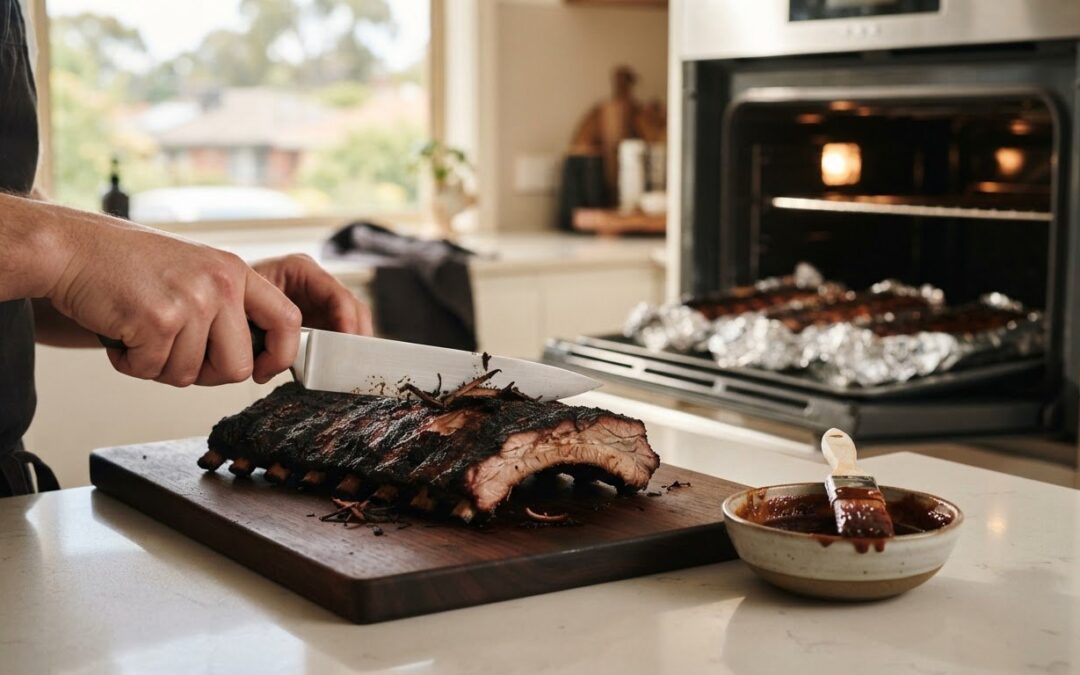
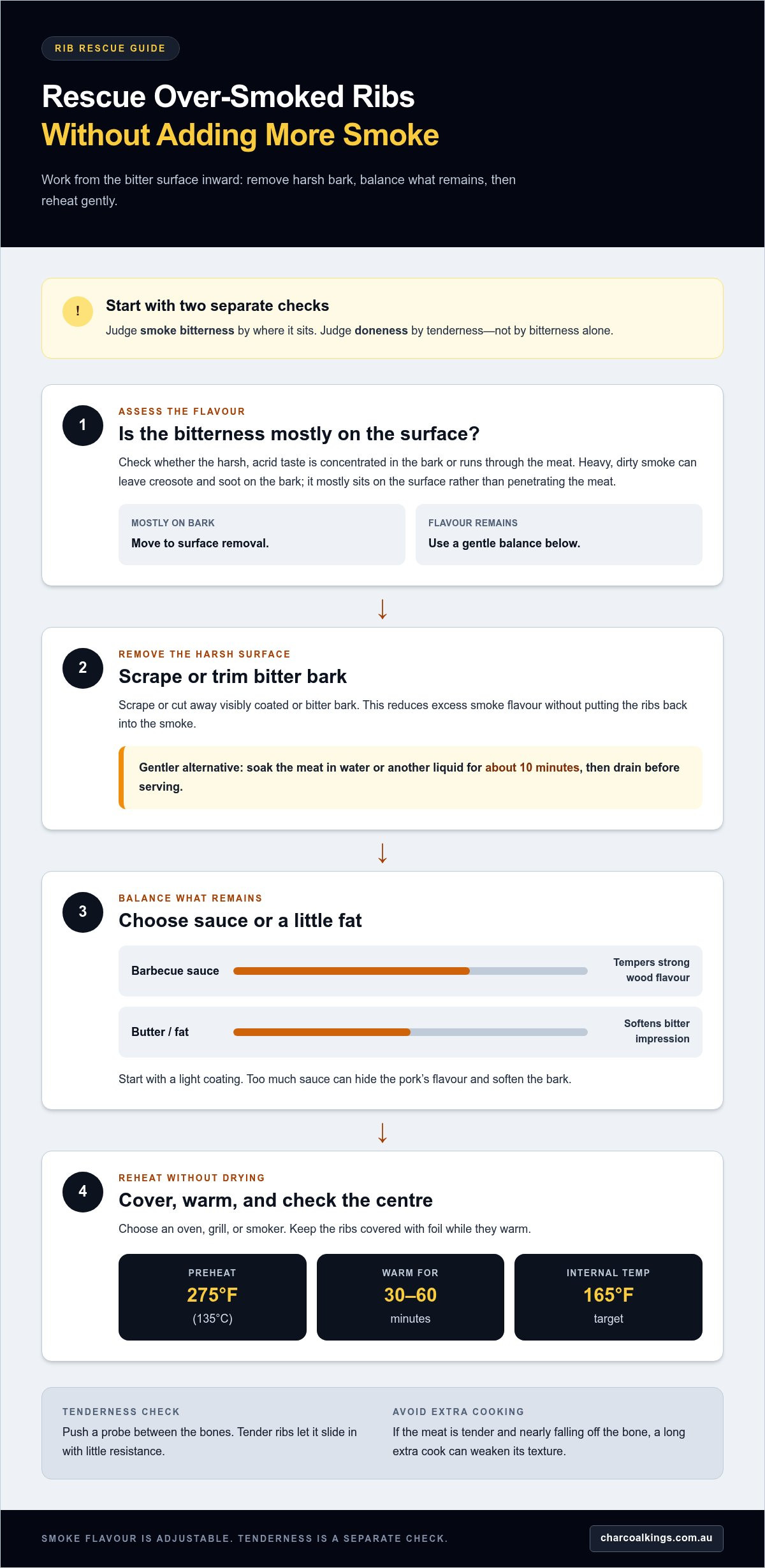
You can often save over-smoked ribs without putting them back in the smoke. The practical answer to how to fix over-smoked ribs is to scrape or trim bitter bark, then balance the remaining flavour with sauce or a little fat. For reheating, cover the ribs with foil and warm them in an oven, grill or smoker preheated to 275°F (135°C) for 30-60 minutes, until they reach an internal temperature of 165°F.
That harsh, acrid taste can make a good rack seem destined for the bin. First, check whether the bitterness is mostly on the surface or runs through the meat. This helps you decide whether to trim the bark, briefly soak the meat or serve it with sauce.
This guide explains how to assess tenderness, recognise dirty smoke and reduce bitter flavour without adding more smoke. You’ll also find reheating steps for an oven, grill or smoker to warm the ribs before serving.
Key Takeaways
- Judge rib doneness by how easily a probe slides between the bones, not by temperature alone.
- Black or grey smoke can signal restricted airflow; look at the fire and smoker conditions before adding more wood.
- Reduce bitter surface flavour by trimming the affected bark, then balance what remains with a suitable accompaniment.
- Use dry wood in controlled amounts and wrap the ribs when they’ve taken on enough smoke.
- Choose an oven, grill or smoker for reheating, and keep the ribs covered so they warm without drying out.
Checking doneness by tenderness and temperature
Over-smoked ribs aren’t automatically unsafe, and bitterness alone doesn’t determine food safety. Heavy, dirty smoke can leave creosote and soot on the bark, so remove any visibly coated bark and assess doneness separately. When learning how to fix over-smoked ribs, first distinguish the smoke flavour from whether the meat is properly cooked.
Use a probe and a grate-level thermometer rather than relying on the smoker’s lid gauge or a timer. One cook reported a 75-degree difference between the built-in thermometer and the temperature below the grate, enough to change cooking time and tenderness.
To see how clean smoke and airflow affect a cook, watch this visual guide:
- Measure at grate level. Place a reliable probe near the ribs, without touching the grate or meat. Compare it with the smoker’s built-in reading, then adjust the vents or fuel to hold a steady cooking temperature. A stable reading helps you interpret the cook; the lid gauge alone may not reflect the heat surrounding the rack.
- Use cooking time as a guide, not a finish line. Baby back ribs at 225°F (107°C) may take about five to six hours. At 275°F (135°C), they may take about four to five hours. Spare ribs at 275°F (135°C) generally take approximately five to six hours. Rack thickness and grate-level heat affect timing.
- Check internal temperature, then test tenderness. Smoked ribs commonly finish around 195-203°F (91-95°C), but the number alone doesn’t determine doneness. Push a probe between the bones. Ribs are tender when it slides in with little resistance. Avoid probing a bone, which can give a misleading reading.
- Use the bend test as a second check. Lift the rack with tongs near its centre. Properly tender ribs bend readily, and the surface may begin to crack. If the rack stays stiff, continue cooking and test again. A fixed schedule, such as smoking baby back ribs for four hours, can leave them underdone.
- Remove the rack when tenderness is right. Don’t keep cooking solely to reach a target temperature if the probe already moves easily between the bones. Rest the ribs before slicing. Apple juice can add moisture during a wrapped cook, but it won’t correct tough meat or replace a tenderness check. When deciding how to fix over-smoked ribs, assess tenderness separately from smoke intensity. This approach also differs from checking chicken, where a single reading may guide doneness more directly.
Avoiding bitter flavour from too much smoke
Apple and cherry are milder fruitwood choices for ribs. Any wood can taste harsh if smoke is dense, combustion is poor or exposure lasts too long. With a pellet, charcoal or electric smoker, use dry fuel, maintain airflow and limit how long smoke reaches the meat.
For a light smoke flavour, expose the ribs to thin blue smoke for about half the smoking time. These steps help preserve tenderness and a clean finish, whether you’re cooking spare ribs or baby back ribs.
- Start with dry, restrained wood. Avoid wet wood chips, which can produce billowing white smoke and coat the ribs with an unpleasant flavour. Add a small amount of dry wood, then watch how the smoke behaves before adding more. On a pellet smoker, don’t assume a steady supply of pellets means the meat needs continuous heavy smoke. Keep the fire burning cleanly and let the ribs finish cooking without extra wood if their flavour is already strong.
- Manage smoke exposure, not just cooking time. Ribs absorb most of their smoke flavour earlier in the cook. Wrap them after about three hours, or when they’re about two-thirds cooked, to limit further exposure. Pink butcher paper or heavy-duty aluminum foil both work. Small ribs may need a smoking portion of four hours or less. Adjust for rack size and tenderness instead of following a fixed schedule blindly.
- Reduce bitter bark on cooked ribs. Creosote vapor forms below 540 degrees and cools and condenses below 250 degrees. It mostly sits on the bark rather than penetrating the meat. Scrape or cut away the affected surface to reduce excess smoke flavour. For a milder adjustment, soak the meat in water or another liquid for about ten minutes, then drain it before serving.
- Balance what remains. Barbecue sauce can temper an overly strong wood flavour, while butter or another fat can soften a bitter impression. Use a light coating first; too much sauce can hide the pork’s flavour and soften the bark. If the meat is tender and nearly falling off the bone, avoid a long extra cook that could weaken its texture further.
- Choose your wood to suit the rack. Apple or cherry fruitwood brings a milder smoke profile to spare ribs than a heavy, prolonged smoke. Start with less wood and add only if the smoke remains clean and the flavour needs more depth. Browse smoking woods for ribs to explore wood options that suit your next cook.
How to identify excessive or dirty smoke
Check the exhaust before judging the ribs. Black or grey smoke can indicate that the fire isn’t getting enough air through the bottom vent. Use these steps to find the cause and correct airflow before more smoke settles on the meat.
- Inspect the smoke leaving the cooker. Look at the exhaust while the charcoal or other fuel burns. Thin blue smoke is a useful visual sign of a cleaner fire; dense black or grey smoke calls for attention. Check the bottom vent first, then inspect the exhaust path for obstruction. Make one adjustment at a time so you can see which change improves the smoke.
- Separate dirty smoke from normal cooking vapour. Smoke can look heavier when the cooker first starts or when moisture leaves the ribs. Don’t react to one brief plume. Watch whether the exhaust clears as the fire settles. Persistent black or grey smoke, especially with a harsh smell, is a stronger warning than a short change in appearance while the cooker heats.
- Check the fire and fuel before adding wood. A restricted bottom vent can starve the charcoal fire of air. Clear the vent, then give the fire time to respond before changing another setting. Avoid adding more wood while the smoke remains heavy. On a pellet smoker, check that pellets feed and burn as intended; on an electric smoker, inspect the wood tray and its airflow.
- Use the ribs as a second clue. Check the surface for a sticky, dark coating and smell the rack before tasting. A bitter, acrid smell differs from the rounded aroma of clean smoke. If the ribs are already wrapped, don’t unwrap them just to expose them to more smoke. Keep the cook focused on tenderness, and avoid adding smoke while you correct the fire.
- Correct the setup before the next rack. Note the vent position, charcoal arrangement and wood amount that produced clean smoke. Change only the factor linked to the problem, then observe the exhaust again. A combination of open airflow and restrained wood use is more useful than adding butter to mask a smoke defect. Record your favorite clean-burning setup, including the cooker’s temperature in degrees, so you can repeat it.
Smoke appearance can help diagnose combustion, but it doesn’t measure tenderness. Pair the clean-smoke check with a probe and a close look at the ribs. A dark surface alone doesn’t prove the whole rack is over-smoked.
Reheating ribs in an oven, grill or smoker
Reheat cooked ribs gently, with foil covering the pan to hold in moisture. Set an oven, grill or smoker to 275°F (135°C), then allow 30-60 minutes for a foil-covered pan. Use a thermometer to check the centre of the meat, and heat leftovers to 165°F before serving.
- Prepare the rack and pan. Remove the ribs from the fridge and arrange them in a single layer in a heat-safe pan. Add a small splash of water, apple juice or another liquid if the meat looks dry. Keep the liquid shallow; the goal is to create moisture beneath the foil, not submerge the ribs. Seal the pan tightly with foil so steam stays inside during reheating.
- Choose your reheating cooker. Preheat an oven, grill or smoker to 275°F (135°C). An oven offers steady, indirect heat; a grill or smoker works when the pan sits away from direct flame. If using a smoker, don’t add extra wood. The ribs are already cooked, and more smoke can deepen the flavour you’re trying to soften.
- Warm the ribs while covered. Place the pan in the preheated cooker and keep it covered for 30-60 minutes. Start checking toward the shorter end of that range, especially for a smaller portion. A thick rack or crowded pan may need longer. Keep the ribs meat-side up during the first 30 minutes of the foil-covered stage to protect the surface.
- Check the internal temperature. Insert a clean thermometer into the thickest meat, away from bone. Heat leftover ribs to 165°F before eating. If the centre hasn’t reached that temperature, reseal the foil and continue warming. Check again after a short interval rather than leaving the pan uncovered, which allows moisture to escape.
- Finish without drying the bark. Once heated, open the foil carefully because trapped steam can escape. If you want a less soft exterior, briefly expose the ribs to the cooker’s dry heat. Watch closely and remove them once the surface suits your preference. A sauce brushed on at the finish can balance strong smoke, but use a light layer.
- Serve promptly and adjust the recipe next time. Let the ribs settle briefly after reheating, then slice between the bones. If the rack tastes smoky, pair it with a fresh, sharp side rather than adding more smoke. Note the cooker, pan size and warming time in your recipe. That record helps you season and reheat the next batch consistently.
What causes ribs to become over-smoked, and how much wood should you use?
- Start with a small, dry wood addition. Too much wood can overwhelm pork ribs, especially when smoke keeps reaching the meat throughout cooking. For charcoal, add one small dry wood chunk about 15 minutes before the ribs go on. Let it begin smoking before placing the rack in the cooker. Avoid loading several chunks at once; a heavy burst can dominate the meat before you can adjust the fire.
- Control wood in an electric smoker. If your electric smoker uses wood chunks, begin with one small chunk. Add another an hour later only if you want more smoke flavour. Keep the additions spaced out rather than filling the tray. This measured approach makes it easier to assess the smoke and stop adding wood once the ribs have enough flavour.
- Feed charcoal in small increments. Add small pecan splits one at a time to a hot charcoal bed, rather than maintaining a massive, half-smothered fire. Small additions let you observe the smoke before committing more fuel. If the smoke turns dense or the ribs smell sharply smoky, pause the wood additions and let the existing fuel burn down.
- Account for the wood’s strength and exposure. Pecan can overpower ribs when used for longer than the first hour, so begin with a restrained amount and assess the aroma as the cook progresses. Apple and cherry are milder fruitwoods, while wet chips can create billowing white smoke. Wood type matters, but so does how continuously smoke contacts the rack.
- Limit smoke once the flavour is established. Thin blue smoke for about half of the smoking time can provide a light smoke flavour. After that, let the ribs continue cooking without adding wood. If your recipe uses a fixed smoking duration, adapt it to the rack and the strength of the smoke rather than treating the schedule as a command. Small ribs can take on smoke quickly.
- Match your fuel routine to your cooker. A charcoal fire needs controlled airflow and small wood additions; an electric smoker needs measured chunks and space between additions. Pellets feed differently, so avoid adding separate wood unless your cooker’s setup calls for it. If you’re choosing equipment for controlled smoking, explore BBQ grills and smokers suited to your cooking style.
Treat the smoke’s appearance and the ribs’ aroma as feedback when deciding whether to add wood, rather than adding it on a schedule. Wet chips can produce billowing white smoke, so avoid them. Dense smoke is a cue to pause, not add more fuel. Aim for controlled exposure, with wood adding flavour without masking the pork. Small, spaced additions also make it easier to tell when the smoke has become too strong.
For an electric smoker that uses wood chunks, the recipe advises starting with one small chunk and adding another an hour later if more smoke flavour is wanted. The original poster used pecan for 1 hour because longer use made the smoke overpower the ribs. A forum participant recommended adding 2-3 small pecan splits one at a time to a hot charcoal bed, rather than maintaining a massive, half-smothered fire. These approaches keep wood additions deliberate and allow the smoke level to be assessed as cooking continues.
Charcoal Kings: Hardwood Lump Charcoal
Charcoal Kings offers Hardwood Lump Charcoal for cooks who want to manage a charcoal fire while smoking ribs. Controlled fuel and airflow help maintain a steady fire, while adding wood sparingly lets you build smoke flavour without overwhelming the meat. Charcoal Kings also offers Charcoal Briquettes, Binchotan Charcoal, and BBQ Grills and Smokers for different BBQ setups.
Choose fuel and equipment that suit your cooking style, then maintain airflow, watch the smoke and add wood in measured amounts. Charcoal won’t remove bitterness from ribs that are already cooked, but it can be part of a more controlled setup for your next cook.
Visit charcoalkings.com.au to explore the BBQ range or get in touch with Charcoal Kings.
Make Your Next Rib Cook More Deliberate
Knowing how to fix over-smoked ribs gives you a starting point, but each cook is also a chance to refine your approach. Keep a simple record of the wood, fuel, cooker settings and flavour you prefer. Change one element at a time to see what works for your setup and palate.
Charcoal Kings offers Hardwood Lump Charcoal, Charcoal Briquettes and Binchotan Charcoal for different BBQ setups. Choose fuel that suits your equipment, then make measured adjustments rather than guessing. A deliberate approach helps you focus on the flavour you want to serve.
Contact Charcoal Kings for rib advice and plan your next cook with confidence. Good ribs come from attention to the fire, the smoke and your own notes. Keep refining your method, and enjoy the results.
Frequently Asked Questions
How Do You Save Over Smoked Meat?
Trim away the most bitter surface, then serve the meat with contrasting flavours. Remove the harsh bark, chop the ribs and serve them in tacos with salsa. Fresh, bright ingredients balance the smoke in each bite. If the smoke still dominates, serve smaller portions rather than trying to mask it with a heavy coating of sauce.
How can you tell if ribs are over-smoked or just have a strong smoke flavour?
Strong smoke is noticeable but still balanced with pork, seasoning and sauce. Over-smoked ribs have a sharp, acrid bitterness that lingers and overwhelms those flavours. Cut a small piece from the centre and compare it with a piece that includes bark. If the centre tastes balanced but the bark is harsh, the excess flavour is concentrated on the surface. If both taste acrid, serve smaller portions with contrasting flavours.
Can over-smoked ribs be salvaged by removing the bark or outer layer?
Yes. Removing the bark can help when bitterness is concentrated on the surface. Creosote mostly remains in the bark rather than penetrating the meat, so scrape or cut away the darkest, harshest layer. Taste a piece underneath before trimming further. If the meat itself is still acrid, use it sparingly in a strongly flavoured dish, such as tacos with salsa, instead of serving thick slices on their own.
Can you braise or pressure-cook over-smoked ribs to improve them?
Braising can soften dry ribs, but it won’t remove smoke absorbed into the meat. The cooking liquid may also take on the strong flavour, so use a small amount and taste it before serving. Pressure cooking can make tender ribs soft enough to shred for a saucy filling. Trim bitter bark first, and don’t use the cooking liquid if it tastes acrid.