Dumping a full chimney of premium briquettes into your grill for a two-minute steak isn’t just overkill; it’s a direct waste of A$5.20 in high-quality fuel. Most Australian grillers struggle with temperature control because they treat every cook with the same heavy hand. You’ve likely experienced the frustration of a fire that dies out 45 minutes into a lamb roast or a sear that lacks that signature crust. Learning exactly how much charcoal to use in a Weber kettle is the difference between a masterclass and a mediocre meal.
We’re going to show you how to master your heat zones with surgical precision. You’ll learn the specific charcoal counts for high-heat searing, indirect roasting, and those 12-hour low-and-slow sessions using 100% natural hardwood. This guide ensures you stop wasting expensive fuel and start hitting perfect internal meat temps every time you fire up. Get sizzlin’!
Key Takeaways
- Learn how to use the Weber Rapidfire Chimney as a universal measuring tool to ensure consistent heat and reliable results for every cook.
- Discover exactly how much charcoal to use in a weber kettle to master both high-heat searing and low-and-slow indirect roasting.
- Understand how to adjust your fuel volume for the Australian climate, accounting for how local wind speeds and temperatures affect your burn rate.
- Master the arrangement of fuel using charcoal baskets to concentrate heat and improve the efficiency of your Kettle.
- Find out why premium, chemical-free Australian hardwood lump is the superior choice for achieving a hotter, longer-lasting, and cleaner-tasting fire.
The Fundamentals of Fueling Your Weber Kettle
Mastering your fire is the first step toward becoming a backyard legend. The charcoal volume you dump into your Weber isn’t just a random guess; it’s the engine room of your entire cook. If you want consistent results every weekend, you’ve got to understand what charcoal is and how it reacts to the specific airflow of a kettle. Many beginners focus entirely on the meat rub, but the real magic happens in the fuel bed where energy density meets oxygen.
Heat management relies on a precise triangle of fuel volume, oxygen flow, and internal space. In a standard 57cm Weber Kettle, the amount of fuel dictates your maximum potential temperature, while the top and bottom vents act as your throttle. Learning how much charcoal to use in a weber kettle removes the guesswork that leads to charred steaks or undercooked roasts. You’re looking for repeatable science, not a roll of the dice.
To better understand this concept, watch this helpful video:
The 57cm Weber Kettle is the industry standard for a reason. Its spherical shape is designed to circulate heat efficiently, but this only works if you follow the Goldilocks rule. Don’t overfill the basket. If you use too much charcoal, you’ll choke the airflow and create a “cold” burn that produces acrid smoke. If you use too little, you won’t have the thermal mass to sustain a 4 hour roast. You need enough fuel to hit your target but enough empty space for the convection currents to move.
Briquettes vs. Lump Charcoal: Does Quantity Change?
Briquettes are the choice for precision. Their uniform shape allows you to count individual beads to hit specific numbers. For example, 50 briquettes in a 57cm kettle typically holds a steady 200°C for roasting. Hardwood lump is different. It’s 100% natural and has a much higher energy density. Because Charcoal Kings premium hardwood lump is screened for large, consistent chunks, it burns hotter and longer than standard supermarket bags. You’ll typically find that you need 20% less volume of our premium lump to reach the same searing temperatures as low grade alternatives. It’s about quality of carbon, not just the size of the pile.
The Goal: Direct vs. Indirect Cooking Temperatures
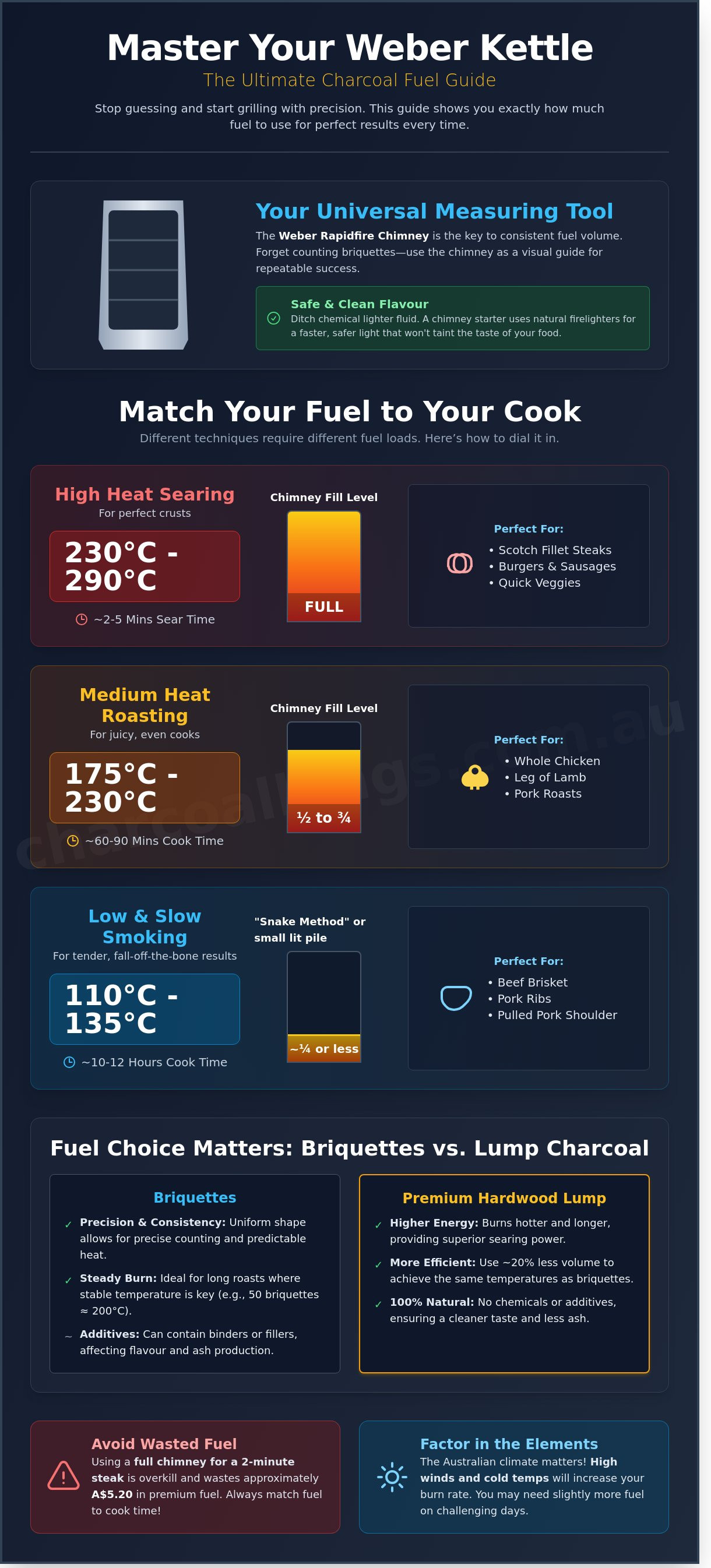
Your target temperature determines exactly how much charcoal to use in a weber kettle for every session. Different techniques require different fuel loads:
- High Heat (230°C – 290°C): Fill a chimney starter to the top. This is essential for searing a A$50 Scotch Fillet or getting that 2 minute crust on burgers.
- Medium Heat (175°C – 230°C): Use a half to three-quarters chimney. This is the sweet spot for roasting a whole chicken or a leg of lamb where you need steady heat for 60-90 minutes.
- Low and Slow (110°C – 135°C): Use the “snake method” or about 15-20 lit briquettes. This provides the gentle, consistent energy needed to break down connective tissue in a 4kg brisket over 10 hours.
Don’t waste fuel by over-filling for a short cook. Match your charcoal volume to your cooking time and temperature goal to get the best performance out of your Weber every single time. Get sizzlin’!
The Chimney Starter: Your Universal Measuring Tool
Forget counting individual briquettes or using plastic measuring cups that eventually melt. The Weber Rapidfire Chimney is the only tool you need for consistent results in the Australian backyard. It holds approximately 2.5kg of standard briquettes or a varying weight of lump charcoal. Using a chimney eliminates the guesswork of how much charcoal to use in a weber kettle by providing a reliable visual volume reference every single time you cook.
Safety is a major factor here. Stop using liquid fire starters. Lighter fluid is a chemical cocktail that ruins the clean flavour of premium Australian hardwood. A chimney uses simple physics. Heat rises, igniting the stack from the bottom up through a concentrated airflow. It’s faster, safer, and keeps your food tasting like meat rather than kerosene. You’ll get a clean burn without the risk of flare-ups from pouring accelerants onto an open flame.
To get started with the perfect load of fuel, follow these steps. Place two natural firelighters on the charcoal grate. Fill your chimney to the desired level based on your recipe. Light the firelighters and sit the chimney directly over them. Wait 15 to 20 minutes. You’ll know it’s ready when the top layer of coals shows a light grey ash coating and a faint red glow is visible through the ventilation holes. Many beginners struggle with temperature control, but mastering your Weber kettle starts with this disciplined ignition process.
The ‘Fraction Method’ for Kettle Temperatures
Think of your chimney in quarters to master heat zones. A 1/4 chimney is ideal for low and slow smoking at roughly 110°C to 120°C. This is the setting for a 6-hour brisket or keeping a tray of snags warm without overcooking them. A 1/2 chimney is the sweet spot for roasting. It delivers a steady 180°C to 200°C, which is perfect for a 1.8kg whole chicken or medium-heat indirect grilling.
When you need maximum power, go for a full chimney. This generates 250°C or higher, allowing you to sear ribeye steaks or use a pizza stone effectively. A Full Chimney serves as the baseline for a 50-minute high-heat burn. This method ensures you aren’t wasting fuel or struggling with a cold grate when the meat hits the metal.
Loading the Chimney with Lump Charcoal
Lump charcoal is irregular and requires a different approach than uniform briquettes. Don’t just pour the bag in. Place larger, fist-sized chunks at the bottom of the chimney to ensure the fire has room to breathe. This prevents “fines” or small charcoal dust from settling at the base and choking the airflow. If the air can’t move, the charcoal won’t light evenly, leading to cold spots in your kettle.
If you’re planning a cook that lasts longer than 3 hours, you’ll need a reservoir of fuel. Place a layer of unlit premium lump charcoal in the kettle first and pour your lit chimney over the top. This technique allows the lit coals to gradually ignite the fresh fuel below. It provides a steady, long-lasting heat source without requiring you to lift the lid and lose temperature every hour. Understanding how much charcoal to use in a weber kettle depends entirely on this initial chimney measurement, so keep your fractions precise.
Calculating Charcoal for Direct vs. Indirect Grilling
The way you stack your fuel determines your burn time and temperature. For a standard 57cm Weber kettle, your arrangement dictates exactly how much charcoal to use in a weber kettle to reach your target temp. If you’re using premium hardwood lump, you’ll need less volume than standard briquettes because the carbon density is higher. In a 2023 efficiency test, charcoal baskets were shown to reduce fuel consumption by 22% compared to free-piling. These baskets concentrate the heat, preventing energy from dissipating across the entire bottom grate.
Managing the “Cold Zone” prevents you from burning through your bag of premium hardwood unnecessarily. If you fill the entire base of the kettle, you’re heating air that isn’t cooking anything. By keeping the charcoal to one side, the other side stays at a lower temperature. This creates a convection current. Hot air rises from the coals, hits the lid, and circles back down over the meat on the cool side. It’s a closed-loop system that maximizes every gram of fuel. You’ll save roughly A$2.50 in fuel per cook by using these zones correctly rather than scattering coals blindly.
Direct Grilling (The High-Heat Sear)
Direct grilling requires a concentrated blast of infrared energy. You want to cover about 50% of the lower grate with a dense layer of glowing coals. For a standard 57cm kettle, this usually means one full chimney starter of premium briquettes or about 1.5kg of natural lump charcoal. Don’t just spread them thin. A thin layer loses heat too fast because the air gaps between the coals allow thermal energy to escape. Pile them at least two or three coals deep to create the intense heat needed for a Maillard reaction on steaks.
By understanding charcoal heat profiles, you’ll see that charcoal can reach 370°C, which is significantly higher than most gas burners. Verify your volume with the 2-second hand test. Hold your palm 12cm above the grate. If you have to pull away after 2 seconds, you’ve hit the 230°C to 290°C range. If you can hold it for 5 seconds, you need to add at least another 500g of fuel to get a proper sear.
Indirect Grilling (The Kettle Roast)
Indirect cooking is more efficient for long sessions. You’ll actually use less fuel over a 4-hour roast than a 30-minute high-heat sear session. Use the 50/50 split method. Place half a chimney of lit charcoal into two side baskets and leave the centre empty. This setup is perfect for a whole chicken or a leg of lamb. Place a foil drip pan between the baskets. This pan reflects heat back toward the meat and catches fat, which prevents flare-ups that waste energy and ruin the flavour profile.
For 8+ hour cooks like brisket or pork shoulder, use the Snake Method. This is the most precise way to manage how much charcoal to use in a weber kettle for low and slow BBQ. Lay a semi-circle of unlit briquettes 2-wide and 2-high around the edge of the grate. A 2×2 arrangement of 100 briquettes can maintain a steady 120°C for 12 hours. Light one end with 5 or 6 hot coals. This chain reaction provides a steady, reliable heat source that costs roughly A$6.00 in fuel for an entire day of cooking. It’s the ultimate display of fuel efficiency for the serious pitmaster.
Variables That Change Your Charcoal Requirements
Most generic BBQ guides assume you’re cooking in a windless, 22°C environment. That isn’t Australia. When you’re calculating how much charcoal to use in a weber kettle, you must account for your local conditions. A standard chimney starter filled with 50 briquettes might be enough for a roast chicken in a sheltered Sydney backyard, but that same quantity will struggle against a 25km/h breeze on a patio in Adelaide. Standard advice fails because it ignores the physical environment of your cook.
Wind is the most aggressive variable you’ll face. It acts like a powerful bellows, forcing oxygen through the bottom vents and into the heart of the fire. This oxygen surge causes the fuel to burn through 15% to 25% faster than usual. If the weather bureau predicts gusts over 15km/h, increase your fuel load by 20% to maintain your target temperature for the duration of the cook. Without this adjustment, you’ll find your heat crashing just as your meat hits the critical stall phase.
The “lid-off” factor is another hidden fuel consumer. Every time you lift the lid for 30 seconds to peek at your brisket, you lose roughly 15°C to 20°C of internal temperature. It takes the kettle several minutes to recover that lost thermal mass. If you’re a frequent “peeker” who checks the meat every 15 minutes, you’ll need to add an extra handful of charcoal every hour just to compensate for the heat loss. It’s better to trust your probes and keep the lid shut.
Environmental Factors in Australia
Coastal humidity in places like Darwin, Brisbane, or the Gold Coast changes how your fuel behaves. High moisture levels in the air can slow down your ignition time by up to 12 minutes compared to a dry day in the outback. It’s vital to store your Charcoal Kings fuel in airtight containers or heavy-duty plastic bins. Damp charcoal sparks more, produces inconsistent heat, and requires more effort to light. For those grilling in a 5°C Melbourne or Adelaide winter, your kettle’s steel walls radiate heat into the cold air rapidly. Expect to use 30% more fuel in July than you would in January to keep the internal temp at a steady 200°C.
The Quality Factor: Premium vs. Standard Fuel
Not all fuel is created equal, and density is the primary reason why. Australian hardwoods like Gidgee or Mallee are significantly denser than the pine-based charcoal found in hardware store bargain bins. A 3kg bag of Gidgee lump charcoal provides the same cooking duration as 6kg of low-grade softwood charcoal. Density equals longevity. When you use high-density wood, you don’t need to refill the kettle during a long 8-hour cook.
- Ash Production: Cheap fuel often contains chemical binders and fillers that result in a 12% ash-to-fuel ratio. This thick ash chokes the bottom vents, dropping the temperature and forcing you to use even more fuel to keep the fire alive.
- Heat Consistency: Premium Gidgee burns at a consistent 300°C+ for searing, whereas softwood charcoal peaks early and fades fast.
- Total Cost: Premium lump charcoal can often be extinguished and reused, reducing total cost.
By choosing high-performing fuel, you reduce the variables you have to manage. You aren’t just buying heat; you’re buying predictable results and less maintenance during your cook. Stop guessing and start measuring based on your specific backyard conditions.
Ready to upgrade your grilling game? Check out our range of premium hardwood charcoal to get the longest burn for your buck.
Get Sizzlin’ with Charcoal Kings Premium Fuel
Mastering your grill requires more than just technique. While you now understand how much charcoal to use in a weber kettle for different cooking methods, the fuel quality determines the final flavour and temperature stability. Choosing the right fuel is the final piece of the puzzle. Our premium natural hardwood charcoal is the most efficient choice for Weber owners because it offers superior density compared to standard supermarket briquettes. You’ll find that our lump charcoal reaches temperatures exceeding 350 degrees Celsius, allowing for a cleaner sear and more consistent heat retention throughout your cook.
The Charcoal Kings promise is simple: no chemicals, just pure Australian timber. Many commercial brands use binders, sawdust, and chemical accelerants that leave a nasty aftertaste on your meat. We source 100% organic Australian hardwoods that burn steady and produce minimal ash. This is vital for Weber kettles, as excessive ash buildup can clog the bottom vents and kill your airflow. When you use our chemical-free lump, you’re ensuring that the only thing you taste is the natural wood smoke and your favourite rubs.
Savvy pitmasters know that consistency comes from using the same high-quality fuel every time. Ordering in bulk is the smartest way to manage your BBQ budget and your results. Purchasing 20kg bags instead of smaller retail packs can reduce your cost per cook by roughly 18%. This ensures you always have enough fuel on hand for those spontaneous weekend sessions. If you’re unsure about the best setup for your specific model, visit our Holden Hill showroom. Our team provides expert advice on everything from the classic 57cm kettle to the larger Ranch models, helping you dial in your airflow and fuel ratios perfectly.
Our Top Recommendations for Weber Kettle Owners
- Gidgee Lump: This is the ultimate heavy-hitter for your Weber. Gidgee is one of the densest timbers in the world, providing a 4 plus hour burn time. It’s perfect for high-heat searing or long-lasting roasts where you don’t want to keep refilling the charcoal baskets.
- Redneck Charcoal: This is our go-to for the everyday weekend griller. It offers straightforward, reliable performance with a quick ignition time. It’s ideal for mid-range temperatures and classic backyard burgers or snags.
- Ironbark: If you love a deep, smoky profile, Ironbark is the answer. It produces a robust flavour that complements the Weber’s lid-on design, infusing your roasts with a traditional Australian campfire aroma.
Join the Royalty: Wholesale and Retail Options
We don’t just cater to backyard legends; we also supply over 65 of South Australia’s premier BBQ restaurants and food services. Our commercial-grade charcoal is trusted by professional chefs from the Adelaide CBD to the Barossa Valley for its reliability and heat output. Whether you’re running a busy smokehouse or just want the same professional results at home, we have the stock to support your passion. If you’re a business owner looking to provide your customers with the best fuel in the state, contact us to become a Charcoal King stockist in your local area today.
Stop settling for subpar fuel that ruins your hard work. Elevate your next cook with the cleanest, hottest burning charcoal available in Australia. Shop our Premium Hardwood range today and master your Weber!
Master Your Next Backyard Burn
Mastering the fire is the essential first step to becoming a true pitmaster. You now have the blueprint for using your chimney starter to hit precise temperatures, whether you’re searing steaks at 250°C or slow-roasting a joint for 4 hours. Understanding exactly how much charcoal to use in a weber kettle is the difference between a cold grate and a perfect crust. A full chimney of 100 briquettes provides the high heat needed for direct grilling, while a half-load of 50 pieces is ideal for indirect roasting. Don’t waste time with chemical-filled supermarket brands that lose heat after just 60 minutes. Charcoal Kings provides 100% natural hardwood that delivers steady, intense heat for 3 hours or more. We’ve been providing expert-led BBQ advice to Australian backyard legends since our inception in 2014. Our premium fuel burns hotter and cleaner than standard alternatives, ensuring your meat tastes like pure wood smoke. It’s time to upgrade your fuel and take total control of your cookout. Grab a bag of our premium hardwood coal and experience the performance of professional-grade heat.
Get Sizzlin’ with Australia’s Best Hardwood Charcoal!
Grab your tongs and get to work.
Frequently Asked Questions
How many briquettes do I need for a 57cm Weber Kettle?
Use 50 to 60 briquettes to reach high heat temperatures between 230°C and 260°C in a 57cm Weber Kettle. For standard indirect roasting at 180°C, 25 to 30 briquettes per side in the fuel baskets provide consistent results. This quantity ensures a reliable 3 hour burn time for most Australian roasts. Adjusting how much charcoal to use in a weber kettle depends on your target temperature and the weather conditions outside.
Can I mix lump charcoal and briquettes in my Weber?
You can absolutely mix premium lump charcoal and natural briquettes to get the benefits of both fuel types. Lump charcoal provides intense initial heat and authentic hardwood aroma, while briquettes offer a steady, predictable burn rate. This combination is ideal for long cooks where you need a 4 hour burn time without constant refuelling. Always ensure your lump charcoal is 100% natural and chemical-free to maintain food quality.
How long will a full chimney of charcoal last?
A full Weber Rapidfire Chimney Starter filled with briquettes typically lasts for 2 to 3 hours of cooking time. If you use premium hardwood lump charcoal, expect a shorter, more intense burn of 60 to 90 minutes. High quality Australian hardwood fuels burn longer and hotter than cheap supermarket alternatives. Monitor your vents closely, as maximum airflow will consume the fuel approximately 20% faster.
Why does my charcoal burn out so quickly in the Weber?
Excessive airflow through fully open top and bottom vents is the primary reason charcoal burns out faster than expected. Check your vent settings; keeping the bottom vent 50% closed can extend your burn time by 45 minutes. Low quality fuel containing fillers also disappears quickly. Using premium natural hardwood charcoal ensures a steady heat profile and reduces the frequency of adding new coals during your cook.
How do I put out the charcoal to reuse it next time?
Close the top and bottom vents completely to starve the fire of oxygen and extinguish the coals. This process typically takes 45 to 60 minutes until the kettle is cool to the touch. You can save up to 30% of your fuel for the next session by reusing these partially burnt pieces. Always shake off the excess ash before relighting them to ensure proper airflow and heat production.
Do I need more charcoal if I’m using a rotisserie attachment?
Increase your charcoal quantity by 20% to 25% when using a rotisserie attachment to compensate for the lid being slightly raised. The gap created by the rotisserie ring allows more heat to escape, requiring roughly 15 extra briquettes to maintain a steady 180°C. For a standard 2kg chicken, 50 briquettes split between the sides will provide the 75 minutes of heat needed for a perfect result.
What happens if I put too much charcoal in the kettle?
Putting too much charcoal in your kettle causes temperatures to spike above 300°C, which can damage the porcelain enamel finish over time. Excessive fuel also leads to flare-ups and charred exterior meat while the inside remains raw. Knowing exactly how much charcoal to use in a weber kettle prevents these issues and saves money. Stick to the recommended 50 to 60 briquette limit for standard high-heat grilling.
How much charcoal should I use for a 3-hour lamb roast?
Use 50 briquettes total, arranged in two fuel baskets with 25 on each side, for a 3 hour lamb roast. This setup maintains a stable temperature of 180°C for the first 90 minutes. You’ll need to add 10 to 12 fresh briquettes to each side every hour to keep the heat consistent. Using premium natural hardwood briquettes ensures the lamb absorbs clean, smoky flavours without any chemical aftertaste. Get Sizzlin’!