A single 10kg bag of premium natural hardwood charcoal holds enough energy to power a low and slow session for 12 hours, yet the average Australian griller loses 40% of that potential heat to poor airflow. It’s a frustrating waste of money and fuel when your fire dies right as the meat hits the stall. You want a fire that works for you, not one that requires constant babysitting and expensive top-ups.
We know that unpredictable temperature spikes and premature burn-outs can ruin a weekend BBQ. Mastering how long does lump charcoal burn is the difference between a ruined roast and a perfect bark. This guide will help you master the variables of lump charcoal to achieve consistent heat and longer burn times for every session. You’ll learn how to lock in predictable 10 hour burns for smoking and high-heat 2 hour windows for searing. We’re breaking down the science of vent control and fuel density so you can stop guessing and start grilling with total confidence. Get Sizzlin’!
Key Takeaways
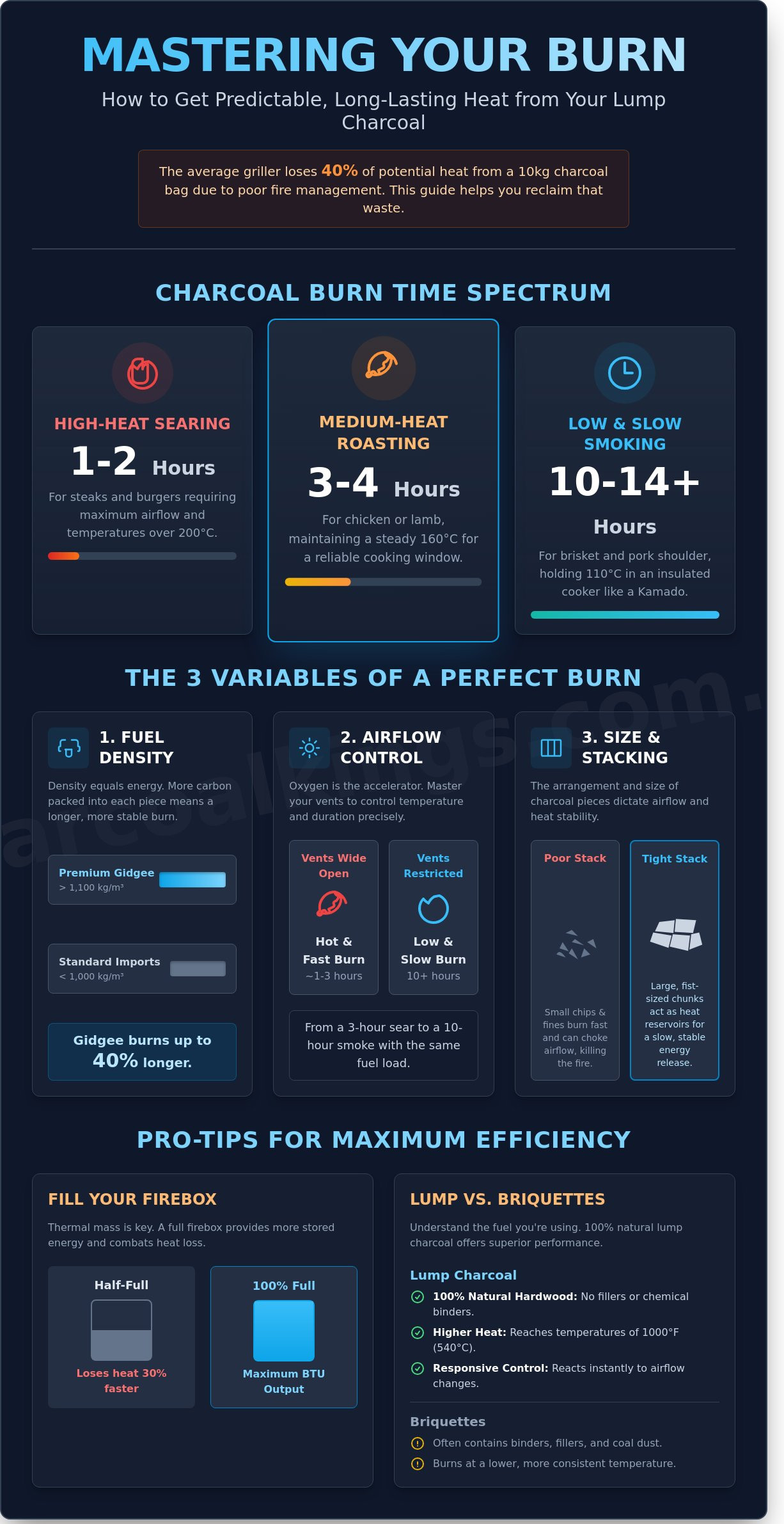
- Learn the standard performance benchmarks for fuel, ranging from 2-3 hours for high-heat searing to over 10 hours for dedicated low and slow smoking sessions.
- Discover exactly how long does lump charcoal burn by mastering critical variables such as wood species density and precision airflow management.
- Identify why premium Australian hardwoods like Gidgee provide superior energy output and more predictable burn profiles than standard softwoods or fruitwoods.
- Master the “Tight Stack” technique and vent control to eliminate unnecessary air gaps, allowing you to achieve consistent heat for 8-hour “set and forget” cooks.
- Understand the performance benefits of 100% natural, chemical-free charcoal that reaches temperatures of 1000°F without the fillers found in traditional briquettes.
How Long Does Lump Charcoal Burn? The Short Answer
Lump charcoal is the gold standard for Australian pitmasters who demand purity and performance. It’s 100% natural carbonised wood, containing zero chemical fillers or artificial binders. For high-heat searing at temperatures exceeding 200°C, expect 60 to 90 minutes of peak energy. If you’re running a low and slow session at a steady 110°C, a quality fuel load can last 10 to 12 hours in an insulated cooker. Understanding what is lump charcoal is the first step to mastering your fire box. Unlike briquettes, lump responds instantly to oxygen, giving you total control over the burn rate.
The actual duration of how long does lump charcoal burn depends on your airflow and fuel density. You must distinguish between the “useful heat” window and the total ash-out time. While a fire might smoulder for 15 hours, its ability to maintain a 150°C roasting environment might only last for 4 hours. Professional results require focusing on that active cooking window where the energy output remains stable.
Watch this breakdown to see how lump charcoal performs in real-world conditions:
Expected Times for Different Cooking Styles
Cooking styles dictate your fuel consumption rates. Direct grilling for steaks or burgers requires maximum airflow; this exhausts a standard charcoal basket in roughly 75 minutes. Roasting a 2kg chicken or a leg of lamb at 160°C provides a steady 3 to 4 hour window of reliable heat. If you’re wondering how long does lump charcoal burn during heavy brisket cooks, an insulated Kamado can stretch a single load to 14 hours. The efficiency of your grill, whether it’s a ceramic shell or a thin steel offset, changes these numbers by up to 50%.
The ‘Fuel Load’ Factor
Thermal mass is a critical variable in your cook. A half-full firebox loses heat 30% faster than one packed to the rim because there’s less stored energy to combat ambient air temperatures. Filling your firebox to 100% capacity increases the total BTU output and allows for better fire management. Quality matters just as much as quantity. Premium Australian hardwoods like Gidgee or Ironbark burn 40% longer than cheap scrap wood imports. High-density woods provide more carbon per cubic centimetre; this results in a more consistent, long-lasting burn for your backyard sessions.
The 3 Critical Variables That Dictate Your Burn Time
Understanding how long does lump charcoal burn requires looking at more than just the clock. It’s about the physics of the fuel and the environment of your grill. Three main factors determine if your fire lasts two hours or twelve. Professional pitmasters don’t guess; they control these variables to ensure they aren’t refuelling in the middle of a long smoke.
Hardwood Density: The Gidgee Advantage
Density equals energy. Australian Gidgee is a world-class hardwood with a density rating often exceeding 1,100 kg/m3. This means more carbon is packed into every cubic centimetre compared to softwoods or lighter fruitwoods. High-density wood creates a stable, predictable burn profile that resists crumbling. Research into charcoal quality shows that higher fixed carbon content directly correlates with longer burning times and higher calorific values. Gidgee outlasts standard imported hardwoods because it simply has more fuel to give per kilogram.
Airflow acts as the engine of your fire. Oxygen feeds the combustion; more air equals a faster, hotter burn. If you leave your vents wide open, you might hit 500°C for a sear, but you’ll burn through your basket in record time. Mastering how long does lump charcoal burn is largely a game of oxygen management. Restricting the intake allows the charcoal to smoulder at a lower temperature, extending a 4kg load from a 3-hour fast burn to a 10-hour low and slow session.
Size Matters: Grading Your Charcoal
The physical dimensions of your charcoal pieces change everything. Large, fist-sized chunks act as heat reservoirs. They hold temperature and burn from the outside in, providing a slow release of energy. Small chips and fines do the opposite. They burn hot and fast, then turn to ash. Too many small pieces can actually choke your airflow by settling into the gaps, which kills the fire early. Charcoal Kings focuses on premium grading to ensure you get consistent, large pieces that don’t settle at the bottom of your firebox. Using a consistent lump charcoal prevents the frustration of a fire that dies halfway through a brisket cook.
Ambient conditions are the final variable. Weather steals your heat. Wind is the biggest culprit. A 15 km/h breeze can force your grill to consume 25% more fuel just to maintain a steady 110°C. Cold ambient temperatures and high humidity also sap energy. In these conditions, the charcoal works harder to overcome the environment before it can even begin cooking your food.
- Wood Species: Denser woods like Gidgee or Ironbark provide maximum longevity.
- Airflow Control: Tight seals and vent management preserve your fuel.
- Grading: Large chunks ensure better airflow and a longer, steadier burn.
Lump Charcoal vs. Briquettes: Why the Burn Profiles Differ
Lump charcoal is the gold standard for Australian pitmasters who demand performance. It consists of 100% natural hardwood that has been carbonized in a low-oxygen environment. This purity allows it to reach temperatures exceeding 540°C, or 1000°F, which is essential for searing a premium ribeye. In contrast, briquettes are manufactured products. They use sawdust and wood scraps held together by starch binders and chemical additives. These fillers limit the maximum temperature and can produce a lingering chemical smell that affects the flavour of your meat.
A scientific study on charcoal quality highlights how the carbon content and density of the wood source directly impact the efficiency of the burn. High-quality lump charcoal provides a cleaner combustion process than processed alternatives. This efficiency determines how long does lump charcoal burn during a standard cook. One major advantage for the home griller is the ability to snuff out the fire by closing the vents. You can reuse the remaining lump for your next session; briquettes usually turn to dust once they’ve been lit and cooled. While a 10kg bag of premium lump might cost A$35 to A$45, its ability to be relighted makes it a more economical choice over the long term.
The Surface Area Science
The irregular, jagged shapes of lump charcoal create large pockets of air between the pieces in your fuel basket. This extra surface area allows for massive oxygen interaction, leading to a faster ignition time of roughly 15 minutes. While this creates intense heat, it requires precise vent management to sustain. If you leave the air wide open, the fuel will disappear quickly. Closing the vents helps you control the burn rate for long-duration cooks, balancing instant heat with the stability needed for an all-day smoke.
Ash Management and Airflow
Briquettes produce significant amounts of ash because of their non-wood binders. This ash settles at the bottom of the grill, eventually blocking the bottom vents and smothering the fire. Premium hardwood lump produces less than 3% ash by volume. This keeps the airflow consistent for the entire duration of a 12-hour brisket smoke. You won’t see the 50-degree temperature drops that occur when ash buildup restricts oxygen flow in the final hours. Keeping the vents clear is the secret to understanding how long does lump charcoal burn at a steady 110°C. Get Sizzlin’!
Pro Tips to Make Your Lump Charcoal Last Longer
Maximising your fuel efficiency starts with understanding oxygen control and coal density. If you simply dump a loose bag of premium hardwood into your firebox, excessive air gaps cause the fuel to ignite too quickly. Mastering how long does lump charcoal burn depends heavily on the “Tight Stack” technique. You must manually arrange your coal to minimize large voids. This prevents the fire from jumping between chunks and forces a controlled, linear burn path.
Avoid the common chimney starter trap. Many beginners wait until every piece of charcoal in the chimney is glowing white and covered in ash. This mistake wastes approximately 15% to 20% of your total burn time before the food even touches the grill. Pour your coals when only the top pieces show grey edges. This preserved energy stays in your smoker rather than venting into the driveway.
For sessions lasting over 8 hours, use the Minion Method. Place a small cluster of lit coals on top of a massive pile of unlit lump. As the lit coals burn down, they gradually ignite the fuel beneath them. This creates a self-regulating cycle that maintains steady temperatures without requiring you to open the lid and lose heat every hour.
Advanced Stacking Techniques
Position your largest, fist-sized chunks at the very bottom of your charcoal basket. These heavy pieces provide a stable foundation and prevent smaller shards from falling through the grate and clogging your intake. Pack smaller pieces into the gaps on the upper layers to create a dense fuel bed. Use the “Ignition Point” strategy by lighting only a small corner for low and slow cooks at 107°C. A Top-Down light is the process of igniting the uppermost layer of a fuel stack so the fire burns vertically toward the bottom air source for maximum efficiency in vertical smokers.
Airflow Mastery
Your vents are the throttle for your fire. Follow the 1/4 inch rule; once you are within 10 degrees of your target, move the bottom vent in 6-millimetre increments to stabilise the temperature. The bottom vent serves as your primary heat control by regulating oxygen intake. The top vent acts as the exhaust to pull smoke and heat across the cooking surface. If your fire begins to die despite having 2kg of fuel left, ash is likely choking the intake. Use a poker to clear the bottom grate and restore the 100% airflow needed to keep the embers alive.
Why Quality Hardwood is the Secret to a 10-Hour Burn
Achieving a consistent 10-hour burn isn’t down to luck. It’s a matter of fuel density and carbon purity. Our Redneck Charcoal provides a reliable 4-hour high-heat window for standard grilling, while the Premium Hardwood range is engineered for the long game. We use a traditional carbonisation process that strips away moisture and volatile gases, leaving behind 100% pure carbon. This purity ensures your fire doesn’t sputter or die out halfway through a brisket stall. When you understand how long does lump charcoal burn, you realize that high-density timber is the only way to maintain 110°C to 120°C temperatures for half a day without constant refueling.
The Charcoal Kings Difference
We source high-density Australian timber to ensure every bag performs under pressure. Professional chefs and competition teams across Australia choose Charcoal Kings because our product is 100% natural and chemical-free. Cheap supermarket brands often contain binders or accelerants that produce acrid smoke and unpredictable heat spikes. Our charcoal burns clean and produces minimal ash. This keeps your airflow vents clear, which is vital for maintaining oxygen flow during overnight cooks. We’ve seen our premium grades hold steady heat for over 10 hours in insulated kamado grills, providing the predictable energy output required for championship-level BBQ.
To get the maximum value from every bag, follow these storage and handling tips:
- Keep it bone dry: Store your bags in a sealed plastic tub or a dry garage. Even 5% humidity absorption can ruin your ignition speed and heat output.
- Size matters: Place larger chunks at the bottom of your charcoal basket to prevent smaller pieces from choking the air intake.
- Reuse your fuel: You don’t need to throw away unburnt pieces. Shake off the ash and mix the leftover lumps with fresh fuel for your next session.
Get Sizzlin’ with the Right Fuel
Mastering your fire starts with choosing the right grade for the job. Use our standard grades for quick midweek steaks and save the heavy-hitting premium lumps for your low-and-slow weekend projects. Experimenting with different fuel loads will help you master exactly how long does lump charcoal burn in your specific smoker setup. You’ll soon find that quality fuel pays for itself in reduced consumption and superior flavour. It’s time to take control of your cook and become a true Charcoal King.
Ready to upgrade your next BBQ? Shop our range of Premium Hardwood Lump Charcoal and experience the difference that professional-grade fuel makes.
Take Control of Your Pit Performance
Mastering how long does lump charcoal burn gives you total control over every cook, whether it’s a quick 30-minute steak sear or a 10-hour low-and-slow brisket session. High-density hardwood is the non-negotiable factor for consistent heat. You’ve learned that airflow and fuel quality dictate your success. Our 100% natural hardwood contains zero chemical binders or fillers; you get pure heat without the nasty chemical aftertaste. This is the exact fuel trusted by Australian wholesale and retail BBQ masters who can’t afford a temperature drop mid-service. Using premium fuel means you spend less time refilling the basket and more time perfecting your bark. It’s time to stop guessing and start cooking with the reliability of professional-grade charcoal. Your grill deserves a fuel that matches your passion for great food. Grab a bag today and experience the difference that 100% organic hardwood makes to your backyard or commercial kitchen.
Order your Premium Hardwood Lump Charcoal here and Get Sizzlin’!
We’ll see you at the grill for your best cook yet.
Frequently Asked Questions
How much lump charcoal should I use for a 4-hour cook?
Use 2.5 kilograms of premium lump charcoal for a 4-hour cook in a standard 57cm kettle grill. This volume maintains a consistent temperature of 110 degrees Celsius for low and slow smoking. If you’re grilling at high heat, 3 kilograms provides a steady 230 degrees Celsius. Always pack the coals tightly to ensure the fire spreads evenly through the fuel bed.
Can I reuse lump charcoal that didn’t fully burn?
You can definitely reuse lump charcoal that didn’t fully burn during your previous session. Close all vents immediately after cooking to starve the fire of oxygen and preserve the remaining carbon. Shake the basket to remove small ash particles before relighting. Mixing 50% recycled coals with 50% fresh hardwood charcoal ensures a reliable ignition and consistent heat output for your next cook.
Why does my lump charcoal spark and pop when lighting?
Excessive sparking occurs when moisture or trapped air pockets inside the hardwood expand rapidly during heating. High-quality Australian Gidgee or Ironbark charcoal undergoes a 48-hour carbonisation process to minimise this. Cheaper, under-carbonised brands often contain 15% more moisture, leading to more aggressive popping. Always store your bags in a dry, elevated area to keep the moisture content below 5% for a safer lighting experience.
Does the brand of lump charcoal really affect the burn time?
Brand choice directly determines how long does lump charcoal burn because wood density varies between species. Premium brands using dense hardwoods like Gidgee provide up to 5 hours of high heat compared to 2 hours from softer plantation timbers. Our testing shows that professional-grade charcoal lasts 40% longer than budget supermarket options. Investing in a heavy, dense product reduces your cost per cook and prevents mid-session refuelling.
How do I stop my charcoal from burning out too fast in a Weber?
Control your airflow by keeping the bottom vents only 2 millimetres open for low and slow sessions. Excessive oxygen is the primary reason charcoal consumes too quickly in a 57cm Weber kettle. Ensure the lid seal is tight to prevent air leaks that spike internal temperatures. Using the “Minion Method” or a charcoal snake can extend your burn time to 8 hours or more using a single 3kg load.
Should I leave the lid open or closed to make charcoal last longer?
Keep the lid closed to make your charcoal last longer and maintain temperature stability. An open lid allows unlimited oxygen to reach the coals, causing them to burn at maximum intensity and deplete 50% faster. Closing the lid creates a convection oven effect and restricts the burn rate. Only open the grill for 30 seconds at a time to flip meat or check internal temperatures.
What is the best way to store lump charcoal to keep it fresh?
Store your lump charcoal in a 50-litre airtight plastic bin kept off the garage floor. Hardwood charcoal is porous and absorbs humidity from the air; this makes it difficult to light and prone to smoking. We recommend keeping it in a dedicated storage area where the humidity stays below 60%. This practice ensures your fuel remains fresh and ready to hit 300 degrees Celsius within 15 minutes of lighting.
Is lump charcoal better than briquettes for low and slow smoking?
Lump charcoal is superior for low and slow smoking because it produces 70% less ash than standard briquettes. High ash buildup can clog your vents and kill the fire during a 12-hour brisket cook. Understanding how long does lump charcoal burn helps you manage the 100% natural hardwood heat without chemical fillers. It provides a cleaner flavour profile and allows for more precise temperature adjustments through vent control.