
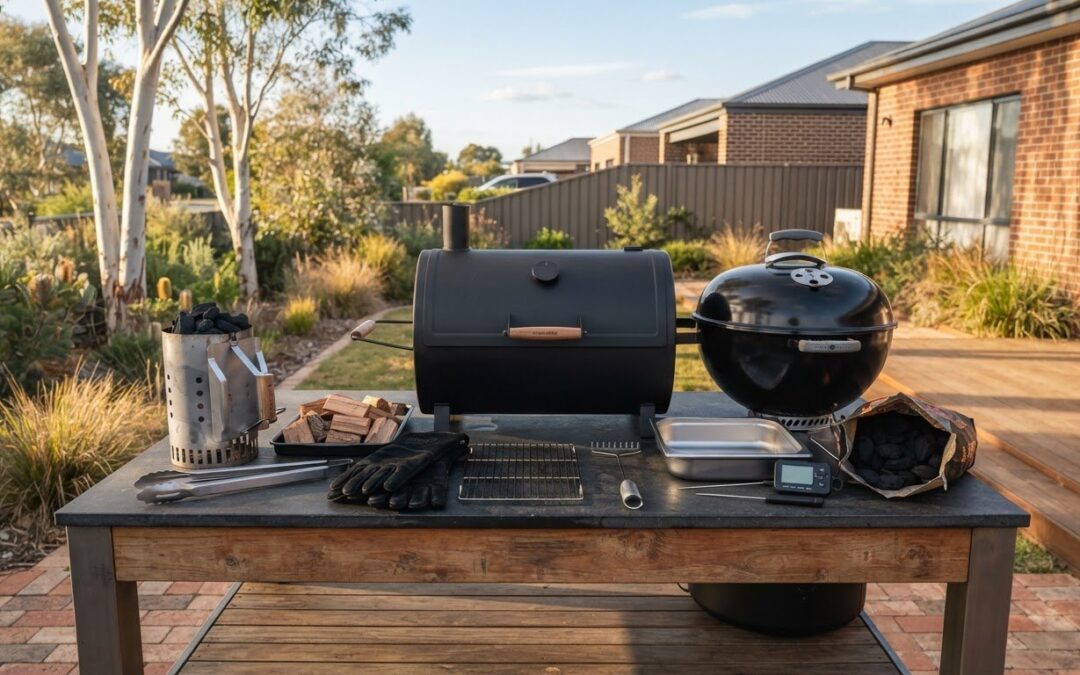
A bigger pile of gear won’t make a better cook. The essential charcoal smoker accessories are the tools that help you check temperatures, manage the fire and handle hot equipment safely. Specialist thermometers and automatic controllers can be useful, but you don’t need every upgrade to get started.
Begin with a reliable way to check temperatures, a suitable charcoal-lighting method and tools for handling hot equipment. These basics help you track the cook, prepare charcoal and protect your hands when tending fuel or moving grates. Then choose additions to suit your smoker and cooking habits. Kettles, kamados and drums differ in how they manage airflow, heat and fuel, so check your setup before buying accessories.
This guide separates essentials from convenient upgrades, with practical advice on temperature monitoring, fire management, safe handling and care. You’ll learn how to build a focused starter kit, decide whether a wireless thermometer is worth adding, and keep equipment ready for the next cook.
Key Takeaways
- Choose essential charcoal smoker accessories by the job they do, not by a fixed checklist or brand name.
- Use cooker and food temperature readings to answer different questions, then match airflow and fire tools to your smoker’s design.
- Compare each accessory’s task and priority with your cooking habits to see which upgrades can wait.
- Check smoker dimensions and compatibility before buying, then clean, care for and store tools to keep them ready for the next cook.
- Build your setup around the fuel and smoking style you use, with charcoal, smokers, smoking woods and BBQ accessories as practical categories to explore.
Essential charcoal smoker accessories: what each tool helps you do
Build your kit around three recurring jobs: checking temperatures, managing fuel and handling hot equipment safely. The essential charcoal smoker accessories aren’t a fixed-length shopping list or a set of must-buy brands. They’re the tools that reliably help with tasks you perform during a cook, such as monitoring heat or moving a hot grate.
Some tools work for both grilling and smoking. Tongs, gloves and thermometers can serve either purpose. Others, such as a fuel basket or ash tool, depend more closely on the smoker’s design. Choose for the task and cooker you have. For background on the process of smoking food, including how heat and smoke shape cooking, see this overview.
For a quick look at how cooking tools fit into a BBQ setup, watch this equipment guide:
Which accessories help control temperature and cooking results?
A reliable thermometer helps answer two different questions: how hot is the cooker, and how far along is the food? A probe placed in the food tracks its internal temperature. A cooker reading helps you monitor the cooking environment. One reading cannot replace the other.
A lid-mounted gauge gives a useful reference, but it measures at the lid rather than necessarily where the food sits. A grate-level reading adds context about conditions at cooking height. Use it to learn how your cooking area behaves, then adjust airflow or fuel gradually and watch the temperature response. Follow the thermometer maker’s guidance for probe placement and care.
Which tools make charcoal handling and cooking safer?
Long-handled tongs help move food or reposition charcoal while keeping your hands farther from the heat. Heat-resistant gloves can help when handling hot grates or other equipment, but they don’t make every surface safe to touch. Use an ash tool suited to your smoker to clear or move ash without disturbing other parts. Let ash cool fully before disposal, and follow the smoker’s instructions.
A chimney starter provides a contained way to prepare charcoal before transferring it to the cooker. Check that its size and shape suit your fuel and routine. Kettles, kamados and drums can differ in access, airflow and fuel arrangement, so the right tools depend on the equipment you own and the tasks you repeat. Start with tools that make those jobs easier to manage, not the longest possible list.
Charcoal smoker accessories for temperature, airflow, and fire management
Fire management is easier when you can connect the smoker’s behaviour with what your thermometer reads. Cooker temperature describes the heat around the food; a food probe tracks its internal temperature. Together, these readings help you decide whether to adjust the fire, keep cooking or check the food again. A dual-probe thermometer monitors the cooking chamber and food at the same time, giving you two useful readings without guaranteeing a particular result.
Airflow matters, but the smoker’s vents are part of its design, not automatically an accessory to buy. Adjusting them changes how air reaches the charcoal. Make one change at a time and observe the temperature response. A thermometer reading is most useful when you consider where the probe sits and how the cooker is set up.
Do you need a dual-probe thermometer for smoking?
A dual-probe thermometer can be useful if you want to monitor the cooking environment and food without moving one probe between jobs. Wired probes connect to a display by a lead, while wireless options reduce the tether and may suit cooks who want to check readings from a distance. Neither format suits every routine. Consider probe placement guidance, display readability where you cook, and whether the device fits your habits. For food-safety guidance, consult the USDA’s information on safe smoking practices.
How do charcoal starters and ash tools support fire management?
A chimney starter helps prepare charcoal outside the smoker before you transfer it to the fire area. It’s a practical tool for cooks who regularly light charcoal. Choose a size and handling method that suit your fuel and smoker, follow the starter’s instructions, and place it on a stable, heat-safe surface.
A charcoal basket can keep fuel grouped in a particular area, which may be useful for a smoker designed to support that arrangement. An ash rake or similar tool can help move or clear ash where the cooker’s firebox allows access. These aren’t universal upgrades. Check the smoker’s design and instructions before adding equipment, and avoid blocking vents or disrupting intended airflow. Let ash cool fully before handling or disposal.
The best essential charcoal smoker accessories are the ones that fit your cooker and solve a task you repeat. Match thermometer probes, charcoal-handling tools and fuel to your setup. If you’re reviewing options, explore charcoal and BBQ accessories as part of planning a compatible kit.
Do you need every charcoal smoker accessory? Essential tools versus extras
No. You can start with a small, task-focused kit and add tools when a recurring job calls for them. Prioritise temperature monitoring, safe handling and a suitable way to light or manage charcoal. Before buying, check what you already own. BBQ tongs may work for smoking, and an existing thermometer may cover your needs if it’s suitable for cooker use.
Use this comparison to distinguish repeat-use basics from convenience and serving extras. Priority depends on your smoker and routine, not on owning every item listed.
| Tool | Primary task | Priority | Who benefits most |
|---|---|---|---|
| Thermometer | Monitor cooker or food temperature | Starter essential | Anyone who wants to track the cook |
| Heat-resistant gloves or long-handled tongs | Handle hot equipment or food | Starter essential if you lack a suitable alternative | Cooks tending fuel, grates or food |
| Chimney starter | Prepare charcoal before adding it to the smoker | Useful for regular charcoal cooks | Those who need a dedicated charcoal-lighting tool |
| Wireless thermometer | Check readings with less tethering | Convenience | Cooks who value remote monitoring |
| Specialised basket or serving tools | Arrange fuel or present food | Optional | Owners whose smoker design or serving style calls for them |
What belongs in a starter kit for charcoal smoking?
Begin with a way to read temperatures, safe tools for handling hot parts, and a charcoal-lighting or management method that suits your cooker. Don’t assume every task needs a new purchase. Check existing BBQ tools for appropriate reach, heat suitability and condition. Aim to cover the jobs you’ll perform on your first cook, not every task you might encounter.
Fuel choice also affects how you plan a cook and load your smoker. Use this charcoal fuel guide to compare fuel options and consider how they fit your setup.
Which accessories can wait until you know your cooking style?
Wireless monitoring may be convenient, but a wired thermometer can be enough if you’re happy to check its display. A specialised basket makes sense only if it fits your smoker and supports the way you arrange fuel. Serving tools suit particular cooks, but they don’t help control the fire. Consider how often you cook, too: a regular long-cook routine may call for different conveniences than occasional smoking.
If you’re learning hot smoking, Michigan State University Extension’s guide to the hot smoking process provides useful context on temperature control and preparation. Let your cooking habits show you what to add next.
How to choose, use, and maintain charcoal smoker accessories
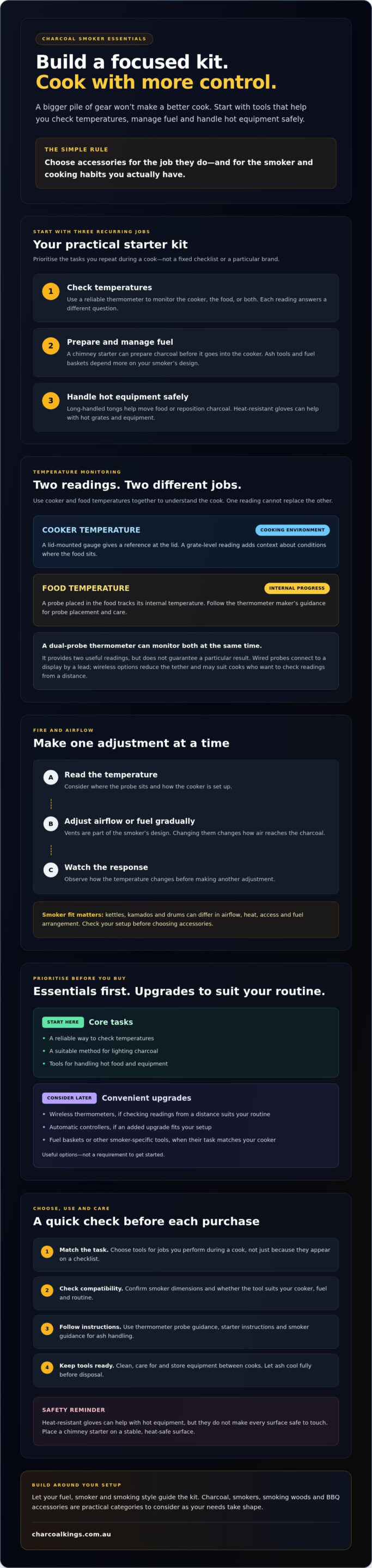
Choose tools to suit your smoker, cooking routine and working conditions. A compact kettle used occasionally has different needs from a larger smoker used for regular long sessions. Before adding gear, use this four-step check to make sure each item earns its place in your kit.
- 1. Identify the task. Name the job you need help with, such as checking food temperature, moving hot grates or clearing ash.
- 2. Check compatibility. Compare the tool’s size and intended use with your smoker’s layout and the manufacturer’s guidance.
- 3. Prioritise by use. Give first consideration to tasks you repeat. If you cook occasionally, favour versatile tools over specialised extras.
- 4. Maintain it. Clean, inspect and store each item according to its material and manufacturer’s instructions.
How do you match accessories to your smoker and cooking habits?
Start with your smoker type, available cooking space and the recipes you make most often. Check that probes can sit where you need them without being pinched by the lid, and that racks or baskets fit without obstructing the cooking area or airflow. Consider how often you cook and where you use the smoker. If your routine is simple, prioritise tools that can handle several recurring jobs.
Compatibility is about more than dimensions. Handles need to be reachable during cooking, and an accessory designed for one cooker may not suit another. For foundational fire and cooking techniques, refer to this charcoal barbecuing guide.
How should you clean and store smoker tools?
Cleaning depends on the tool’s material and the maker’s instructions. Remove grease and food residue from cooking tools as directed. Clear ash from suitable equipment only after it has cooled. Don’t immerse electronic displays or thermometer components unless their instructions allow it.
Before each cook, inspect probe wires and tips, glove condition, tong joints and handles for signs of wear or damage. Store thermometers and other sensitive equipment as directed, away from conditions that could damage them. Use heat-resistant tools as intended, keep a stable place ready for hot equipment, and follow the smoker and accessory instructions for safe operation.
Use this checklist to narrow down the essential charcoal smoker accessories that fit your setup, then explore charcoal and BBQ accessories to plan your toolkit.
Build a practical smoker setup with Charcoal Kings
A dependable setup starts with a few tools matched to recurring jobs: checking temperatures, handling fuel and hot equipment, and keeping the cooking area manageable. Add convenience or serving gear only when your smoker and habits call for it. This keeps the focus on equipment you’ll use rather than a long checklist of extras.
Charcoal Kings is an Australian supplier of charcoal, BBQ grills and smokers, smoking woods and BBQ accessories. These categories work together in a cook, but each has a different purpose. Fuel supplies heat, smoking wood contributes smoke, the smoker shapes the cooking environment, and accessories help you monitor or manage the process.
How should accessories work with charcoal and smoking wood?
Choose charcoal and smoking wood to suit the cook you’re planning and the guidance for your smoker. Fuel is not a substitute for temperature-monitoring or handling tools, and an accessory won’t make an unsuitable fuel choice right for the cooker. Check how your smoker is designed to hold and receive fuel, then consider the smoke character you want from the wood.
Think of your setup as a working system: fuel and wood support the fire and flavour, while compatible accessories help you manage the cook. Browse Charcoal Kings’ confirmed categories for charcoal, smokers, smoking woods and BBQ accessories, and check current product details before settling on specific items.
What is the next step when you are ready to shop?
Write a short list based on recurring needs, such as monitoring temperature or safely handling hot parts. Then check the smoker’s dimensions and instructions against each accessory’s intended use. Confirm current specifications and compatibility before ordering, especially for items that must fit inside or attach to the cooker. Don’t assume a tool will suit every smoker simply because it’s described as a BBQ accessory.
If you’re still deciding which smoker fits your cooking space and plans, use the Australian BBQ buying guide to help narrow your options. Once your setup is clear, add only tools that address a real task. That’s how essential charcoal smoker accessories earn their place: through fit, safe use and regular value at the cook.
Build your smoker kit one useful tool at a time
The best essential charcoal smoker accessories are the ones that solve regular tasks in your setup. Prioritise temperature checks, safe fuel handling and tools that suit your smoker’s design. Add specialised or convenience gear only when your cooking routine gives it a clear job.
Before buying, check compatibility, follow the maker’s use and care instructions, and inspect equipment before each cook. A thermometer, charcoal tool or basket is useful only if it fits your cooker and the way you work. Keep your kit focused, then adjust it as your skills and cooking habits develop.
Charcoal Kings is an Australian-based supplier serving retail, wholesale and food-service customers. Its categories include charcoal, smokers, smoking woods and BBQ accessories, giving you a practical place to explore the parts of your setup together. Check current product details and compatibility as you browse.
Explore charcoal, smokers, and BBQ accessories at Charcoal Kings, then get your next cook underway with confidence.
Frequently Asked Questions
What accessories do you need for a charcoal smoker?
Start with a reliable way to check cooker and food temperatures, tools for handling hot equipment, and a charcoal-lighting method that suits your smoker. These essentials help with recurring tasks, but you may already own suitable BBQ tongs or gloves. The right kit depends on your cooker’s design and your routine. Add items such as specialised baskets or wireless monitors only when they solve a task you regularly face.
Is a separate meat thermometer necessary if my smoker has a built-in gauge?
A separate food probe is useful because a built-in gauge reads the cooking environment, not the food’s internal temperature. The smoker’s gauge can help you track heat, while a probe inserted into the food gives a different reading for assessing the cook. Check your thermometer’s instructions for correct placement and use. If your existing equipment can provide both readings appropriately, you may not need another device.
Do I need a charcoal chimney starter for smoking?
No, a chimney starter isn’t essential for every smoker or lighting routine. It can be useful if you regularly prepare charcoal separately before adding it to the cooker. Consider whether it suits your fuel, smoker access and available safe working space. Follow its instructions, set it on a stable, heat-safe surface and use suitable protection when handling hot equipment. Choose a lighting method that fits your smoker’s guidance.
Can I use regular BBQ tongs and gloves with a charcoal smoker?
Yes, suitable BBQ tongs and heat-resistant gloves can work for smoking as well as grilling. Check that tongs have enough reach for your cooker and that gloves are intended for the handling tasks you have in mind. Gloves don’t make every hot surface safe to touch. Inspect both tools for wear before cooking, and follow their care instructions. Replace damaged tools rather than relying on them around hot fuel or grates.
What happens if I rely only on my smoker’s lid thermometer?
You’ll have a reading from the lid area, but it may not represent conditions at grate level or tell you the food’s internal temperature. That leaves useful information missing as you manage the cook. A grate-level thermometer reading adds context about heat near the food, while a food probe tracks the food itself. Use the smoker’s gauge as a reference, and position other probes according to their instructions.
Are wireless BBQ thermometers worth it for charcoal smoking?
They can be worthwhile if checking readings without a wired connection suits your cooking routine. A wired thermometer may be simpler if you’re happy to read its display near the smoker. Before choosing, consider display readability, probe placement, connection needs and how you’ll use the device outdoors. Check the manufacturer’s specifications and care guidance. Wireless monitoring is a convenience, not a requirement for learning to manage a charcoal smoker.
How do I choose smoker accessories without buying unnecessary gear?
List the tasks you repeat, then check which suitable tools you already own before shopping. Match any new accessory to your smoker’s dimensions, design and instructions, and prioritise tools for temperature checks, fuel handling and safe cooking. The essential charcoal smoker accessories for your setup depend on how often you cook and what you make. Add specialised or serving gear only when a clear need emerges.