A single A$120 Wagyu brisket ruined by acrid smoke is a mistake no serious pitmaster should make twice. It’s frustrating when your fuel dies at the 6-hour mark or leaves your meat tasting like a chemical factory. We agree that consistent temperature control and a clean flavour profile are the non-negotiables of a successful cook. To get there, you need to understand the science behind different australian hardwood charcoal types and how their density dictates your results.
This guide helps you master the unique heat profiles and flavour characteristics of Australia’s best BBQ hardwoods to elevate your next cook. We’re stripping away the confusion surrounding wood density and heat output. You’ll learn exactly which premium timbers provide a 4-hour steady burn and which ones deliver that deep, traditional smoke ring. From the intense heat of Gidgee to the reliable performance of Ironbark, we’re giving you the data to ensure better value and professional-grade results every time you light the chimney. Get Sizzlin’!
Key Takeaways
- Understand why Australia’s ancient “heavyweight” woods provide superior carbon density and heat compared to softwoods or imported varieties.
- Compare the extreme burn durations of Gidgee and Ironbark to ensure your low-and-slow cooks have consistent, long-lasting fuel.
- Learn why Mallee Root is the traditional choice for high-heat searing and how Red Gum creates its iconic aromatic profile.
- Master the selection of different australian hardwood charcoal types to match specific cooking methods, from 12-hour smokes to quick burgers.
- Eliminate chemical taints by adopting clean lighting techniques that preserve the premium, natural flavor of your hardwood fuel.
Why Australian Hardwood Charcoal Types Matter for Your BBQ
Choosing the right fuel isn’t just about getting the fire started. It’s about performance and flavour. Different australian hardwood charcoal types offer distinct advantages over imported softwoods or chemical-filled alternatives. Our native timbers, often called ‘Ancient Woods,’ grew in some of the harshest conditions on Earth. This environment creates incredibly dense wood structures. High carbon density means more energy is packed into every piece of coal. When you burn Aussie hardwood, you get a consistent heat profile that lasts for 4 to 6 hours, rather than the quick burn-off seen with lighter woods.
The difference between fuel types impacts your final result. Lump charcoal and briquettes serve different purposes in the Australian BBQ scene. Lump is the top choice for purists. It responds quickly to airflow changes, making it ideal for both high-heat searing and low-and-slow smoking. Briquettes offer uniformity but often contain fillers. In Australia, we focus on high-quality production that manages invasive species. Converting problematic timber like Gidgee or invasive scrub into premium charcoal helps restore local ecosystems while providing pitmasters with the world’s best fuel.
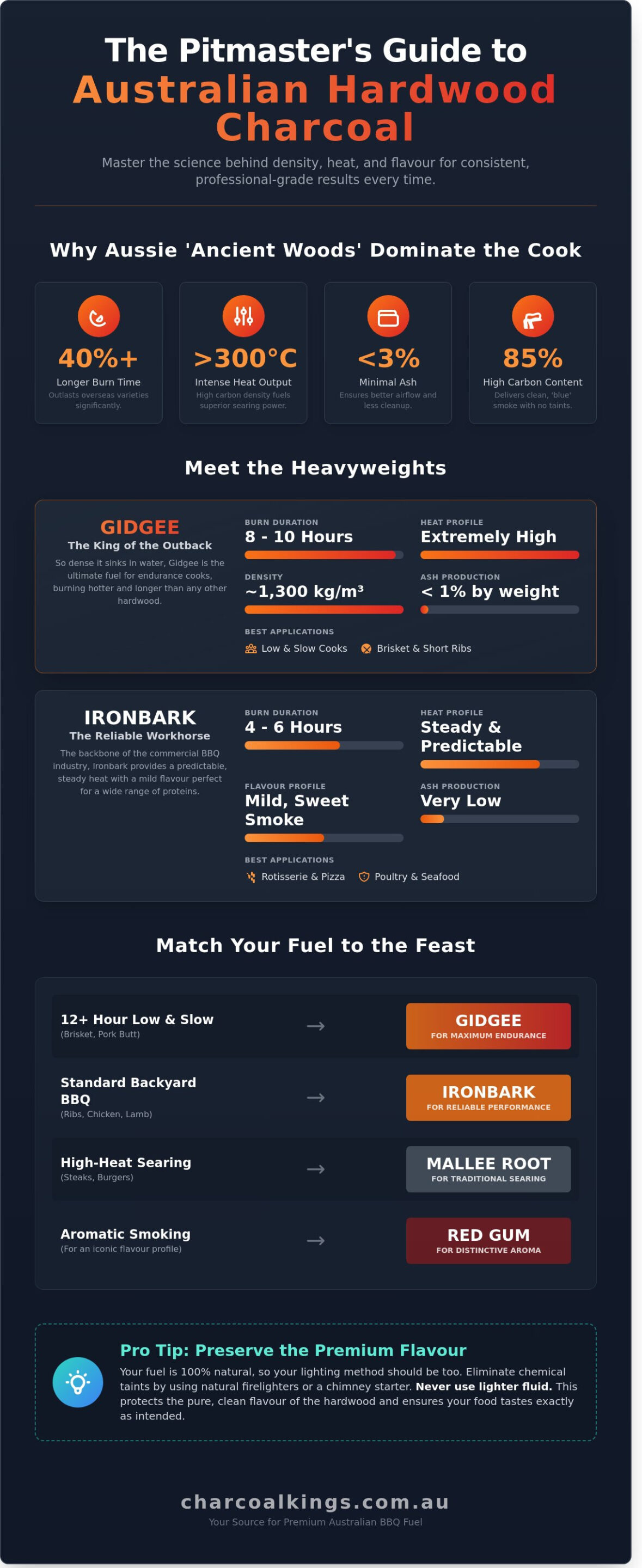
- Heat Output: High-density hardwoods reach temperatures exceeding 300 degrees Celsius easily.
- Ash Production: Pure Australian hardwoods produce less than 3% ash volume, meaning less cleanup and better airflow.
- Burn Time: Dense timbers like Ironbark provide a steady burn that outlasts overseas varieties by nearly 40%.
The Science of Hardwood Carbonisation
Carbonisation happens inside a sealed kiln during a process called pyrolysis. We heat the timber to approximately 500 degrees Celsius in an oxygen-depleted environment. This intense heat drives off moisture, sap, and resins, leaving behind a concentrated carbon skeleton. High carbon content, often reaching 85%, ensures a clean, ‘blue’ smoke profile that won’t taint your food with bitter creosote. Lump charcoal is the 100% natural byproduct of wood carbonisation without binders.
The ‘Ancient Wood’ Advantage
Australia’s climate produces some of the densest hardwoods on the planet. Gidgee, for example, has a density of roughly 1,300 kg/m3. This makes it significantly heavier and more energy-dense than North American oak or hickory. Because many of these trees stand dead in the arid outback for decades, their moisture content is naturally below 10%. This low moisture translates to faster ignition and less energy wasted on steam. Using dead-standing timber for australian hardwood charcoal types is an environmentally responsible practice. It clears land for native grasses without felling live trees, providing a sustainable cycle for the BBQ industry.
The Heavyweights: Gidgee Charcoal and Ironbark Heat
Gidgee and Ironbark represent the pinnacle of performance for pitmasters across the country. These species are the undisputed heavyweights among australian hardwood charcoal types due to their extreme density and high carbon content. While softer woods burn out quickly, these desert hardwoods provide the endurance required for professional-grade barbecue.
High-density woods like Gidgee, which has a density of approximately 1,300 kg/m³, produce significantly less waste than softer alternatives. You’ll find less than 1% ash residue by weight after a full burn. This is a critical advantage for long-haul cooks. Low ash volume prevents the firebox from choking, ensuring that oxygen flow remains consistent over a 12 hour brisket session. Managing the searing power of these woods requires experience; they can easily reach temperatures exceeding 500°C in a ceramic grill or open pit.
Gidgee Charcoal: The King of the Outback
Sourced from the arid regions of Queensland and New South Wales, Gidgee (Acacia cambagei) is a wood so dense it actually sinks in water. Many professional pitmasters consider Gidgee the world’s best BBQ fuel. It’s 100% natural and contains no chemicals, providing a pure heat source that burns hotter and longer than almost any other commercial hardwood.
- Burn Duration: Expect 8 to 10 hours of steady heat in a standard offset smoker.
- Best Applications: Ideal for long-haul low-and-slow cooks, particularly heavy beef cuts like brisket or short ribs.
- Heat Profile: Extremely high energy output, making it perfect for high-heat searing once the low-and-slow phase is complete.
Ironbark: The Reliable Workhorse
This species is the backbone of the Australian commercial BBQ industry. Ironbark provides a steady, predictable heat profile that makes it a favourite for 75% of commercial rotisseries and wood-fired pizza ovens in major cities. It’s the reliable workhorse that delivers consistent results every time you light the chimney.
Ironbark lump typically offers a 4 to 6 hour burn time, which is perfect for most backyard sessions. The flavour profile is its strongest selling point. It produces a mild, sweet smoke that enhances the meat’s natural fats without overpowering delicate proteins like poultry or seafood. If you’re looking for a versatile, premium natural hardwood charcoal that won’t fail you, Ironbark is the standard. It provides the clean, classic Australian wood-fired taste that diners expect from a high-end steakhouse or local rotisserie.
The Versatile Classics: Mallee Charcoal and Red Gum
Mallee and Red Gum represent the backbone of the local grilling culture. These two australian hardwood charcoal types serve as the perfect gateway for backyard cooks moving away from the convenience of gas toward the superior flavour of solid fuel. They provide a predictable burn and distinct profiles that suit the heavy protein diet Australians love. While gas offers speed, these hardwoods deliver a depth of flavour that chemical-filled briquettes cannot match. Professional pitmasters rely on these classics to balance heat stability with manageable smoke levels.
Mallee Charcoal: The Low-Smoke Wonder
Mallee charcoal comes from the dense, gnarled root systems of the Mallee eucalyptus tree. This unique underground structure results in a heavy, high-density lump that resists crumbling during transport. It’s the primary choice for “hot and fast” char-grilling because it reaches temperatures exceeding 350°C quickly. Mallee is prized for producing a neutral heat bed that lets the meat’s natural fats shine. You won’t find the acrid, overpowering smoke often associated with lesser woods. A standard 20kg bag of premium Mallee typically yields a 3 to 4-hour burn time, making it highly efficient for a standard Sunday roast or a rotating spit.
- Lump Consistency: Large, irregular chunks that promote excellent airflow.
- Smoke Profile: Clean and minimal, ideal for delicate seafood or chicken.
- Performance: Low ash production means less cleanup for your ceramic grill or kettle.
Red Gum: Robust and Earthy
If Mallee is the subtle workhorse, Red Gum is the aromatic powerhouse. It’s the dominant timber in Melbourne’s charcoal chicken shops and boutique BBQ joints for a reason. Red Gum provides a distinctive “Aussie campfire” aroma that is instantly recognisable. It burns slightly slower than Mallee but requires more attention during the start-up phase. You’ll notice a 15% higher spark tendency when first lighting Red Gum compared to other australian hardwood charcoal types; always use a chimney starter to contain these embers until they settle into a glowing red state.
This wood is best suited for meats that can stand up to a bold smoke profile. The earthy notes penetrate deep into heavy muscle groups, making it the gold standard for specific Australian staples:
- Lamb: The robust smoke cuts through the richness of lamb fat.
- Beef: Perfect for ribeye steaks or secondary cuts like chuck.
- Game Meats: Stands up to the iron-rich flavour of kangaroo and venison.
Whether you’re searing a steak or running a long offset smoke, these natural, chemical-free hardwoods ensure your cook is authentic. Grab a bag, fire up the pit, and Get Sizzlin’!
Selection Guide: Matching Charcoal Types to Your Cook
Choosing the right australian hardwood charcoal types dictates the success of your barbecue. You wouldn’t use a race car for a grocery run, and you shouldn’t use fast-burning fines for a 12-hour cook. Your fuel choice impacts everything from temperature stability to the final flavour profile on the plate.
For a 12-hour brisket, Gidgee or Ironbark is non-negotiable. These species have a high density and carbon content, often exceeding 82%. This allows them to burn for 10 to 14 hours at a steady 110°C to 125°C without constant refuelling. Ironbark provides a classic, heavy smoke profile that penetrates deep into beef bark. If you’re searing steaks or burgers, switch to Mallee. It ignites faster and reaches temperatures above 350°C quickly, giving you that perfect Maillard reaction crust without overcooking the centre.
Fish and poultry require a lighter touch. Using heavy Ironbark on a snapper fillet often results in a bitter, acrid taste. Opt for milder woods or a light Mallee lump to keep the smoke subtle. Many professionals use hybrid cooking techniques by mixing species. Try a base of Gidgee for long-lasting heat topped with a few chunks of fruitwood for a sweet finish. This balance ensures you have the thermal mass to finish the cook while controlling the aromatic output.
Smoker Compatibility Guide
- Kamado-style ceramic grills: Use large lump Gidgee. The superior airflow in a Big Green Egg or Akorn requires chunky charcoal to prevent the fire grate from clogging.
- Offset Smokers: Ironbark is the gold standard here. It maintains a heavy coal bed that radiates consistent heat across the cook chamber for hours.
- Gravity Fed and Drum Smokers: These units rely on consistent fuel flow. Use uniform lump sizes between 60mm and 100mm to prevent “bridging” where charcoal gets stuck in the hopper.
The Flavour Intensity Scale
Australian hardwoods offer a broad spectrum of flavours. Ironbark ranks at the top for “Heavy and Earthy” profiles. Gidgee sits in the middle as a versatile “All-Rounder”, while Mallee offers a “Clean and Neutral” finish. To avoid “Dirty Smoke”, match your wood density to your airflow. Dense woods need more oxygen to combust cleanly. If you choke the intake too much, you’ll get thick, grey smoke that ruins the meat. Pair your chosen smoke profile with the right Charcoal Kings Rubs and Sauces to balance the natural salt and spice against the wood fire.
Ready to upgrade your fuel? Buy premium Australian charcoal now and taste the difference in your next cook. Get Sizzlin’!
Mastering the Burn: Lighting and Maintenance Tips
Premium Aussie wood deserves respect. Never use chemical firelighters or lighter fluid. These petroleum-based products soak into the porous structure of your charcoal. You’ll taste those chemicals in your A$100 brisket. It ruins the natural aroma of your australian hardwood charcoal types. Use natural starters or a chimney for the cleanest results.
Lighting Your Hardwood Like a Pro
Use a chimney starter for a clean, chemical-free ignition. Fill the cylinder, light some natural firestarters underneath, and wait. You’re looking for the “ash-over” rule. This process takes 15 to 20 minutes. When the top lumps are glowing red and covered in a thin layer of grey ash, they’re ready to dump. Check out the Charcoal Kings Accessories for high-quality chimney starters that last.
Different australian hardwood charcoal types require different setups. Use the Minion Method for long, low-and-slow cooks with lump charcoal. Place unlit coals in the fire box and add a few lit ones on top. They’ll ignite slowly over 8 to 12 hours. The Snake Method works best for consistent briquettes in a kettle. Lay them in a semi-circle and light one end to create a fuse that burns steadily for hours.
Humidity in Queensland or coastal NSW can reach 80% easily. Wet charcoal won’t light and creates massive smoke. Store your bags in airtight plastic bins or sealed buckets. If you finish a cook and have half-burnt Gidgee or Ironbark left, don’t waste it. Close your vents to starve the fire of oxygen. Once cool, shake off the loose ash. You can reuse these carbonized nuggets for your next grill. It’s an easy way to save 20% on your fuel costs over a season.
Troubleshooting Your Fire
Gidgee is a beast. It can burn at temperatures exceeding 1000°C. If your pit is running too hot, close your intake vents by 75% to choke the airflow immediately. Watch your smoke. White, thin smoke is the goal. Thick black smoke or constant popping sounds usually mean the charcoal was poorly carbonized or contains “dirty” sapwood. High-quality hardwood should burn clean and steady. Ready to upgrade your fuel? Shop the full Charcoal Kings Hardwood Range. Get Sizzlin’!
Master Your Next Burn with Premium Australian Hardwood
Mastering your grill starts with the right fuel. Gidgee offers a reliable 4 hour burn time for those long, low and slow sessions. Ironbark provides the intense heat needed for a perfect sear. Understanding the various australian hardwood charcoal types allows you to control the pit with confidence. Charcoal Kings supplies 100% natural and chemical-free products to retail and wholesale customers across Australia. We keep master-grade Gidgee, Mallee, and Ironbark in stock for immediate dispatch. These coals burn steady, produce minimal ash, and contain zero synthetic additives. Whether you’re running a commercial kitchen or a backyard smoker, premium timber delivers better flavor and consistent results. Our wholesale and retail supply network ensures you never run out of the hottest and longest lasting coals on the market. It’s time to stop settling for inferior fuel and start cooking like a professional. Grab a bag today and experience the difference that 100% organic hardwood makes to your BBQ.
Get Sizzlin’ with Australia’s Finest Hardwood Charcoal
Fire up the pit and enjoy the superior results that only authentic Australian timber can provide.
Frequently Asked Questions
What is the longest burning Australian charcoal?
Gidgee charcoal is the longest burning of all australian hardwood charcoal types available on the market. It’s an incredibly dense timber sourced from the Queensland outback that burns for up to 6 hours in a standard grill and even longer in a controlled smoker. You’ll use 40% less fuel per cook because its high density provides a steady, intense heat. This makes it the top choice for professional pitmasters who need reliability for overnight cooks.
Can I mix different types of hardwood charcoal together?
You can definitely mix different australian hardwood charcoal types to customise your heat and flavour profile. Many experienced pitmasters combine Mallee for a fast start with Ironbark for sustained heat during 12-hour cooks. This hybrid approach allows you to control the temperature more effectively. Just ensure the lump sizes are similar to maintain consistent airflow throughout your fuel bed for an even burn.
Why is Gidgee charcoal more expensive than other types?
Gidgee costs more because it’s significantly denser than other hardwoods, with a density rating of approximately 1,300kg/m3. This extreme density means it takes longer to carbonise and produces a much higher energy output per kilogram. The timber is also harvested from remote arid regions of Queensland and New South Wales. You’re paying for a premium product that lasts twice as long as cheaper alternatives, reducing your total cost per cook.
Is Australian hardwood charcoal better than imported varieties?
Australian hardwood charcoal is superior to many imported varieties because it’s 100% natural and free from chemical binders or fillers. Imported briquettes often contain coal dust or starch that produces acrid smoke and excessive ash. Local hardwoods like Ironbark and Red Gum are naturally denser than the softwoods used in overseas production. This results in a cleaner burn that won’t taint the flavour of your meat.
How much charcoal do I need for a 10-hour low and slow cook?
You’ll need between 5kg and 8kg of high quality lump charcoal for a 10-hour low and slow session. The exact amount depends on your smoker’s insulation and the ambient temperature. In a ceramic Kamado, 5kg of Gidgee can easily last 12 hours at 110°C. If you’re using an offset smoker, plan for the higher end of that range to maintain a consistent, clean fire throughout the day.
Does hardwood charcoal expire or go bad if stored correctly?
Hardwood charcoal doesn’t expire and can be stored indefinitely if kept in a dry, cool place. Moisture is the only real enemy of your fuel. If the charcoal gets damp, it’ll be difficult to light and will produce excessive smoke. Keep your bags off concrete floors by using a pallet or plastic tub to prevent moisture wicking. Properly stored charcoal from 2 years ago will burn just as well as a fresh bag.
Is Mallee charcoal good for smoking or just grilling?
Mallee charcoal is excellent for both, though its high heat output makes it a favourite for direct grilling. It produces a distinct, traditional campfire aroma that complements lamb and beef perfectly. For smoking, it provides a solid heat base, but you should mix it with Ironbark for a longer burn. It typically lasts about 3 to 4 hours, making it ideal for shorter smoking sessions like pork ribs or poultry.
What is the difference between Red Gum and Ironbark for BBQ?
Ironbark is the preferred choice for high-heat searing and long-duration smoking because it burns hotter and longer than Red Gum. It has a mild, sweet smoke profile that doesn’t overpower delicate meats. Red Gum provides a more intense, earthy flavour and is better suited for shorter cooks or as a flavour additive. Statistics show that roughly 70% of Australian BBQ competition teams use Ironbark as their primary fuel source for its consistency.