

The iconic kettle shape is a fixture in Aussie backyards, but when it comes to buying a new weber bbq, a serious question arises: are you paying for premium performance or just the brand name? With a high price tag and a growing list of competitors offering similar features, it’s easy to feel uncertain. You want incredible flavour, but you also want to know if there are better value-for-money alternatives out there, or if mastering charcoal is truly worth the effort over the convenience of gas.
This is the definitive 2026 breakdown. Our charcoal experts are cutting through the marketing noise to deliver a straightforward, honest review. We’ve tested the Weber range against its toughest competition, comparing build quality, ease of use, heat control, and-most importantly-the real-world cooking results. By the end of this article, you will understand exactly how a Weber stacks up and feel confident choosing the right BBQ for your budget and your pursuit of serious flavour.
What Makes a Weber BBQ an Icon? The Legacy of the Kettle
In Australian backyards, the silhouette of a Weber Kettle is more than just a piece of cooking equipment; it’s a cultural icon. For decades, the Weber BBQ has defined what it means to grill, smoke, and roast outdoors. Its influence is undeniable, built on a foundation of simple, effective design that fundamentally changed how people cook with fire. This legacy began not in a design studio, but with a simple marine buoy and a desire for a better steak.
The design’s mastery of heat control is what allows for incredible versatility, from searing steaks to slow-cooking ribs. To see it in action, watch this quick overview:
The Original Kettle: A Design That Changed Everything
In 1952, George Stephen, an employee at Weber Brothers Metal Works, was frustrated with open-top braziers that produced unevenly cooked food and dangerous flare-ups. Slicing a metal buoy in half, he created a dome-lidded grill. This innovation introduced the principle of convection cooking to the backyard. The lid trapped heat and smoke, circulating it around the food for consistent results. The dual-vent system-one on the bottom to feed oxygen to the coals and one on top to control airflow and temperature-gave grillers unprecedented control. For a deeper look into the Weber company history, the full story showcases this ingenuity.
Key Features That Define a Weber Charcoal Grill
The core design has been refined over the years, but the key components that deliver performance remain. These features are the standard for quality in charcoal grilling.
- Porcelain-Enamelled Bowl and Lid: This signature finish isn’t just for looks. It reflects heat, ensures consistent cooking temperatures, and protects the steel from rust and burnout for years of reliable service.
- Plated Steel Cooking Grates: Heavy-duty and built to last, these grates provide excellent heat transfer. Premium models feature hinged sides, allowing you to add more charcoal during long cooks without removing the entire grate.
- The One-Touch Cleaning System: A standout feature on premium models, this system uses three blades in the bowl to sweep ash into a high-capacity, enclosed ash catcher. Cleanup is fast, simple, and clean.
Beyond the Kettle: The Modern Weber Lineup
While the Kettle is its foundation, the modern Weber lineup has expanded to meet every need. The core charcoal family includes the original Kettle series, the dedicated Smokey Mountain smoker, and the Performer series, which integrates a kettle into a convenient workstation. To compete across the market, Weber also produces successful gas (Spirit, Genesis) and pellet grill (SmokeFire) ranges. This review, however, will focus on the charcoal models where the Weber legacy was forged.
Weber’s Charcoal Grills: A Deep Dive for Purists
For those who believe true barbecue is cooked over coals, the Weber charcoal lineup is foundational. While competitors offer endless features, the classic weber bbq experience is built on a mastery of fundamentals: superior airflow control, durable construction, and iconic design. This is where Weber’s reputation was forged, and these grills remain the benchmark for backyard purists across Australia.
The Classic Kettle Series: Is it Still King?
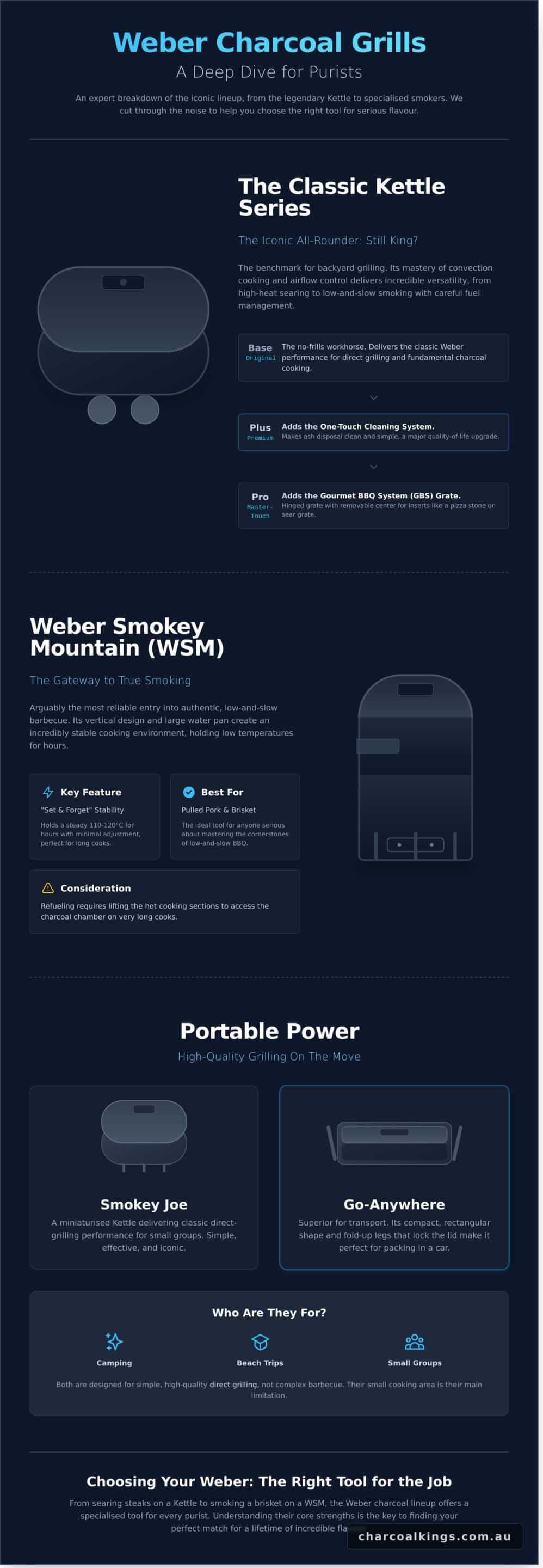
The Weber Kettle is an icon for a reason. Its value proposition shifts across three core models. The base Original Kettle is the no-frills workhorse, perfect for direct grilling. Stepping up to the Original Premium adds the invaluable One-Touch cleaning system, making ash disposal clean and simple. The top-tier Master-Touch includes the Gourmet BBQ System (GBS) hinged grate, allowing for inserts like a sear grate or pizza stone. For searing steaks, the Kettle’s design creates a powerful convection effect, while its surprising versatility allows for low-and-slow ribs with careful coal management. Its consistent performance is why many, including this comprehensive best charcoal grill review from The New York Times, still rank it at the top.
Weber Smokey Mountain (WSM): The Smoker for the Masses
The WSM is arguably the most reliable entry point into authentic, low-and-slow smoking. Its vertical design is brilliantly simple: a charcoal chamber at the base, a large water pan to stabilize temperature and add moisture, and two stacked cooking grates. The WSM is legendary for its ‘set and forget’ stability, holding a steady 110-120°C for hours with minimal vent adjustment. It’s the ideal choice for anyone serious about pulled pork or brisket without the investment of a large offset. Its main drawback is the need to lift the hot cooking section to add more fuel during very long cooks.
Portable Options: Go-Anywhere vs. Smokey Joe
For grilling on the move, Weber offers two excellent solutions. The Smokey Joe is a miniaturised Kettle, delivering classic performance for small groups. Its main competitor is Weber’s own Go-Anywhere grill. With a compact, rectangular shape and fold-up legs that lock the lid for transport, the Go-Anywhere is superior for packing in a car for camping or a trip to the beach. Both are limited by a small cooking area and are designed for direct grilling, not complex barbecue. They are the perfect tool for simple, high-quality grilling away from home.
How Does Weber Stack Up Against the Competition?
At Charcoal Kings, we respect quality gear. A solid weber bbq is a benchmark for a reason, but it’s crucial to understand where it fits in the broader market. The right tool depends on the job, your budget, and the flavour you’re chasing. Here’s our straightforward breakdown.
Kettle vs. Kettle: Weber vs. Napoleon & Big Box Brands
The Weber Kettle is the icon. Its build quality is the key differentiator. Weber uses a heavier gauge steel and a superior porcelain-enamel coating that resists rust for years. Cheaper big-box brands from Bunnings or Mitre 10 might look similar and cost under A$100, but they often use thinner metal that warps and rusts out after a few seasons. Competitors like Napoleon offer premium features like hinged, cast-iron grates, but often at a higher price. The verdict: if you grill more than a few times a year, the Weber investment pays for itself in longevity and performance.
Smokers: WSM vs. Offset Smokers & Drum Smokers
The Weber Smokey Mountain (WSM) is a ‘set and forget’ champion. Its vertical design is incredibly efficient and holds steady temperatures for hours, producing a clean smoke flavour. It’s a different beast entirely from a traditional offset ‘stick burner’.
- Offset Smokers: These horizontal cookers demand more fire management but reward you with a deep, rich smoke flavour profile that’s hard to replicate. They are the choice for traditionalists.
- Drum Smokers (UDS): A high-performance alternative that offers incredible value. They are as efficient as a WSM but can also run at higher temperatures for searing, offering a versatility that many pitmasters love.
The Gas Debate: Weber Gas Grills vs. The Flavour of Charcoal
Weber’s Spirit and Genesis gas lines are massively popular in Australia for their convenience and reliability. We get it. You turn a knob, and you have heat. But convenience comes at a cost: flavour. Gas grilling is essentially outdoor oven cooking. It simply cannot replicate the intense radiant heat and authentic smokiness produced by burning real wood charcoal. The choice is clear: gas is for convenience, but charcoal is for ultimate taste and a superior crust on your steak. Discover the unbeatable flavour of natural lump charcoal.
Key Factors to Consider Before You Buy Any BBQ
Before getting caught up in brand names, the most important step is to define your own needs. The best barbecue isn’t about the logo on the lid; it’s about the one that fits your cooking style, space, and budget. Use this guide as your personal checklist to find the right tool for the job.
Build Quality & Materials: The Longevity Test
A BBQ is an investment. Look for units built with thick-gauge steel and quality welds. A stable frame and solid legs are non-negotiable. Cheaper models often use thin, powder-coated steel that looks good on the showroom floor but quickly rusts and fails, especially in Australia’s coastal air. A solid warranty and easy access to spare parts are crucial. A major advantage for a premium weber bbq, for instance, is the ten-year warranty and readily available grates and accessories.
Cooking Style: Grilling, Roasting, or Low-and-Slow Smoking?
What do you plan to cook most often? Your answer dictates the type of grill you need. Don’t buy an offset smoker if you only ever grill sausages and steaks. Be honest about your primary goal:
- All-Rounder: For grilling, roasting, and occasional smoking, a kettle grill like the classic weber bbq is the undisputed champion of versatility.
- Dedicated Smoking: If you dream of brisket and pulled pork, an offset smoker or a quality kamado provides the temperature stability for long cooks.
- High-Heat Searing: Gas grills and kamados excel at creating that perfect steakhouse crust.
Size & Capacity: How Many People Are You Feeding?
Grill size is often listed by diameter or square centimetres, but what does that mean in real life? A standard 57cm kettle grill can comfortably cook for 6-8 people, holding around 12-15 burger patties. Our advice is simple: always buy slightly larger than you think you need. It’s better to have extra space for guests or a large roast than to run out of room. Finally, measure your patio or balcony. Ensure the BBQ’s physical footprint, including side tables, fits your outdoor space comfortably.
Once you’ve chosen the right hardware, the next step is pairing it with premium fuel. At Charcoal Kings, we supply the 100% natural hardwood charcoal that brings out the best in any barbecue. Get the right foundation and Get Sizzlin’!
The Verdict: Is a Weber BBQ Right For You?
After extensive testing, our conclusion is clear: the classic weber bbq remains a benchmark for quality, versatility, and reliability in the Australian backyard. It’s a fantastic piece of equipment that rarely disappoints. However, the ‘best’ BBQ is always the one that fits your specific needs, budget, and cooking style. At Charcoal Kings, we believe in matching the right tool to the right pitmaster.
Who Should Definitely Buy a Weber BBQ?
A Weber is an outstanding investment for several types of grillers. We give it a strong recommendation if you are:
- The Beginner: Its predictable heat control and simple design make it one of the easiest charcoal grills to master.
- The ‘Buy It For Life’ Customer: With a 10-year warranty on major components and legendary durability, a Weber offers excellent long-term value for your money.
- The Versatile Cook: If you want one unit that can sear steaks, roast a whole chook, and handle some light smoking, the classic Kettle design is a proven all-rounder.
When to Consider an Alternative (And Our Top Picks)
While an excellent grill, a Weber isn’t the final word for every situation. You might be better served by an alternative if:
- You’re a Low-and-Slow Specialist: For dedicated smoking, the superior airflow control and capacity of a dedicated offset or drum smoker from our range will deliver more consistent results for briskets and pork butts.
- You’re on a Strict Budget: The upfront cost can be a hurdle. While we caution against very cheap options that won’t last a season, there are more budget-friendly kettle-style grills that offer a good starting point.
The Final Ingredient: Don’t Power a Great Grill with Bad Fuel
Remember, your grill is only half of the equation. Powering a premium piece of kit with cheap, chemical-laden briquettes is like putting standard unleaded in a performance engine. The fuel you choose directly impacts heat, burn time, and most importantly, the flavour of your food.
Premium, all-natural lump charcoal, free from fillers and binders, burns hotter, cleaner, and imparts a pure, smoky taste. A quality BBQ deserves quality fuel. It’s the single biggest upgrade you can make to your cooking, ensuring you get the absolute best performance from your investment. Get it right from the start.
The Final Verdict: Choosing Your Next BBQ
After weighing the pros and cons, it’s clear that Weber’s reputation for quality and performance is well-earned. Their iconic designs have set the standard for backyard grilling in Australia for decades. However, the modern market is packed with strong competitors, meaning your perfect grill depends entirely on your budget, cooking style, and desired features.
Ultimately, whether a classic weber bbq is your champion or another brand wins you over, one thing is certain: the quality of your fuel is just as critical as the quality of your grill. As Australia’s Charcoal Specialists, we know that serious BBQ flavour starts with premium, natural hardwood charcoal.
We provide the expert advice to match the right fuel to your new BBQ for incredible results. Ready to find your perfect setup? Get Sizzlin’! Explore Our Expert-Curated Range of BBQs & Smokers and unlock next-level flavour. Happy grilling!
Frequently Asked Questions
Are Weber BBQs overpriced for what you get?
While the initial cost of a Weber BBQ can be higher than competitors, it’s an investment in quality and longevity. You are paying for premium materials like heavy-gauge steel and a baked-on porcelain-enamel finish that resists rust and cracking. With generous 10-year warranties and proven performance, the higher price in AUD reflects a product built to last decades, not just a few seasons. It’s value over a lifetime, not just a low upfront cost.
What is the real difference between a Weber Kettle and a cheaper lookalike?
The difference is in the materials and engineering. A genuine Weber Kettle uses heavy-gauge steel with a thick, porcelain-enamelled coating that won’t peel or rust easily. Cheaper copies use thin metal and simple paint. Weber’s design ensures a tight-fitting lid and precise air vents for superior temperature control, something lookalikes struggle with. This superior construction means a Weber is built for a decade of performance, while a cheaper alternative often fails after one or two seasons.
How long does a Weber charcoal BBQ typically last?
A well-maintained Weber charcoal BBQ can easily last 15 to 20 years, and many original models are still in use decades later. The key is the robust porcelain-enamel bowl and lid, which are backed by a 10-year warranty against rust and burn-through. With basic care, like using a cover and regular cleaning of the ash catcher, your investment will deliver consistent performance for years. It is built to endure the harsh Australian climate.
Is it difficult to control the temperature on a Weber Kettle?
Controlling the temperature on a Weber Kettle is a skill, not a difficulty. It’s managed using the air vents. The bottom vents control the amount of oxygen reaching the charcoal, acting as the main accelerator for your fire. The top vent is for fine-tuning the temperature and controlling smoke flow. Once you understand this simple two-vent system, maintaining a steady temperature for grilling or low-and-slow cooking becomes straightforward and repeatable. A little practice is all it takes.
Can you smoke meat effectively on a standard Weber Kettle?
Absolutely. The Weber Kettle is a surprisingly effective smoker. The key is setting up a two-zone fire, banking your charcoal to one side and placing the meat on the other indirect heat side. For longer cooks like pulled pork or brisket, methods like the ‘charcoal snake’ allow you to maintain a low, steady temperature for hours. With a water pan to add moisture, a standard Kettle can produce authentic, smoky barbecue results that rival dedicated, more expensive smokers.
Which is better for flavour: a Weber charcoal grill or a Weber gas grill?
For authentic, smoky barbecue flavour, a Weber charcoal grill is unmatched. When meat drippings vaporise on hot coals, they create a distinct smoke that infuses the food. This is the classic BBQ taste. A Weber gas grill, while incredibly convenient, produces a cleaner flavour. Its ‘Flavorizer Bars’ vaporise drippings to create some barbecue flavour, but it lacks the deep complexity that real charcoal and wood smoke provide. The choice comes down to prioritising authentic flavour versus push-button convenience.