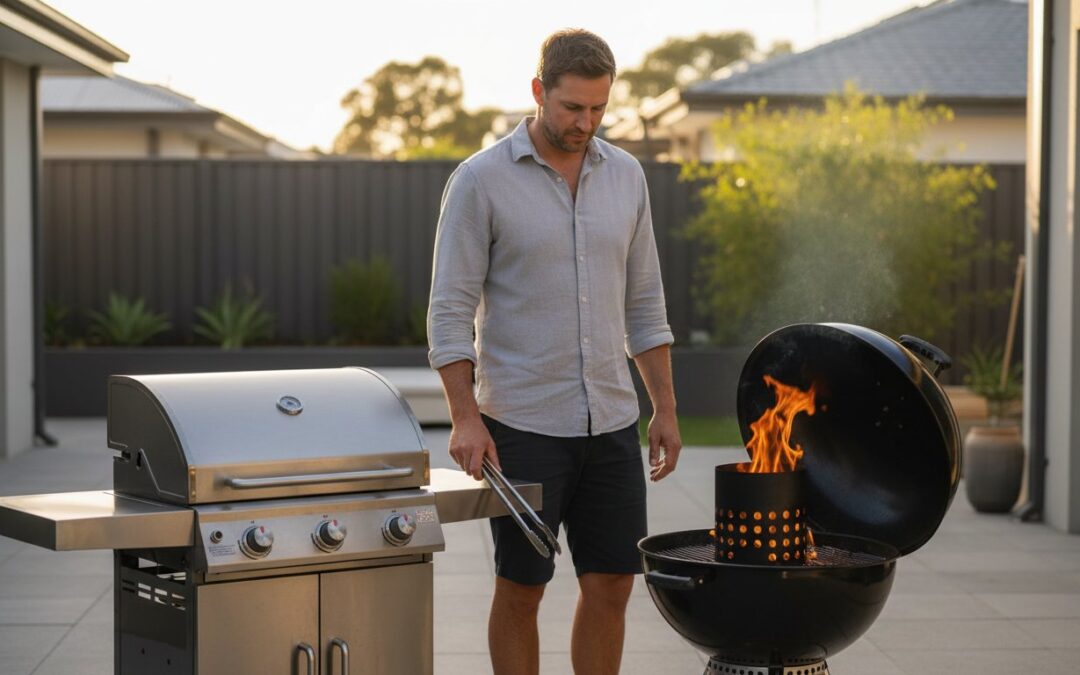
The convenience of a gas BBQ is undeniable. Turn a knob, and you’re cooking. But the pursuit of authentic, smoky flavour demands more. It demands the primal connection of real fire and premium, natural hardwood charcoal. For many seasoned gas grillers, the idea of switching from gas bbq to charcoal feels like a leap into the unknown. You worry about mastering temperature, the extra time for setup and cleanup, and the fear of charring an expensive cut of Aussie beef. These are valid concerns, but they are not roadblocks.
This is your expert, no-nonsense guide. Forget the myths and get the facts. We will break down the real-world differences in flavour, workflow, and the essential gear you actually need to invest in. You will learn the hands-on techniques to control your heat and understand the true pros and cons before you spend a single dollar. This is your blueprint for deciding if you’re ready to master a new skill and unlock the unparalleled flavour that only charcoal can deliver.
Key Takeaways
- Learn the fundamental difference between gas convection and charcoal’s radiant heat to understand the massive flavour upgrade.
- This guide provides a clear roadmap for switching from gas bbq to charcoal, covering everything from grill choice to your first successful cook.
- Identify the few essential, high-impact tools you actually need for success, avoiding costly and unnecessary gadgets.
- Master a simple, repeatable process for lighting, temperature control, and cleanup, turning potential hassles into a rewarding new skill.
The Flavour Showdown: Why You’re Really Thinking of Switching
Let’s get straight to the point. The primary reason you’re considering switching from gas bbq to charcoal is the pursuit of authentic, unbeatable flavour. A gas grill is essentially an outdoor oven; it cooks primarily with hot air (convection), which is efficient but lacks the magic that defines true barbecue.
To see just how transformative this switch can be, watch this helpful video:
Charcoal, on the other hand, provides intense, direct radiant heat. This is the key to achieving a superior crust and deep sear on your steak-the Maillard reaction in its purest form. More importantly, the smoke from real hardwood charcoal is not an additive; it’s a fundamental ingredient that gas simply cannot replicate.
How Charcoal Creates Unbeatable Flavour
When natural hardwood charcoal combusts, it releases hundreds of aromatic compounds that infuse your food with a distinct, smoky taste. The real performance happens when meat drippings hit the glowing coals. They instantly vaporize into a flavourful smoke that rises back up, basting the food in its own essence. This process is what creates that authentic BBQ character. Even the type of charcoal matters: natural lumpwood offers a clean, subtle smoke, while briquettes provide a consistent, classic flavour profile.
The Honest Role of a Gas Grill
A gas grill has its place. Its undeniable convenience-quick start-ups and precise temperature dials-makes it a champion for a fast weeknight cook-up of snags or burgers. The long history of barbecue grills shows a constant evolution towards convenience. However, accessories like ‘smoker boxes’ are an attempt to imitate charcoal’s flavour, not replicate it. They add a hint of smoke but miss the crucial vaporisation process that defines authentic barbecue.
Gas vs. Charcoal: A Quick Comparison Table
Here’s a direct comparison to help you weigh the practical differences.
| Feature | Gas Grill | Charcoal Grill |
|---|---|---|
| Flavour Profile | Clean, basic roast flavour | Rich, smoky, complex |
| Heat-up Time | 5-10 minutes | 15-25 minutes |
| Temp Control | Precise, dial-based | Manual, via vents (a skill) |
| Cleanup Effort | Minimal (grate scraping) | Moderate (ash disposal) |
| Running Costs (AUD) | Low (A$2-A$3 per hour) | Moderate (A$4-A$8+ per cook) |
The Verdict: Gas is the clear winner for weeknight ease. But for weekend feasts where flavour is king, charcoal is the undisputed champion.
The New Workflow: What Really Changes Day-to-Day
The biggest hesitation when switching from gas bbq to charcoal centres on three things: time, temperature control, and cleanup. Forget the idea that this is a downgrade in convenience. Instead, view it as an upgrade in skill and involvement. The process isn’t a hassle; it’s a rewarding ritual that connects you to the food you cook. There is a learning curve, but it’s straightforward. After a few sessions, this new workflow becomes a fast, enjoyable, and essential part of the superior flavour experience.
From Turning a Knob to Starting a Fire
Your most important new tool is a chimney starter. It is the only method you need for lighting natural lump charcoal or briquettes efficiently and cleanly. The process is simple: fill the chimney with charcoal, place it over a lit firelighter or crumpled paper, and wait 15-20 minutes. The coals will be white-hot and ready to pour into your BBQ. This method completely eliminates the need for lighter fluid, ensuring your food tastes of pure smoke and fire, not harsh chemicals.
Mastering the Heat: Learning to Use Vents
Temperature control on a charcoal BBQ is managed with airflow. The core principle is direct: more air equals more heat. Your BBQ will have two sets of vents:
- Bottom (Intake) Vents: These are your primary control. Open them to feed oxygen to the coals and increase the temperature; close them to restrict air and lower it.
- Top (Exhaust) Vents: These vents control airflow and smoke. Use them for fine-tuning your temperature.
While it sounds technical, this becomes intuitive. You’ll quickly learn how adjusting the vents affects the fire, giving you precise command over your cooking environment.
The Cleanup: A Practical Guide to Ash Management
Ash cleanup is simpler than you think. Once the cook is finished and the coals have cooled completely-usually overnight-the ash is ready for disposal. Many modern kettle BBQs feature one-touch cleaning systems that sweep ash into a catcher for easy removal. For other models, an ash scoop and a metal bucket are all you need. Compare this to scrubbing greasy flavouriser bars and scraping out a rancid grease trap on a gas unit. Managing ash is a dry, straightforward task that takes mere minutes.
Your New Toolkit: Essential Gear for the Charcoal Convert
When you’re switching from gas bbq to charcoal, you leave behind the convenience of a knob for the superior flavour of a real fire. This requires a different mindset and a new, more tactile set of tools. Forget the endless gadgets; a successful transition relies on a few high-impact essentials that give you complete control over the heat and flavour.
The Fuel: Premium Lump Charcoal vs. Briquettes
Your first and most important choice is the fuel itself. Premium hardwood lump charcoal is simply carbonised wood. It burns hotter, faster, and cleaner, leaving behind very little ash and imparting a pure, smoky flavour. Briquettes are manufactured from wood by-products and binders, offering a uniform shape and consistent burn time, but they don’t match the raw performance or authentic taste of lump. For the best results, start with the best fuel. We recommend our range of 100% natural hardwood charcoal.
The Essentials: What You Absolutely Need on Day One
Don’t overcomplicate your initial setup. You only need a few core items to get started correctly and safely. This is the non-negotiable gear for your first cook.
- Chimney Starter: This is the single best tool for lighting charcoal. It uses convection to light coals quickly and evenly without the need for chemical-laden lighter fluid, which can taint your food.
- Heat-Resistant Gloves: You’re dealing with extreme temperatures. A quality pair of leather or silicone gloves is essential for safely handling a hot chimney starter, adjusting vents, or moving grill grates.
- Long Tongs & Grill Brush: A set of long-handled tongs gives you the reach to manage food over a hot fire without burning your hands. A sturdy grill brush is crucial for keeping your cooking surface clean for better flavour and performance.
The Next Level: Gear for Better Results
Once you’ve mastered the basics of lighting and heat management, a few key pieces of equipment will elevate your cooking. An instant-read digital thermometer is the only way to guarantee perfectly cooked meat, taking all the guesswork out of doneness. Charcoal baskets or rails make creating a two-zone fire effortless, giving you direct and indirect heat zones for ultimate cooking flexibility. Finally, adding wood chunks or chips introduces another layer of authentic smoke flavour, turning your BBQ into a genuine smoker.
Choosing Your First Charcoal Grill: A Quick Guide
Making the move to authentic charcoal flavour means choosing new hardware. Your gas grill is built for convenience, but a charcoal BBQ is engineered for taste and temperature control. The first step in switching from gas bbq to charcoal is matching a grill to your budget, available space, and cooking ambitions. This guide breaks down the three main types to help you make a smart investment.
The Classic Kettle Grill
For most people, the kettle grill is the perfect entry point into the world of charcoal. Its iconic dome shape is not just for looks; it creates a convection effect that cooks food evenly. Kettles are incredibly versatile, mastering everything from high-heat searing for steaks to two-zone cooking for a Sunday roast. They are the undisputed all-rounders of the charcoal world.
- Best For: Beginners and all-rounders who want to grill, roast, and dabble in smoking.
- Budget: Highly affordable, with quality models starting from around A$250.
- Key Feature: Supreme versatility and a massive ecosystem of accessories.
The Kamado / Ceramic Grill
Kamado grills are the high-performance machines of charcoal cooking. Built from thick ceramic, they offer unmatched insulation, making them incredibly fuel-efficient and capable of holding precise temperatures for hours. This makes them exceptional for both low-and-slow smoking of brisket and reaching searing temperatures for the perfect crust on a steak. This performance comes at a price, representing a significant upgrade.
- Best For: The serious enthusiast who wants top-tier performance for both grilling and smoking.
- Budget: A premium investment, typically starting from A$1,200 and up.
- Key Feature: Unbeatable temperature stability and fuel efficiency.
The Dedicated Smoker
If your dream is to produce authentic, fall-off-the-bone American-style BBQ, a dedicated smoker is your tool. Units like offset or drum smokers are purpose-built for cooking ‘low and slow’. They are designed to maintain low, stable temperatures over long periods, perfect for transforming tough cuts like brisket and pork shoulder into tender masterpieces. While they excel at smoking, they are not designed for quick, direct grilling.
- Best For: Aspiring pitmasters focused exclusively on smoking ribs, brisket, and pulled pork.
- Budget: Varies widely, from accessible drum smokers around A$400 to large offsets costing thousands.
- Key Feature: Specialised design for authentic low-and-slow barbecue.
Ultimately, the right grill empowers your cooking style. Once you’ve chosen your hardware, the next step is to power it with the best fuel. Explore our range of 100% natural lump charcoal and briquettes to get the premium results your new grill deserves.
Your First Cook: A Simple Plan for Guaranteed Success
The theory is covered. It’s time to light the fire. Your first cook after switching from gas bbq to charcoal should be a victory, not a source of stress. This straightforward plan eliminates guesswork and guarantees a superior result, proving you made the right choice for authentic flavour.
Forget complex recipes. Success comes from mastering one fundamental technique that gives you total control over the heat.
Master the Two-Zone Fire
This is the single most critical skill for any charcoal griller. A two-zone fire is your control dial and your safety net. Simply bank your hot, ashed-over coals to one side of the grill. This creates a direct, high-heat zone for searing and an indirect, cooler zone for gentle cooking. If food is cooking too fast, simply move it to the cool side. It’s that simple.
Easy First Recipe: Reverse-Seared Steaks
This method is foolproof and delivers edge-to-edge perfection with an incredible crust-something a gas grill can’t replicate. It highlights the precise temperature control and intense searing power you now have.
- Setup: Arrange your grill with a two-zone fire. Aim for a grill temperature of around 120-135°C on the cool side.
- Cook: Place your seasoned, thick-cut steaks (Scotch fillet or sirloin works well) on the cool, indirect side. Close the lid and let them cook gently until they are about 10°C below your final desired temperature.
- Sear: Move the steaks directly over the hot coals. Sear for 60-90 seconds per side, until a deep, flavourful crust forms.
- Rest: Let the steaks rest for 10 minutes before slicing. This guarantees a juicy result.
Common Mistakes to Avoid
Your journey to becoming a charcoal master will be much faster if you sidestep these common pitfalls. The biggest challenge when switching from gas bbq to charcoal is learning patience.
- Using too much charcoal. An inferno is difficult to control. One chimney starter of quality lump charcoal is more than enough for most cooks.
- Not waiting for the coals. Don’t start cooking until the coals are fully lit and covered in a thin layer of white ash. This ensures consistent, predictable heat.
- Constantly lifting the lid. If you’re lookin’, you ain’t cookin’. Every time you open the lid, you lose heat and valuable smoke flavour. Trust the process and your thermometer.
The foundation of any great charcoal cook is premium fuel. Our natural hardwood lump charcoal provides the consistent heat and clean smoke you need for guaranteed success. Get Sizzlin’!
Your Path to Authentic Barbecue Is Clear
The decision of switching from gas bbq to charcoal is ultimately a commitment to superior flavour and a more engaging cooking craft. You’re leaving behind the sterile convenience of a gas knob for the hands-on, primal satisfaction of managing a live fire. As this guide has shown, the perceived challenges are easily overcome. The new workflow quickly becomes a rewarding ritual, and with the right essential gear, you’ll be producing authentic, smoky results that gas grills simply cannot replicate.
The foundation of any great charcoal cook is the fuel itself. As Australia’s trusted supplier for competition teams and top restaurants, we understand that quality is non-negotiable. That’s why our charcoal is 100% natural hardwood-no chemicals, no additives, just pure potential for incredible flavour and a long, consistent burn.
Ready to make the switch? Start with the best fuel. Shop our Premium Charcoal.
The flavour you’ve been chasing is waiting. Fire it up.
Frequently Asked Questions
Is switching from a gas to a charcoal BBQ healthier?
Cooking with premium, natural hardwood charcoal eliminates any risk from gas leaks or malfunctions. The health factor in charcoal cooking relates to managing flare-ups. When fat drips onto hot coals, it can create smoke containing PAHs. Using a two-zone fire setup minimises this, giving you authentic wood-fired flavour without excessive charring. Ultimately, choosing 100% natural, chemical-free charcoal ensures a pure cooking fuel, which is a key benefit when switching from gas bbq to charcoal.
How much more expensive is using charcoal compared to an LPG bottle?
Charcoal is typically more expensive per cook. A 9kg LPG bottle swap costs around A$30-A$40 and provides many hours of cooking. In comparison, a 10kg bag of premium lump charcoal costs between A$40-A$60 and will last for approximately 3-5 cooking sessions, depending on the temperature and duration. The higher cost reflects the premium, natural fuel source and the superior flavour it imparts. The investment is in performance and taste, not just heat.
Can you still cook quickly on a charcoal BBQ on a weeknight?
Yes, weeknight cooking on charcoal is entirely achievable with the right tools and technique. Using a charcoal chimney starter is the most efficient method. It can have a full load of charcoal lit and ready for cooking in just 15-20 minutes-often faster than a gas grill takes to preheat properly. This allows you to get that authentic charcoal flavour for quick meals like steaks, burgers, and sausages without dedicating your entire evening to the process.
What is the best type of charcoal for a beginner making the switch?
For those new to charcoal, high-quality briquettes are an excellent starting point. They are manufactured for uniform size and shape, which provides a very predictable and consistent burn time and temperature. This makes heat management much easier to learn. Once you are comfortable controlling the fire, you can graduate to a premium natural lump charcoal to experience a hotter burn and the distinct flavour profiles of pure hardwood.
Do I need to get rid of my gas BBQ when I buy a charcoal one?
No, there is no need to get rid of your gas BBQ. Many outdoor cooking enthusiasts own both, as they serve different purposes. The gas BBQ offers unmatched speed and convenience for a quick meal, while the charcoal BBQ provides superior flavour and a more engaging cooking experience. Think of them as different tools for different jobs. Keeping both gives you the ultimate flexibility to choose between convenience and authentic, smoky flavour.
How do I safely dispose of hot ash after cooking?
Safety is non-negotiable. After cooking, close all vents on your BBQ to extinguish the coals and let the ash cool completely in the grill for at least 24-48 hours. Never dispose of ash you believe to be even slightly warm. Once fully cooled, transfer the ash to a dedicated metal container with a secure lid. Do not use a plastic bin or paper bag. The cooled ash from 100% natural hardwood charcoal can be used to enrich garden soil.