
That wild temperature swing on your offset smoker is the fastest way to ruin a premium cut of brisket. If you’re tired of fighting thick white smoke and the constant stress of a fire that won’t behave, it’s time to learn how to control temperature in an offset smoker for good. The difference between average and exceptional, competition-grade barbecue lies in mastering this one essential skill. It’s not an art; it’s a science built on solid technique.
This is your definitive, no-nonsense guide to total fire management. We will show you the correct way to build and maintain a stable coal bed, how to use your vents for precision airflow control, and how to troubleshoot the common issues that cause frustrating temperature spikes. Forget the guesswork. By following these steps, you will gain the confidence to hold rock-solid temperatures for hours, producing perfectly smoked food with that clean, blue smoke you’re after. Let’s get it fired up.
Key Takeaways
- Mastering temperature control begins before lighting the fire; it’s about building a small, hot, and efficient coal bed with premium fuel.
- Treat your vents as the primary controls. Learn the simple principle of airflow management to precisely raise and lower your smoker’s heat.
- Discover our repeatable process that demystifies how to control temperature in an offset smoker, turning frustrating cooks into consistent successes.
- Overcome common temperature spikes and stalls with expert troubleshooting tips and advanced techniques for rock-solid stability.
The Foundation: Why Fuel Choice and Fire Setup is Everything
Mastering an offset smoker doesn’t start with complex vent adjustments or fancy gadgets. The secret to how to control temperature in an offset smoker is built from the ground up, beginning with the fuel you choose and the fire you build. Your goal is not a large, smouldering blaze but a small, hot, and efficient fire. This creates a clean-burning heat source that is predictable and easy to manage, laying the groundwork for a successful cook every time.
To see these principles in action, this video offers a clear look at effective fire management:
Choosing Your Fuel: Charcoal Base vs. Wood Splits
The best practice is to use a combination of charcoal for a stable heat base and quality wood splits for flavour and temperature maintenance. Not all fuel is created equal, and your choice has a direct impact on performance.
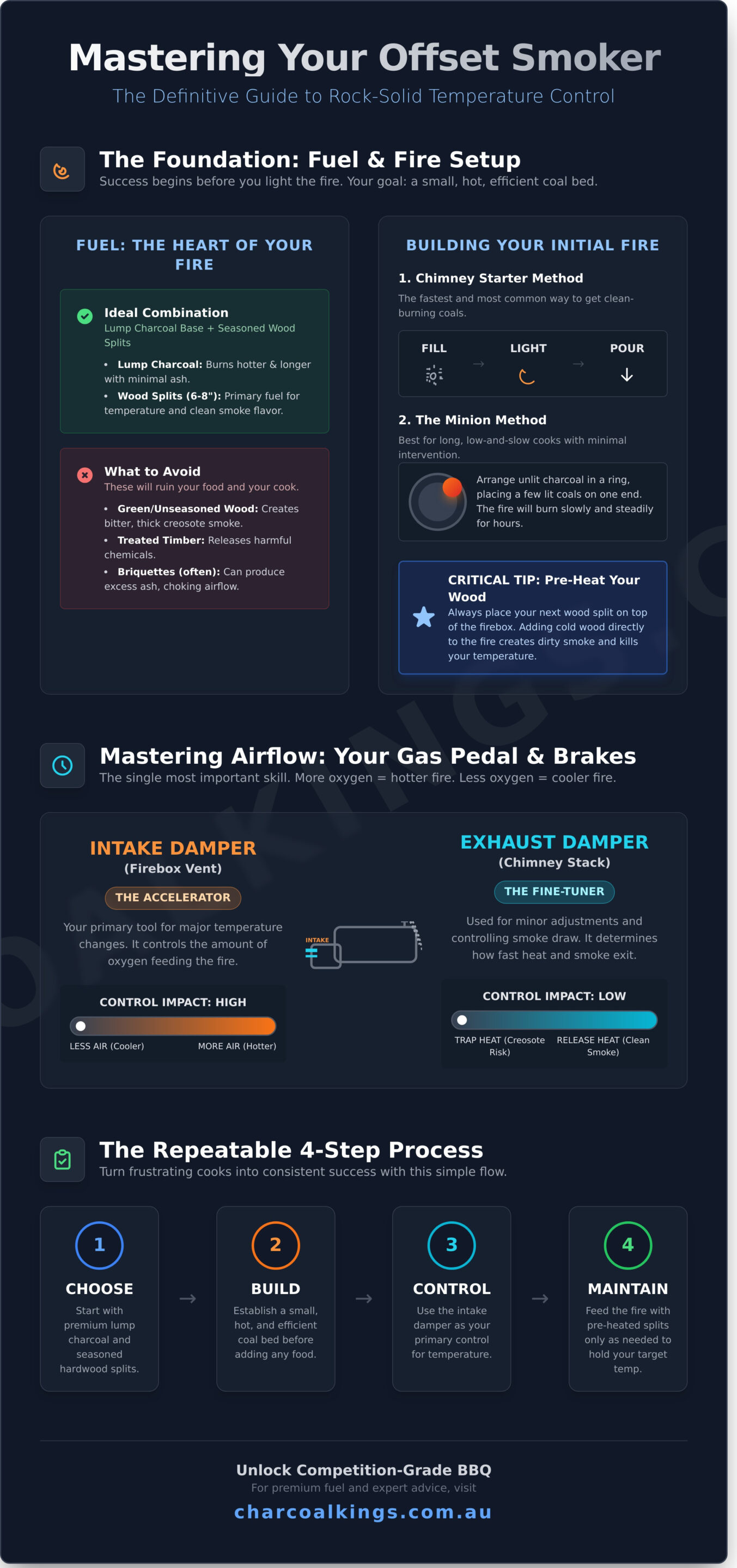
- Lump Charcoal: The ideal foundation. Premium natural lump charcoal burns hotter and longer, producing minimal ash which ensures better airflow in your firebox.
- Briquettes: While consistent in shape, many briquettes contain binders and fillers that produce excess ash, potentially choking your fire over a long cook.
- Wood Splits: Once your charcoal base is established, seasoned hardwood splits (6-8 inches long) become your primary fuel. They maintain temperature and deliver clean smoke flavour. Understanding the science of smoking shows that clean combustion from quality hardwood is essential for authentic barbecue flavour.
- What to Avoid: Never use unseasoned (green) wood or treated timber like construction scraps. They release bitter-tasting creosote and harmful chemicals that will ruin your food.
Building Your Initial Fire: Two Proven Methods
Getting your fire started correctly sets the tone for the entire cook. The objective is to get a base of coals burning cleanly before you even think about putting meat in the smoker.
- The Chimney Starter Method: The fastest and most popular way to light charcoal. Fill a chimney starter with lump charcoal and light it from below. In 15-20 minutes, you’ll have perfectly lit, white-ashed coals ready to pour into your firebox.
- The Minion Method: Best for long, unattended cooks. Arrange a ring of unlit charcoal in your firebox and place a small amount of lit coals on one end. The fire will slowly burn through the unlit fuel, providing hours of steady heat.
A crucial tip: Always pre-heat your next wood split by placing it on top of the firebox. Adding cold wood directly to the fire kills the temperature and produces thick, dirty smoke.
Establishing the Perfect Coal Bed
Your coal bed is the heart of the operation. Before closing the smoker lid, you need a compact, established bed of glowing red coals. This is your heat engine; the wood splits you add later are simply fuel to maintain it. Resist the urge to add too much fuel at once. Piling on cold splits or charcoal will suffocate the fire, causing a temperature crash and billowing white smoke. Feed the fire one or two splits at a time as needed to maintain your target temperature. Get the perfect foundation with our Premium Hardwood Lump Charcoal.
Mastering Airflow: Your Smoker’s Gas Pedal and Brakes
Forget complex gadgets. The secret to mastering your offset smoker lies in one simple element: air. Understanding airflow is the single most important skill for learning how to control temperature in an offset smoker. The principle is direct and effective: more oxygen fuels a hotter, faster-burning fire, while less oxygen starves it, lowering the temperature. Your smoker gives you two primary tools to manage this flow: the intake damper on your firebox and the exhaust damper on your chimney.
The goal is not to constantly fight your smoker, but to find the perfect equilibrium where your vents are set to consistently hold your target temperature with minimal intervention.
The Intake Damper (Firebox Vent): Your Accelerator
Think of this as your gas pedal. Located on the firebox, the intake damper directly controls the volume of oxygen feeding your premium lump charcoal and wood splits. To start a cook, leave this vent wide open to establish a strong, clean-burning fire. As you approach your target temperature, begin closing it incrementally. This is your primary control for making significant temperature adjustments, both up and down. A small adjustment here has a big impact.
The Exhaust Damper (Chimney): Your Fine-Tuning Dial
The exhaust damper, or chimney baffle, controls how quickly heat and smoke leave the cooking chamber. It is best used for small, precise adjustments. There is one golden rule: always keep the exhaust at least halfway open. Closing it too much traps old, stale smoke, which creates a bitter, acrid flavour on your meat-a cardinal sin in barbecue. Use small adjustments here to nudge your temperature up or down by 5-10 degrees, but never choke the smoke.
Finding the Sweet Spot: How to Use Vents Together
Achieving a stable temperature is about finding the balance between air in and heat out. The most reliable method requires patience. Make one small adjustment at a time, always starting with the intake damper for major changes. After an adjustment, wait 10-15 minutes to see the full effect before touching it again. Rushing this process is the fastest way to a fluctuating temperature. A deep understanding of offset smoker fire management is built on this patience. A common and highly effective setup is to leave the exhaust chimney wide open for maximum draft and then use only the intake vent to dial in your heat. This is how to control temperature in an offset smoker for a clean-burning fire and superior flavour.
The Step-by-Step Method for Locking In Your Target Temperature
Theory is one thing, but execution is everything. This section provides a reliable, repeatable process for locking in your ideal cooking temperature. Every smoker has its own personality-its unique airflow patterns and heat retention. Patience and observation are your best tools. We strongly recommend using a high-quality digital thermometer placed at grate level for true readings, not the often-inaccurate one on the lid. Keep a simple log of your vent settings, fuel additions, and temperature fluctuations. This data is invaluable for future cooks.
Step 1: Preheating the Smoker
A clean, hot fire is the foundation of a successful cook. Start by lighting a full chimney of premium lump charcoal. Once the coals are completely lit and covered in a layer of white ash, dump them into your firebox. Add one or two seasoned hardwood splits on top. For this initial stage, leave the firebox door and all smoker vents wide open. This ensures maximum airflow, allowing the wood to ignite quickly and burn off any acrid, thick smoke, leaving you with that clean, thin blue smoke perfect for barbecue.
Step 2: Stabilising at Your Target Temperature
Once your fire is burning cleanly, it’s time to bring the smoker up to temp. Close the cook chamber door and set your exhaust and intake vents to your typical starting positions (e.g., fully open exhaust, half-open intake). Your goal is to let the temperature climb and overshoot your target by about 25°F (15°C). This approach is more efficient than trying to chase a low temperature upwards. As it passes your target, begin to slowly close the intake damper in small increments. This reduces oxygen, causing the temperature to gently fall and settle precisely where you want it. This method is one of the core offset smoker fire management techniques that separates beginners from seasoned pitmasters.
Step 3: Managing the Fire During the Cook
Maintaining your temperature requires consistent fuel management. The key to understanding how to control temperature in an offset smoker is to add fuel before the temperature drops significantly. A proactive approach prevents wild temperature swings. Follow this simple cycle:
- Monitor the Fuel: Expect to add a new wood split roughly every 45-60 minutes, depending on your smoker and conditions.
- Look for the Cue: Add the new split only when the previous one is mostly burned down and covered in a fine white ash.
- Aid Ignition: When you add the new split, briefly open the intake vent a little more for a few minutes. This extra oxygen helps the new wood ignite quickly, preventing a drop in temperature.
Troubleshooting Common Temperature Problems
Every pitmaster has faced a stubborn smoker. Temperature swings, spikes, and stalls are a normal part of the learning curve. The secret isn’t some magic trick; it’s understanding your fire and making small, patient adjustments. Panicking and slamming vents shut will only make things worse. Mastering these common issues is a core part of learning how to control temperature in an offset smoker for consistent, premium results.
Problem: My Temperature is Spiking Too High
A sudden temperature spike is almost always caused by one of two things: you’ve added too much fuel at once, or your intake damper is open too wide and feeding the fire an excess of oxygen. Your goal is to gently reduce the fire’s intensity, not extinguish it.
- Solution: Start by closing your intake damper by a quarter or a half. Give it 10-15 minutes to see the effect before making another change.
- Crucially, do not close the chimney damper. A closed exhaust traps dirty smoke and will ruin your food with a bitter taste. Always maintain a clear airflow.
- If the temperature is far too high, you can open the cook chamber door for 30-60 seconds to quickly vent the excess heat.
Problem: My Temperature is Dropping and Won’t Recover
If your pit temperature is falling, your fire is dying. This is typically due to a lack of oxygen from a choked fire or simply running low on fuel. Your first move should always be to introduce more air before adding more wood.
- Solution: Open the intake damper wider to increase airflow to the coals.
- Use a fire poker to gently stir the coal bed. This knocks loose ash from the embers and allows them to breathe.
- If the fire is genuinely low on fuel, add a single, smaller wood split that you’ve been pre-heating on top of your firebox. A warm, dry split will ignite fast and clean.
Problem: I Have Thick, White, Billowing Smoke
This is the dreaded “bad smoke.” Thick, white smoke indicates incomplete combustion and will leave an acrid, bitter flavour on your meat. It’s caused by using wet wood or by suffocating the fire when the vents are closed too far. Clean, efficient combustion produces a very thin, almost invisible blue smoke.
- Solution: Immediately open both the intake and exhaust vents fully. This creates a powerful draft to get the fire burning hot and clean again.
- The quality of your fuel is non-negotiable. Achieve clean smoke every time with our premium Smoking Woods. Ensure your wood is properly seasoned and pre-heated before it goes into the fire.
Advanced Techniques for Rock-Solid Stability
You’ve got the basics down. Now it’s time to achieve competition-level consistency. These advanced techniques are what separate the weekend cook from the pitmaster, helping to buffer against temperature swings and create a perfectly even cooking environment. Some may require minor, inexpensive modifications to your smoker, but the results are undeniable. These are the secrets pros use for rock-solid stability.
Using a Water Pan
A simple but highly effective tool. A large, heavy-duty pan of water placed in the cook chamber acts as a massive heat sink. It absorbs excess thermal energy during temperature spikes and radiates it back slowly, creating a stable environment. The added humidity also helps to form a superior bark on your meat. For best results, place the water pan below the main cooking grate, near the firebox opening.
Installing Tuning Plates
The notorious hot spot next to the firebox is a common challenge. Tuning plates are the definitive solution. These are a series of heavy steel plates installed under the cooking grate that force heat and smoke to travel more evenly through the chamber. This ensures the end furthest from the firebox cooks at the same rate as the end closest to it. Many modern smokers include them, or they can be added as a high-impact upgrade.
Managing Wind and Cold Weather
The environment is a major variable, and knowing how to control temperature in an offset smoker means adapting to the conditions.
- Wind Direction: Always position your smoker so a breeze blows towards your firebox intake vent, not across it. This provides a steady, consistent draft. A crosswind can create a vacuum effect at the exhaust, pulling heat out too quickly and causing your fire to run away.
- Cold Temperatures: In cold weather, your smoker loses heat to the surrounding air much faster. You will burn significantly more fuel. Start with a larger coal bed and be prepared to add splits more frequently. For serious winter smoking, an inexpensive welding blanket draped over the cook chamber provides excellent insulation.
Mastering these professional techniques requires a clean, stable fire. Starting with a premium, natural hardwood charcoal provides the reliable foundation you need for true temperature control.
Locking In Your Temperature: The Final Word
Mastering your offset smoker is a journey of practice, but it’s built on a simple foundation. Ultimately, knowing how to control temperature in an offset smoker comes down to two core principles: starting with a clean, high-quality fire and making small, deliberate adjustments to your airflow. By understanding how your fuel choice and vent settings work together, you transform a temperamental beast into a reliable cooking tool.
The quality of your fuel is non-negotiable for achieving that stable burn. As Australia’s trusted supplier for retail, wholesale, and food services, Charcoal Kings provides the premium fuel that professionals rely on. Our 100% natural hardwood charcoal delivers a clean, consistent burn, giving you the predictable performance needed to eliminate guesswork and focus on your food.
Ready to master your pit? Get expert advice from our seasoned BBQ professionals. Shop our range of premium charcoal and smokers now!
With the right techniques and superior fuel, you’ll be holding rock-solid temperatures for hours. Now, get sizzlin’!
Frequently Asked Questions
How often should I add wood to my offset smoker?
Monitor your temperature, not the clock. Add a new wood split when the smoker’s temperature begins to dip, typically every 45 to 60 minutes. Using dense, seasoned Australian hardwoods like Ironbark provides a longer, more stable burn. Pre-heating your splits on top of the firebox ensures they ignite quickly, preventing major temperature drops and maintaining a clean fire for a superior result.
Can I use only wood in my offset smoker without charcoal?
Yes. Running an offset on a pure wood fire is the traditional and authentic method. You must first build a solid coal bed from larger logs, allowing them to burn down completely. From there, you feed the fire with smaller, seasoned splits to maintain your target temperature. This technique requires active fire management but delivers an unmatched, pure wood smoke flavour. It is the mark of a true pitmaster.
What is the best temperature for smoking brisket in an offset?
The optimal temperature range for smoking brisket is between 120°C and 135°C (250°F to 275°F). This is the proven sweet spot for rendering fat and breaking down tough connective tissue into gelatin. Holding a steady temperature within this zone is critical for a tender, juicy result. A consistent fire fuelled by premium hardwood is the foundation for producing a brisket with a perfect bark.
Why is the temperature different on my smoker’s lid thermometer versus at the grate?
Factory-installed lid thermometers are unreliable. They measure the ambient temperature in the dome, high above your food where hot air collects. The true cooking temperature at the grate level is often 10-20°C lower. For precision and repeatable results, always use a quality digital thermometer with probes placed directly at the grate, next to your meat. This is the only way to know your real cooking temperature.
How do I get that thin, blue smoke everyone talks about?
Thin, blue smoke is the result of a clean, efficient fire. It is the only smoke that should touch your food. Achieve this by ensuring your fire has ample oxygen and is burning hot, not smouldering. Use properly seasoned, dry hardwood splits. Thick, white smoke indicates incomplete combustion and will deposit a bitter, acrid flavour onto your meat. Master your airflow to master your smoke.
Does the type of offset smoker I have affect temperature control?
Absolutely. The build quality of your smoker is a primary factor in how to control temperature in an offset smoker. Thicker gauge steel retains heat far better, resulting in stable temperatures and reduced fuel usage. Cheaper, thin-metal smokers suffer from heat loss and leaks, causing wild temperature fluctuations. A well-constructed unit with tight seals and efficient airflow design makes temperature management significantly easier and more consistent.